
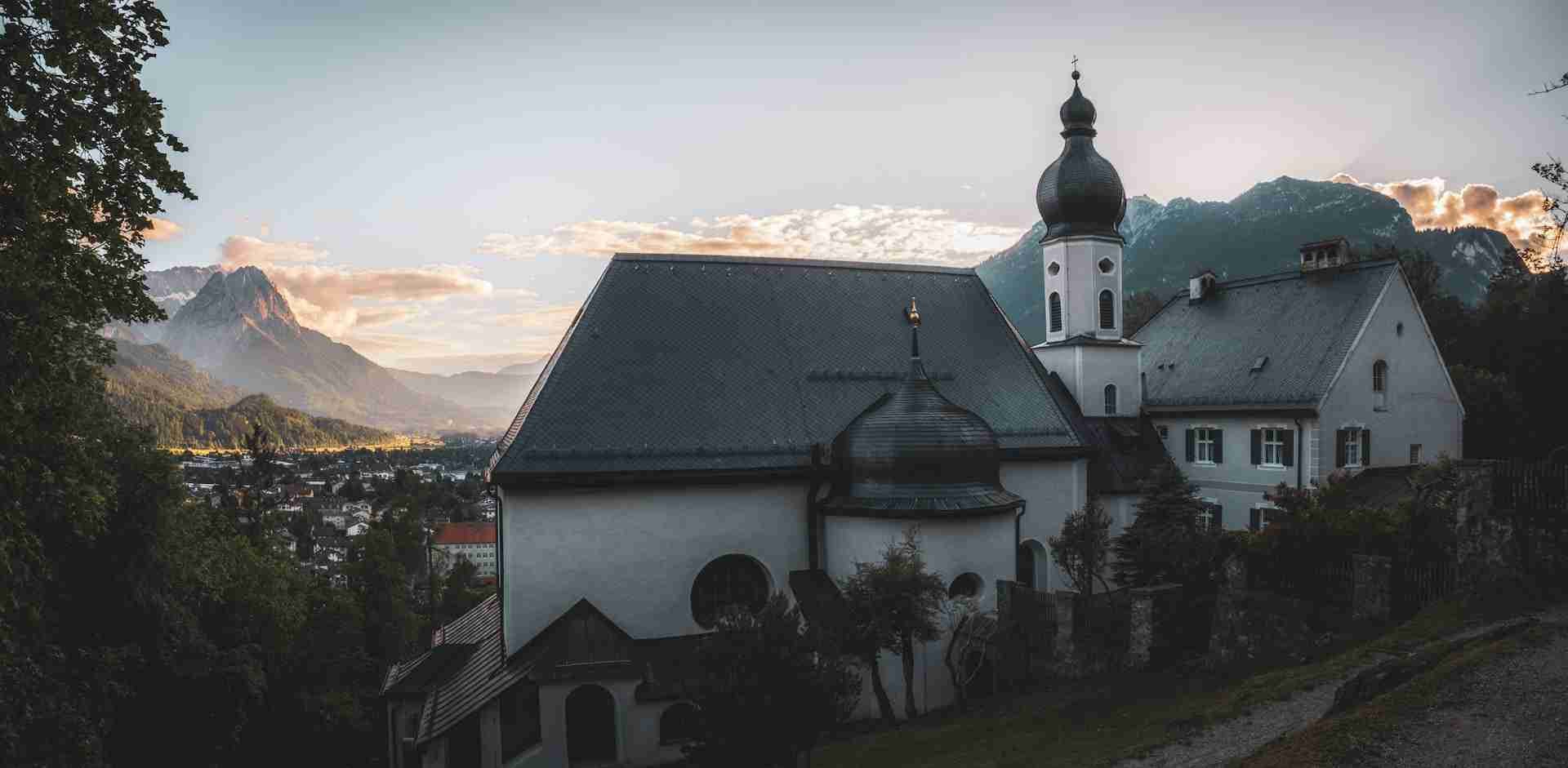
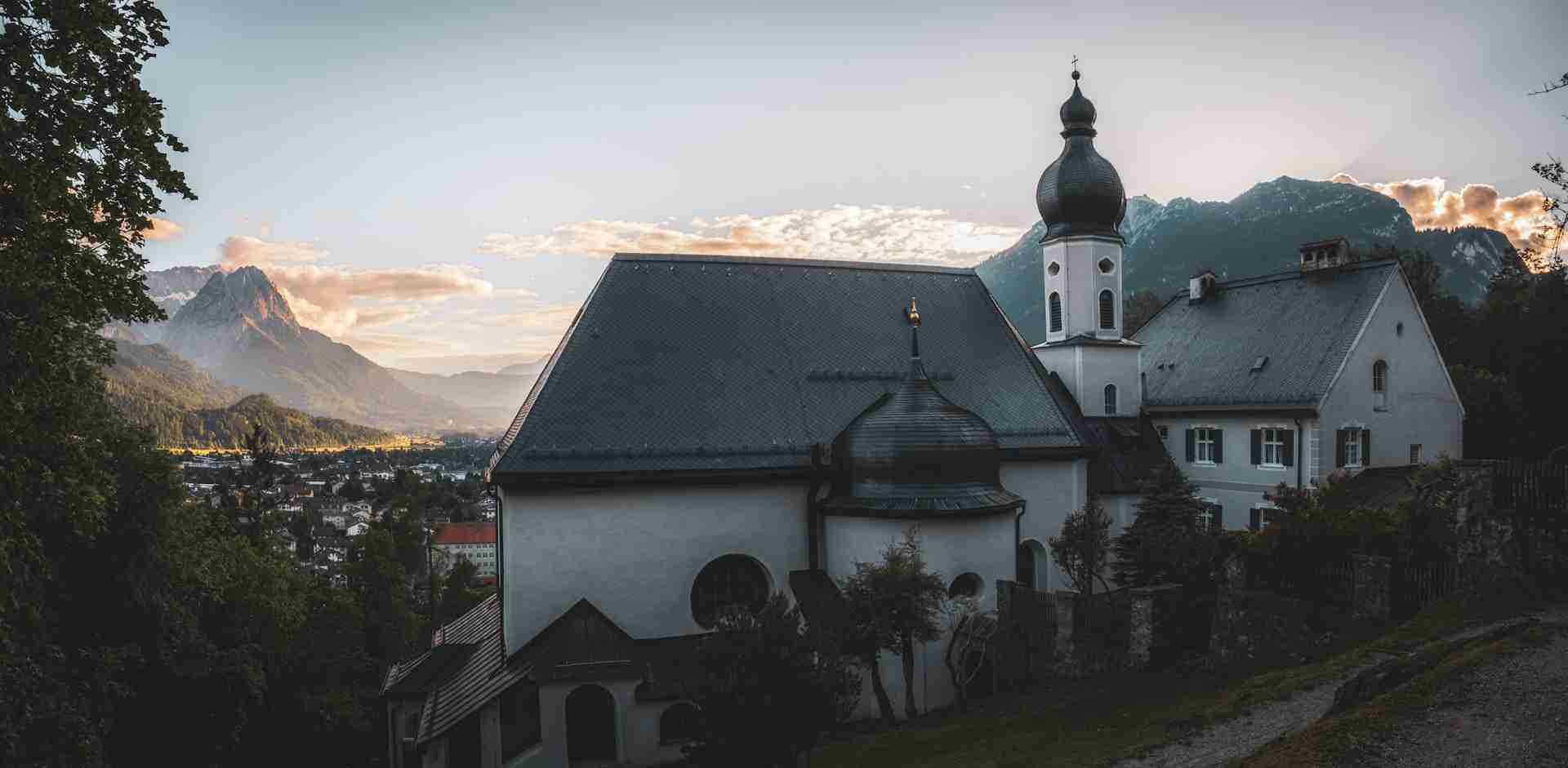
Perched above the valley town of Garmisch-Partenkirchen, Wallfahrtskirche St. Anton is a Baroque pilgrimage church framed by forest, mountain ridges, and quiet footpaths. Built in the 18th century and tucked into the lower slopes of the Wank mountain, this whitewashed chapel, with its copper-domed bell tower and red-tiled roof, offers photographers a striking contrast to the dense woodland and towering alpine peaks beyond. The site is more than a spiritual retreat—it's a location rich in mood, light, and cultural texture. Whether captured through atmospheric mist or golden evening sun, St. Anton provides a blend of architectural charm and alpine drama that speaks quietly but powerfully through the lens.
Best Photography Opportunities
• Elevated frontal view from the ridge path above
One of the strongest perspectives comes from the footpath that curves along the ridge just above the church. This elevated view reveals the full geometry of St. Anton—its clean white walls, elegant bell tower, and tiled roof—framed by sloping pines and open sky. In morning light, the façade catches soft illumination while shadows fall behind it into the forest. Use a mid-range zoom or wide prime to balance the architecture with natural surroundings, and wait for moments when clouds break across the Wetterstein mountains in the background to add scale and atmosphere.
• Golden hour side light through the lower tree line
From the trail ascending from Partenkirchen, there are several clearings where side light during late afternoon strikes the church from the west. These moments are ideal for capturing the texture of the walls, roof, and trees with dramatic warm tones. A telephoto lens works well here to isolate the church among its wooded context, especially when distant ridges begin to fade into late-day haze. Include surrounding trees in the frame to create a natural vignette or use overhanging branches as foreground framing for a more immersive composition.
• Fog and mist enveloping the bell tower
On damp mornings or following rainfall, the lower slopes of the Wank often trap fog that drifts between the pines and swirls around the church. From the trail just below or beside the structure, you can compose with the bell tower partially obscured by mist—emphasizing form and silhouette over detail. This is a prime opportunity for black-and-white conversions, as the Baroque curves and sharp tower lines stand out against the diffused background. Use a longer lens for compressed compositions or a fast prime for handheld low-light work.
• Detail studies of Baroque ornament and worn textures
The small size of St. Anton allows for close study of its architectural elements—arched doors, decorative stonework, weathered paint, and metal fixtures. Overcast light or open shade works best for these intimate shots, reducing glare and emphasizing tone. A short telephoto or standard lens (50mm or 85mm) provides the necessary control over background blur and focus. These details pair well with wide landscape views in a multi-image series and help to convey the church's age, use, and craftsmanship.
• Twilight and blue hour with valley lights below
For photographers willing to stay until nightfall, the clearing near the church offers a peaceful setting for blue hour photography. As light fades, the white façade of the church glows softly against the darker trees, and distant lights in Garmisch begin to twinkle in the valley below. Use a tripod and wide-angle lens to include the church and distant townscape in a single frame. Shoot multiple exposures if necessary to balance the luminosity of the building with the deepening sky and ambient city light.
Best Time to Visit
Wallfahrtskirche St. Anton is accessible and photogenic year-round, though each season brings its own visual language. Spring, from April to early June, offers fresh foliage, blooming forest undergrowth, and soft light that filters through budding trees. Morning fog is common in the shoulder season, adding depth to compositions from above or behind the church. Snowmelt from the Wank trails can create additional ground-level texture and reflectivity.
Summer provides the most consistent light and longest shooting hours. The church is often framed by deep green forest, and golden hour light stretches across the valley for an extended period. While crowds are minimal at St. Anton compared to other landmarks, earlier hours offer quieter conditions and cleaner compositions.
Autumn, especially late September through October, is perhaps the most atmospheric season for this location. The surrounding forest shifts into deep ochre and rust tones, and the church stands in luminous contrast against the turning trees. Low sun angles enhance shadows and depth, while frost or mist brings softness to morning scenes. Photographers looking for quiet solitude and warm-toned images will find autumn the most rewarding time.
Winter transforms the church into a minimalist tableau. Snow drapes the roof and softens the footpaths, turning the surrounding trees into monochromatic pillars. Blue hour in winter brings a cool, desaturated palette that pairs well with the chapel's clean architectural lines. Access can be limited during heavy snowfall, so check local trail conditions, and prepare for icy paths.
How to Get There
Wallfahrtskirche St. Anton is located on the lower slopes of the Wank mountain, just above the Partenkirchen district of Garmisch-Partenkirchen. The church is accessible only by foot, with several well-marked trails leading from the valley up to the site. The most direct route begins at the Wankbahn base station or from near the Partenkirchen cemetery, with a 30 to 45-minute moderate uphill walk through wooded paths and occasional open clearings.
The trail is well-maintained and open year-round, though snow or ice may be present in winter. For photographers carrying gear, the hike is manageable with a small backpack and good footwear. There are no facilities at the church itself, so bring water and be prepared for changing conditions. The site is free to access, and no photography restrictions apply, though respectful behavior is expected.
By car, Garmisch-Partenkirchen is easily reached from Munich via the A95, with ample parking throughout town. By train, hourly service runs from Munich Hauptbahnhof to Garmisch-Partenkirchen station. From the station, it's a short walk or local bus ride to the trailhead.
Recommended Photography Gear
The varied shooting distances and lighting conditions around Wallfahrtskirche St. Anton make a versatile kit essential. A wide-angle zoom (16–35mm) is ideal for capturing the church within its landscape, especially from elevated trails or for blue hour valley views. A mid-range zoom (24–70mm) is excellent for forest compositions, side-lit angles, and balanced detail-to-context shots near the structure.
A telephoto lens (70–200mm) is useful for compressing background mountains, isolating the church against textured forest, or capturing hikers along distant trails. For detail shots and low-light work in fog or twilight, a fast prime lens (35mm or 50mm) adds sharpness and flexibility.
A tripod is essential for long exposures, twilight, and low-light forest scenes. Include a remote release or timer for stability. A circular polarizer helps control glare on foliage or painted surfaces, especially after rain. In foggy conditions, a lens hood and cloth are crucial to keep condensation off the glass.
Because access requires hiking, a compact setup packed in a weather-resistant backpack is recommended. Sturdy boots, layers, and a light rain jacket will help with changing mountain conditions. If shooting in winter, bring microspikes for traction and gloves that allow fine control for camera settings.
Nearby Photography Locations
Just a short drive or hike from the valley, this dramatic gorge features sheer rock walls, waterfalls, and suspended walkways. Best shot early in the day or under overcast skies for moody, contrast-rich compositions.
Accessible by cable car or steep hike, the summit offers sweeping panoramic views over Garmisch, the Zugspitze massif, and Austria beyond. Excellent for sunrise, cloud inversion photography, or layered telephoto work.
This old-world street features frescoed buildings, cobblestone paths, and Bavarian charm. Ideal for architectural details and contextual townscape shots, especially in golden hour or twilight.
A calm lake south of Garmisch with views toward the Zugspitze and Wetterstein. Excellent for early morning reflections, especially in autumn when foliage color surrounds the shoreline.
• Alpspitze via Osterfelderkopf
From the Alpspitzbahn cable car, photograph the dramatic pyramid-shaped Alpspitze and deep alpine valleys. Great for high-elevation landscape compositions and atmospheric transitions.
Wallfahrtskirche St. Anton is not a grand cathedral or tourist landmark—it's something quieter, older, and more intimate. It invites stillness. The changing light across its bell tower, the hush of the trees around it, and the slow drift of fog from the valley all create images that linger. For photographers looking to capture not just scenery, but serenity, this hilltop chapel is an essential frame.
Comments
Loading comments…