
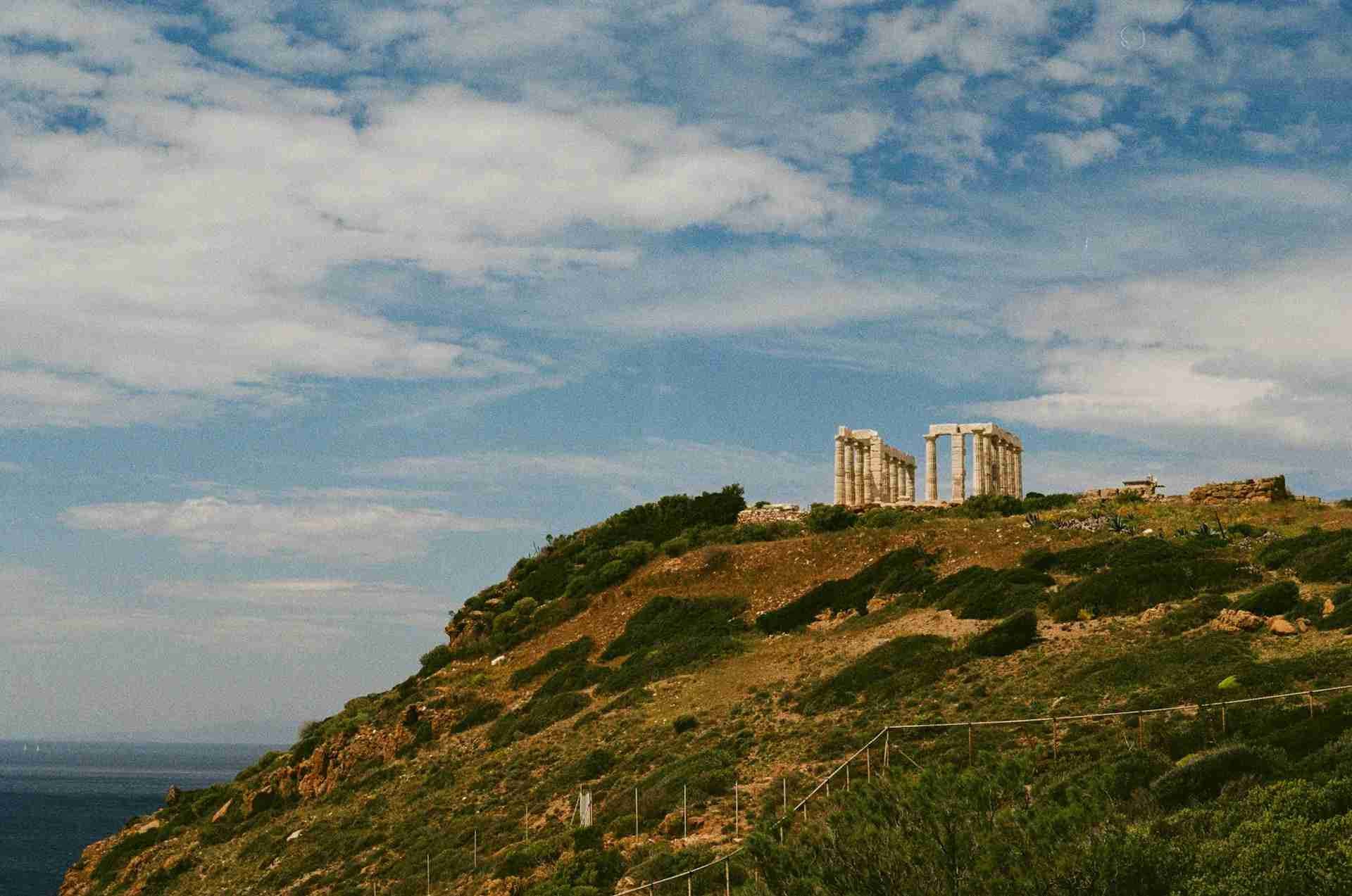
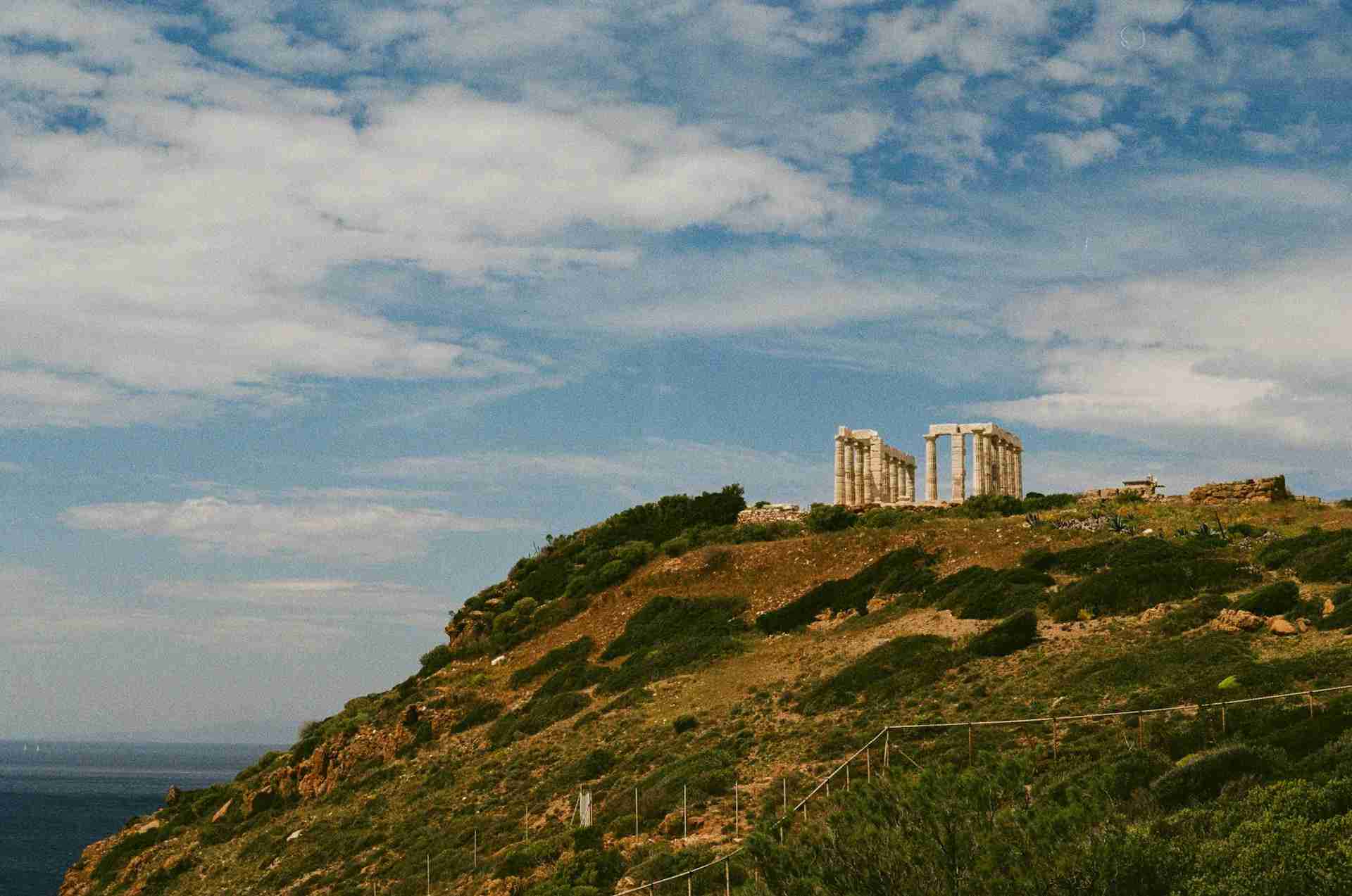
Standing high on the cliffs of Cape Sounion, the Temple of Poseidon has watched over the Aegean for more than 2,400 years. Built in the fifth century BCE, the temple's gleaming marble columns are all that remain of a sanctuary dedicated to the god of the sea. For photographers, this is one of Greece's most rewarding classical ruins, offering not only elegant Doric architecture but also one of the most dramatic settings of any ancient site. The white marble rises above turquoise waters, with the headland providing sweeping views in every direction. Changing light transforms the temple from harsh midday brilliance to golden radiance at sunset, making it a place where architecture and seascape meet in perfect harmony.
Best Photography Opportunities
• Wide Coastal Vistas with Temple Silhouette
One of the most striking perspectives is the wide view of the temple perched on the edge of the cliff, framed by the Aegean Sea stretching to the horizon. Shooting from the slopes below allows you to emphasize the dramatic position of the temple above the waves. A wide-angle lens captures the cliff, sea, and sky together, while vertical compositions highlight the temple's lofty placement. Sunset is particularly rewarding here, when the sun sinks directly behind the columns and the building becomes a powerful silhouette.
• Architectural Studies of the Doric Columns
Close-up work around the temple reveals the strength and rhythm of its Doric design. The fluted marble shafts, weathered by centuries of sea air, provide rich texture for detailed photography. Shooting along the colonnade emphasizes symmetry and repetition, while angled views capture depth and perspective. Early morning and late afternoon side light enhance surface relief and bring out subtle color in the marble. These studies are best complemented by a medium focal length to isolate columns without distortion.
• Foreground Elements with Ruins
Scattered around the temple are fragments of marble blocks and the remains of the foundation, which can be used as foreground elements in wider shots. Placing these in the frame adds depth and context, guiding the viewer's eye from detail to the main structure. These compositions are most effective in soft light, when shadows add texture without overwhelming highlights. A low shooting angle can exaggerate scale and make the temple appear even more imposing.
• Atmospheric Seascapes from the Clifftop
The headland of Cape Sounion itself is as photogenic as the ruins. From the paths around the temple, you can look down over sheer cliffs to the deep blue waters of the Aegean. These views work well as environmental frames that balance architecture and landscape. Including boats, passing clouds, or distant islands adds scale and dynamism to the scene. Shooting on windy days emphasizes the power of the sea, while calm conditions are ideal for long exposures that smooth the water into a painterly surface.
• Twilight and Night Photography
As evening falls, artificial lighting illuminates the temple, creating a glowing beacon against the darkening sea. Blue hour compositions are particularly effective, with the cool tones of sky and water contrasting against the warm marble glow. A tripod and long exposures are essential for capturing this scene without noise or blur. On clear nights, the absence of nearby light pollution allows for astrophotography, with the temple silhouetted beneath a sky full of stars. This combination of ancient ruin and night sky makes for a uniquely powerful image.
Best Time to Visit
The Temple of Poseidon can be photographed throughout the year, but conditions vary. Spring and autumn are the most comfortable seasons, with soft light, mild temperatures, and fewer visitors. Summer provides long days and reliable sunsets, though midday light can be harsh and crowds heavy. Winter offers a quieter atmosphere and the possibility of dramatic skies as storms move across the Aegean. For daily timing, sunset is the highlight, as the temple is perfectly oriented toward the western horizon. Early morning provides solitude and cooler light, ideal for detail work on the columns. Overcast days are excellent for architectural studies, while clear evenings reward with glowing twilight views.
How to Get There
Cape Sounion is located about 70 kilometers southeast of Athens and is easily accessible by road. By car, the drive takes around an hour and follows the coastal highway with frequent sea views. Public buses also run from Athens to Sounion, making the site accessible without private transport. The temple is part of a protected archaeological site, and entry requires a ticket. Parking is available near the entrance, with a short walk up the hill to the ruins. Tripods are permitted in outdoor areas but should be used respectfully to avoid blocking pathways, as the site can become crowded at peak times. Drones are not allowed due to archaeological restrictions. The site includes visitor amenities such as restrooms and a café, making it practical for extended shooting sessions.
Recommended Photography Gear
A wide-angle lens between 14 and 24 millimeters is essential for capturing the temple in its dramatic coastal setting, while a mid-range zoom in the 24 to 70 millimeter range is perfect for architectural compositions and foreground studies. A telephoto lens up to 200 millimeters is useful for compressing columns, isolating details, or framing the temple against distant islands. A sturdy tripod is required for twilight and night photography, and a circular polarizer helps control glare from the sea and deepen sky tones during the day. Graduated neutral density filters are valuable for balancing the bright sky against the darker cliffs at sunset. Comfortable shoes, sun protection, and water are important, especially in summer, as the site is fully exposed to the elements.
Nearby Photography Locations
Just north of Sounion, Lavrio is a small port town with fishing boats, quayside scenes, and the opportunity to photograph maritime life against the backdrop of the Aegean.
• Vouliagmeni Bay
Located along the coastal road back toward Athens, Vouliagmeni offers a photogenic mix of beaches, rocky coves, and turquoise water. Early morning light here is soft and ideal for seascapes.
About an hour away, the Acropolis provides a complementary subject to Sounion, with its Parthenon offering equally strong classical architecture in an urban setting. Sunrise and sunset views from the nearby hills are particularly rewarding.
Accessible by ferry from Lavrio, Kea is one of the Cycladic islands closest to the mainland. Its whitewashed villages, terraced hills, and coastal views provide endless photographic opportunities.
Inland from Sounion, this reservoir surrounded by forested hills is a peaceful spot for landscape photography, particularly in the early morning when mist sometimes rises from the water.
The Temple of Poseidon combines classical architecture, dramatic landscape, and dynamic light in a single location. Its cliff-top setting above the Aegean ensures that every visit feels unique, shaped by shifting skies and the endless motion of the sea. For photographers, it is a place where history and nature align perfectly, offering images that are as timeless as the temple itself.
Comments
Loading comments…