
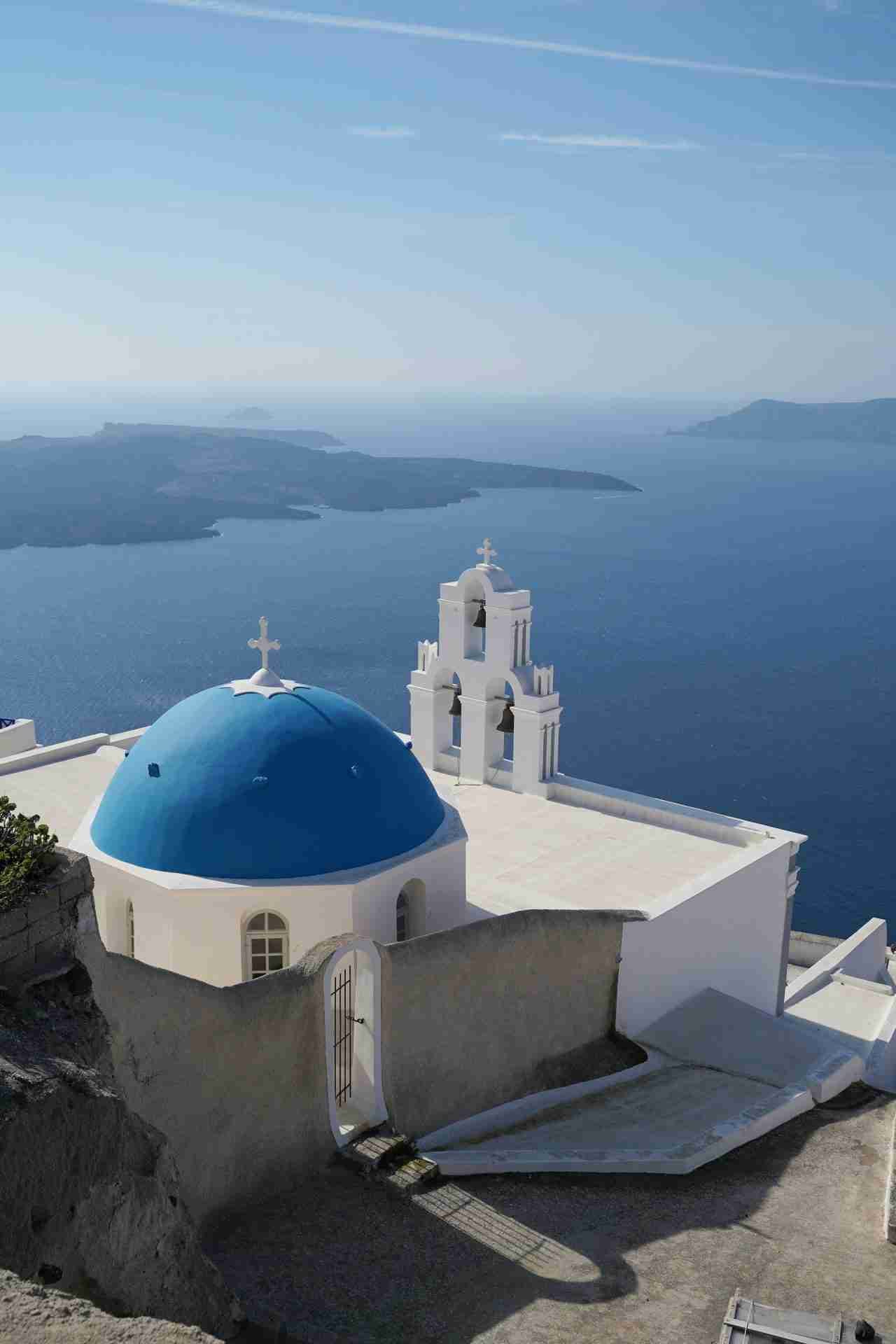
Three Bells of Fira sit just north of central Fira in the area of Firostefani, perched above the caldera with an uninterrupted drop toward the sea. The small church complex is defined by clean white walls, a simple dome, and the three bells suspended on a curved frame that faces outward toward the water. What makes this location photographically strong is not complexity, but clarity. The structure is compact, easy to read, and positioned in a way that naturally separates it from surrounding buildings. From many angles, the bells and dome stand cleanly against sky and water, giving photographers a clear subject within a dramatic setting. This is a location that rewards precision, patience, and careful control of background relationships.
Best Photography Opportunities
• Full View of the Bells and Dome
The most recognizable composition is the direct view of the three bells with the dome and caldera beyond. From this position, the curved bell frame creates a strong horizontal anchor while the dome adds a clear central form. Small changes in camera height make a noticeable difference in how the bells overlap the horizon and water. Early light helps maintain detail in white surfaces and keeps contrast under control. This viewpoint benefits from careful timing, as even a few people stepping into the frame can disrupt the clean geometry.
• Angled Views Showing Depth and Separation
Stepping slightly to the side introduces depth and allows the bells, dome, and caldera to separate more clearly. From these angles, the structure feels less graphic and more spatial, with foreground and background working together. Longer focal lengths can simplify the background and reduce visual noise from nearby buildings. Side light adds definition to curved surfaces without creating harsh shadow. These compositions often feel more relaxed and less rigid than straight on views.
• Lower Angles Emphasizing the Drop Toward the Sea
Shooting from a lower position places more emphasis on the vertical drop behind the church. This approach highlights how close the structure sits to the edge and reinforces the relationship between architecture and landscape. Careful framing is required to keep the dome and bells from merging with bright backgrounds. Including a small amount of foreground wall or path helps ground the image. This perspective works well when the sea is visible and calm.
• Details of Bells, Cross, and Curves
Closer views of the bells, metal supports, and cross allow for quieter images focused on shape and proportion. These compositions avoid the busy surroundings and rely on contrast between white surfaces and darker metal elements. Even light works best here, keeping highlights controlled. Detail images add variety and work well when wider views feel complete. They also provide options during busier periods when clean wide frames are difficult.
• Evening and Early Night With Subtle Light
As daylight fades, the structure holds its shape against darker tones in the sky and sea. This period allows photographers to balance remaining ambient light with small artificial sources nearby. Exposure control becomes important to avoid losing detail in white surfaces. A tripod helps maintain precision during slower shutter speeds. These images feel calm and deliberate when timed carefully.
Best Time to Visit
Early morning is the most reliable time to photograph the Three Bells. Light is softer, contrast is lower, and visitor numbers are significantly reduced, which makes clean compositions much easier. Morning light also helps preserve detail in white walls that can quickly clip later in the day. Midday is usually the most challenging period, with strong sun, deep shadow, and steady crowds cycling through the area. Late afternoon can work if cloud cover softens the light or if the sun angle provides gentle separation between structure and background. Evening and early night offer a different mood, especially when the sea remains visible and the sky retains some brightness. Seasonal changes affect crowd levels more than light quality, with spring and autumn generally offering the most workable balance.
How to Get There
The Three Bells are located in Firostefani, a short walk north of central Fira along the main caldera path. The route is entirely pedestrian and follows paved walkways with steps and gentle slopes. Access is open, and there is no fee to photograph exterior views from public space. Because the area is popular, arriving early is the easiest way to work without constant interruptions. Parking in Fira and Firostefani is limited, so many visitors arrive by bus or taxi and walk the final stretch. Tripod use is possible but best reserved for early morning or later in the day when foot traffic slows.
Recommended Photography Gear
A compact and flexible setup works best at this location. A standard zoom lens allows quick framing changes between wide architectural views and tighter compositions. A short telephoto lens is useful for isolating the bells and dome against the caldera without pulling in nearby structures. Wide lenses can be used carefully, but distortion must be managed to keep lines clean. A tripod is helpful for early morning shade and evening work when shutter speeds drop. A polarizer can help manage glare and deepen tones in the sea, though it should be used carefully to avoid uneven results. Keeping gear light makes it easier to reposition and wait for clean moments.
Nearby Photography Locations
This section of the caldera walk offers cleaner sightlines and fewer obstructions than central Fira. It works well for layered views and quieter compositions.
A short walk away, this monastery introduces additional white architecture with open views toward the sea. It pairs well with the Three Bells for architectural continuity.
Located further north, Imerovigli provides higher elevation views and simpler layouts. It is useful for wider scenes with less visual congestion.
This prominent landform adds a strong natural subject and works well for sunrise and late afternoon light. It offers contrast to the small scale of the church.
• Fira Rooftop Viewpoints
Back toward Fira, elevated terraces and walkways allow longer lens views across rooftops. These spots help place the Three Bells within the broader town structure.
Comments
Loading comments…