
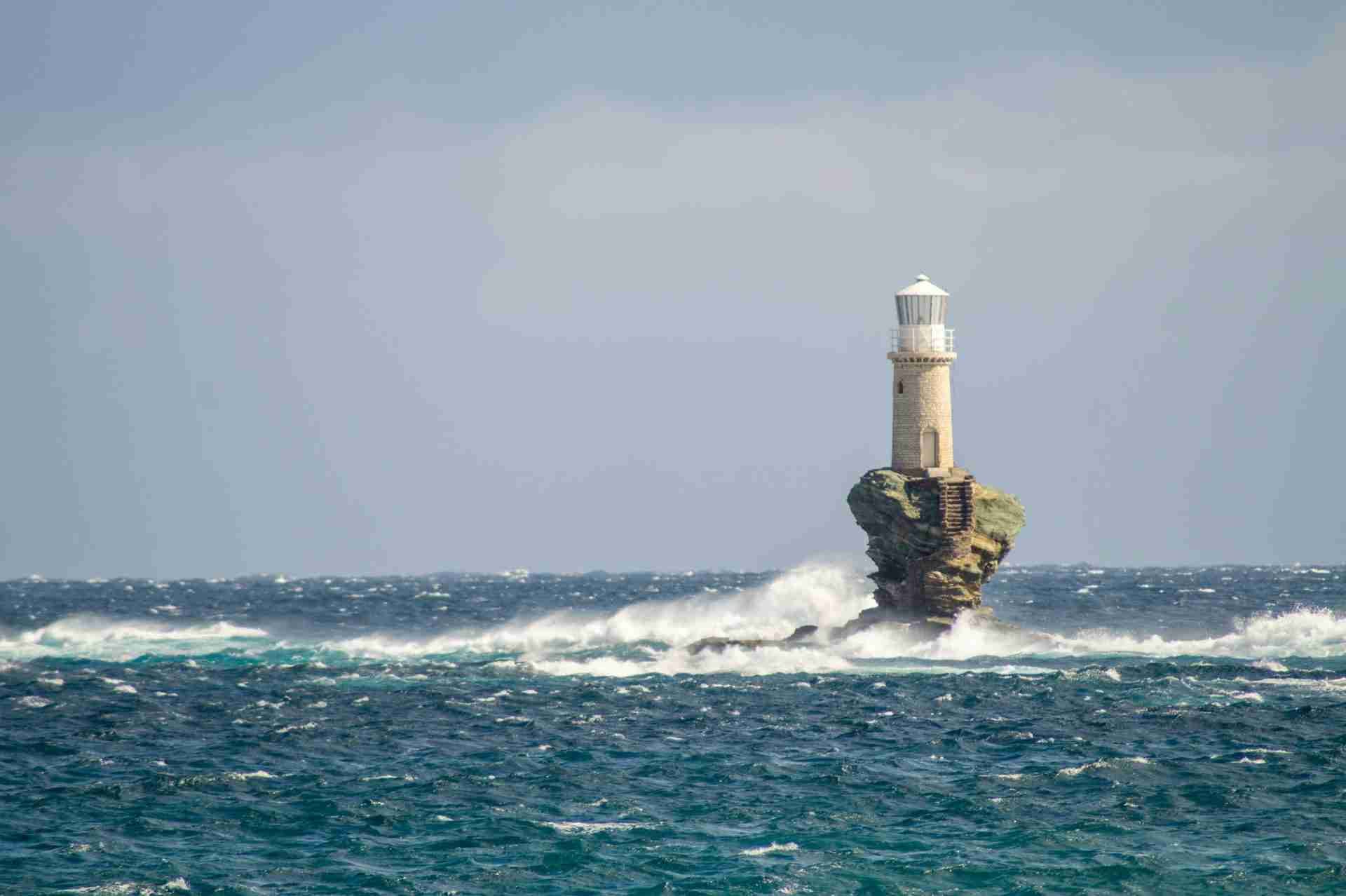
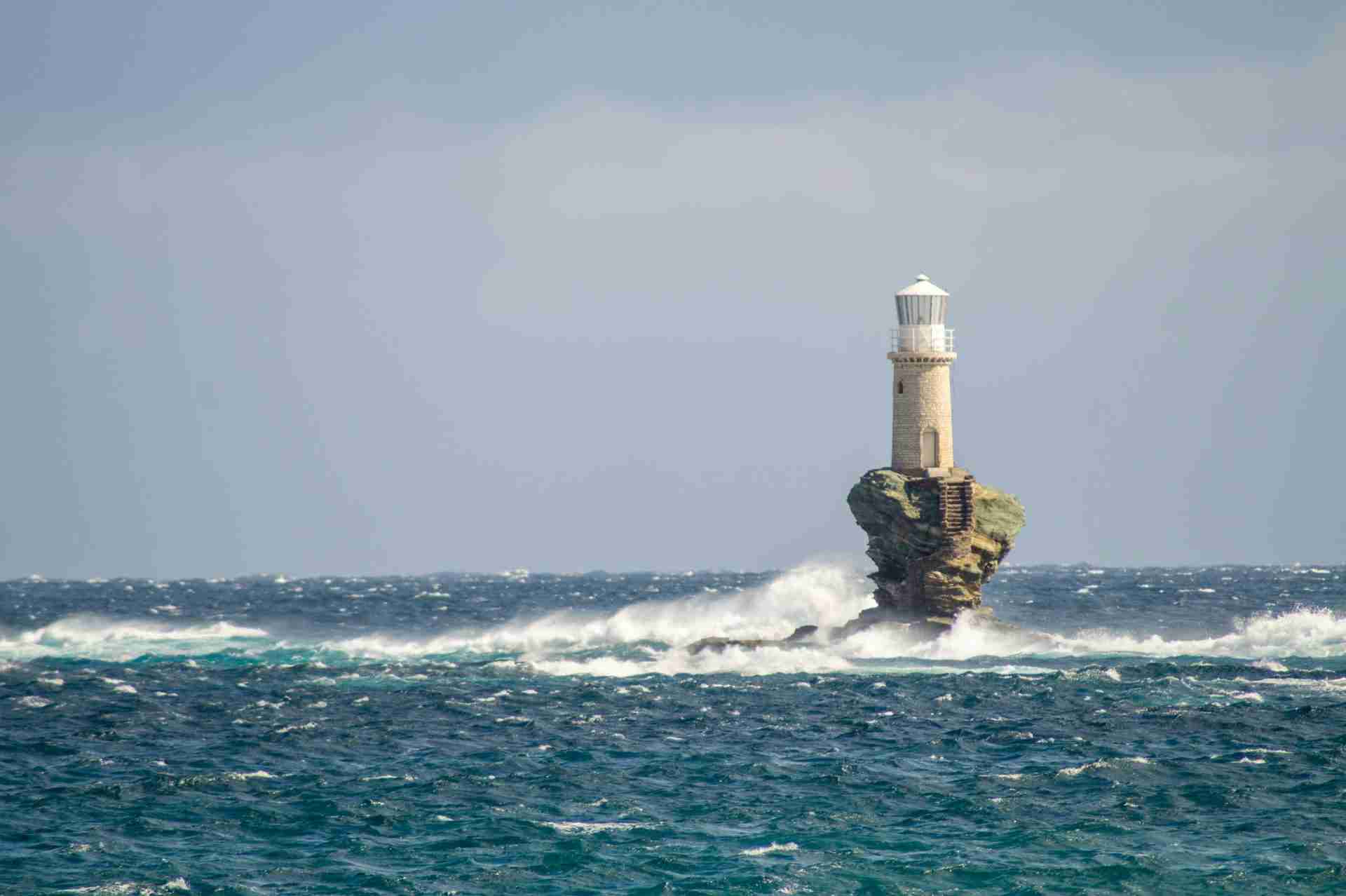
Tourlitis Lighthouse stands on a narrow rock pillar just offshore from the town of Chora on the island of Andros. The small stone lighthouse sits dramatically above the Aegean Sea, appearing almost as if it were placed on top of a natural pedestal carved from the cliffside. Waves crash against the base of the rock while the lighthouse rises above the water, creating one of the most distinctive coastal scenes in Greece. From the nearby cliffs and walking paths, photographers can capture the lighthouse against open sea and sky while the rugged coastline frames the composition. The combination of dramatic geology, historic architecture, and constant ocean movement makes Tourlitis Lighthouse a powerful subject for coastal photography.
Best Photography Opportunities
• Clifftop View from the Peninsula – The most classic viewpoint of Tourlitis Lighthouse comes from the cliff edge along the Chora peninsula. From this vantage point the lighthouse sits perfectly framed on its narrow rock pillar with the Aegean Sea stretching behind it. The elevation of the viewpoint allows photographers to capture the full height of the rock formation rising out of the water. Moving along the path slightly can help position the lighthouse with different sections of cliff or sea in the background. This angle works well with both wide compositions and tighter frames that isolate the lighthouse against the horizon.
• Wide Coastal Scenes – The cliffs surrounding the lighthouse add context and scale to the landscape. Photographers can step back along the coastal paths to include sections of the rocky shoreline within the composition. These wider scenes show how the lighthouse sits just beyond the cliff edge, emphasizing the dramatic placement of the structure. Waves striking the rock below can add movement and energy to the photograph. This type of composition works especially well when the sea is active and clouds move across the sky.
• Sunset Light – Tourlitis Lighthouse is particularly striking during sunset when warm light spreads across the cliffs and water. As the sun lowers toward the horizon, the lighthouse often becomes silhouetted against the glowing sky. Photographers can use the darker outline of the rock pillar and lighthouse to create strong contrast against the brighter ocean background. Clouds moving across the sunset sky often enhance these compositions with changing colors and light patterns. Waiting until after the sun has dipped below the horizon can also reveal softer tones across the sea.
• Stormy Seas and Wave Action – When winds pick up across the Aegean, waves crash against the base of the rock pillar beneath the lighthouse. These moments can produce dramatic images where white spray rises around the dark stone formation. Photographers positioned safely along the cliffs can capture the energy of the sea interacting with the isolated rock. Faster shutter speeds help freeze the motion of the waves as they strike the base of the formation. These conditions often create some of the most dynamic photographs of the lighthouse.
• Night Photography – After sunset the lighthouse light becomes visible against the darker sky and sea. Long exposures can capture the soft glow of the beacon as it rotates above the water. The surrounding cliffs often remain dark, which helps isolate the illuminated tower within the frame. Photographers can also capture the faint glow of lights from the town of Chora nearby. Working with a tripod allows longer exposures that reveal detail in the surrounding sea and sky.
Best Time to Visit
Late afternoon and sunset are usually the most rewarding times to photograph Tourlitis Lighthouse. The sun lowers over the Aegean Sea and casts warm light across the cliffs and rock pillar. These conditions often produce strong color in the sky and reflections across the water.
Spring and autumn can offer especially good photographic conditions because the light tends to be softer and the island is less crowded. Summer often brings clear skies and calm seas, which create clean compositions around the lighthouse. Winter storms occasionally produce rough seas and dramatic clouds that can add energy to the coastal landscape. Checking weather conditions before visiting can help photographers choose between calm scenic views or more dramatic wave action.
How to Get There
Tourlitis Lighthouse is located beside the town of Chora on the island of Andros in Greece. The lighthouse sits just offshore from the eastern edge of the town and is visible from several coastal viewpoints. Visitors can walk from the center of Chora toward the coastal paths that lead to the cliffs overlooking the lighthouse. Several short walking routes provide viewpoints where photographers can safely frame the lighthouse from above. Parking is available in the town, after which most viewpoints are reached on foot within a few minutes.
The lighthouse itself stands on a rock pillar offshore and cannot be accessed directly. All photography is done from the nearby cliffs and walking paths overlooking the sea. Access to these viewpoints is free, though visitors should remain cautious near cliff edges and avoid unstable ground when positioning their camera equipment.
Recommended Photography Gear
A wide lens works well for capturing the lighthouse along with the surrounding cliffs and ocean landscape. This type of lens helps emphasize the scale of the rock pillar and the open sea beyond it. A moderate zoom lens can also be useful for isolating the lighthouse against the horizon or focusing on waves breaking at the base of the rock.
A tripod is very helpful for sunset and night photography when light levels drop and longer exposures become necessary. Neutral density filters can allow photographers to create longer exposures of the moving water during brighter conditions. A circular polarizing filter can also help reduce glare from the ocean surface and improve contrast between the sky and sea.
Nearby Photography Locations
sits on a narrow peninsula with traditional Cycladic buildings overlooking the sea. Photographers can capture whitewashed houses, narrow streets, and views of the coastline from elevated points around the town. The combination of architecture and ocean scenery creates a variety of photographic subjects.
lies just below Chora and offers a rocky shoreline with strong views back toward the cliffs and town above. Waves rolling into the bay often create dramatic coastal scenes, especially when the sea is active. Sunset light frequently illuminates the cliffs surrounding the beach.
sits high in the mountains of Andros overlooking the surrounding valleys and coastline. The stone monastery blends naturally with the rocky hillside and offers expansive views across the island. Photographers can capture both architectural and landscape scenes from this elevated location.
is one of the most scenic coastal areas on Andros, featuring clear water, river wetlands, and a long stretch of shoreline backed by hills. The beach provides opportunities for both seascape photography and wildlife photography near the river mouth. The remote setting creates a peaceful landscape with minimal development.
sit on a hill overlooking the coastline and surrounding countryside. From this elevated position photographers can capture wide views across the island and the Aegean Sea. The remaining stone walls also provide interesting foreground elements for landscape compositions.
Comments
Loading comments…