
Situated along Budapest's grand Andrássy Avenue, the Hungarian State Opera is one of the most visually rewarding architectural subjects in the city. Built in the late nineteenth century and designed in a neo-Renaissance style with Baroque influences, the building presents a balanced mix of symmetry, sculptural ornament, and rich material textures. Its curved façade, grand archways, and sculpted stonework lend themselves to classical framing as well as abstract studies in light and shadow. Whether you're capturing the play of natural light across the façade, interior patterns of the grand staircases, or atmospheric details within the auditorium, the Opera House offers photographers both technical challenges and compositional rewards.
Best Photography Opportunities
Façade Symmetry from Andrássy Avenue
The front of the Opera House is best photographed from across the wide avenue, where you can frame the building straight-on to emphasize its symmetry. Early morning light from the east gives a soft, directional quality to the sculptural details while avoiding harsh shadows. A tilt-shift lens or a carefully aligned wide-angle lens helps maintain straight verticals and a clean, undistorted frame. Including pedestrian or streetcar movement in a long exposure can add contrast between the stillness of the structure and the activity of the street. Use a low ISO and tripod for best results during low-light sessions just after sunrise.
Detail Work in the Archways and Sculptures
Close-up studies of the statuary, balustrades, and arched recesses surrounding the main entryway provide rich texture and tonal contrast, especially during golden hour or in soft overcast light. These compositions reward patience and subtle framing, where slight changes in angle reveal different relationships between shadow and form. A 70 to 200 millimeter lens allows you to isolate faces, carvings, and edge patterns while avoiding background distractions. These details often photograph well in black and white, particularly when working with strong natural contrast.
Interior Staircase and Grand Foyer
The interior of the Opera House is accessible through guided tours, which offer controlled opportunities to photograph the grand staircases, marble columns, gilded ceilings, and mirrored foyers. Early tour slots provide the cleanest compositions before the space becomes crowded. Tripods are not permitted inside, so plan for high ISO and fast primes in the f/1.4 to f/2.8 range. A 24 to 70 millimeter lens is versatile for tight interior work, but wide primes in the 20 to 35 millimeter range allow for full-room compositions with strong lines and balance. Focus on the repetition of lamps, the curve of banisters, and how light reflects off polished stone.
Auditorium Architecture and Low Light Studies
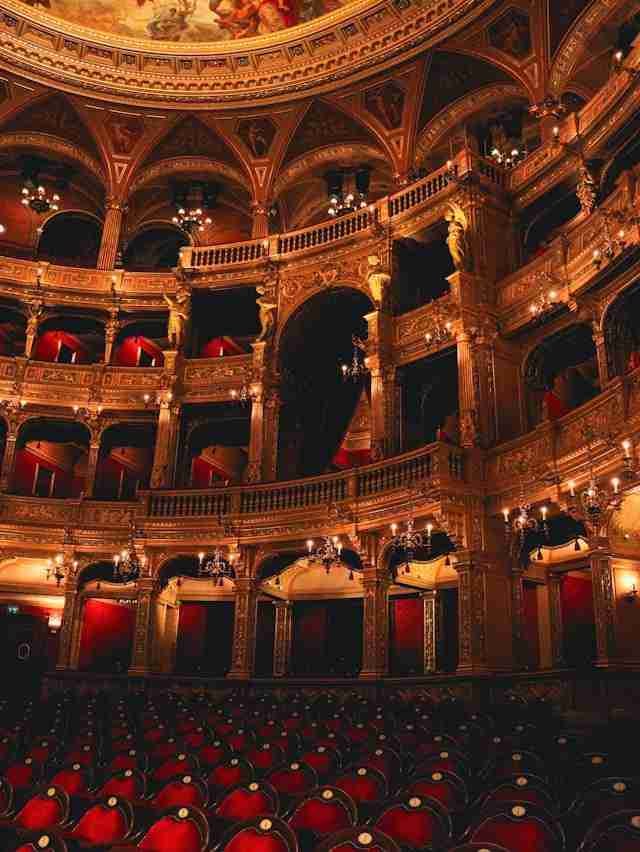
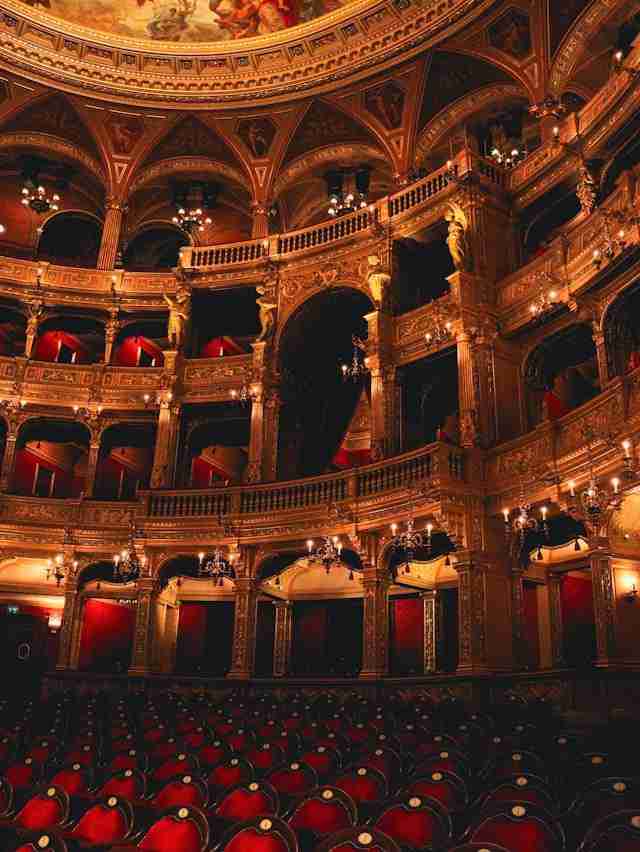
Photographing the main performance hall requires careful exposure and timing. With its concentric balconies, velvet seats, and ornate ceiling fresco, the auditorium offers excellent symmetry and compositional flow. Use spot metering to protect highlight detail in the chandeliers and painted ceiling. Most shooting here is handheld, so stabilization and high ISO performance are key. Lean into the softness of available light rather than fighting it, and consider bracketing exposures for highlight and shadow recovery. Silence and discretion are important, especially if photographing during a rehearsal or live performance under special permission.
Evening Exteriors with Mixed Light
As daylight fades, the Hungarian State Opera begins to glow under a combination of façade lighting and ambient city illumination. The warm light across the stone contrasts with the cooler tones of twilight, creating a vibrant color separation in long exposures. From the far sidewalk on Andrássy Avenue, you can use a wide or mid-range lens to frame the full front of the building with symmetrical streetlights or passing traffic. Longer exposures smooth car movement and allow for cleaner foregrounds. Use a tripod and cable release, and shoot during blue hour for the most balanced light conditions.
Best Time to Visit
For exterior photography, the most consistent and flattering light occurs in the early morning hours from March through October. During this time, soft eastern light illuminates the façade from the side, highlighting the sculptural depth without casting deep shadows into the archways. These conditions are best for full-structure framing and detail work across the stone surfaces. Late afternoon and early evening also work well, particularly during golden hour when the building begins to catch warm light on its western and southern faces.
Interior photography is best during the first guided tours of the day when the halls are quiet and ambient light is more even. The grand staircase and foyer receive some natural light from the windows above, which pairs well with the warm tones of the interior fixtures. If you plan to shoot the auditorium, contact the Opera House ahead of time for any special permission or media passes that may allow additional time or equipment use.
Winter visits offer a quieter atmosphere and fewer crowds, which is especially useful for interior detail work. Snow or frost on the plaza adds a clean visual element that can frame the warm stone of the building. In summer, tourist traffic increases sharply, so plan your sessions early in the day or later in the evening for the best access and fewest distractions.
How to Get There
The Hungarian State Opera is located on Andrássy Avenue in central Budapest, between Oktogon and Bajcsy-Zsilinszky út. It is easily reached by Metro Line 1, with the Opera stop situated directly in front of the building. Several tram and bus routes also run nearby, and pedestrian access is excellent throughout the neighborhood.
There is no fee to photograph the exterior. Interior access requires joining a guided tour, which is offered daily in multiple languages. Photography is permitted inside during the tours, but tripods and large camera bags are not allowed. If you are planning to photograph during a performance or rehearsal, you must arrange access in advance through the Opera House's administrative office.
The sidewalk space across from the building provides enough distance for full-structure compositions without needing elevated platforms or ladders. Morning sessions offer the cleanest shooting conditions, while blue hour sessions offer the best balance between natural and artificial light.
Recommended Photography Gear
A tilt-shift lens or a 16 to 35 millimeter wide-angle zoom is essential for architectural compositions of the exterior, especially when working close to the building's façade. For interior and detail work, a 24 to 70 millimeter zoom offers flexibility in tight spaces, while a 70 to 200 millimeter lens allows for selective framing of sculpture, balcony patterns, and ceiling details.
Due to restrictions on tripod use inside, fast primes with large apertures are recommended. Lenses in the f/1.4 to f/2.8 range will allow you to work handheld while maintaining sharpness and clean exposure in the low-light interior spaces. For exterior night photography, a sturdy tripod, remote shutter release, and a two to six stop neutral density filter can help balance bright artificial lights during longer exposures.
Pack a small, lightweight gear setup for interior sessions, as large bags are not allowed on tours. Bring extra batteries and memory cards, as you'll be working quickly in changing light. A microfiber cloth is helpful for cleaning lenses after working outside, especially in winter or damp weather. A bubble level or grid overlay in your camera viewfinder will help keep verticals aligned, which is essential when framing large architectural forms.
Nearby Photography Locations
Just a short walk away, this cathedral offers a grand dome, intricate stonework, and excellent interior symmetry. The building is best photographed in early morning light or from its rooftop viewpoint, which provides a commanding view of the city.
Lined with historic buildings and mansions, the avenue itself is a destination for architectural photographers. Strong lines, repeating windows, and classic iron balconies give structure and rhythm to mid-length compositions in soft light.
This modern square contrasts well with the older structures nearby. The Ferris wheel can be used creatively in wide shots or blurred in long exposures at night. The area is especially vibrant during twilight.
Visible from several nearby bridges and riverside walks, the Parliament Building is one of the most visually striking in Europe. Shoot from across the Danube for sunset reflections or during blue hour when the façade is fully illuminated.
The largest synagogue in Europe features a blend of Moorish and Gothic architectural influences. Its warm brickwork and onion domes offer strong visual contrast with surrounding buildings, and the interior is open to photography during tours.
The Hungarian State Opera is a location that rewards both precision and exploration. Its architectural harmony and attention to detail invite structured compositions, while its interior mood and layered design offer space for creative interpretation. Whether you are working in soft natural light or the glow of evening lamps, this building remains a cornerstone for anyone photographing architecture in Budapest.
Comments
Loading comments…