
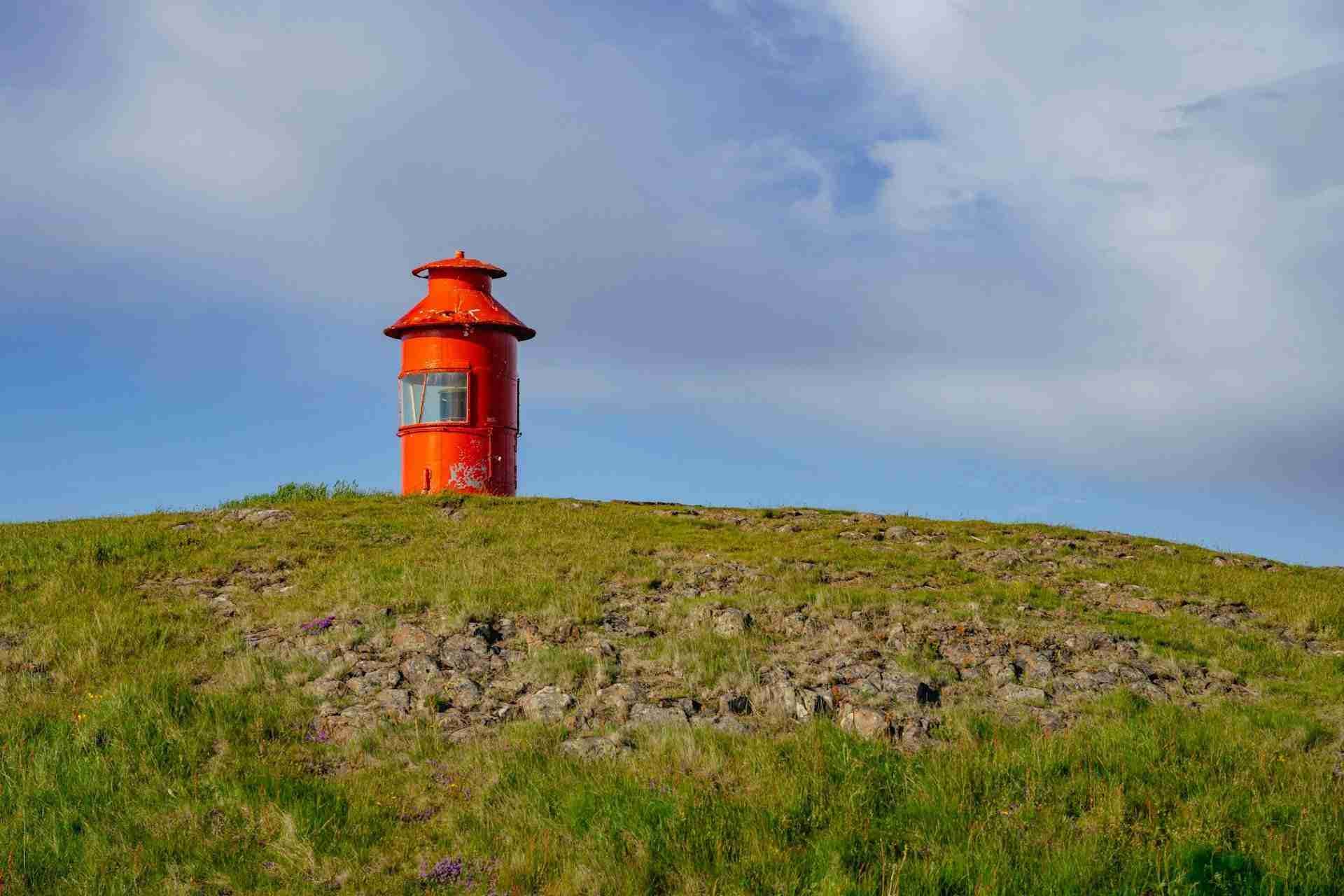
Perched atop a rugged islet just outside the fishing village of Stykkishólmur on Iceland's Snæfellsnes Peninsula, the Súgandisey Island Lighthouse offers one of the most accessible yet atmospheric locations for coastal photography in West Iceland. Though modest in size, this bright orange, cylindrical beacon stands in stark contrast to the windswept basalt and ever-changing skies that surround it. Set against views of Breiðafjörður Bay and its scattered islands, the lighthouse is both a visual anchor and a natural viewpoint—ideal for capturing Iceland's moody seascapes, colorful skies, and minimalist architectural forms. The short walk to Súgandisey Island makes it an ideal stop for photographers looking to blend dramatic landscape with a dash of maritime heritage.
Best Photography Opportunities
• Lighthouse as Color Contrast
: The striking orange paint of the Súgandisey lighthouse offers bold contrast against Iceland's typically cool-toned skies and muted terrain. Whether you're shooting on a cloudy day, under snowfall, or during the golden light of sunset, the structure immediately draws the eye and can be used as a visual counterpoint in wide-angle compositions. Composing it alongside dark volcanic rocks or the silvery waters of Breiðafjörður helps emphasize its saturated hue, creating strong, graphic imagery.
• Panoramic Views of Breiðafjörður
: From the top of the island, expansive views stretch across the fjord and toward the distant Snæfellsnes mountains. This makes it an excellent location for sweeping panoramas, especially during sunrise or sunset when the light rakes across the water and silhouettes the surrounding islets. In the summer months, low-angle light lingers for hours, offering subtle shifts in color and tone that are ideal for layering distant landforms and cloud textures in longer compositions.
• Minimalist and Symmetrical Compositions
: The lighthouse's compact, cylindrical shape makes it perfect for minimalist compositions that rely on symmetry and negative space. Using a telephoto lens or approaching directly on-axis, you can isolate the structure against sky or sea for clean, balanced images that emphasize Iceland's quiet, elemental beauty. This is especially effective in winter, when snow creates a near-monochrome palette and the lighthouse becomes the sole burst of color in the landscape.
• Moody Weather and Changing Light
: Súgandisey's exposed position ensures fast-changing weather, from storm clouds and rain to brief windows of sun. These dramatic shifts create dynamic shooting conditions where light and shadow can transform a scene in moments. Photographers who embrace the unpredictability of Iceland's climate will find endless opportunities here—reflected skies, light breaking through clouds, and atmospheric haze over the water all contribute to layered, emotionally resonant images.
• Human Scale and Environmental Portraits
: The small size of the lighthouse makes it easy to incorporate human figures into the frame for scale. Whether it's a lone figure walking the path, a bundled-up traveler approaching the beacon, or a portrait silhouetted against the sea, the island lends itself to storytelling. These moments are especially impactful in wide compositions where the figure appears dwarfed by the sky and surrounding sea, adding a sense of solitude and place.
Best Time to Visit
Súgandisey Island can be visited year-round, but the best light occurs during the shoulder seasons of spring and autumn, when the sun remains low in the sky for long periods and the clouds often produce dramatic conditions. In summer, the golden hour stretches late into the night, particularly in June and July, providing hours of soft, directional light that bathes the lighthouse and surrounding sea in warm tones. These extended twilight hours are ideal for photographers interested in subtle light transitions and atmospheric haze over the fjord.
In winter, snow transforms the landscape into a high-contrast environment perfect for minimalism and monochrome work. The lighthouse, with its bold orange color, stands out even more dramatically against white drifts and stormy skies. Stormy weather often brings fast-moving light and dramatic cloud cover, ideal for moody, layered compositions. Wind can be intense year-round, so come prepared to stabilize your camera, especially for long exposures. The fjord often mirrors the sky during calm periods, and reflections can be particularly vivid after a rainfall or during sunrise when light grazes the water's surface.
How to Get There
Súgandisey Island is connected to the mainland by a short causeway from Stykkishólmur's harbor, and the walk to the lighthouse takes less than 10 minutes from the port. The trail is well-maintained and follows a gradual incline, making it accessible for most visitors, even with gear. Street parking is available near the harbor, and no permits or entrance fees are required to access the island. The lighthouse and its surroundings are open at all hours, making sunrise, sunset, or even midnight sun photography fully feasible. Be mindful of weather conditions, especially in winter, as high winds and icy paths can make the ascent more challenging.
Exploring Súgandisey and the Surrounding Area
Beyond the lighthouse itself, the island offers plenty of rewarding perspectives. The slopes below the beacon are covered in hardy grasses and volcanic stone, which make excellent foreground elements when composing seascapes or wide shots of the fjord. Turning inland, you can photograph the Stykkishólmur harbor and town, where colorful Icelandic houses and boats offer charming subjects from an elevated vantage point. Birdlife is active in spring and summer, and it's not uncommon to spot Arctic terns, eider ducks, or seagulls circling the island or resting on its rocky edges. The area is compact, so exploration is quick but rewarding, with each change in angle revealing new lines, textures, and framing opportunities.
Nearby Photography Locations
: Just below the island, this working harbor offers classic Icelandic maritime scenes—colorful boats, weathered docks, and backdrop views of the town's red-roofed houses. It's especially photogenic during early morning when the boats are still and the water acts as a perfect mirror.
: A short drive from Stykkishólmur, this modest hill offers wide views over the surrounding plains and fjords. It's a popular sunrise location, and the light from the east often paints the landscape in soft, warm hues. Legend says you can make a wish at the summit, which adds a narrative element to a sunrise shoot.
• Bjarnarhöfn Church and Shark Museum
: This tiny rural church, set against mountains and farmland, is a great spot for minimalist countryside shots. Nearby, the rustic shark-curing sheds provide characterful textures and quirky local color for documentary-style photography.
: Just south of Stykkishólmur, this moss-covered lava flow is otherworldly in both scale and texture. During overcast or foggy weather, it offers a moody, primeval landscape that contrasts beautifully with the simplicity of the Súgandisey lighthouse.
• Kirkjufell and Kirkjufellsfoss
: About an hour's drive west, this iconic mountain and waterfall pairing is one of the most photographed scenes in Iceland. While far more popular and often crowded, it's a natural extension of any trip to the Snæfellsnes Peninsula and offers grand, vertical compositions to balance the more intimate scenes at Súgandisey.
Súgandisey Island Lighthouse may be small in stature, but it delivers an outsized visual impact, especially for photographers attuned to contrast, mood, and simplicity. Its setting at the edge of sea and sky, combined with its vivid color and easy accessibility, makes it a must-visit location for anyone photographing the Westfjords or Snæfellsnes region. Whether you're after stormy drama, soft twilight, or bold minimalism, this quiet island perch invites patient observation and offers something new with every shift in light.
Comments
Loading comments…