
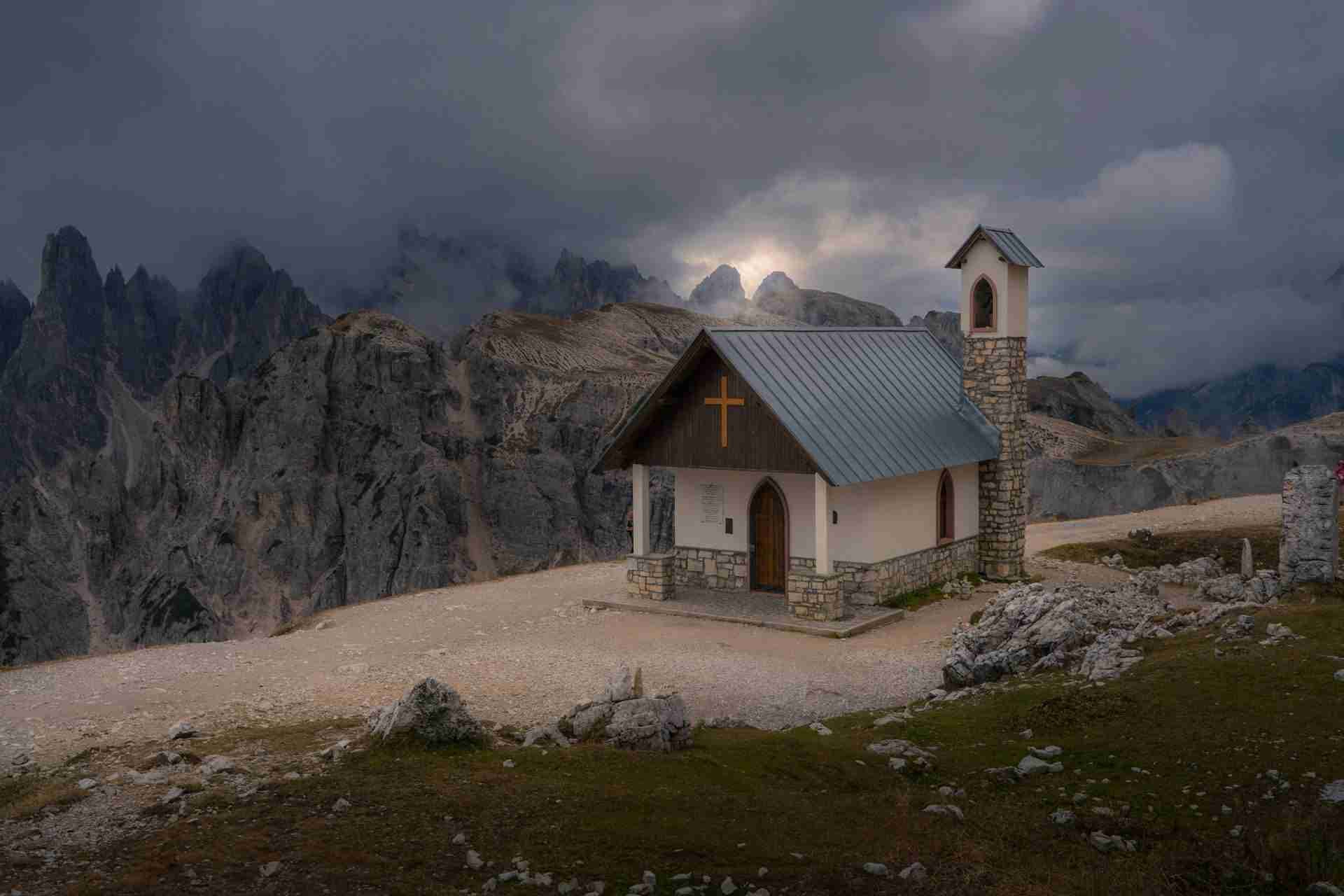
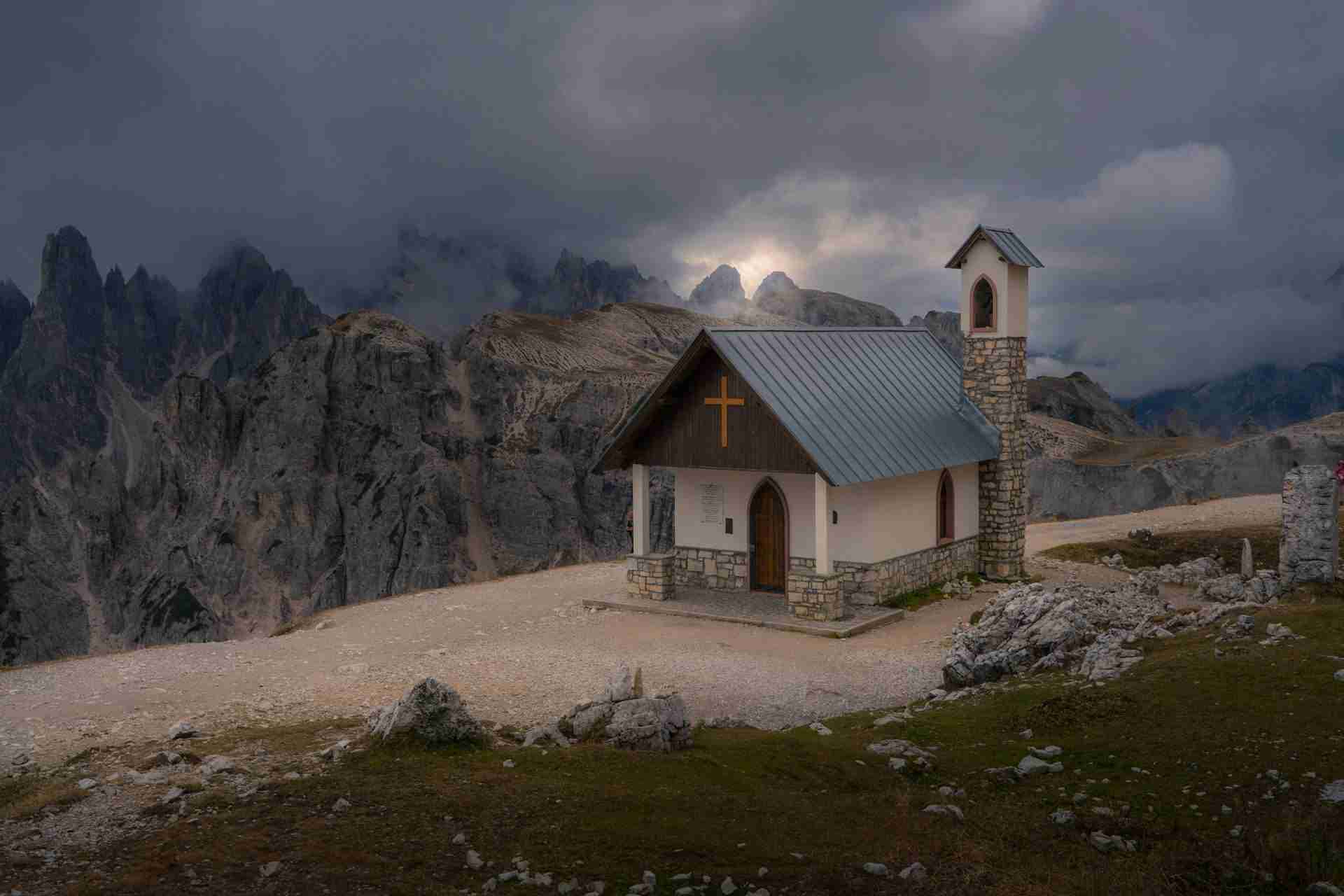
Cappella degli Alpini stands quietly on a rocky slope near Rifugio Auronzo, facing one of the most recognizable views in the Dolomites. This small mountain chapel, built in honor of the Alpini military corps, is framed by the towering vertical walls of the Tre Cime di Lavaredo, and sits along the main hiking route that circles these peaks. Its position just off the trail makes it accessible, but the simplicity of its form against the towering limestone massifs offers a powerful contrast for photographers. The chapel appears humble and still, almost fragile in comparison to the stone cathedrals that rise behind it. Whether captured in golden morning light, under rolling fog, or during a quiet blue hour, Cappella degli Alpini offers a rare chance to combine intimacy and grandeur in a single frame.
Best Photography Opportunities
• Sunrise from the Trail Below
Just a short walk along the Tre Cime loop trail gives you a clean view looking up at the chapel with the peaks rising directly behind it. This is one of the most rewarding compositions, particularly at sunrise when the first light strikes the top of the Tre Cime and slowly moves downward. Use a wide angle lens to include foreground trail textures or rocks, which help create depth and lead the viewer's eye upward. On clear mornings, the chapel's dark roof stands out sharply against the warming stone. This angle works well for both environmental wide shots and more balanced frames that place the chapel slightly off center with space to breathe.
• Curving Foreground Trail
Approaching the chapel from the west gives you access to a natural curve in the trail that can be used as a leading line toward the structure. This angle is strongest in the early morning or late afternoon, when light skims across the terrain and highlights the surface textures of grass, stone, and wood. A mid range zoom lens allows for tighter framing if you want to balance the chapel with the background cliffs without including too much sky. The angle also gives a better sense of the chapel's location within the larger landscape, especially when small figures appear on the trail for scale. Light clouds or soft haze can help mute the background just enough to push focus toward the chapel.
• Above the Rifugio
For a more elevated perspective, climb the slope behind Rifugio Auronzo and look down toward the chapel and the plains beyond. From this view, the chapel appears as a solitary marker in a wide space, with Tre Cime looming far above. This composition benefits from longer lenses, which allow you to compress the background and isolate the chapel against the open terrain. Use early or late light to draw contrast between the lit stone faces and the darker foreground. This is also an excellent place for shooting weather changes, as fog often rolls in from the valley and settles below the ridgeline, making the chapel appear suspended between earth and sky.
• Moody Weather
On overcast or shifting weather days, approach the chapel from the south and use the heavier sky as a backdrop to frame it in a more subdued, minimalist scene. The chapel holds visual weight even in soft light, and with fog or light rain, the surrounding details fade into the background, letting its shape and presence carry the image. This is a good opportunity to shoot in black and white, or to reduce contrast for a softer, more contemplative style. A tripod is helpful here for slower shutter speeds and precise framing. These scenes often feel more personal and atmospheric than those taken in clear light.
• Close-Up Textures and Details of the Chapel
Although the chapel is small, it offers several strong subjects for detail photography, including the wooden cross, rooflines, stone steps, and surrounding cairns left by hikers. Use a midrange lens or a short telephoto to isolate textures and study the contrast between natural and constructed elements. These compositions are best in early or late light when shadows define the surface and create subtle dimension. Overcast light also works well for shooting textures evenly without harsh highlights. Detail shots help round out a location set by adding quiet, observational frames that connect emotionally to the space.
Best Time to Visit
Cappella degli Alpini is best photographed from late June through early October, when the roads to Rifugio Auronzo are open and snow has cleared from the trails. Sunrise offers the most rewarding light, as the sun rises behind the chapel and lights up the eastern faces of the Tre Cime, creating strong separation between subject and background. The first two hours after sunrise provide long shadows and soft side light that shape the terrain without flattening detail. Sunset works best when shooting toward the west, capturing the chapel in the foreground as the peaks behind it fall into shadow or catch the last light on their upper ridges.
During the summer months, especially July and August, this area sees high foot traffic by mid morning. For clean frames and minimal distractions, arrive before dawn or plan your session for the early evening when most hikers have begun their descent. September is an excellent month for quieter conditions, more stable weather, and lower sun angles that enhance texture and form across the landscape. Stormy or foggy days are also worth exploring, as the area takes on a completely different mood that emphasizes solitude and silence. Be mindful of fast moving clouds and rain, as the weather can shift rapidly and affect both visibility and trail conditions.
How to Get There
Cappella degli Alpini is located near Rifugio Auronzo in the Tre Cime Natural Park, part of the Sexten Dolomites in the Province of Belluno. From the town of Auronzo di Cadore, follow signs to the Tre Cime toll road, which leads up to the Rifugio and the large parking area nearby. The toll road is open from late spring through early fall, depending on snow conditions. The chapel is a short walk from the parking area, positioned along the main loop trail that circles the Tre Cime peaks. The route is well marked and easy to follow, with packed gravel paths and wooden signage along the way.
No permits or fees are required to photograph the chapel, though the toll road does have an access fee, which varies seasonally. Arrive early if visiting in peak season, as parking fills up quickly, especially on clear mornings. The trail is accessible to most visitors and requires only basic footwear, though more rugged boots are recommended if you plan to explore further along the ridgeline or continue around the Tre Cime circuit. If staying overnight, Rifugio Auronzo offers lodging and meals, making it a convenient base for sunrise and blue hour sessions around the chapel and surrounding peaks.
Recommended Photography Gear
Photographing Cappella degli Alpini calls for a lightweight but capable kit that allows you to shoot wide vistas, midrange environmental scenes, and close details without needing excessive equipment. A wide angle lens in the 16 to 35 millimeter range is ideal for capturing the chapel with the Tre Cime in the background, especially from trail-level perspectives where foreground elements help anchor the frame. Use this lens to play with sky movement during early light or to emphasize the scale between chapel and mountain.
A 24 to 70 millimeter zoom provides excellent versatility, allowing you to frame both wider environmental portraits and tighter detail studies. This lens also performs well when shifting between full light and cloud cover, giving you more framing options on the move. For compression effects or tighter studies of the peaks behind the chapel, bring a 70 to 200 millimeter lens. This longer focal length is particularly useful when the light hits only parts of the ridge or when fog creates layers of separation.
A compact tripod is helpful for low light shooting, long exposures, and composing with precision, especially during sunrise or shifting weather. A circular polarizer can enhance sky contrast and deepen the tones of the rock, while a graduated neutral density filter helps balance the bright sky against the shaded slopes. A microfiber cloth is essential in cooler or humid conditions, when condensation may build up. Bring light layers and a rain cover for your gear, as conditions can shift quickly and shelter is limited along the trail.
Nearby Photography Locations
, which begins and ends near the chapel, offers some of the most dramatic and varied compositions in the Dolomites. The trail passes through open alpine terrain, dramatic ridgelines, and several rifugi with views of the peaks from all angles. It is ideal for sunrise and sunset shoots, as the light wraps differently around each face of the Tre Cime.
, located at the base of the Tre Cime access road, provides early morning reflections of surrounding cliffs and forested slopes. When the water is calm, the lake becomes a strong location for mirror-like compositions with pastel skies and mountain color.
, accessible from nearby trailheads, is a jagged subrange of spires and ridges that works beautifully for both wide angle landscapes and telephoto compression shots. The complex geology and dramatic angles provide a visual contrast to the more symmetrical lines of Tre Cime.
, a neighboring peak with trail access from the same area, offers high vantage points for looking back toward the chapel and Tre Cime from elevated ground. This trail includes tunnels and historic World War I paths, making it both a photographic and cultural experience.
, located along the circuit, gives you a closer view of the eastern face of Tre Cime and serves as a useful stop for mid-hike breaks or sunset shooting. From here, the peaks appear layered and dynamic, especially with shifting afternoon light and weather.
Cappella degli Alpini offers more than a quiet subject along a busy trail. It is a point of calm and scale where stone, history, and light meet in one of the most photographed mountain settings in the world. What makes it special is not just where it stands, but how it holds its own against the landscape, inviting you to slow down and see how something small can still speak clearly within a vast and changing scene.
Comments
Loading comments…