
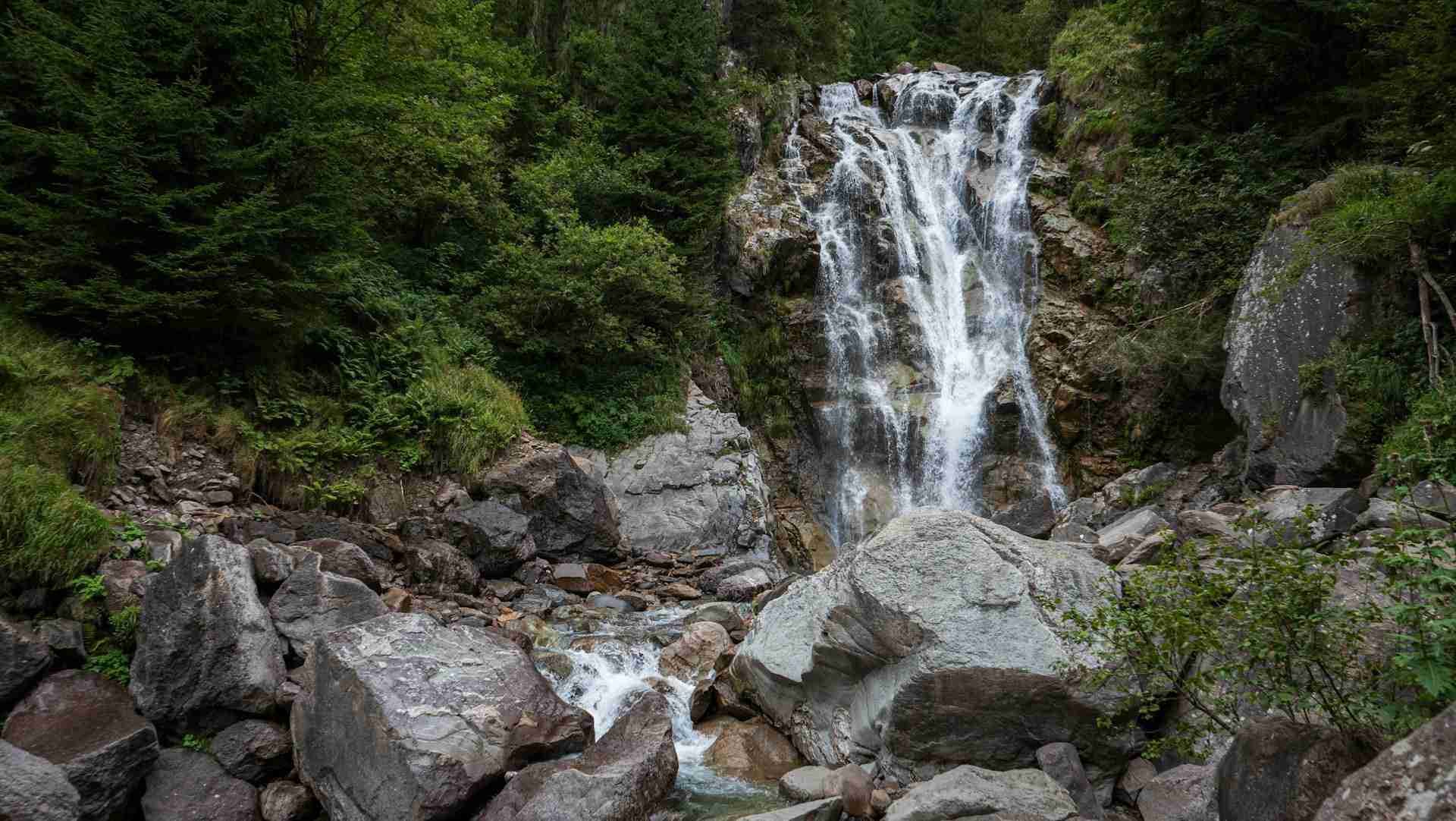
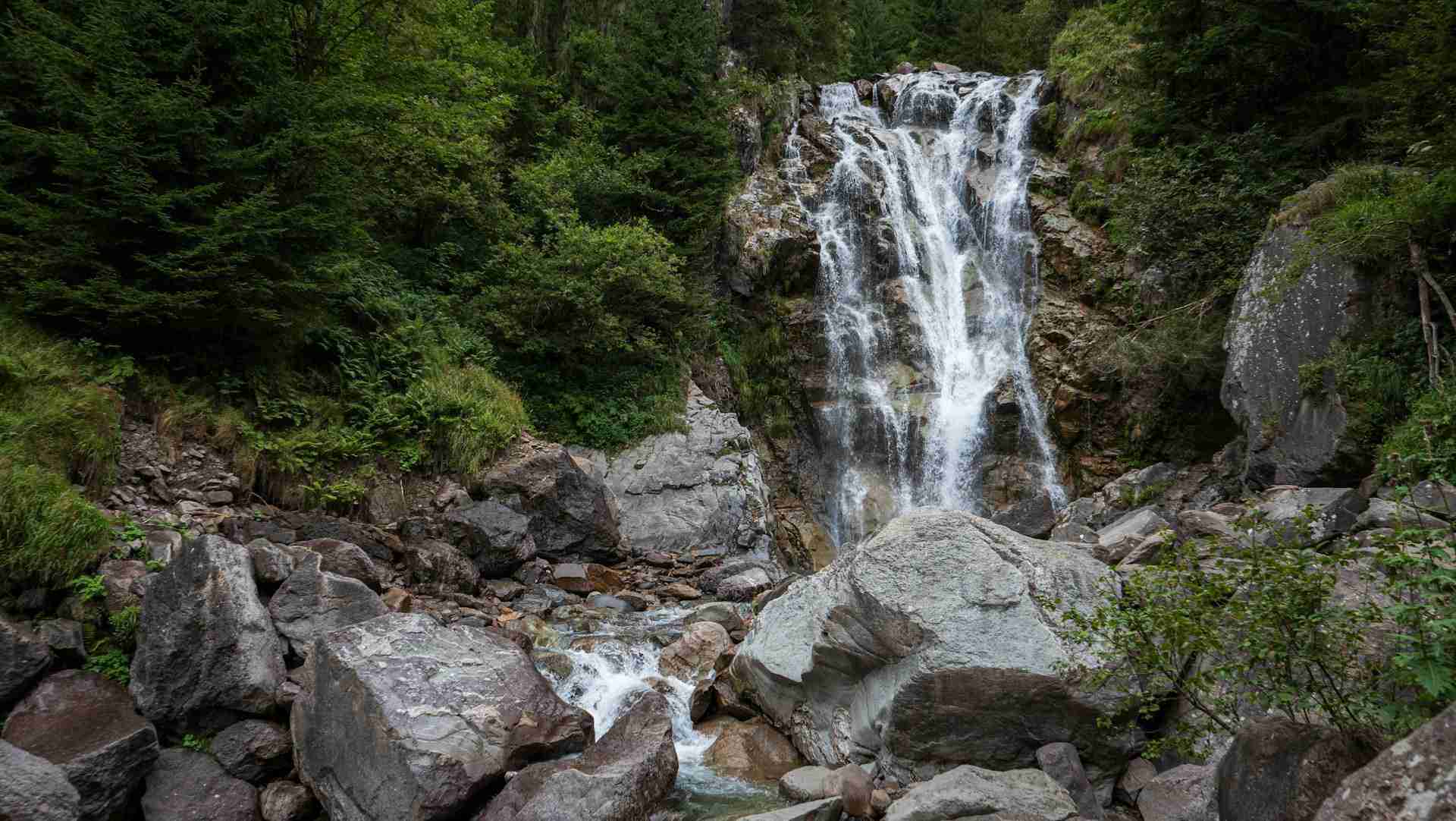
Hidden within the upper Val di Scalve in Lombardy, the Cascata del Vò is a tall, elegant waterfall that tumbles down a sheer rock face near the village of Schilpario. Surrounded by dense beech and fir forests, the waterfall is one of the most striking natural attractions in the Bergamo Alps. Its vertical drop and narrow chute create a clean, linear form that contrasts beautifully with the rugged cliffs and mossy boulders at its base. For photographers, Cascata del Vò offers both classic long-exposure opportunities and more intimate detail work, where light, spray, and forest textures combine into layered compositions. The surrounding valley is quieter than many other alpine regions in northern Italy, making this location ideal for those seeking strong natural subjects in a peaceful setting.
Best Photography Opportunities
• Full-Length Views of the Waterfall
The most obvious but still most rewarding composition is the full view of Cascata del Vò from its base. Wide-angle lenses in the 16 to 24 millimeter range allow you to capture the waterfall in its entirety along with the cliffs and surrounding forest. In spring and early summer, when snowmelt increases flow, the water's sheer force becomes a central subject. Long exposures of one to four seconds transform the fall into a soft white ribbon, while faster shutter speeds freeze the turbulent descent for a more dramatic impression of power. Including foreground boulders or foliage helps anchor the composition and emphasizes scale. Morning light often arrives at an angle, highlighting the water without overpowering the shadows in the cliffs, making it the best time for full-length shots.
• Detail Studies of Rock, Moss, and Water Flow
Beyond the grandeur of the entire cascade, the base of the waterfall offers countless opportunities for detail work. Water runs across smaller channels and moss-covered rock, breaking into rivulets and spray. Using a mid-range zoom, you can isolate sections where the water interacts with textured stone, capturing abstract patterns that emphasize form and movement. A macro lens reveals tiny plants and moss thriving in the constant dampness, creating natural contrasts of bright green against wet gray stone. Working in overcast or shaded conditions enhances these details, since soft light reduces glare on wet surfaces and deepens the subtle variations in tone. These close studies balance a portfolio of grand waterfall views with quieter, more intimate interpretations.
• Seasonal Perspectives and Ice Formations
Cascata del Vò is a waterfall that transforms drastically with the seasons, making repeat visits rewarding. In spring, the flow is at its strongest, creating thunderous power and heavy spray that fills the air. Summer brings a gentler cascade surrounded by dense green foliage, with calmer conditions that make long exposures easier to control. Autumn adds a vivid palette of gold, orange, and red from the surrounding forest, reflected in wet rock surfaces and fallen leaves scattered near the base. Winter may be the most spectacular season of all, as parts of the falls freeze into towering ice curtains, complete with icicles and crystalline textures. These frozen formations invite both wide scenes and close studies, with blue light reflecting in the ice on clear days. Each season delivers a different mood, making the waterfall a year-round subject.
• Framing with Forest and Approaching Perspectives
The trail that leads to the waterfall provides several vantage points where the falls are partly visible through the trees. These approaches are excellent for building layered compositions that lead the viewer's eye through foliage toward the cascade itself. Using trunks or overhanging branches as natural frames adds structure to the image while also conveying a sense of discovery. In autumn, golden leaves contrast with the stark white water, while in spring, bright green foliage glows against the darker rock walls. Shooting at mid-range focal lengths allows you to balance the context of the forest with the clarity of the waterfall. These perspectives work especially well in diffused light, when the forest is evenly illuminated and colors are rich.
• Atmospheric Conditions, Spray, and Light Effects
Because of its setting, Cascata del Vò often produces mist that catches sunlight at certain times of day. Shooting into the light on clear mornings reveals halos and occasional rainbows as spray refracts the sun's rays. Faster shutter speeds freeze droplets suspended in the air, creating dynamic, high-energy compositions. Longer exposures blur the mist into a dreamy haze, giving the entire scene a more ethereal quality. Tripods and lens protection are crucial here, as spray can quickly accumulate on glass. These effects shift quickly with wind direction and light, rewarding patience and readiness. Capturing them adds movement and atmosphere beyond the static structure of the waterfall.
Best Time to Visit
Cascata del Vò is accessible and photographable throughout the year, but each season offers a different visual character. In spring, melting snow fills the stream with energy, and the waterfall roars at its most powerful. Photographers should prepare for heavy spray during this time, but the sheer force of the cascade makes for unforgettable images. Summer offers gentler conditions, with the falls surrounded by lush, vibrant foliage that frames the water in rich green tones. Early mornings and evenings are best for calmer winds and softer light, which help preserve reflections in the pools and maintain balanced exposures.
Autumn is perhaps the most photogenic season, with the surrounding forest painted in golden hues that contrast against the silvery water. Mist is common in the valley at this time, and capturing the falls as fog lifts through the trees creates a layered, atmospheric effect. Winter transforms the site into a frozen wonderland, with ice curtains forming along the rock walls and snow covering the surrounding forest. Access may be more difficult, but the reward is unique compositions of frozen and flowing water side by side. For lighting in all seasons, mornings offer the softest conditions and fewer visitors, while overcast days provide ideal light for long exposures and detail work.
How to Get There
Cascata del Vò is located in the upper Val di Scalve, near the village of Schilpario in the province of Bergamo, Lombardy. From Schilpario, the trail to the falls begins on the outskirts of the village and is clearly marked. The walk takes around 20 minutes and follows a gentle, well-maintained path through forest before arriving at the base of the waterfall. Parking is available in Schilpario, with dedicated spaces close to the trailhead.
There is no fee to access the waterfall, and the trail is suitable for most visitors, though it can become muddy or icy depending on the season. Proper hiking footwear is recommended, especially in winter or after rain. Facilities near the waterfall are minimal, but Schilpario itself offers restaurants, cafés, and small accommodations. Photographers should be prepared for damp conditions near the base, with waterproof clothing and protective gear for equipment. Drone use is allowed but should be approached with care, as the steep cliffs and spray can create turbulence.
Recommended Photography Gear
Photographing Cascata del Vò benefits from a flexible kit that can handle both grand scenes and detailed studies. A wide-angle lens in the 16 to 35 millimeter range is essential for capturing the full length of the waterfall within its alpine surroundings. A 24 to 70 millimeter zoom is useful for mid-range work, balancing the waterfall with forest and rock context. A telephoto lens in the 70 to 200 millimeter range allows for compression of details in the rock face or isolating sections of the cascade. For texture and abstract studies, a macro lens is invaluable for close-ups of moss, ice, and rivulets.
A sturdy tripod is critical for long exposures, especially when shooting at slower shutter speeds to create silky water effects. Neutral density filters allow extended exposures even during bright daylight, while a circular polarizer reduces glare on wet rock and enhances forest greens. Waterproof covers and microfiber cloths are essential due to constant spray at the base of the falls. In winter, extra batteries are necessary as cold temperatures drain power quickly. A lens hood also helps protect glass from droplets while shooting into the mist.
Nearby Photography Locations
Just minutes from the falls, Schilpario retains its alpine character with wooden balconies, stone houses, and narrow lanes. The village is surrounded by steep mountains, making it an excellent location for architectural and cultural photography, especially during golden hour when light spills into the valley.
This prominent mountain peak towers above Val di Scalve and provides sweeping views across the Bergamo Alps. The trail to Pizzo Camino offers multiple vantage points for panoramic landscape photography, with sunrise revealing mist-filled valleys and distant alpine silhouettes. Telephoto lenses are particularly useful here for layered horizon shots.
Known as the "Queen of the Orobie Alps," the Presolana massif is one of the region's most dramatic limestone ranges. Its cliffs and ridges make it a striking subject in both wide landscapes and long-lens compositions. The massif is best photographed at sunrise or sunset, when shadows accentuate its rugged form.
The surrounding valley is laced with forest trails that lead to smaller cascades, streams, and textured woodland scenes. These trails are especially rewarding in autumn, when fallen leaves carpet the ground and soft light filters through the canopy. Close-up and macro work here complements waterfall photography with quieter forest scenes.
South of Val di Scalve, Lake Iseo offers broad waterscapes framed by mountains and dotted with picturesque villages. Its changing water levels reveal interesting shoreline textures, and Monte Isola, the largest lake island in Europe, provides strong focal points for wide compositions. Sunset sessions here are particularly rewarding.
Cascata del Vò combines raw power with quiet detail, making it one of Lombardy's most rewarding natural photography sites. Its seasonal shifts, from thunderous spring flows to frozen winter sculptures, ensure that no two visits produce the same results. With its accessible trail, dramatic vertical drop, and rich surrounding landscapes, the waterfall offers photographers the chance to explore both sweeping alpine drama and delicate natural textures within a single location.
Comments
Loading comments…