
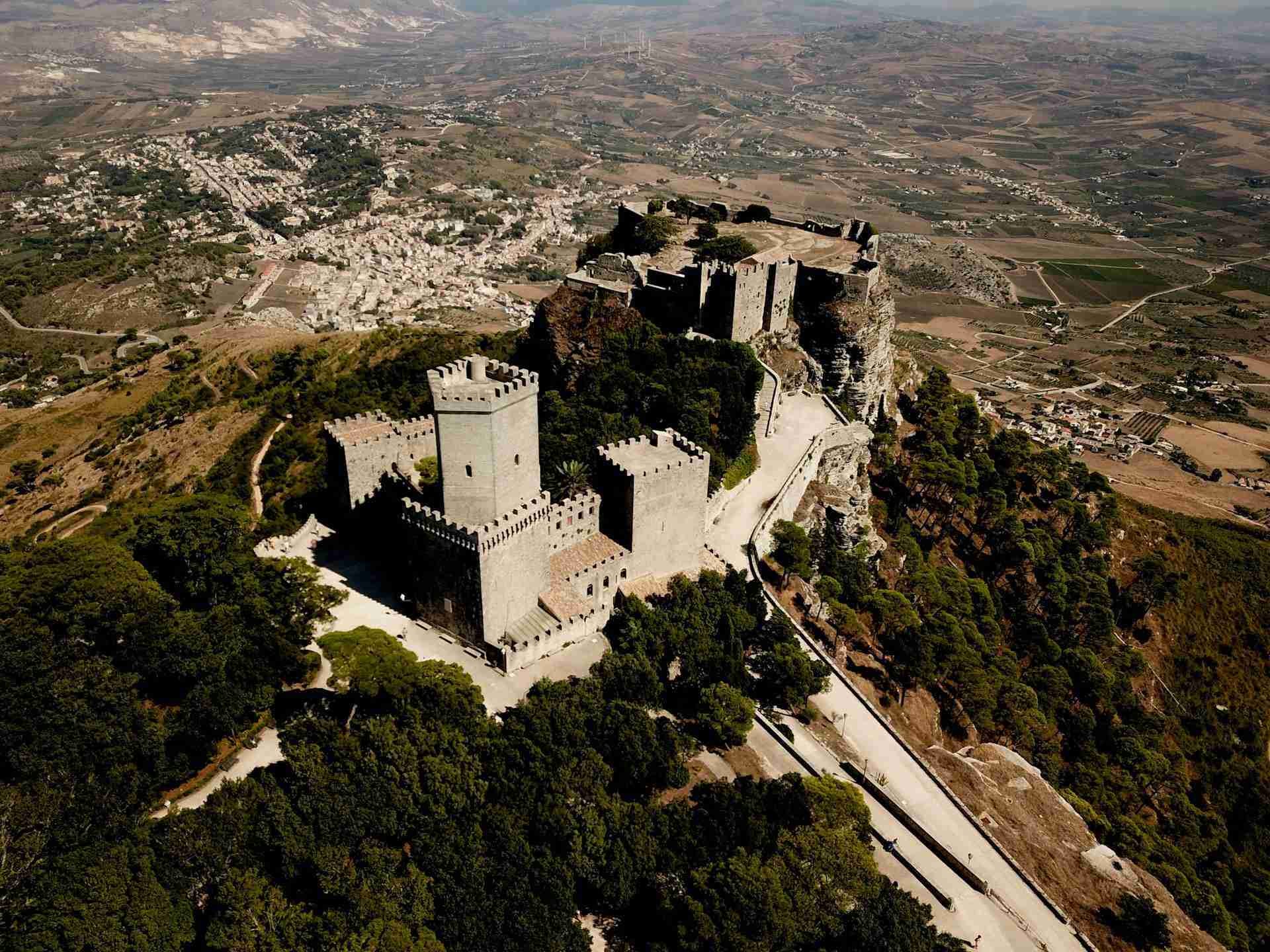
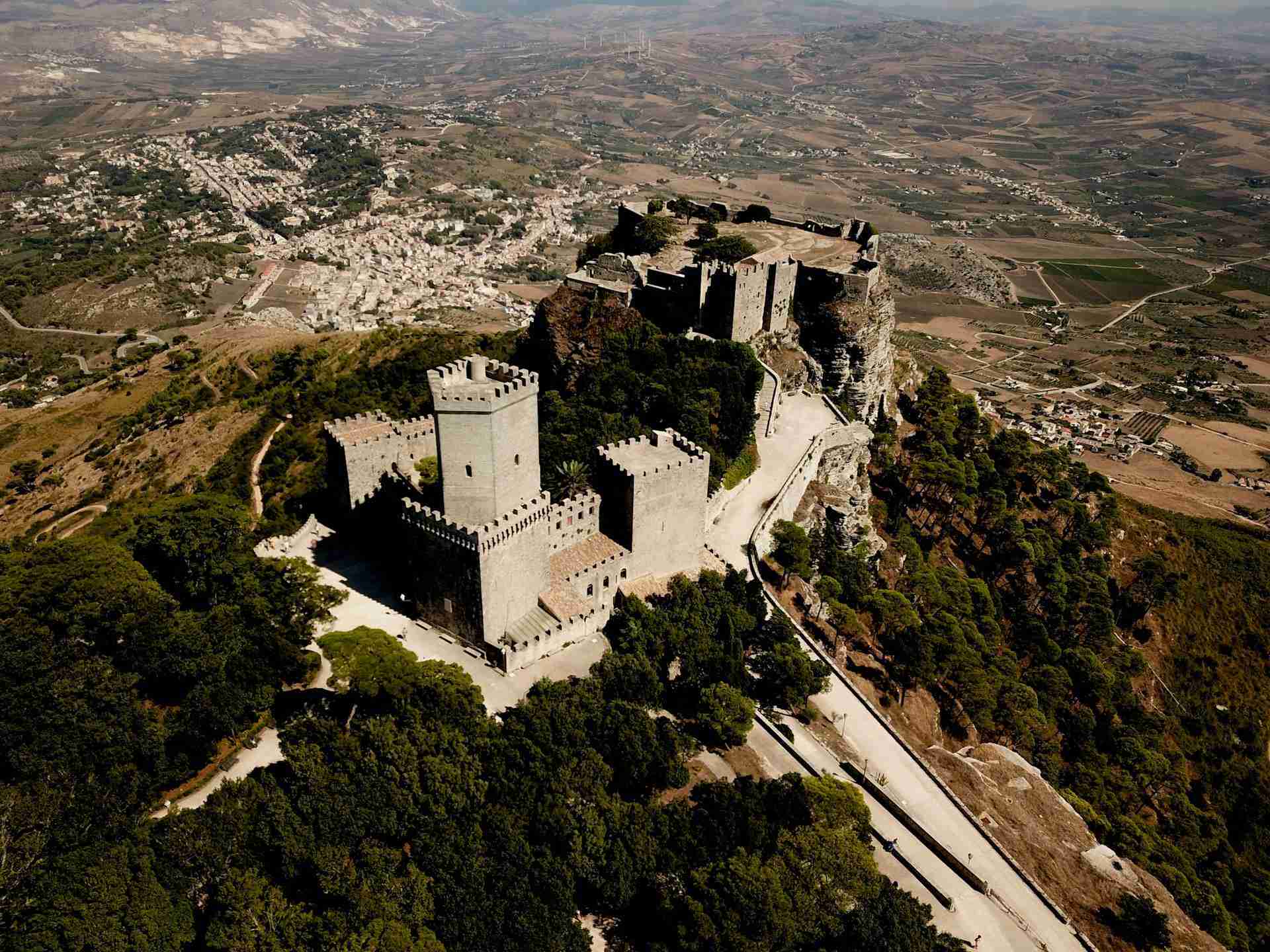
Standing sentinel over the clouds on the summit of Mount Erice, Castello del Bálio is a place where medieval architecture, sweeping Sicilian vistas, and mountain air converge in a setting of remarkable serenity and photographic potential. Perched above the Tyrrhenian coast in western Sicily, this 14th-century fortress complex—paired with the nearby Giardino del Bálio—offers stone towers, fortified walls, and elevated gardens all surrounded by panoramic views of Trapani, the Egadi Islands, and Monte Cofano. While Castello di Venere may steal some attention with its dramatic cliffside ruins, Castello del Bálio provides a quieter, more refined photographic experience with its walkable terraces, poetic symmetry, and interplay of stone and vegetation.
Best Photography Opportunities
• Frontal approach and symmetrical towers
As you approach the castle from the main path through the gardens, two narrow towers rise symmetrically on either side of the main gate, linked by battlemented walls. Photographing this entrance from the garden's stone walkway offers a clean, balanced composition that works beautifully in early morning or late afternoon light. A wide-angle lens captures both towers and framing trees, while mid-morning sun enhances the warm tones of the stone and casts crisp shadows across the façade. To emphasize symmetry, shoot head-on with the walkway as a leading line, aligning the verticals carefully to retain architectural precision.
• Terrace views over Trapani and the sea
One of Castello del Bálio's strongest visual assets is its elevation. From its outer terraces and walls, photographers can frame broad landscapes that stretch from the rooftops of Erice down to the salt pans, harbor, and shimmering Tyrrhenian Sea beyond. Use a telephoto lens to isolate ships on the water or compress the receding layers of hills and towns below. Wide-angle shots at sunrise or sunset allow the golden sky to spill across the horizon, with castle battlements in silhouette or soft edge light. These compositions pair particularly well with long exposure techniques when clouds are moving across the coastline.
• Side-lighting through Giardino del Bálio
The adjoining gardens provide both context and contrast to the solid mass of the castle. In the early morning, sunlight filters through the trees, casting long shadows across the mossy walls and stone benches. Capture the relationship between soft organic forms and rigid architecture by framing the towers through tree branches, arches, or paths. A mid-range zoom lens allows you to adapt quickly to changing light conditions while moving through this atmospheric space. Autumn is especially photogenic here, as falling leaves add texture and color to the stone-lined walkways.
• Detail studies of battlements, stonework, and aged textures
Castello del Bálio is rich with architectural texture: aged bricks, crenellated turrets, narrow staircases, and weathered iron fixtures all lend themselves to close-up compositions. In flat light, these surfaces come alive with fine tonal gradients that work well in black and white. Use a fast prime lens to isolate repeating shapes like arched openings or decorative stone patterns. Shooting from oblique angles helps reveal depth, shadow, and the story of time embedded in the stone.
• Twilight silhouettes and atmospheric sky transitions
As the sun sets over the western coast, the castle's towers stand in silhouette against a pastel or fire-streaked sky. From the open plazas on the northern side, compose frames that include the silhouette of the castle, distant mountains, and the last ambient light falling on the gardens. Blue hour compositions are particularly strong when framed with a bit of the town's glowing windows or ambient lamplight. A tripod is necessary here for exposures in the 5–20 second range, especially when aiming for both shadow detail in the castle and softness in the fading sky.
Best Time to Visit
The best times to photograph Castello del Bálio are spring and autumn, when light conditions, weather patterns, and foliage are most visually dynamic. From March to May, the garden comes to life with blooming flowers, fresh grass, and clear morning light. These months also bring stable weather, making it easier to plan golden hour sessions from the terraces.
September to early November
offers warm light, fewer tourists, and a higher likelihood of dramatic clouds or coastal haze—ideal for photographers interested in mood-driven compositions and layered views down to the sea. During this period, the sun angle adds structure to the castle's battlements and highlights the varied tones of its aging stone.
Summer can be bright and clear but also harsh and contrast-heavy in the midday hours. Photographers should work during the first two and last two hours of daylight when shadows are soft and stone surfaces take on a golden glow. Sunset brings excellent color over the sea, and fog occasionally rolls in during the evening, adding atmosphere to the mountaintop.
Winter
is quieter and more moody, with higher chances of overcast skies, rain showers, and early morning fog rising through the valley. The castle takes on a ghostly quality in this light, perfect for monochrome or subdued tonal palettes.
How to Get There
Castello del Bálio is located at the eastern edge of Erice, a medieval mountaintop town roughly 750 meters above sea level. The easiest way to access Erice is via the funivia
(cable car) from Trapani, which operates year-round and offers sweeping views of the coastline during the ride. Once in the town, follow signs to Giardino del Bálio, which leads directly to the castle.
For those arriving by car, there is parking available near Porta Trapani, the main pedestrian gate to the old town. From there, it's a 10-minute walk along cobbled streets to the castle and gardens. The site is open daily with no entrance fee required to explore the grounds and exterior.
Paths within the garden and around the castle are paved but uneven, so wear sturdy shoes, especially if carrying gear or staying through sunset. There are benches, rest areas, and informational plaques throughout the area, as well as nearby cafés and public restrooms near the town square.
Tripods are permitted throughout the gardens and castle exterior, but interior access is limited and typically not part of standard tourist visits.
Recommended Photography Gear
Photographing Castello del Bálio and its surroundings requires a mix of architectural and landscape gear. A wide-angle zoom is essential for capturing the full width of the castle towers and framing them through garden pathways or trees. A mid-range zoom (24–70mm) provides flexible control over framing when shooting both context and tighter architectural details. A telephoto lens (70–200mm) is key for compressing the coastal views from the terraces, isolating ships at sea, or framing silhouettes at sunset.
A travel tripod is crucial for golden hour and blue hour exposures, particularly for shooting during low-light conditions in the gardens or from the northern walls. A circular polarizer is useful in bright conditions to deepen skies and manage reflections from stone surfaces. Neutral density filters in the 3–6 stop range are helpful if you intend to blur moving clouds or create soft ambient exposures near dusk.
A fast prime lens (35mm or 50mm) is recommended for interior shadows or handheld low-light detail shots. Bring extra batteries and memory cards, especially if planning long sessions around sunset or extended bracketing. A weather-resistant bag is recommended in cooler months, and a compact LED panel can be helpful for fill lighting small architectural features during twilight.
Nearby Photography Locations
Just below Castello di Venere, Torretta Pepoli clings to the cliffside and offers fairy-tale atmosphere in morning mist or golden hour. Shoot from the Belvedere for wide landscapes or descend the trail to frame its Gothic arches among the rock and trees.
The garden that surrounds the castle is a location in its own right, with shadow-dappled paths, moss-covered benches, and tranquil viewpoints over Trapani and Monte Cofano. Best visited in early morning when long light casts through the tree canopy.
This ruined Norman fortress sits further east along the cliff and delivers rugged stone textures, dramatic elevation, and sweeping views. Excellent for black-and-white studies, foggy conditions, and bold compositions where sky meets stone.
• Monte Erice Ridge Trails
For photographers seeking wilder terrain, trails extend along the mountaintop, offering panoramic views to the north and east. These trails provide opportunities to shoot the castle from a distance, surrounded by natural elements like windblown grasses and open sky.
• Trapani Salt Pans
A short drive from the base of Erice, these shallow basins create reflective compositions of sky, windmills, and migrating birds. Perfect for sunset photography, the salt pans offer broad horizontal compositions that contrast beautifully with the vertical lines of the Castello above.
Castello del Bálio is not only a historical relic but a lens through which the entire western coast of Sicily comes into view. With its balanced architecture, garden setting, and commanding perspective over land and sea, it invites photographers to explore themes of light, symmetry, and timelessness. Whether capturing distant landscapes, intricate details, or the quiet play of shadow through stone, it offers a deeply layered and rewarding visual experience.
Comments
Loading comments…