
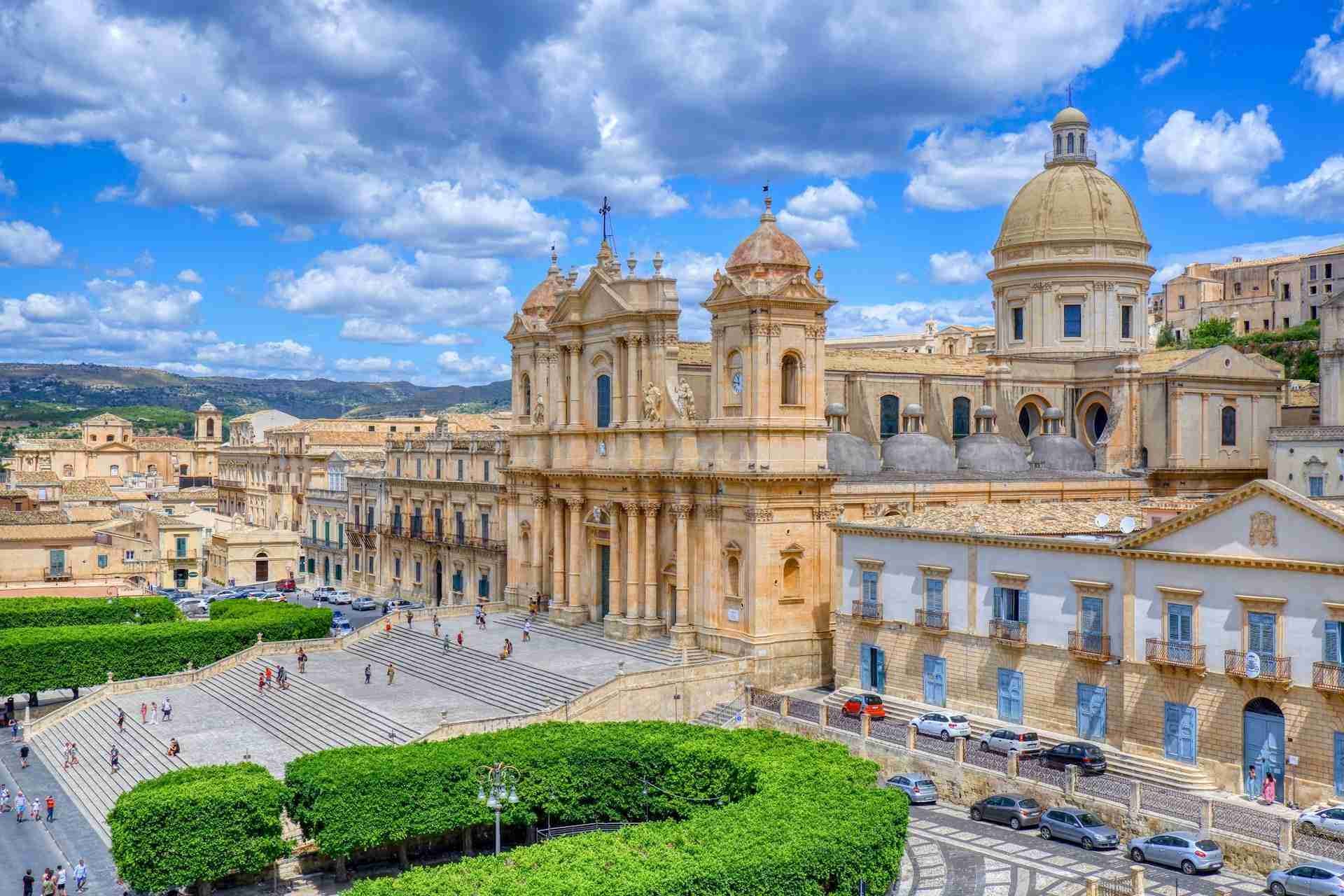
In the historic center of Noto, Sicily, Cattedrale di San Nicolò rises above Piazza del Duomo in balanced proportion and golden light. This 18th-century Baroque cathedral was built from warm toned local limestone that shifts in color throughout the day, from pale cream in the morning to amber by late afternoon. The broad staircase leading to its entrance and the open space of the square in front provide excellent flexibility for composition. Symmetry and scale play a major role here, but so does timing, as the soft Mediterranean light interacts with the building's carved surfaces and structured forms. Whether you're shooting wide views from the piazza or isolating architectural details, this site rewards patience and thoughtful framing more than dramatic angles or rapid fire shooting.
Best Photography Opportunities
• Full view from across Piazza del Duomo
The most complete view is from the far side of the piazza, where you can photograph the entire front of the cathedral, the long stairway, and the framing space of the square below. Morning is the best time for this angle, with soft sunlight from the east giving the façade a warm, even glow. A wide angle lens works well for full views, while a standard zoom helps if you want to focus more tightly on the structure itself. Shadows are light and easy to manage at this hour, and the space is usually quiet enough to work without distraction. Including a few small figures on the steps can help establish a sense of scale.
• Side perspectives with architectural layering
Moving to either side of the square gives you the chance to work with more depth, including foreground elements like streetlamps or railings. In the afternoon, sunlight casts strong shadows along the building's side walls, creating contrast that brings out the texture of the stone. These angles let you capture the building's volume and the way it fits into its urban surroundings. A polarizing filter helps control glare off the pavement, especially on clear days. These compositions work well for both wide context shots and tighter architectural frames.
• Details from the stairway and upper façade
From the cathedral steps, you can isolate decorative elements such as columns, statues, and carved doorways. This location is ideal in the early evening when the light becomes more directional but remains soft. A mid range telephoto lens allows you to frame parts of the structure without distortion. Working closer to the building also reduces the need for extreme angles, helping keep vertical lines clean. These shots benefit from a steady tripod and slow, deliberate composition.
• People and light on the steps
The staircase often becomes a gathering place in the late afternoon, giving you the opportunity to include human activity in your compositions. The repeated lines of the steps add structure, while sunlight from the west side of the square casts long shadows that can define form and motion. A moderate focal length lets you capture natural interaction without feeling intrusive. Waiting for spacing and posture to line up makes all the difference in these frames. This is a good setting for simple, honest street photography with architectural context.
• Twilight with exterior lighting
After sunset, the cathedral is lit with warm artificial light that contrasts well with the cooling tones of the evening sky. This is one of the best times to work with long exposures and balanced tones, especially during blue hour. Use a tripod to stabilize the shot and a standard zoom or wide angle lens for flexibility in composition. The stone surface holds color well after dark, and the square remains accessible for slow, careful work. Aim for symmetry and straight lines, as the structure's formal design makes misalignment more obvious.
Best Time to Visit
The cathedral and piazza are most productive in the morning and again in the late afternoon. Early light provides clean, soft coverage across the façade with low contrast, especially useful for wide shots and color accuracy. In the late afternoon, shadows lengthen and textures become more defined, which works well for side perspectives and tighter framing.
Spring and fall offer ideal light quality and more manageable crowds. Summer brings clearer skies and strong contrast, though midday light is usually too harsh for balanced exposures. Evenings in summer offer warm glow and low angle sunlight that enhances the shape of the building. Winter light is cooler and lower all day, which works well for detail oriented compositions and images with a more muted color palette.
Night photography is reliable, with the cathedral's lights switched on shortly after sunset and consistent coverage across the façade. The wide square makes it easy to set up without foot traffic interfering.
How to Get There
Cattedrale di San Nicolò sits on Corso Vittorio Emanuele, the main street in Noto's historic center. If arriving by car, you will need to park outside the old town and walk into the pedestrian zone. The walk from the nearest parking area is short and follows flat streets. The square and cathedral are directly accessible from multiple entry points and are clearly signed.
Noto is connected by regional train to nearby cities such as Syracuse. From the train station, the cathedral is about a fifteen minute walk uphill. Taxis and local buses are available for those who prefer not to walk. The square is open all day, and photography is unrestricted on the exterior. Tripods are allowed on the piazza but may not be permitted inside the cathedral, especially during services or scheduled events.
Recommended Photography Gear
A standard zoom lens, such as a 24 to 70 millimeter, covers most of what you'll want to shoot around the piazza. A wide angle lens is useful when working close to the cathedral or for capturing the full sweep of the square. A telephoto lens between 70 and 200 millimeters helps isolate decorative features on the upper façade and compresses layers when shooting from the sides.
A tripod is essential for twilight and night photography and useful when aligning architectural compositions. A polarizing filter helps reduce pavement glare and brings out the sky's color during the day. Neutral density filters may help during bright conditions if you're aiming for longer exposures or crowd smoothing.
The location is easy to navigate and has no elevation challenges or trail access, so it's practical to carry a full gear setup without compromise. Bring a microfiber cloth to keep lenses clean, especially if you're shooting close to the ground or in breezy conditions.
Nearby Photography Locations
Just a few minutes away, this Baroque church features curved architecture and strong shadow play on its façade. The surrounding area is quiet and offers enough space for side and frontal compositions. It is best shot in the afternoon when sunlight defines the rounded stone features.
• Via Nicolaci
This narrow street is lined with elaborate balconies and decorated stonework. The strong vertical lines and tight layout work well for detail photography and street scenes. Light enters from the side late in the day, giving a mix of warm stone and cool shadows.
Directly across from the cathedral, this symmetrical civic building balances the piazza with a more refined and formal architectural tone. It pairs well in wide compositions with the cathedral and also holds up in close studies of its arches and columns.
• Porta Reale
The main entrance arch to the old town is another useful subject for structure and framing. Shooting through it toward the cathedral adds depth and context, especially in morning light when the street is still quiet.
At the far end of Corso Vittorio Emanuele, this compact church sits just above a small square. Its clean lines and minimal decoration are well suited to soft, even light or moody twilight images.
Cattedrale di San Nicolò offers a steady rhythm of changing light and clean space. It rewards simple compositions, strong timing, and close attention to how shape and shadow interact throughout the day. The surroundings are easy to navigate, and the variety within a short walk makes it one of the most practical and flexible locations for photography in southeastern Sicily.
Comments
Loading comments…