
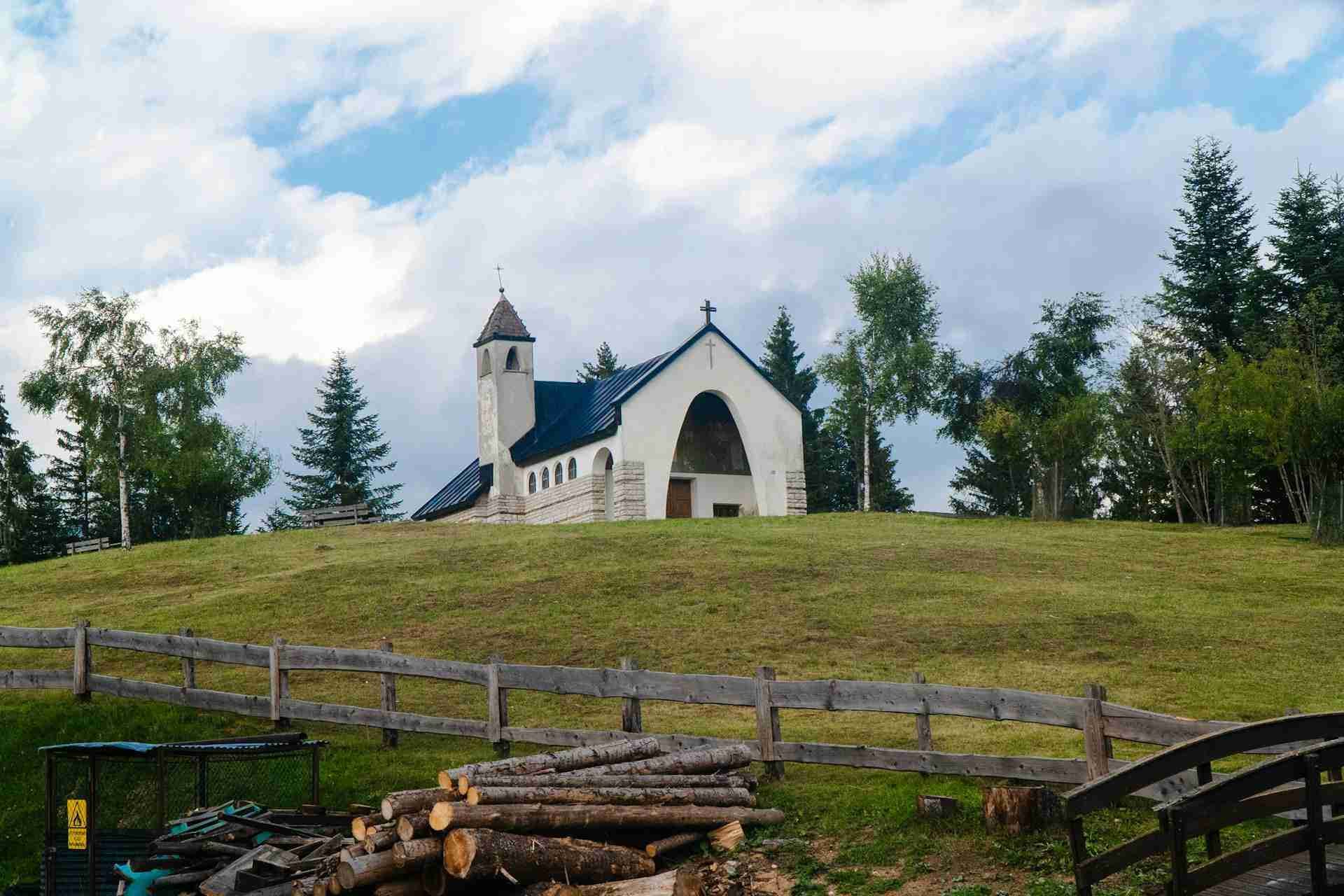
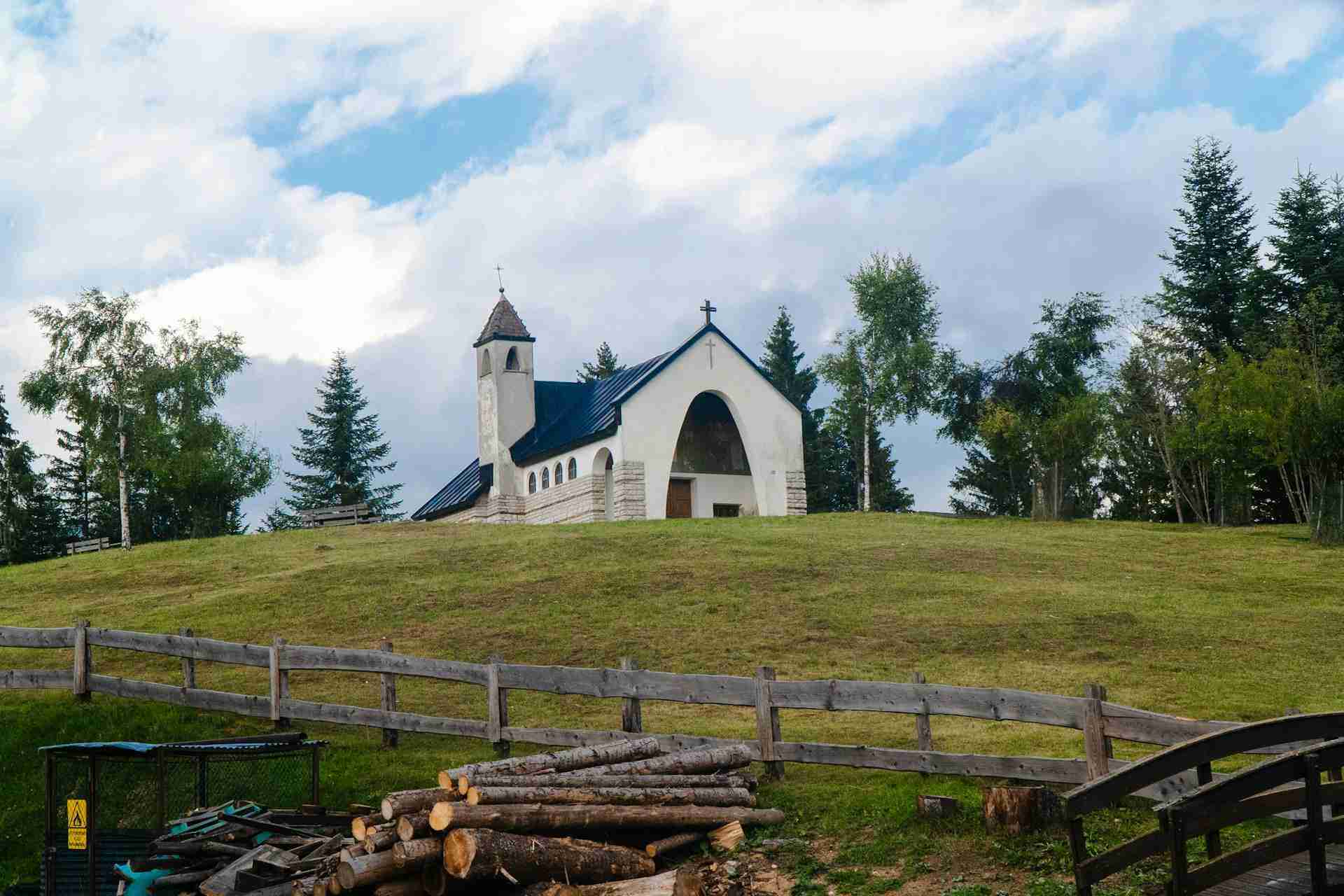
Set just outside the mountain town of Levico Terme in northern Italy, the Chiesetta di San Giovanni Battista sits quietly among wooded hills and steep trails. This small stone chapel is tucked into a curve of alpine forest, surrounded by tall firs and framed by views that open up over the Valsugana valley below. Its structure is simple and sharply defined against the shifting light of the forest, offering photographers the chance to work with clean lines, soft textures, and changes in atmosphere that come quickly with mountain weather. The surrounding trails provide a variety of approaches, each revealing a different angle or foreground. While small in scale, the chapel rewards patience and timing with images that balance form and setting in a subtle, reflective way.
Best Photography Opportunities
Early Morning Light on the Forest-Facing Side
In the first hours after sunrise, soft light filters through the forest canopy and touches the stone walls and wooden door of the chapel. This creates a quiet contrast between the sunlit structure and the cool, shaded trees behind it. Shooting from the lower trail looking up allows you to use the curve of the slope as a natural lead-in to the chapel, with branches and foliage framing the upper portion of the image. A wide aperture can help separate the chapel from the forest, giving the image depth and clarity. These moments are brief, as the sun rises quickly and the light becomes more direct within an hour.
Side Profiles with Tree Line and Sky
The sloped clearing around the chapel creates a natural platform for side-profile shots that include both the chapel and the distant valley beyond. This setup is best in the afternoon when the light cuts across the roof and stone, bringing out the rough texture in the walls and wooden trim. Shooting at a slight upward angle from the trail below allows you to line up the chapel with the edge of the forest and include a strip of sky above. These compositions benefit from a medium focal length and careful alignment, especially if you want to avoid bright spots in the sky that pull focus away from the structure.
Moody Forest Compositions on Overcast Days
When clouds settle over the hills or light rain softens the contrast in the forest, the Chiesetta becomes part of a quiet, monochromatic scene. These conditions are ideal for black and white work or low contrast color photography where subtle variation and texture carry the composition. Shooting from within the trees and using trunks, branches, or moss-covered rocks as foreground elements helps build layered depth. A tripod is useful in these conditions, allowing for slower shutter speeds and narrower apertures that hold sharpness across the frame. Even without sunlight, the chapel maintains enough tonal separation to remain the focal point.
Seasonal Variation in the Clearing
The small meadow surrounding the Chiesetta changes character with the seasons, and this shift is useful for photographers looking to return to the location with fresh eyes. In spring, early grass and flowers appear near the base of the chapel and along the trail. These can be used as low foreground elements in wide-angle compositions. Summer brings full green foliage, which encloses the chapel more tightly and emphasizes the contrast between natural and built forms. In autumn, scattered leaves on the roof and ground add warm tones to the stone and wood, while winter strips back the surrounding trees and introduces clean lines, frost, and snow detail. Each season offers a different set of framing tools.
Long Lens Isolation with Background Compression
For those looking to simplify the scene, a telephoto lens can be used from nearby clearings or trails to isolate the chapel against the background ridge or forest wall. This is especially effective on misty days when the background is muted and the chapel appears sharp and detailed. Shooting with a long lens also reduces perspective distortion, making the building appear more upright and evenly proportioned. These shots work well for print or editorial work where strong subject focus and clean edges are needed.
Best Time to Visit
The best months for photography at the Chiesetta di San Giovanni Battista are from late April through early November, when the forest offers a full range of textures and light. Spring is ideal for soft light and fresh greens, particularly in the morning when light enters from the east and hits the clearing first. By early summer, longer days allow more flexibility, but the midday sun becomes harsh on the exposed side of the chapel. Plan to shoot early or late when the shadows are longer and more directional.
Autumn is especially rewarding. From late September through October, the trees surrounding the chapel begin to shift in color, adding soft yellows and oranges to the midground. The lower angle of the sun adds richness to the stone and wood, and morning mist is common, helping to separate the chapel from the background. These conditions are excellent for moody or layered compositions.
Winter photography is possible but more difficult. The forest becomes stark and high contrast, and snow or frost may cover the surrounding ground. However, the chapel stands out clearly in fresh snow, and low light conditions can produce strong black and white images. Shorter days and colder temperatures require extra care with gear and exposure settings. Fog and frost are common in January and February and can add subtle detail to surfaces around the chapel.
How to Get There
The Chiesetta di San Giovanni Battista is located directly along Via dei Forti, just above the center of Levico Terme in the Trentino-Alto Adige region of northern Italy. There is no hiking or trail access required to reach the site. You can drive straight to the chapel by following local signs through Levico Terme and continuing uphill on Via dei Forti until the chapel comes into view. Parking is available nearby along the roadside, and the location is easy to access at any time of day, including early morning or late evening. The site is open year round, and there are no entrance fees or photography restrictions. Tripods are permitted, and the area surrounding the chapel includes space for setting up gear safely without interfering with foot traffic or nearby homes.
Recommended Photography Gear
For photographing the Chiesetta di San Giovanni Battista, a versatile lens setup is ideal. A wide-angle lens in the 16 to 35 millimeter range works well for environmental compositions that include the chapel, surrounding forest, and trails. A 24 to 70 millimeter zoom offers flexibility for tighter framing or portrait-style compositions that focus on the building itself. For isolating details or compressing the background, a 70 to 200 millimeter lens is helpful, especially when shooting from nearby clearings or through natural openings in the trees.
A tripod is recommended for early morning or overcast conditions when light levels drop, particularly if you plan to use narrow apertures for full depth of field. Neutral density filters are useful for long exposures of moving mist or low light motion in the forest. A polarizing filter can help manage glare on wet stone and deepen the greens in spring or summer. Use care with polarizers when including sky, as uneven gradients may appear in wide compositions.
Wear trail shoes or light hiking boots with grip, as the forest edge near the chapel includes uneven ground and tree roots. A weather-resistant backpack and protective cover for your camera are useful during foggy or damp conditions. Bring a microfiber cloth and lens blower to handle condensation or water droplets. If visiting near sunrise or sunset, a headlamp is helpful for setup in low light. The area is quiet, so extra batteries and cards allow for extended sessions without the need to return to town.
Nearby Photography Locations
Just below the chapel, this small alpine lake offers still water reflections, tree-lined shores, and early morning fog during the cooler months. Sunrise light often catches the surface and shoreline reeds, creating calm compositions with gentle color transitions. The lake is best visited in the early morning or evening for low light and minimal wind.
The wooded park near Levico Terme provides soft trail views, filtered light, and scattered benches and stone walls that work well for documentary-style compositions. In autumn, the tree canopy becomes golden, and the light filtering through offers excellent backlit leaf detail and natural framing opportunities.
A short walk or drive from the chapel, this restored Austro-Hungarian fort sits on a forested hilltop with panoramic views over the valley. The structure itself is solid and angular, contrasting with the natural lines of the surrounding landscape. Early morning or late afternoon light brings out detail in the stone and surrounding forest.
Panarotta Ridge Views
Above the town, the ridge near Panarotta offers sweeping alpine views with layered peaks and distant valleys. The road is longer but accessible by car in summer, and it leads to open viewpoints ideal for telephoto work. The trail system includes exposed clearings and soft evening light.
Vetriolo Terme Woodlands and Streams
Further up the mountain road, the forest near Vetriolo Terme includes streams, small waterfalls, and moss-covered rocks. This area is ideal for long exposures, abstract detail shots, and compositions that emphasize movement and texture in water and vegetation.
The Chiesetta di San Giovanni Battista offers more than just a subject to photograph. It provides a space where light changes slowly, where the forest shapes every composition, and where simplicity encourages intention. Whether framed by branches, softened by fog, or lit from the side in golden hour light, the chapel remains grounded and expressive. For photographers who value quiet, timing, and natural framing, this hillside retreat near Levico Terme is well worth the visit.
Comments
Loading comments…