
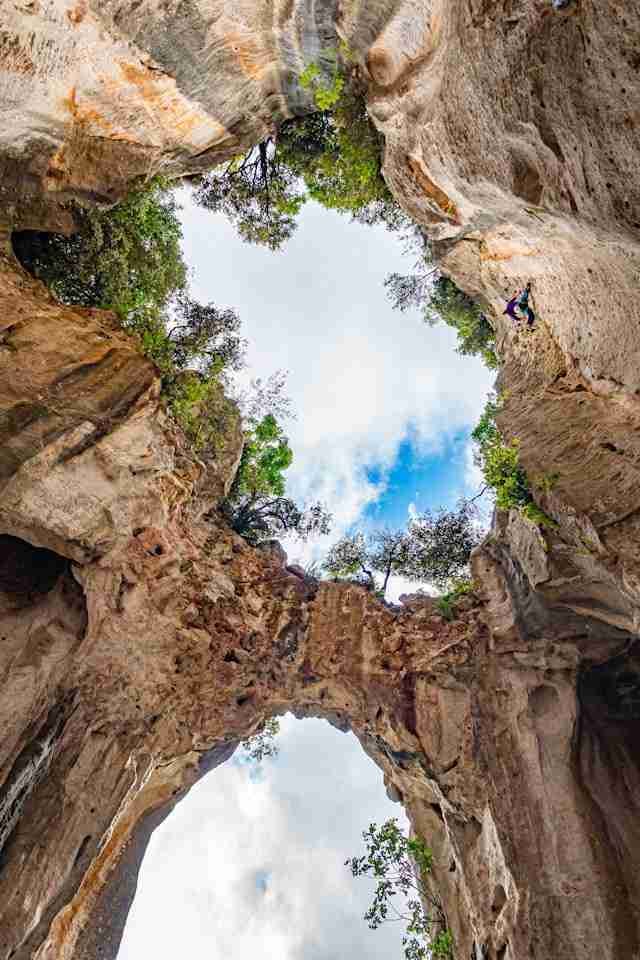
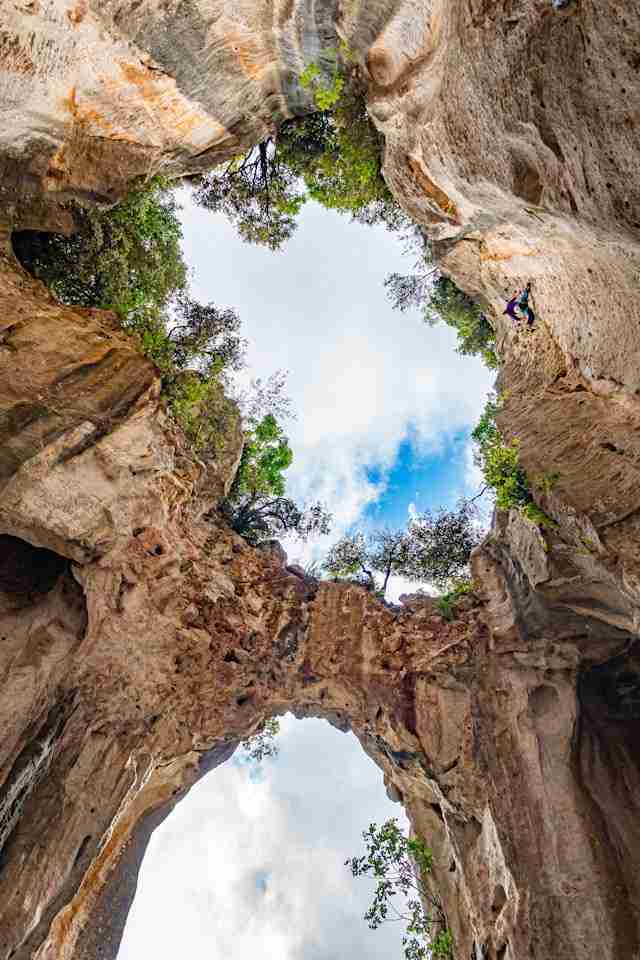
Hidden within the limestone cliffs of the Ligurian Apennines, Grotta dell'Edera is a collapsed cave that opens into a natural limestone amphitheater surrounded by sheer walls, ivy-covered ledges, and a sky window that floods the interior with shifting light. Located above the village of Finale Ligure in the Italian region of Savona, the site feels both enclosed and exposed, offering a rare mix of intimacy and scale that makes it a dream location for photographers. The name translates to "Ivy Cave," and true to that title, its vertical walls are often draped in green, contrasting with the bleached limestone and soft blue sky above. Whether you are shooting climbing scenes, abstract textures, or wide-angle landscapes from inside the circle of stone, Grotta dell'Edera delivers a powerful, natural geometry that rewards creative perspective and attention to contrast.
Best Photography Opportunities
Midday Light from the Skylight Opening
The most dramatic compositions in Grotta dell'Edera happen when the sun reaches its highest point and sends clean light down through the large opening above. Around midday, sunlight enters at a steep angle and strikes the chamber floor while leaving the walls in shadow. This contrast between light and dark creates natural structure in your composition and works well with wide-angle lenses that capture both floor and sky in the same frame. From the center of the chamber, you can shoot upward to emphasize the curve of the limestone and the brightness of the sky. The symmetry and simplicity of this setup allows for creative framing that feels both abstract and architectural.
Climbers Framed Against the Sky
Grotta dell'Edera is one of the best-known climbing spots in the Finale Ligure region, and human figures regularly appear against the brightness of the open ceiling. These silhouettes give photographers an immediate sense of scale, especially when framed mid-climb with extended limbs or ropes hanging from the wall. Using a medium telephoto lens allows you to isolate the climber against the sky and compress the distance between the walls and the circular opening. Timing is key. Waiting until the climber is perfectly framed within the light opening gives you a moment of clarity where form, motion, and background align. This type of photography works well even in harsh sunlight due to the natural contrast built into the scene.
Stone Texture and Natural Patterns on the Walls
The limestone walls inside the cave are full of vertical lines, mineral stains, and organic growth that create strong abstract compositions. The ivy that creeps along the rock adds a softer counterpoint to the rough textures, and climbers' chalk marks introduce subtle human elements. On cloudy days or when the sun is blocked by the cliff edge, the shadows soften and detail becomes easier to control. This is the time to focus on close-up shots and surface patterns. A macro or short telephoto lens works best for this kind of photography. Look for natural transitions in tone or lines that intersect with cracks, vines, or changes in rock color.
Looking Outward from Inside the Cave
Shooting outward from the interior of Grotta dell'Edera into the surrounding forest allows you to create compositions where the stone walls act as a natural frame. This inward-to-outward perspective can be especially effective early in the morning or late in the afternoon when light filters through the trees beyond the cave's edge. The bright green of the forest contrasts with the darker stone and draws the eye through the composition. A tripod is helpful for balancing the wide exposure range between the dim foreground and the bright background. Using live view or a manual exposure blend gives you more control over the dynamic range and allows you to retain detail in both shadow and highlight.
Seasonal Mood and Light Quality
While the structure of the cave remains consistent throughout the year, the environment around it shifts significantly. In spring, the ivy becomes more vibrant and new green shoots begin to hang from the upper walls. Light during this season is soft and diffused, especially on mornings when mist from the valley lingers. Summer brings harder contrast and dry textures, making black and white photography more effective. In autumn, fallen leaves accumulate around the base of the chamber and color returns to the trees surrounding the cave. Winter strips the walls of most growth and offers the cleanest view of the rock surfaces, but also introduces colder light and lower contrast. Each season supports a different photographic approach, from layered color to tonal simplicity.
Best Time to Visit
Spring and autumn are the most productive seasons for photography in Grotta dell'Edera. From March through June, the surrounding forest is green and fresh, and the air is cool enough to spend long hours shooting without discomfort. During these months, light enters the cave cleanly from midmorning to early afternoon, and the rock retains its natural color without excessive glare. Ivy begins to grow again, which softens the cliff edges and adds visual variety to wide-angle compositions. Morning clouds often break by midday, revealing the opening above while keeping the cave floor in usable shade.
Late September through early November offers lower sun angles, more directional light, and richer color in the surrounding foliage. This is the best time for working with contrast and depth, especially in compositions that look outward from within the cave. Early morning fog or low cloud layers are more common in autumn, and they can add soft diffusion or layered separation between the trees and the sky.
Summer is workable but more difficult. The sun rises high and fast, and shadows inside the cave become sharp and harsh. While this can be used for high-contrast compositions, it limits your flexibility with exposure and requires careful timing. Plan to shoot early or later in the day to avoid the full midday glare. Winter is quieter and often less crowded, but light levels drop and trail conditions can become slick or unstable. Only experienced hikers and photographers should attempt the route during this time, and extra care must be taken with footing and exposure balance due to the high contrast between snow or bright skies and the shaded interior.
How to Get There
Grotta dell'Edera is located in the Finale Outdoor Region, a popular hiking and climbing area above Finale Ligure in the Liguria region of Italy. To reach it, first travel to Finale Ligure by regional train or car. From the Finale Ligure train station, local roads lead to the villages of Montesordo or Feglino, which are common trailheads for the area. Parking is available near the start of the trail, though spaces can fill up quickly on weekends or during climbing events.
The most direct trail begins from Montesordo and follows marked climbing access paths that lead to Monte Sordo and Grotta dell'Edera. The hike takes approximately 30 to 45 minutes and includes rocky, uneven terrain with moderate elevation gain. Good trail shoes and a balanced pack are recommended, especially if carrying a tripod or extra gear. The trail passes through forest and limestone outcrops before arriving at the cave's upper edge. From there, a short descent brings you into the chamber.
There is no fee or permit required to visit the cave, and it is open to the public year round. Be respectful of climbers who use the site regularly, and avoid disrupting any active climbing routes while shooting. Drones are not permitted inside the grotto, and the use of artificial lighting or flash is strongly discouraged. There are no restrooms or water sources along the trail or at the cave, so prepare accordingly. Early mornings are the quietest time to shoot and offer the best chance to work without interruptions.
Recommended Photography Gear
A wide-angle lens is essential for photographing Grotta dell'Edera. A focal length in the 14 to 35 millimeter range allows you to capture the full opening above, the vertical rock walls, and the interior floor in a single frame. For close-up texture and partial detail shots, a 24 to 70 millimeter zoom provides flexibility in tighter spaces. If you plan to photograph climbers or compress the scene for scale, a 70 to 200 millimeter lens will give you enough reach while preserving sharpness and background separation.
Bring a tripod for interior exposures and any scene where the light difference between cave and sky is extreme. A tripod also helps with composing vertical frames and keeping lines clean when shooting upward or outward. A set of neutral density filters is useful if you want to experiment with long exposures, especially when clouds are moving across the opening above. A lens hood can help reduce flare if you are shooting into the light during midday.
Because the trail is rocky and the cave floor uneven, use a backpack with good weight distribution and avoid bulky shoulder bags. Carry a microfiber cloth and blower to manage dust and debris, and pack an extra layer in case the temperature drops once inside the cave. Water, snacks, and a small headlamp are useful if you plan to spend extended time at the location. While the cave is naturally lit during the day, shadows can shift quickly and affect both exposure and safe movement.
Nearby Photography Locations
Just below the cliffs of Finale Ligure, Finalborgo is a walled village with narrow streets, textured stone buildings, and arched passageways. It is excellent for architectural photography and offers a mix of shadow and light that changes throughout the day. Early morning provides soft contrast and quiet streets for careful compositions.
This nearby climbing area includes large limestone faces with exposed cliffs and scattered trees. From certain angles, you can shoot into the valley below with compressed perspectives. The open rock and natural ledges offer clean lines and opportunities for detail and action photography.
Southwest of Finale Ligure, Capo Noli offers cliffs and sea views with dramatic drops into the Mediterranean. This coastal route features strong horizon lines, rocky textures, and distant ship traffic. Sunset along this trail creates glowing light that reflects off the water and stone.
San Lorenzino Plateau and Chapel Ruins
Located above the climbing sectors, this plateau includes the remains of old chapels and terraces. The open space gives you panoramic views of the surrounding hills and works well with wide focal lengths. The stonework and paths provide human-made elements for balanced landscape compositions.
Grotta Pollera and Natural Arches
For more advanced hikers, Grotta Pollera offers another cave system with a different shape and atmosphere. The trail is steeper but leads to dramatic rock formations, natural arches, and forest framing. The cave's entrance creates framing opportunities for interior-to-exterior compositions similar to Grotta dell'Edera.
Grotta dell'Edera is a place where light enters deliberately, creating a chamber that feels as much like a sculpture as a landscape. Its walls hold both motion and stillness, shaped by time, weather, and human hands. For photographers who want to challenge their framing instincts and play with contrast, rhythm, and perspective, this natural formation offers a chance to work in a space that is entirely unique. Whether you visit with clear skies or under shifting clouds, the cave rewards patience and creativity at every turn.
Comments
Loading comments…