
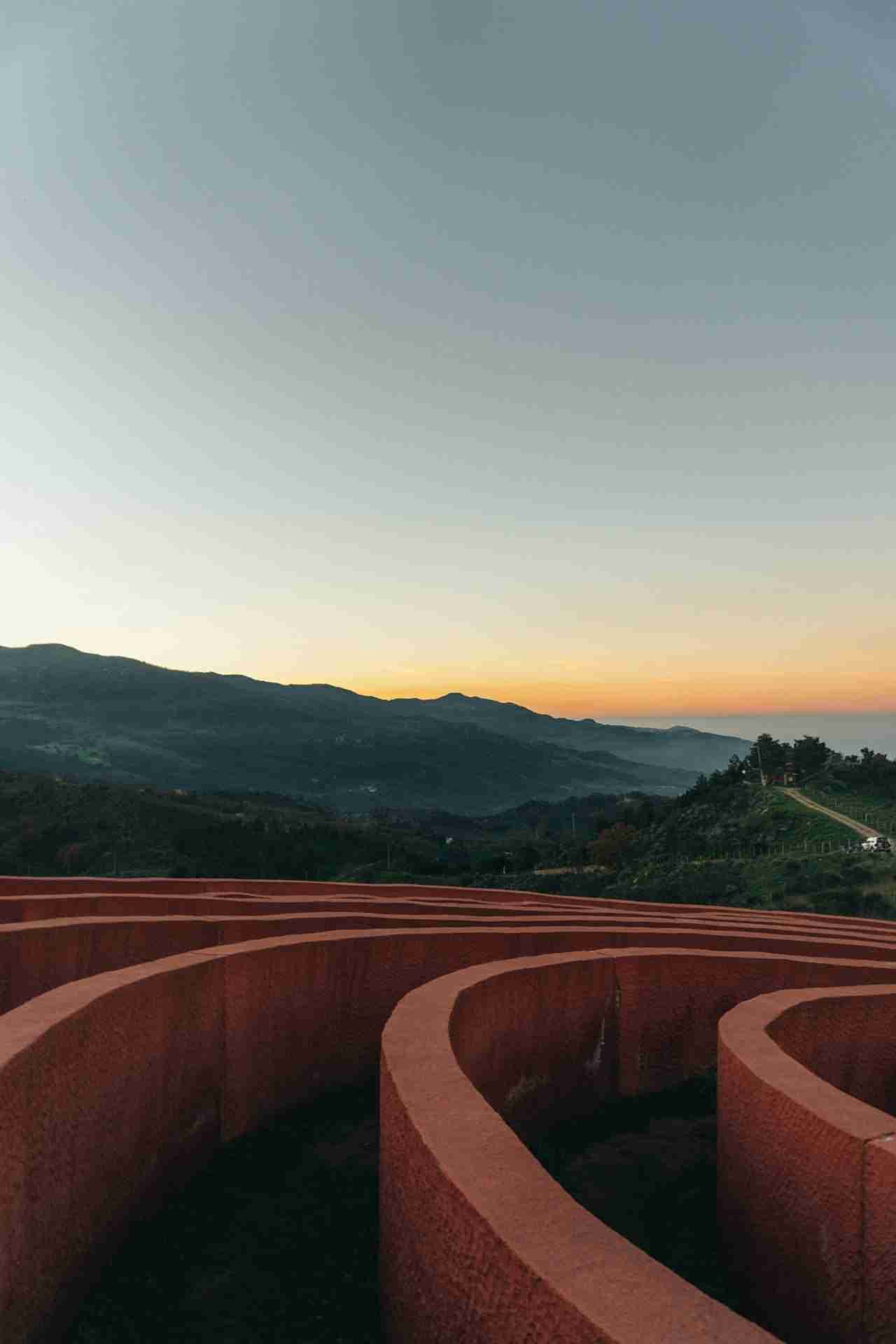
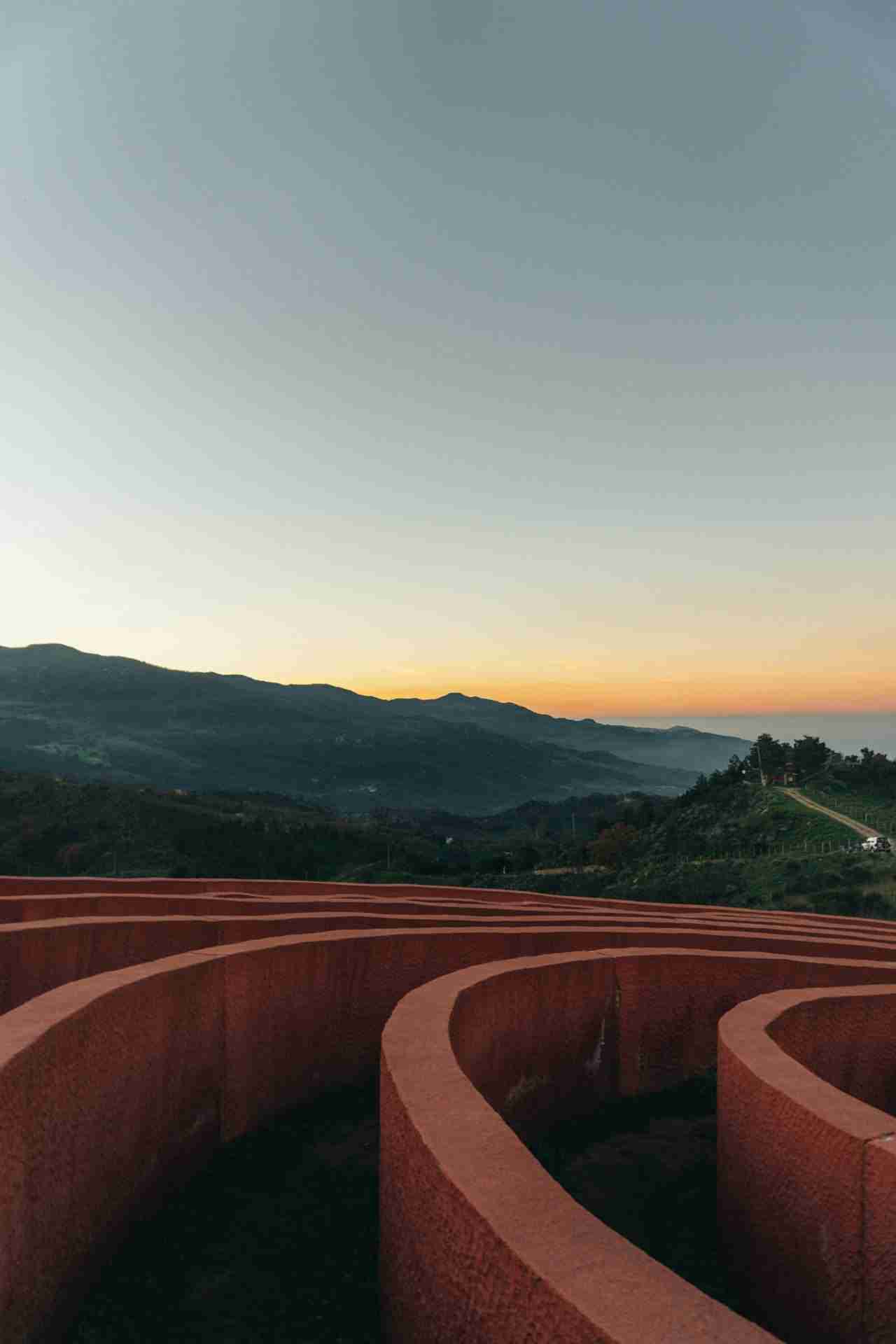
High on a Sicilian ridge in Castel di Lucio, the Labirinto di Arianna emerges from the landscape like a forgotten relic or alien geometry etched into the earth. Created by artist Italo Lanfredini in 1990 as part of the Fiumara d'Arte open-air museum, this stone labyrinth is a spiral form of raw cement, weathered by time and wind. It invites viewers (and photographers) to walk slowly, both physically and visually, through a dialogue of pattern, isolation, and light. With the Nebrodi Mountains in the distance and the Mediterranean sky often stretching wide and cloudless overhead, this sculpture becomes more than an artwork: it's a powerful convergence of art and land. For those willing to journey off the main paths of Sicily, Labirinto di Arianna offers a minimalist yet compelling photographic subject.
Best Photography Opportunities
• Aerial Perspectives and Spiral Symmetry
The most complete way to capture the labyrinth's form is from above. If you are flying a drone, aim to photograph at a height that preserves the concentric design while also showing the surrounding landscape, which adds scale and context. Morning light casts delicate shadows into the curves of the spiral, emphasizing the geometry without flattening it. Later in the day, side light can carve stronger lines into the sculpture's texture, enhancing its dimensionality. When using a drone, consider shooting both directly overhead for abstract patterns and at a shallow angle for a more immersive three-dimensional feel.
• Interior Paths and Repetition
Walking inside the labyrinth reveals a very different visual experience. The stone walls rise around you, framing tight corridors and repeated arcs that change with your position. These lines are ideal for compositions using a wide-angle lens, especially at ground level. Use leading lines to guide the viewer's eye along the path, and look for moments where light leaks through gaps or casts shadows across the curve of the stone. Interior shots work especially well in diffused light, which softens the contrast and preserves detail in both the walls and the sky beyond.
• Shadows and Harsh Light Interplay
During midday or late afternoon, strong Sicilian sunlight turns the labyrinth into a playground of light and shadow. The gaps in the spiral create high-contrast patterns on the ground and walls that shift constantly as the sun moves. These conditions are perfect for black-and-white photography, allowing you to focus on the relationship between structure and shadow. Shoot from eye level or above to include long shadow lines that mirror the spiral itself. Underexpose slightly to preserve highlight detail in bright conditions, especially on cloudless days.
• Textures and Surface Weathering
Close-up studies of the labyrinth's walls reveal a wealth of photographic material. The raw concrete has aged naturally, developing cracks, discoloration, moss, and exposed aggregate that create unique textural surfaces. Use a short telephoto or macro lens to isolate these patterns and treat them as abstract compositions. Morning and late afternoon light help highlight surface variations, while overcast skies reduce glare and allow for accurate color capture. These texture shots make excellent supporting images in a broader visual narrative of the site.
• Distant Context with Landscape Integration
From outside the spiral, the labyrinth appears nestled in the rugged Sicilian countryside. Step back and use a mid-range lens to frame the sculpture with rolling hills, distant farms, or open sky. This perspective emphasizes the contrast between human-made form and the organic sweep of land. Sunrise and sunset offer the most atmospheric conditions, with changing color temperatures adding mood and tonal variation to the landscape. Including small figures within the scene can enhance scale and help convey the isolation and serenity of the location.
Best Time to Visit
The labyrinth is open to the elements year-round, but its visual character changes significantly with season and light. Spring is one of the most rewarding times to visit. The surrounding hills are green, wildflowers often bloom in the adjacent fields, and the light is soft and low throughout much of the day. These conditions bring color and warmth to both the sculpture and the background landscape.
Summer introduces more dramatic light and strong shadows, especially around midday when the sun is high and the walls of the labyrinth become sharply defined. If you visit in summer, plan to shoot either early in the morning or late in the afternoon to avoid harsh overhead light. These periods also tend to be cooler, making the site more comfortable to explore.
Autumn brings warmer tones to the surrounding vegetation and softer skies, while winter, though less colorful, can offer mist, overcast conditions, and clearer visibility across the valley. The structure's light-colored stone interacts beautifully with soft grey skies, lending a subdued, quiet tone to images. Because of the site's elevation and exposed position, wind is common throughout the year. Plan accordingly and come prepared to stabilize your gear.
Golden hour, especially at sunset, is the best time for dramatic, dimensional lighting. The sculpture catches the final side light of the day in a way that adds depth to both interior and aerial compositions. Twilight can also be productive, particularly for drone photographers capturing the labyrinth in silhouette against the glowing sky.
How to Get There
Labirinto di Arianna is located near Castel di Lucio in the province of Messina, Sicily, as part of the broader Fiumara d'Arte collection, a distributed sculpture park spanning several remote towns in the region. The site is not heavily signposted, so it is best to use GPS coordinates or navigate via Google Maps. The closest village is Castel di Lucio, from which it is about a ten-minute drive on winding country roads. Be prepared for narrow, uneven roads common in rural Sicily.
There is no formal entrance gate or ticket booth, and access to the sculpture is free. A small gravel parking area sits nearby, just a short walk from the labyrinth. The ground is uneven, so wear sturdy shoes, especially if you are carrying heavy gear. There are no amenities on site, no restrooms, water fountains, or shade structures, so bring everything you will need, particularly in warmer months.
Tripods and drones are allowed, but flying is subject to Italy's drone laws, which require line-of-sight operation and respect for altitude limits and privacy zones. Cell reception can be inconsistent, so download maps and local documentation in advance. The site is typically uncrowded, even in peak season, allowing photographers to work with calm and intention.
Recommended Photography Gear
A versatile kit with wide and standard focal lengths is ideal for capturing both the architectural form and surrounding landscape. A wide-angle lens in the 14 to 24 millimeter range is perfect for interior shots, leading line compositions, and exaggerated spiral perspectives. For more controlled framing or compressed views, a 24 to 70 millimeter lens covers most needs. A short telephoto or 85 millimeter prime can isolate sections of the sculpture or capture figures walking through the spiral with a gentle compression effect.
If you plan to shoot aerial perspectives, bring a drone with a high-resolution camera capable of both top-down and angled shots. Choose one with good wind resistance, as breezes are common on the ridge. Carry extra batteries, as the site's remote location offers no charging options.
A tripod is essential for long exposures and blue hour work, especially when shooting from ground level with fine focus on texture. A polarizing filter can help cut glare on the stone and saturate color in the surrounding hills. A neutral density filter is optional but useful for creating motion blur in cloud-streaked skies, which often occur at higher elevations. A lens cloth, water, sun protection, and backup memory cards round out a good field kit for this location.
Nearby Photography Locations
Located a short drive from the labyrinth, this massive concrete sculpture resembles a giant stone portal and offers strong graphic forms against open sky. It is especially photogenic at sunrise, when directional light casts angular shadows across its surfaces.
Perched on a nearby hilltop, this sculptural pyramid sits at the intersection of land, art, and astronomy. Composed of steel and stone, it offers incredible views and striking silhouettes during sunset and blue hour sessions.
The hilltop town itself offers narrow alleys, textured stone buildings, and panoramic views of the surrounding Sicilian countryside. It is an excellent location for architectural and cultural photography, particularly in the golden light of late afternoon.
Further north, the town of Mistretta combines medieval structures, open plazas, and wooded trails. The changing elevation and old-world charm make it a rewarding stop for both street and landscape photographers.
This nearby natural park contains a variety of hiking trails, high-elevation forests, and expansive viewpoints. On clear days, you may even catch views stretching to Mount Etna. It is a great complement to the sculptural minimalism of the labyrinth with its dense, organic textures.
Comments
Loading comments…