
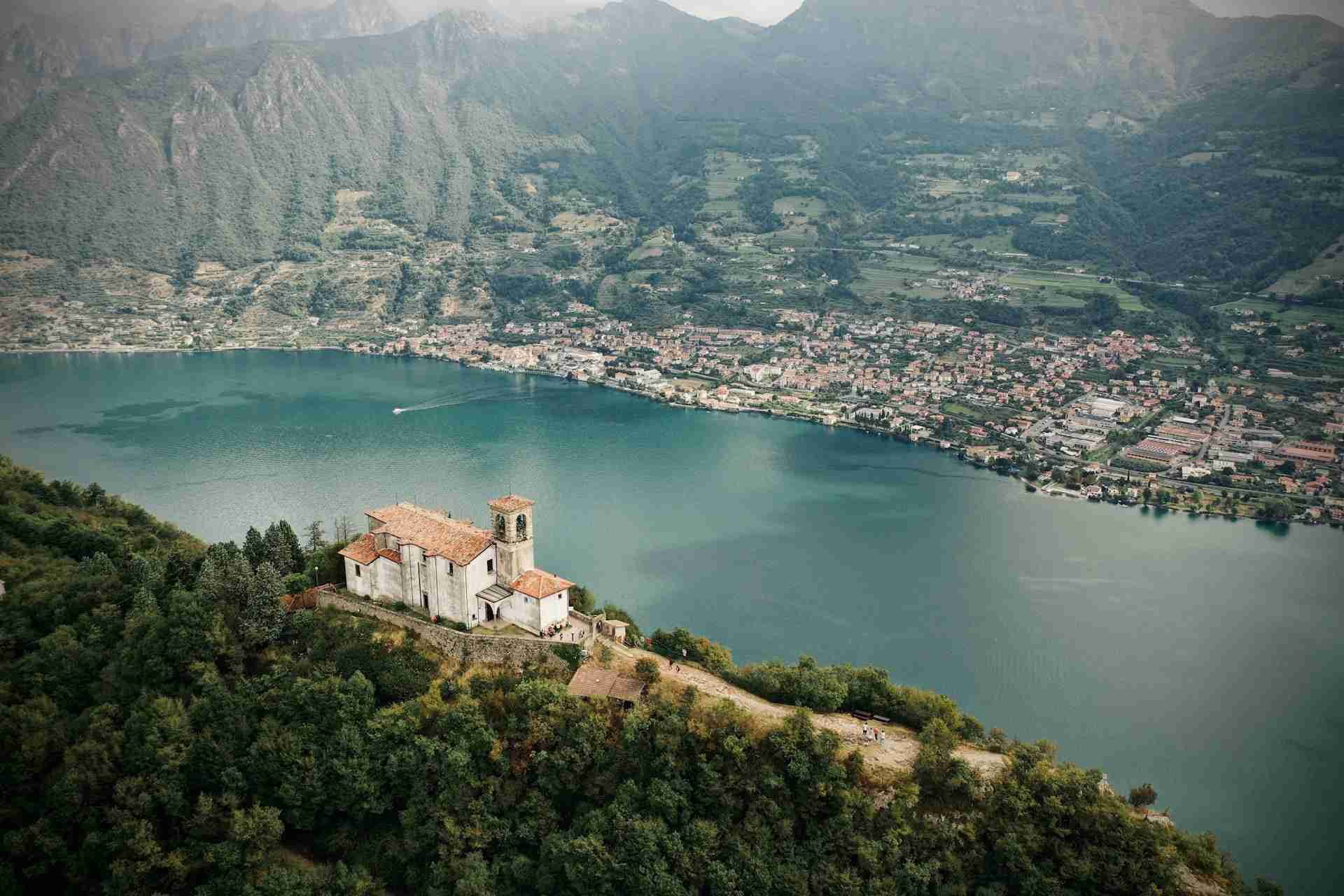
Atop the wooded slopes of Monte Isola in Lake Iseo, the Santuario della Madonna della Ceriola stands as both a spiritual and photographic landmark. Perched at 600 meters above sea level, the hilltop sanctuary offers panoramic views in every direction—across the deep green of the island, over the shimmering surface of Lake Iseo, and out to the distant peaks of the Lombardy Prealps. The church itself, modest in size but rich in detail, is surrounded by cypress trees, stone terraces, and narrow mountain trails that provide ample compositional variety. This combination of altitude, seclusion, and natural beauty makes the sanctuary a rewarding location for photographers seeking both landscape and architectural subjects framed by shifting light and wide skies.
Best Photography Opportunities
• View Over Lake Iseo from the Terrace
The open space just below the church offers a sweeping view over the southern end of Lake Iseo and the surrounding foothills. A wide-angle lens captures the full arc of the shoreline, with the lake's changing light forming the image's central mood. Sunrise often produces mist rising off the water, while sunset casts golden reflections that stretch toward the horizon. Including parts of the stone wall or tree branches in the foreground helps anchor the frame and add depth. On clear days, the sharp horizon allows for layered compositions from lake to ridge to sky.
• Framing the Church Among Cypress Trees
The sanctuary is flanked by tall cypress trees and dense vegetation, making it ideal for natural framing. Use a mid-range zoom to isolate the church facade with trees on either side or to include leading paths in the foreground. Early morning and late afternoon light filters through the foliage, creating contrast and motion in the shadows. These compositions benefit from a low angle and vertical framing, especially when clouds provide textured backdrops. Overcast conditions also work well, reducing contrast and emphasizing the detail in stone and wood.
• Architectural Detail and Texture
The church's modest but finely crafted features, including arched windows, tiled roof, and stonework, offer close-up opportunities that emphasize texture and age. Use a standard zoom or prime lens to isolate decorative elements like the bell tower or carved doors. Side lighting brings out the roughness of the materials, while soft, cloudy light is ideal for capturing subtler tones and detail. These shots work particularly well in a series that complements broader landscapes, tying structure to setting.
• Pilgrimage Trail and Human Scale
The path leading to the sanctuary winds up from Cure and passes through chestnut groves, switchbacks, and open ledges. Including hikers or walkers along the trail adds narrative and scale, giving viewers a sense of the elevation and distance involved. Shoot from behind or at a distance with a telephoto lens to compress the frame and highlight the relationship between people and place. Early morning offers the quietest scenes, while late afternoon often brings warm light filtering through the trees.
• Summit Panoramas and Changing Skies
Because of the sanctuary's elevated position, it's an excellent location for dramatic skies and distant ridge layers. Long-lens compositions can pick out peaks in the Bergamo Alps or focus on the patterns of nearby village rooftops. Wait for transitional weather, such as passing clouds or breaking mist, to introduce movement and contrast. Stitching together a multi-frame panorama is highly effective here, particularly when combining sky, lake, and foreground structure into a single cohesive image.
Best Time to Visit
The sanctuary and surrounding trails are accessible throughout the year, though each season offers a different photographic atmosphere. Spring brings fresh greenery to the hillsides and clear skies over the lake, with blooming trees and soft morning light. Summer provides the most reliable access and longer daylight hours, but the midday sun can be harsh and crowds more frequent. Autumn colors enhance both the trees around the sanctuary and the forests along the ascent, adding warm tones that complement the pale stone and earth paths.
Winter brings quiet, clarity, and a stark color palette, with bare trees, low light, and distant snow-covered peaks on the horizon. Sunrise and sunset are the most productive times in every season, especially for capturing directional light across the landscape and highlighting the textures of the building. Fog and morning haze are common over the lake and can create moody, layered images when viewed from the summit.
Aim to visit early in the morning for soft light and solitude, or in late afternoon when shadows stretch across the hills and the western exposure lights the church facade directly.
How to Get There
To reach the sanctuary, first take a ferry to Monte Isola from Sulzano, located on the eastern shore of Lake Iseo. Ferries run frequently and the crossing takes less than ten minutes. From the ferry terminal in Peschiera Maraglio, you can either walk up through the village of Cure or hire an e-bike to ease the climb.
The footpath from Cure to the sanctuary is well-marked and takes about 30 to 45 minutes on foot, ascending through woodland and past terraced gardens. While the incline is consistent, the path is in good condition and can be managed with camera gear and hiking shoes. No entrance fee is required to visit the church, and the surrounding grounds are open to the public.
There are no facilities at the summit, so bring water and plan accordingly. Nearby villages on the island offer cafés, markets, and lodging options if you intend to spend more time exploring the area. Mobile service is available at the summit, though slightly weaker along the ascent.
Recommended Photography Gear
A wide-angle lens is essential for capturing the full landscape from the summit, as well as environmental compositions that include the church and lake. A standard zoom (24–70mm) provides flexibility for both mid-range views and architectural framing. A telephoto lens (70–200mm) is useful for distant mountain scenes, detail shots, and compressing space between ridges.
A lightweight but sturdy tripod is highly recommended for sunrise and sunset shooting. A polarizing filter helps reduce glare from the lake and deepens the contrast between sky and foliage. Bring a lens cloth to handle the humidity and light dust on the trail. A weather-sealed backpack and extra batteries are essential for full-day sessions in mixed conditions.
Comfortable hiking shoes, sun protection, and layers for changing temperatures will ensure you can focus on photography rather than logistics. Pack light, but be prepared for both bright light at the summit and cool shade along the trail.
Nearby Photography Locations
This lakeside village features stone alleys, moored boats, and colorful facades. It's especially photogenic in early morning when the water is still and warm light hits the buildings from the east.
A private island visible from Monte Isola, Isola di Loreto can be photographed from several high viewpoints. Its castle-like villa and cypress trees make for strong focal points in lake panoramas.
• Sensole
A quieter village on the western side of Monte Isola, Sensole offers sunset-facing views across the water toward the mainland. Olive trees and lakeside walking paths provide texture and framing for intimate compositions.
On the mainland, the waterfront at Sulzano provides clear views of Monte Isola and the sanctuary above. It's ideal for long-lens compositions at sunrise, especially when mist rises from the lake and softens the horizon.
For more adventurous photographers, this steep peak across the lake offers one of the best panoramic views of the entire Iseo basin, including a distant view of the sanctuary. It's a challenging but rewarding hike, especially at dawn.
The Santuario della Madonna della Ceriola rewards photographers willing to climb for perspective. Its blend of spiritual architecture, natural elevation, and shifting lake light provides a versatile and satisfying canvas for careful, time-based work.
Comments
Loading comments…