
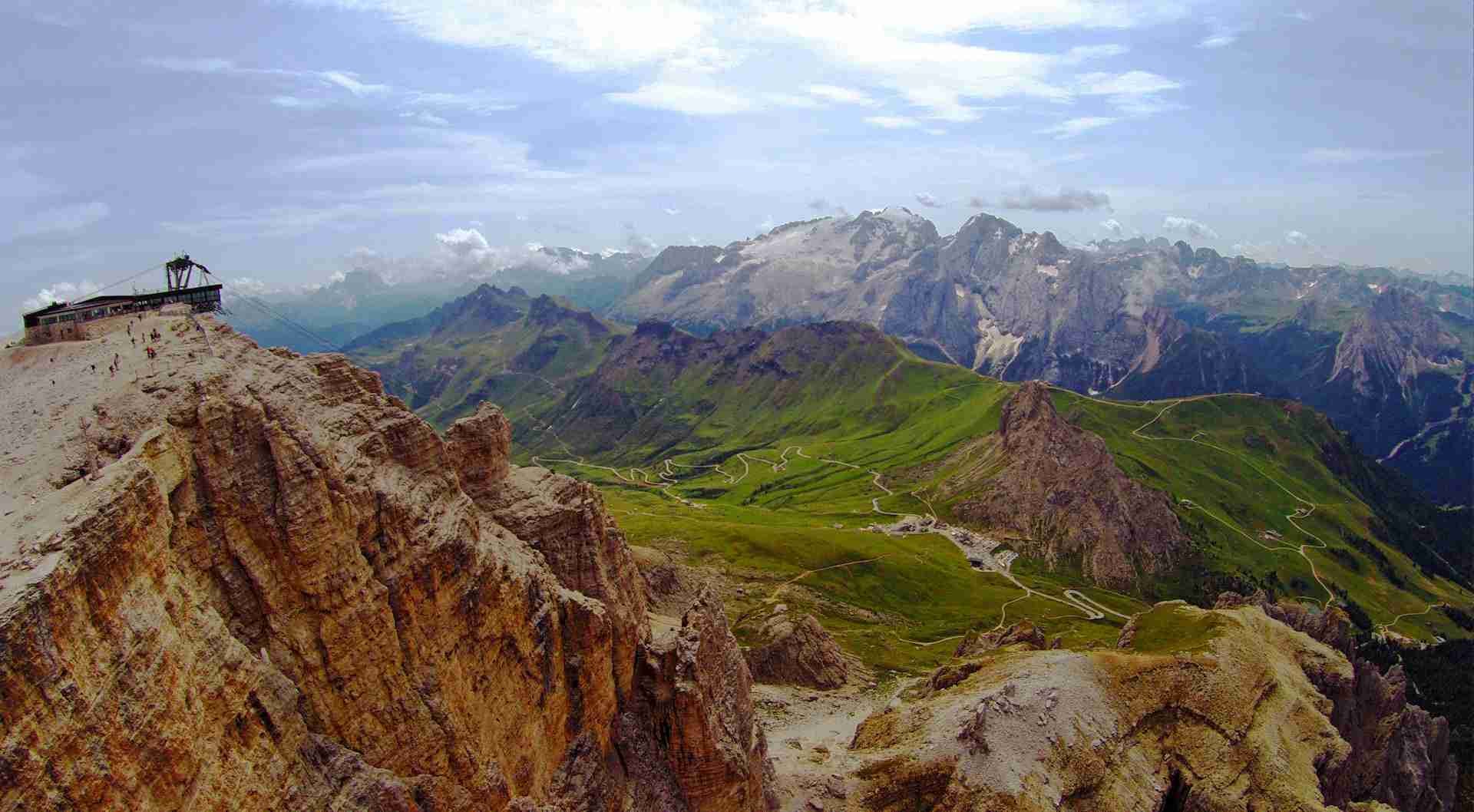
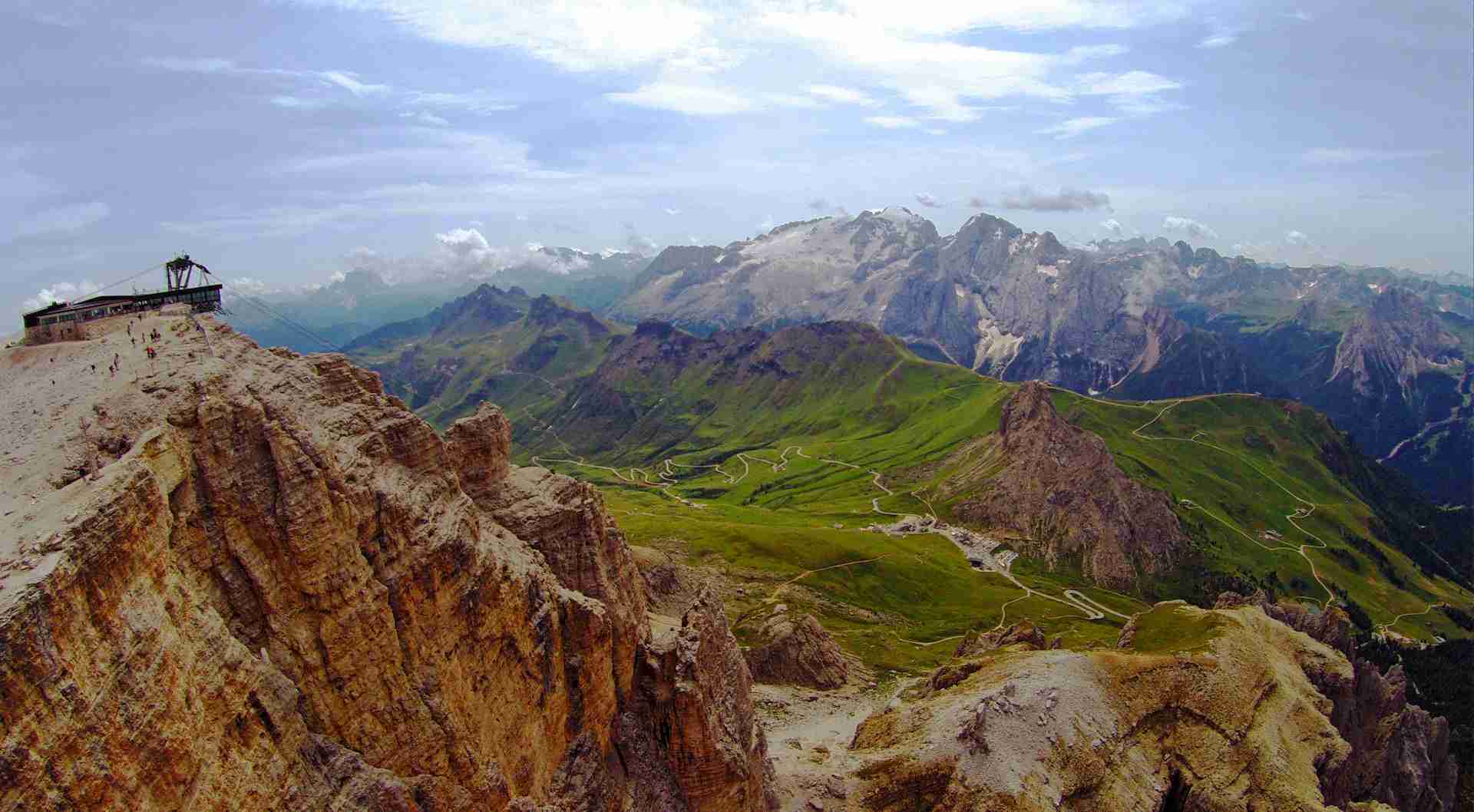
Sitting high in the heart of the Dolomites, Sass Pordoi offers photographers immediate access to some of the most dramatic alpine terrain in Europe without the need for an all-day ascent. Reached by cable car from Passo Pordoi, this wide limestone plateau opens into vast views of the Sella Group, Marmolada, and distant ridges that stretch across the horizon. The terrain is raw and elemental, with jagged peaks, fractured rock, and shifting clouds that wrap around the vertical cliffs below. From sunrise through late afternoon, the light here moves fast, casting deep shadows and brilliant highlights across stone that changes tone by the hour. This is not a subtle location. It is high, exposed, and filled with potential for stark compositions, large-scale layering, and work that balances atmosphere with geological form.
Best Photography Opportunities
Sunrise on the Marmolada Ridgeline
The best view from Sass Pordoi faces southeast toward Marmolada, the highest peak in the Dolomites. At sunrise, the first light skims the glacier-covered face and slowly warms the limestone cliffs around the plateau. The contrast between the glowing peaks and the shadowed valleys below gives strong definition and a natural gradient from warm to cool tones. Using a telephoto lens from the platform allows you to isolate the jagged lines of the ice and rock while layering the background ridges in soft morning haze. Wide-angle lenses can capture the full expanse of sky and terrain, but timing is key. Within thirty minutes of sunrise, the contrast becomes harder and the warm light fades quickly.
Edge Compositions Above the Cliffs
One of the defining features of Sass Pordoi is its vertical drop. The limestone plateau falls away abruptly into sheer cliffs that descend into the valleys far below. Standing near the edge, you can shoot downward into a series of sharp ridges, switchback trails, and occasional snow patches depending on the season. This is an ideal setup for ultra wide-angle work. The sense of space, height, and distance can be emphasized by placing textured foreground rock in the frame and leading the eye outward. During midday, the shadow lines along the cliff face create graphic separation between vertical and horizontal elements.
Black and White Studies in Harsh Light
The high-altitude sunlight on Sass Pordoi can become overpowering by late morning, flattening color and pushing contrast to extremes. Rather than avoid these conditions, use them for black and white work. The fractured limestone surfaces, deep shadows between rock layers, and sharp edges of the landscape lend themselves to monochrome compositions. Adjusting your exposure slightly under mid-tones preserves texture while allowing bright highlights to clip naturally. Using a polarizer can help reduce glare on the rock, though care should be taken to avoid uneven sky gradients at wide angles.
Cloud Movement and Weather Shift Sequences
The altitude and exposure of Sass Pordoi create fast-moving weather patterns. Clouds roll over the peaks in waves, often drifting through the valley and climbing over the plateau. These conditions are ideal for long exposure photography. With a sturdy tripod and neutral density filters, you can slow shutter speeds and capture the movement of clouds across still ridgelines. This creates tension between motion and form, especially when the horizon is split between moving sky and static stone. Conditions change by the minute, so plan to stay flexible and work quickly when transitions occur.
Minimalist Frames Along the Stone Plateau
Despite the grand scale, many areas on top of the plateau lend themselves to minimalist compositions. Broken stone, scattered cairns, and single lines of snow or grass can be isolated against empty sky or distant haze. These images rely on precise framing and exposure rather than broad drama. Overcast conditions are especially helpful here, softening shadows and allowing for balanced tones without distraction. A short telephoto lens allows you to compress spatial elements while keeping the focus tight and intentional. These shots often work best when paired with a muted color palette or converted to soft monochrome.
Best Time to Visit
Sass Pordoi is best visited from late June through early October when the cable car is in operation and the plateau is clear of snow. Sunrise is the most rewarding time to shoot, particularly if you can catch the first lift or hike up from Passo Pordoi before dawn. The eastern view toward Marmolada and the Sella Group is best captured in the hour following sunrise, when warm light and low-angle shadows define the terrain. Morning fog and thin clouds often linger below the cliffs, adding layered texture to wide compositions.
Afternoon light becomes harsher, especially in the summer months, but it brings out the bone-white color of the limestone and the deep blue of the alpine sky. These conditions work well for high contrast or black and white photography. By late afternoon, shadow begins to move across the plateau and down into the surrounding valleys. Golden hour is less dramatic on the main platform but can be used to frame distant peaks in silhouette. Autumn provides longer shadow angles, more stable air, and fewer visitors, making it an excellent time for long-lens landscape studies.
Winter transforms Sass Pordoi into a different kind of environment, but access becomes limited to backcountry skiers and mountaineers. The cable car runs during ski season, but most of the plateau is covered in snow, and movement across the terrain becomes more difficult. Photographic opportunities are still possible, especially on clear days, but strong winds, low sun, and glare from snow require additional preparation and care.
How to Get There
Sass Pordoi is accessed from Passo Pordoi, a high mountain pass that connects Canazei in the Fassa Valley with Arabba in the Livinallongo Valley. From the pass, a cable car runs directly to the top of Sass Pordoi during the summer and winter seasons. The ride takes only a few minutes and places you on the plateau at an elevation of around 2,950 meters. There is parking available at the base station and public transport connections from Canazei during the summer months.
For photographers interested in pre-sunrise work or hiking access, the route to the top can also be reached by foot from Passo Pordoi. The trail is steep and exposed but well marked. It typically takes about an hour and a half to two hours depending on conditions and pace. Shooting at dawn from the top requires starting the hike well before sunrise, so bring a headlamp and cold weather gear if you plan to climb before the lift opens.
There is no special fee for photography, and tripods are allowed. However, the area can become crowded during midday in peak season, so early arrival is recommended. The platform is exposed to wind and sudden weather changes, so always check the forecast and be prepared for quick shifts in visibility or temperature.
Recommended Photography Gear
For work on Sass Pordoi, bring a full-frame capable wide-angle lens such as a 14 to 24 or 16 to 35 millimeter zoom. The landscape demands coverage that captures both the sky and sweeping rock formations. A 24 to 70 millimeter lens is helpful for more controlled framing, especially when working with foreground detail and layered backgrounds. A 70 to 200 millimeter lens is essential for compressing ridges, isolating distant peaks, or capturing patterns in light and shadow on the cliffs below.
A sturdy tripod is necessary for long exposure photography and for sunrise or sunset conditions. Bring neutral density filters to manage exposure times for cloud motion or highlight control during brighter hours. A circular polarizer helps deepen sky color and manage glare on stone, though it should be used carefully to avoid uneven tonal shifts in wide scenes.
Because the plateau is entirely exposed, bring wind protection for your gear and yourself. Gloves, a soft lens cloth, and a sealed weather-resistant bag are helpful. Wear layers, as temperature can drop quickly even in summer. Battery life is less of an issue at this altitude during warm months, but always bring a spare and monitor heat buildup if your camera is in direct sun. Good hiking shoes are necessary even for short walks on the plateau, as the terrain is uneven and sharp in places. Sunglasses and sunscreen are essential due to intense UV reflection off the rock.
Nearby Photography Locations
Even before taking the lift, the area around Passo Pordoi offers beautiful scenes. Switchback roads, grazing meadows, and mountain silhouettes provide early morning shooting options. The light here is softer and more filtered, making it a good location for a warm-up session or late afternoon work.
From the top of Sass Pordoi, experienced hikers can reach Piz Boè, one of the most accessible 3,000 meter peaks in the Dolomites. The trail is exposed and challenging but leads to panoramic views in all directions. Along the way, sharp ridgelines and snow patches add variation to your compositions.
Passo Sella and Langkofel Group
Just to the north, Passo Sella offers views of the Langkofel and Plattkofel peaks. These massive walls catch first light and make excellent subjects for sunrise. The road and trail system here allow for varied perspectives, including alpine pastures and dramatic cliff bases.
A short drive from Passo Pordoi, this artificial lake reflects the Marmolada glacier and offers strong symmetry in calm conditions. It is best visited early in the morning when the water is still and the glacier is lit from the east.
Down below, the villages of Canazei and Campitello sit in the shadow of the peaks and offer classic valley views with alpine architecture and morning mist. These are great locations for contextual photography that places human structures within the massive scale of the surrounding mountains.
Sass Pordoi offers a platform that feels close to the clouds and carved from the bones of the earth. Its clarity, scale, and exposure challenge you to think differently about light, form, and contrast. Whether you are chasing ridgelines in golden light or standing still as clouds sweep over stone, the experience leaves a strong impression. For photographers who appreciate bold subjects and elemental conditions, this place will stay in your frame long after you descend.
Comments
Loading comments…