
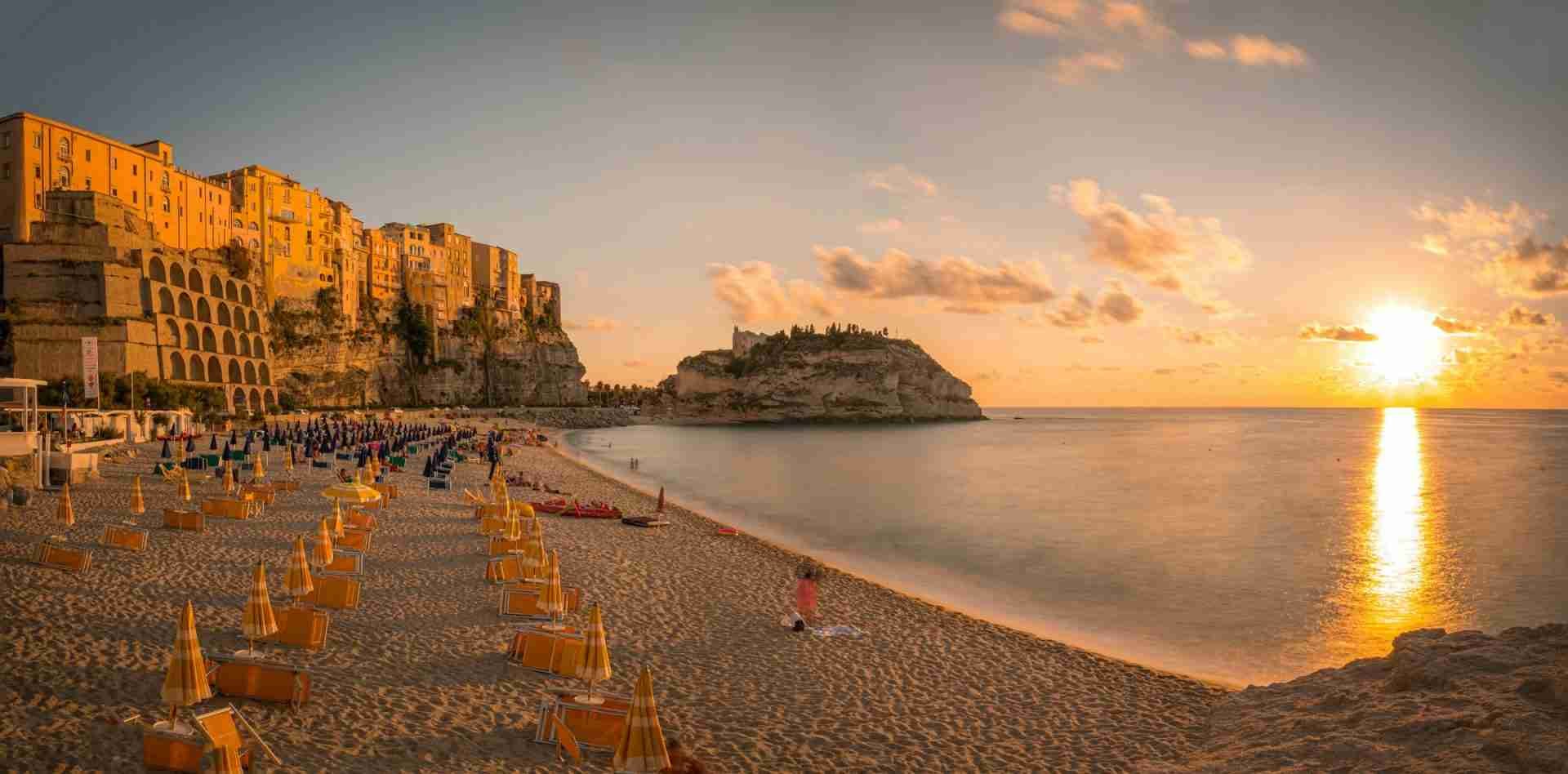
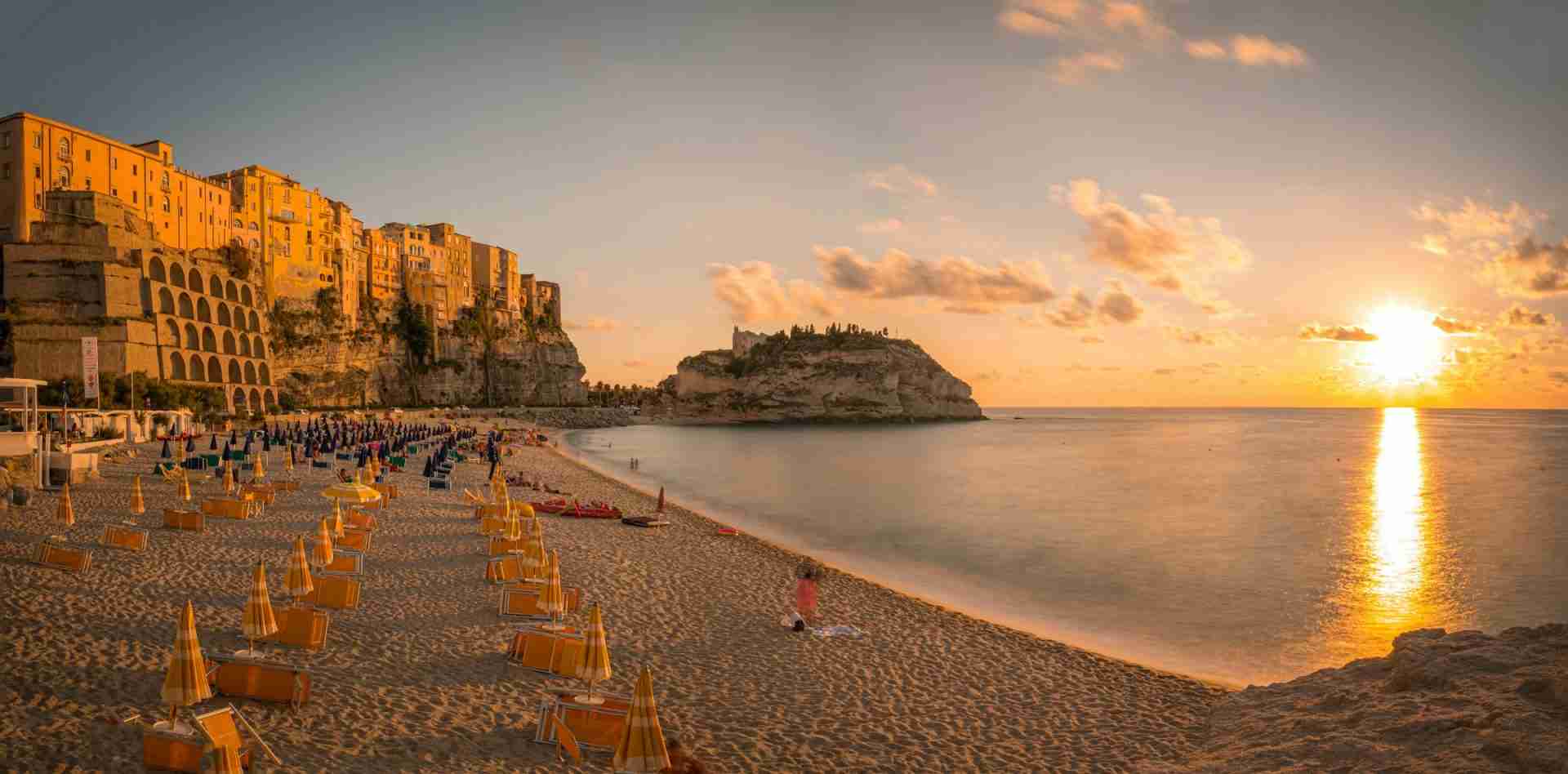
Spiaggia della Rotonda sits directly below the historic center of Tropea, where steep cliffs drop into clear turquoise water along the Tyrrhenian Sea. From above, the beach appears tucked beneath layers of pale rock and clustered buildings that seem to hover at the cliff edge. At sea level, the perspective flips, and the town rises dramatically overhead, creating one of the most recognizable coastal scenes in Calabria. The combination of textured cliffs, calm water, and the elevated old town gives photographers multiple compositional directions within a relatively compact stretch of sand. This is not just a beach for horizon shots. It is a location built on vertical contrast, where water meets rock and architecture all within a single frame.
Best Photography Opportunities
• Layered Composition Toward Santa Maria dell'Isola
One of the strongest views from Spiaggia della Rotonda is toward Santa Maria dell'Isola, the monastery perched on a rocky outcrop just offshore. From certain positions along the sand, you can align the shoreline as a leading line that directs the eye toward the rock formation. The key here is spacing. Too much empty water weakens the frame, while too little reduces the sense of place. Adjusting your height slightly changes how the monastery separates from the cliff behind it. Early morning light often defines the contours of the rock without creating harsh shadow, while sunset introduces warmer tones that strengthen the shape against the sky.
• Town Rising Above
Turning your attention inland reveals one of the beach's most dramatic characteristics. The old town of Tropea sits directly above the cliffs, creating a strong vertical relationship between sea level and skyline. From lower angles near the water's edge, the buildings appear to stack upward in layers. Including a small section of wet sand in the foreground adds reflection and subtle texture. A moderate focal length keeps the perspective natural without exaggerating the height of the cliffs. This composition works best when light strikes the upper walls of the town, creating separation between structure and rock.
• Elevated View From the Historic Center
From above, near viewpoints along Tropea Old Town, the curve of Spiaggia della Rotonda becomes clear. The beach arcs gently beneath the cliffs, and the water shifts from deep blue to lighter turquoise near shore. From this vantage point, you can emphasize color contrast and shoreline geometry. Longer focal lengths compress the beach and intensify the layered effect between sand and sea. Paying attention to shadow movement across the cliffs helps avoid flat midday compositions. This perspective captures how closely the town and beach are connected.
• Rock Formations
At the edges of the beach, exposed rock formations provide opportunities for more structured compositions. Placing a rock in the lower frame gives depth and anchors the image. When waves move around these formations, slow shutter speeds create smooth motion that contrasts with the rigid cliff face. Overcast conditions help preserve detail in both water and stone without blowing highlights. This approach creates a more intimate coastal study compared to wide horizon shots.
• Sunset Silhouettes and Reflected Color
Because Spiaggia della Rotonda faces west, sunset is one of the most visually rewarding times to photograph it. As the sun lowers, the cliffs and monastery can be rendered as silhouettes against warm sky tones. The water often reflects subtle gradients from orange to soft blue. A tripod allows careful exposure adjustments as light fades. Waiting for the moment when the sky transitions smoothly rather than abruptly can make the final image feel balanced and cohesive. Sunset here is less about direct sun and more about color interaction between sea and sky.
Best Time to Visit
Light direction is critical at Spiaggia della Rotonda. Early morning offers quieter conditions and softer tones, especially in peak travel months when the beach fills quickly. Morning light tends to illuminate the cliffs indirectly, preserving texture without harsh shadow. Late afternoon and sunset are particularly strong because of the west facing orientation. Warm light enhances the pale rock and brings depth to the water's color. Midday can be challenging due to strong overhead sun and high contrast, especially in summer when the sand and rock reflect intense light. Overcast conditions can actually produce richer color in the water and maintain detail across the cliff face. Spring and early autumn often provide the best balance of manageable crowds, comfortable temperatures, and softer light angles. Wind conditions also matter, as calmer seas produce cleaner reflections and smoother water transitions near the shore.
How to Get There
Spiaggia della Rotonda is located directly below the historic center of Tropea. Access is typically via stairways descending from town level down to the beach. Parking is available in designated areas within Tropea, followed by a walk through the old town and down toward the shoreline. There is no fee to access the public beach. The descent involves a noticeable elevation change, so comfortable footwear is important, especially if carrying equipment. Because the beach is relatively compact, arriving early in the day allows greater freedom to move and refine angles before it becomes crowded.
Recommended Photography Gear
A standard zoom lens is ideal for covering the range of compositions available here, from wide shoreline scenes to tighter architectural frames of the monastery and cliffside town. A short telephoto lens is useful for compressing the layers of rock, town, and sky into more graphic compositions. A sturdy tripod is recommended for sunset and long exposure work near the rocks. A polarizer can help manage glare and enhance water color, particularly during brighter conditions. Neutral density filters are useful if you plan to slow shutter speeds while retaining balanced exposure. Because of the stair access and sandy terrain, carrying a streamlined kit makes movement easier and reduces fatigue.
Nearby Photography Locations
Climbing to the monastery provides sweeping coastal views and strong elevated compositions. It offers angles not possible from the beach below.
Located south of Tropea, Capo Vaticano features dramatic cliffs and wide sea panoramas. It expands the coastal narrative beyond the town itself.
• Pizzo
This nearby town offers a similar cliffside setting with different architectural layout. It provides variety within a short drive.
Adjacent to Spiaggia della Rotonda, this stretch of sand offers alternate angles toward the rock formation and monastery.
Known for its clear water and rocky coves, Grotticelle provides additional opportunities for coastal compositions with varied terrain.
Comments
Loading comments…