
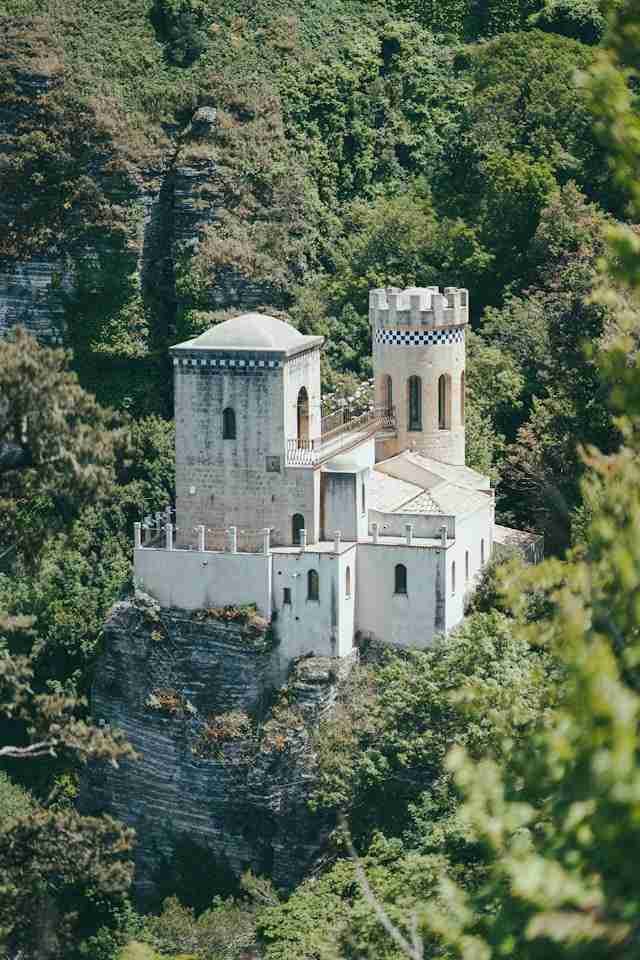
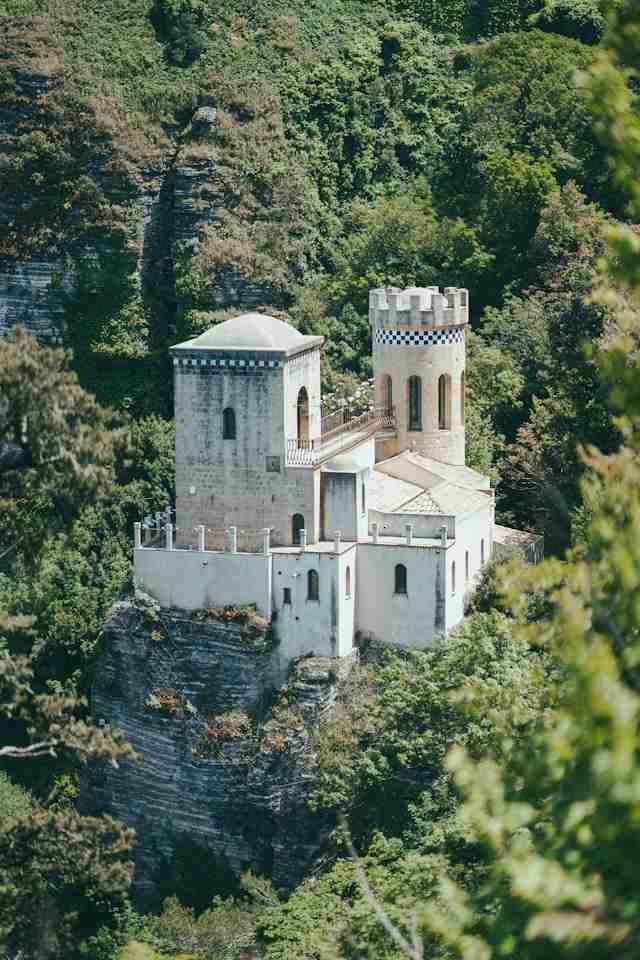
Perched dramatically on the cliffs below the medieval town of Erice, Torretta Pepoli is one of the most visually poetic sites in western Sicily. This neo-Gothic stone tower, built in the 19th century by Count Agostino Pepoli as a retreat for artists and intellectuals, rises out of the mountainside like something from a dream—framed by windblown cypress trees, limestone crags, and panoramic views over the Gulf of Trapani. Unlike grand castles or urban landmarks, Torretta Pepoli offers photographers a quiet, fairy-tale atmosphere, heightened by its isolation, surrounding ruins, and golden Mediterranean light. From intimate architectural studies to sweeping landscape compositions, it invites a thoughtful, cinematic approach.
Best Photography Opportunities
• Cliffside view from the Belvedere near Castello di Venere
From the upper path near Castello di Venere, a classic vantage point frames the entire Torretta Pepoli nestled into the cliffside below. This overlook provides an elevated angle that places the tower against the vast Tyrrhenian Sea. A mid-telephoto lens is ideal to compress the visual layers—tower, cliff, and distant coastline—into a painterly landscape composition. In the golden light of late afternoon, the pale stone of the tower glows warmly while the blue sea behind softens into pastel tones. Early morning, by contrast, brings cool shadows and soft mist, ideal for low-contrast minimalist frames.
• Descending trail views and framed perspectives
A stone trail winds down toward the tower, revealing increasingly intimate perspectives as it descends. From this route, the tower can be framed through foreground elements such as overhanging cypress branches, textured stone walls, or patches of ivy. These scenes work well with a wide-angle or standard lens to incorporate depth, leading lines, and the interplay of light and shadow. Photographers should pause at bends in the trail, where the view momentarily opens toward the sea with the Torretta suspended at the edge of the cliff.
• Architectural detail and historic texture studies
Up close, Torretta Pepoli reveals a wealth of fine architectural features: pointed arch windows, stone buttresses, wrought-iron balconies, and weather-aged masonry. These are best photographed under soft, diffuse light—especially in overcast conditions or during twilight. A fast prime lens allows for shallow depth of field when isolating sculptural elements or capturing the texture of the limestone. These compositions lend themselves to both color and monochrome interpretations, depending on how the photographer wishes to express the site's mood.
• Sunset silhouettes and coastal light
As the sun sets over the western coast, Torretta Pepoli is perfectly placed to catch rim light and golden silhouettes. From slightly elevated positions along the trail or adjacent hillsides, photographers can include the tower in the foreground with sweeping views of the Trapani coast and the Egadi Islands beyond. Long exposures can smooth the sea and capture the movement of low-lying mist, while bracketing helps manage the high contrast between shadowed cliff faces and the glowing sky. Twilight after sunset often yields the best tones, when artificial lights from Trapani begin to shimmer along the waterline below.
• Low clouds, fog, and moody weather
One of Erice's most distinctive photographic advantages is its elevation. Fog and low clouds frequently move across the mountainside, partially obscuring or revealing Torretta Pepoli in brief, evocative moments. These atmospheric conditions are excellent for minimalism and mood-driven compositions. Use a telephoto lens to isolate the tower in mist, or a wide lens to capture it as part of a larger, ethereal landscape. These weather events are often short-lived, so preparation and quick framing are essential to capitalize on fleeting light and shifting visibility.
Best Time to Visit
The most rewarding seasons to photograph Torretta Pepoli are spring and autumn. From March through May, the cliffs are dotted with blooming wildflowers and the air is clear enough to reveal the coastline in sharp detail. In this period, the angle of light at both sunrise and sunset is particularly flattering to the terrain, casting long shadows that add structure to both the vegetation and the tower itself.
From September to early November, the air becomes warmer and heavier, creating conditions that frequently produce low fog and golden haze—ideal for mood-driven imagery. These months also bring fewer tourists to Erice, giving photographers more uninterrupted access to trails and views.
Summer can be harsh in midday due to high contrast and flattened light, but early morning and late evening still offer soft illumination. Visitors should note that wind can be persistent on the cliffs, especially in the afternoon, which can affect long exposures or drone stability.
Winter is less predictable, with overcast skies and colder temperatures, but the potential for atmospheric weather and deserted paths makes it an excellent time for photographers seeking solitude and moody ambiance. Regardless of season, sunrise and sunset remain the best windows for capturing both the tower and the surrounding landscape at their most photogenic.
How to Get There
Torretta Pepoli is located just beneath the Castello di Venere in the historic hilltop town of Erice, part of Sicily's Trapani province. The most convenient approach is by cable car from Trapani, which transports visitors up the mountain with views over the bay. Once in Erice, follow signs to the Castello di Venere and the Giardino del Balio. From there, the Belvedere viewpoint offers the first glimpse of the tower.
The main access path to Torretta Pepoli begins just south of the Belvedere and descends along a stone-paved trail with multiple switchbacks. The trail is moderate in difficulty and takes approximately 15 minutes to reach the base of the tower, with several points along the way suitable for setting up tripods or pausing for compositions. Good walking shoes are essential, as the path can be slippery after rain or fog.
There is no vehicle access to the tower itself. Photographers arriving by car can park outside Erice's main gate at Porta Trapani and proceed on foot through the historic center. Erice is compact and walkable, with cafés, restrooms, and shops near the central square.
While the exterior of Torretta Pepoli is the primary draw, access to the interior may be restricted due to preservation work. Visitors should check with the Erice tourism office or local guides for current status if interior shots are a goal.
Recommended Photography Gear
Photographing Torretta Pepoli effectively requires a balanced kit for both landscape and architectural subjects. A wide-angle zoom (16–35mm) is ideal for trail shots and including foreground elements with the tower in the background. A mid-range zoom (24–70mm) provides versatility for both environmental context and close framing of structural features. A telephoto lens (70–200mm) is particularly effective for compressing space, isolating the tower in mist or haze, and photographing distant coastal elements from the Belvedere.
A lightweight but sturdy tripod is necessary for early morning, golden hour, and blue hour exposures—especially when working in low light or bracketing for dynamic range. A remote shutter or interval timer is helpful for minimizing vibrations on uneven trail surfaces. A circular polarizer can help deepen sky tones and reduce reflections from wet stone or foliage, while a 3- or 6-stop ND filter enables motion blur in clouds or soft light conditions without overexposing.
Weatherproofing is important, especially for foggy or windy days. Use a weather-sealed backpack, and keep lens cloths, rain covers, and extra batteries easily accessible. Layers are advised, even in warmer months, due to Erice's elevation and variable mountain air. A headlamp is recommended if staying past sunset or arriving before sunrise, as the trails are unlit.
Nearby Photography Locations
This Norman fortress above Torretta Pepoli offers 360-degree views of the sea, cliffs, and surrounding valley. It's excellent for sunrise and late afternoon compositions with dramatic light cutting across the old stone ruins. Use the castle's crumbling walls to frame distant scenes or silhouettes.
Located just above the tower, this terraced garden provides framed views through tree canopies and stone arches. Early morning is best for capturing backlit mist through the cypress trees, and late afternoon offers soft light on the surrounding hills.
Visible from many high points in Erice, this distinctive conical mountain rising from the sea makes for a compelling subject in its own right. From the edge of the town walls, use a telephoto lens to compress the silhouette of Monte Cofano against layers of sea and sky, especially at sunset.
Down the mountain near the coast, the salt pans offer reflective pools, historic windmills, and flamingos in season. Best photographed at sunset or during blue hour, the still water and long, flat lines contrast beautifully with Erice's rugged verticality.
Tucked into a quiet corner of Erice's old town, this church and its adjacent cloister provide quiet compositions of religious architecture, old stone courtyards, and shadow play through narrow alleys. Ideal for slow-paced, contemplative shots and detailed texture work.
Torretta Pepoli is not a landmark of grandeur, but of intimacy and enchantment. Its placement, clinging to the cliffside between forest and sky, offers photographers a rare subject that is as much about atmosphere as form. Whether veiled in fog or glowing in Mediterranean sunset, it rewards those who arrive with patience, a studied eye, and a willingness to follow the mountain's changing light.
Comments
Loading comments…