
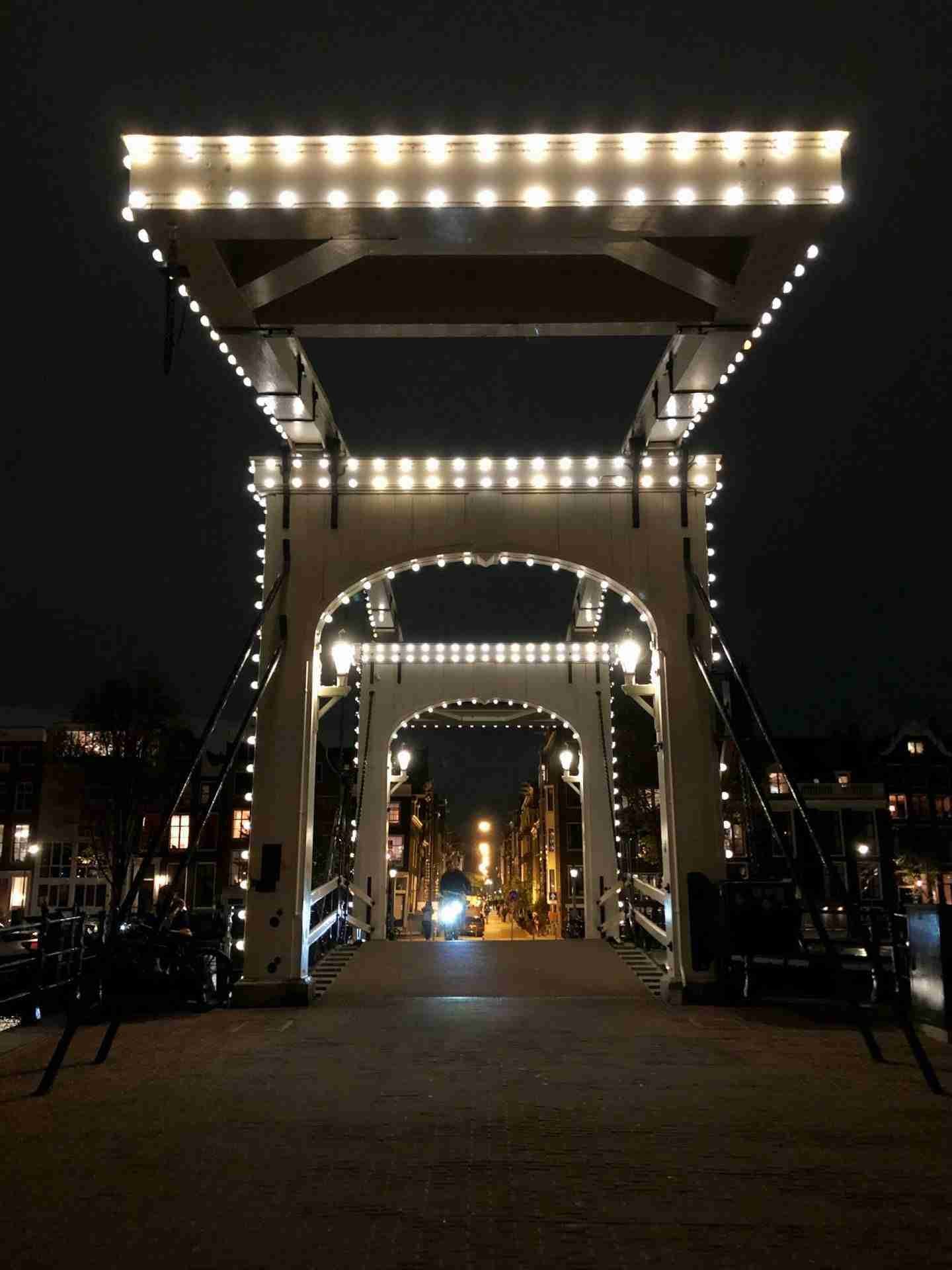
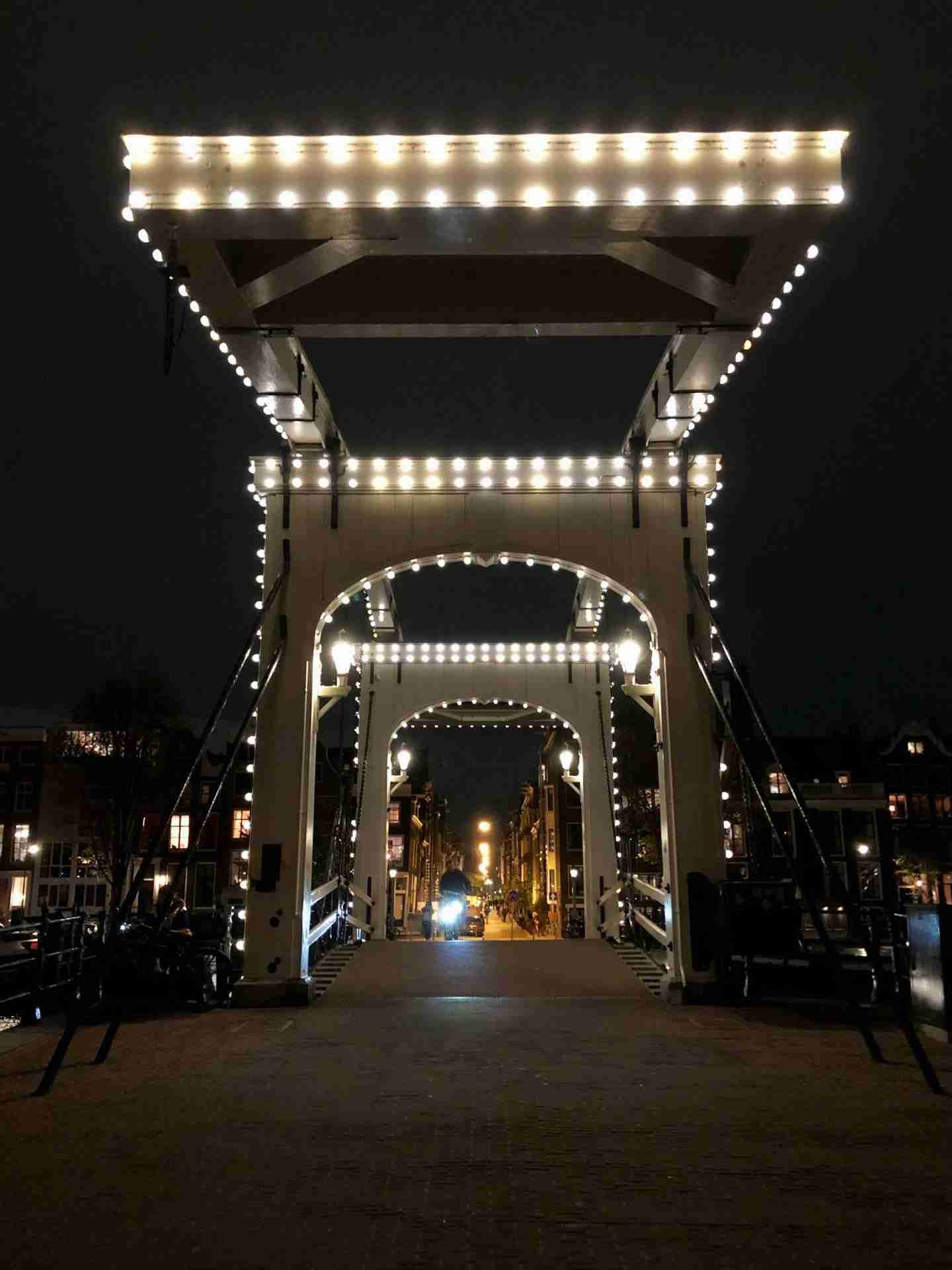
Spanning the Amstel River with graceful symmetry, the Magere Brug, or Skinny Bridge, is one of Amsterdam's most iconic and photogenic drawbridges. This white-painted wooden structure, with its delicate arches and classical lantern lighting, connects the banks of the river between Kerkstraat and the lively neighborhoods of Rembrandtplein and the Hermitage Amsterdam. While simple in form, the bridge's charm lies in its proportions, historical significance, and the way it interacts with light and water at different times of day.
Originally built in 1691 and rebuilt in the 20th century, Magere Brug combines historic character with architectural minimalism. For photographers, it serves as both subject and setting—working equally well in grand cityscapes or in quiet, detail-oriented compositions. Whether glowing under rows of lamps at night or framed by canal traffic during the day, the bridge remains a central feature of the Amstel's visual rhythm.
Best Photography Opportunities
• Symmetrical Framing from the Riverbank
The best-known angle of the bridge is a head-on shot from the eastern or western bank of the Amstel, where its dual bascules and clean geometry create perfect symmetry. A wide-angle lens captures the full structure along with the canal walls and lantern posts. In the early morning, this view is bathed in soft light with minimal pedestrian traffic. During blue hour, the bridge's small lamps light up in a crisp chain across its length, producing a luminous arc that reflects beautifully in the river.
• Reflections and Long Exposure Waterwork
The calm waters of the Amstel often mirror the shape of the bridge, particularly at night or during still mornings. Use long exposures to smooth out ripples and enhance the reflection effect. This is especially effective when shooting from slightly downstream or from one of the lower canal docks on either side. Incorporating moored boats, bridge lights, or passing canal cruisers can add dynamism and contrast to an otherwise minimalist composition.
• Environmental Portraits and Human Scale
The bridge is a favorite for couples, cyclists, and pedestrians alike. Its clean background and timeless design make it a beautiful location for lifestyle and environmental portraits. Shooting from a low angle with a wide aperture allows for soft foreground and background blur, with the arches or lanterns acting as natural framing elements. Early evening offers particularly rich light and bustling energy without overwhelming foot traffic.
• Street Detail and Crossover Traffic
From either end of the bridge, the lines of lanterns, wooden beams, and iron counterweights offer visual cues that guide the eye into the frame. Capture trams or cyclists crossing in motion blur, or focus on the machinery and materials of the drawbridge itself. These details evoke the mechanical and tactile history of Amsterdam's canal infrastructure. Use a mid-range lens for best results and time your exposures to highlight passing movement while maintaining sharp architectural edges.
• Night Photography and Bridge Lighting
After sunset, the bridge is illuminated by hundreds of soft bulbs, giving it a romantic and cinematic presence. Blue hour offers the perfect balance between ambient twilight and artificial lighting, while full night scenes allow the bridge to glow against the dark river. Long exposures from the bank or nearby bridges help create moody, serene compositions where the light reflections trace elegant arcs along the water.
Best Time to Visit
Golden hour and blue hour are the most rewarding times to photograph Magere Brug. The structure aligns nicely with the sun's path, receiving warm side lighting in both morning and evening. Early mornings are peaceful, with minimal foot traffic and soft light that enhances the bridge's pale color and river texture. Evenings, especially in spring and fall, bring active canal life and glowing lanterns that make the scene feel alive.
Nighttime is one of the most visually powerful moments to visit. The bridge lighting, combined with reflections on the Amstel, offers an excellent opportunity for low-light, long-exposure work. Visit on a clear or slightly misty night for the best effect.
Magere Brug is charming in every season. In winter, snow outlines the structure and adds crisp contrast. Spring brings blooming trees along the embankments, while summer delivers golden sunsets that stretch late into the evening.
How to Get There
Magere Brug is located along the Amstel River between the Keizersgracht and Prinsengracht canals. It connects the eastern side of the city, near the Hermitage Amsterdam and Theater Carré, with the canal belt neighborhoods to the west.
From Amsterdam Centraal Station, it's about a 20-minute walk or a short tram ride to the Waterlooplein stop. From there, follow the Amstel south, and the bridge will come into view as you pass the Stopera. Alternatively, walk from Rembrandtplein or Utrechtsestraat—both routes provide pleasant city scenes and additional photo stops.
The bridge is free to access and open to pedestrians and cyclists. For river-level photography, scout nearby docks or boat rental points along the Amstel's edge. Be cautious of slippery surfaces and maintain a low profile if photographing close to the water.
Recommended Gear and Shooting Tips
A wide-angle lens is excellent for capturing full bridge compositions and symmetrical perspectives. A 24–70mm mid-range zoom provides flexibility for portraits, detail shots, or layered urban compositions that include nearby bridges, houseboats, or canal life. For night photography, a tripod is essential—especially for long exposures across the water.
A polarizer can help control glare on the river during daylight hours, and a neutral density filter enables long exposures at sunset without blowing out highlights. A fast prime lens is useful for handheld street-level work and for shooting during blue hour without too much noise at higher ISOs.
Use the bridge's built-in repetition—lamps, railings, beams—as a compositional aid. Frame with foreground elements like bikes or railing posts to guide the eye. Adjust your elevation to balance the height of the bridge with the riverbank, and experiment with reflections to create symmetry or painterly abstractions.
Nearby Photography Locations
• Amstelkerk and Canal Junction
Just west of the bridge sits Amstelkerk, a historic wooden church tucked into the corner of a quiet square. Combined with the converging canals nearby, it makes a good pairing for daytime architectural photography.
East of the bridge, this cultural center features symmetrical gardens and elegant exterior walls. Ideal for detail-rich compositions and quiet scenes with formal geometry.
• Carré Theater and Amstel Stretch
Heading further south along the river brings you to Theater Carré and a less-developed section of the Amstel with wide river views, rowboats, and long shadows. Great for golden hour silhouettes and lifestyle shots.
Just downstream, the ornate Blauwbrug offers high drama and old-world elegance. It provides a contrasting subject to Magere Brug's simplicity and is perfect for dusk photography from either bank.
• Utrechtsestraat and Canal Corners
This vibrant street intersects several canals and bridges, creating wonderful urban compositions that highlight Amsterdam's intimate charm. It's an ideal area for shooting bikes, trams, and canal houses in golden or twilight light.
Magere Brug remains one of Amsterdam's most enduring visual icons—simple in structure but endlessly expressive under shifting light and weather. For photographers, it offers a rare combination of symmetry, reflection, and timeless design, making it a worthy centerpiece in any Amsterdam photo series.
Comments
Loading comments…