
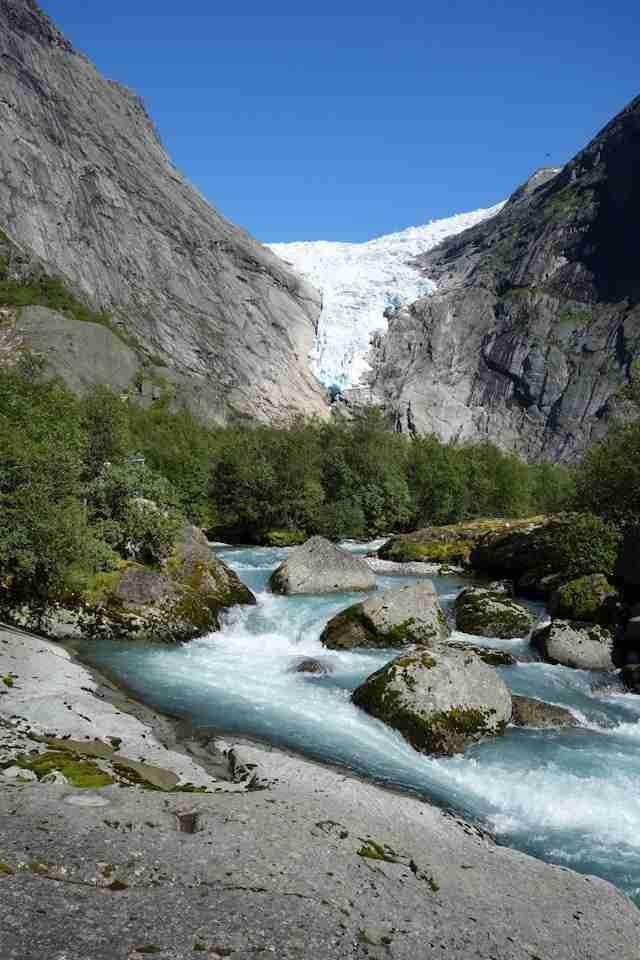
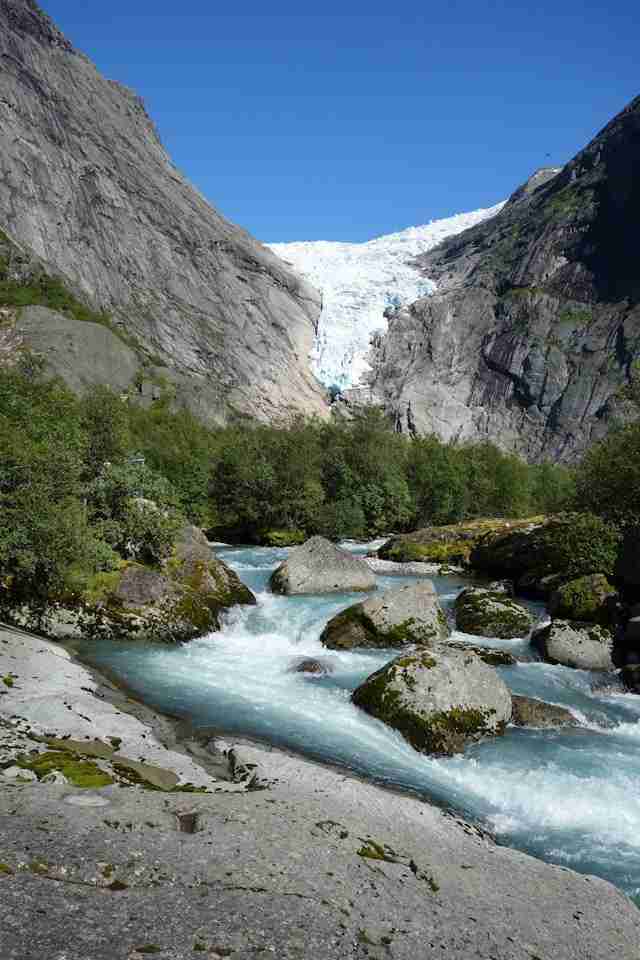
Descending from the vast Jostedalsbreen ice cap into a steep-sided valley near Olden, Briksdalsbreen is one of Norway's most photogenic and accessible glaciers. With its vivid blue crevasses, thunderous meltwater streams, and towering rock walls, the glacier presents a powerful visual narrative of climate, geology, and motion. Though its terminus has retreated significantly in recent decades, Briksdalsbreen remains a striking symbol of Norway's glacial landscapes—surrounded by waterfalls, mirror-like lakes, and dramatic shifts in light. For photographers, it's a landscape rich in contrast and story, with dynamic subjects ranging from sweeping wide-angle vistas to fine textural details in ice and stone.
Best Photography Opportunities
• Frontal view from the lake and moraine trail
The main hiking path to Briksdalsbreen ends at a viewpoint across a glacial tarn, with the ice tongue spilling down between near-vertical cliffs. From here, a wide-angle lens captures the glacier's full height and the turquoise lake in the foreground. Use a polarizing filter to control reflections and enhance the tones in the glacial meltwater. In the early morning or late afternoon, side lighting brings out the contours in both ice and surrounding rock. Include boulders, braided streams, or hikers in the foreground to anchor the composition.
• Telephoto studies of crevasses and seracs
From the main viewing area, a longer lens allows you to isolate jagged seracs, deep ice cracks, and blue fractures that mark the glacier's slow descent. These abstract compositions emphasize form and translucency, especially under soft overcast light or when filtered sunlight strikes the ice. Early in the season, snowfall may still cover sections of the glacier—later in summer, the exposed ice reveals more texture and detail.
• Trailside waterfalls and glacial runoff
The hike to Briksdalsbreen passes several dramatic waterfalls, including the powerful Volefossen, which drops more than 300 meters down the granite face. These cascades make excellent secondary subjects, particularly in long exposure. Use neutral density filters to slow shutter speed and smooth water flow, and frame with vegetation or mossy rock for depth and contrast. During rain or melt periods, the volume of these waterfalls increases dramatically, adding intensity to their motion and sound.
• Glacial lake reflections and moody light
On calm mornings, the glacial lake may reflect the lower tongue of the glacier and surrounding cliffs. These scenes work well with a mid-range zoom, capturing symmetrical compositions or cropping tightly into partial reflections. Overcast conditions intensify the lake's cyan color and allow for even exposure across sky and water. Mist rising from meltwater streams adds a dramatic touch, especially during early morning or after rainfall.
• Hikers and scale in the landscape
To convey the vastness of the glacier and valley, include people within the frame—distant hikers on the trail, silhouettes near the moraine, or figures dwarfed beneath waterfalls. These shots are best composed with a telephoto or from a high vantage point that allows separation between subject and background. Wide-angle versions with people in the foreground can also work if carefully composed with strong leading lines and clean edges.
Best Time to Visit
Briksdalsbreen is most photographable from late May through early October, when the trail is free of snow and access to the glacier area is open. Late spring (May to mid-June)
brings a mix of snow patches, high meltwater flow, and fresh greenery—a powerful combination for photographing contrasts in color and tone. Early mornings in this period are often cool and misty, producing dramatic atmospheres with soft, diffuse light.
High summer (late June through August)
offers the most stable conditions and longest hours of light. The glacier is usually fully exposed, showing its layered ice, and the surrounding valley is lush with wildflowers and moss. Afternoon light can be harsh on clear days, so aim for golden hour or overcast conditions. Waterfalls are at their most active during this period, and the lake typically reaches its most vibrant tone.
Early autumn (September to early October)
brings cooler air, lower sun angles, and richer tones in the valley vegetation. The glacier's features become more defined in angled light, and fog is more common in the mornings. This season also offers fewer tourists, allowing for quieter compositions and longer tripod setups.
Winter access is not available to the public. Heavy snow, avalanche risk, and trail closures make this a non-photographic season for Briksdalsbreen.
How to Get There
Briksdalsbreen is located in the municipality of Stryn, near the village of Olden in western Norway. From Olden, follow the Briksdalsbreen road (signposted from the main RV60 route) for approximately 20 kilometers to the Briksdalen valley. The road ends at a large visitor center with a café, shop, and parking area.
From the parking lot, the glacier is reached by a well-maintained 3-kilometer trail that gains about 200 meters of elevation. The walk takes around 45 to 60 minutes at a moderate pace. Along the way, several scenic spots offer views of the waterfalls, the surrounding mountains, and the glacier tongue as it comes into view.
Electric troll cars (open-sided mini-buses) run during the summer season and can drop passengers closer to the final viewpoint, though photographers may prefer to walk in order to scout compositions. Drones are not permitted in the area, and visitors must stay behind the marked barriers near the glacier's edge due to safety risks from icefall and meltwater surges.
Recommended Photography Gear
Photographing Briksdalsbreen requires equipment that handles high contrast, wet conditions, and landscape depth. A full-frame mirrorless or DSLR camera with a sturdy sensor and weather sealing is ideal. A wide-angle zoom
is essential for framing the glacier with foreground elements or capturing full vertical scenes from below the ice. A 24–70mm lens
adds flexibility for trail compositions, mid-range landscapes, and tighter frames on waterfalls and the glacier face.
A telephoto lens (70–200mm)
is especially valuable for compressing crevasses, isolating climbers or hikers, and working with fog and cliff detail. For long exposures of water and clouds, a sturdy tripod
is critical—preferably one with rubber feet for use on stone platforms. Neutral density filters
(6- or 10-stop) help achieve water blur in bright conditions, while a circular polarizer
reduces glare from wet rock and enhances lake color.
Bring microfiber cloths, a rain cover, and a weather-sealed bag, as rain and mist are frequent. Battery life can be reduced in damp, cold conditions, so carry spares in a dry pouch. Lightweight waterproof hiking gear and comfortable boots are essential for moving safely on the wet trail.
Nearby Photography Locations
Just south of Briksdalen, Lovatnet is a serene glacial lake famous for its turquoise water and sheer surrounding cliffs. In calm conditions, the reflections here are perfect, and cabins along the shoreline provide scale and rustic detail. Morning light is best, especially with fog lifting from the valley.
The town of Olden itself sits at the head of the Nordfjord, with sweeping views down the fjord's length. The harbor and nearby hills offer strong compositional leading lines, particularly in evening light when the fjord reflects the warm hues of sunset.
Located further into the Lodalen Valley, Kjenndalsbreen is another outlet of Jostedalsbreen with a steeper and narrower icefall. It's less developed and more secluded, providing quieter shooting conditions with dramatic cliffs and ice in close proximity.
• Loen Skylift and Mount Hoven
The Loen Skylift ascends nearly 1,000 meters to the summit of Mount Hoven, offering panoramic views of the fjord, valleys, and distant icefields. From the top, trails provide high-altitude perspectives ideal for wide-angle landscape compositions or stitched panoramas under changing mountain light.
Briksdalsbreen is not just a glacier—it's a dynamic convergence of ice, rock, and water that offers both majesty and intimacy. Whether you're drawn to the drama of its retreating face or the softness of its morning reflections, it's a place where light shifts quickly, stories are carved in ice, and every frame connects geology with atmosphere.
Comments
Loading comments…