
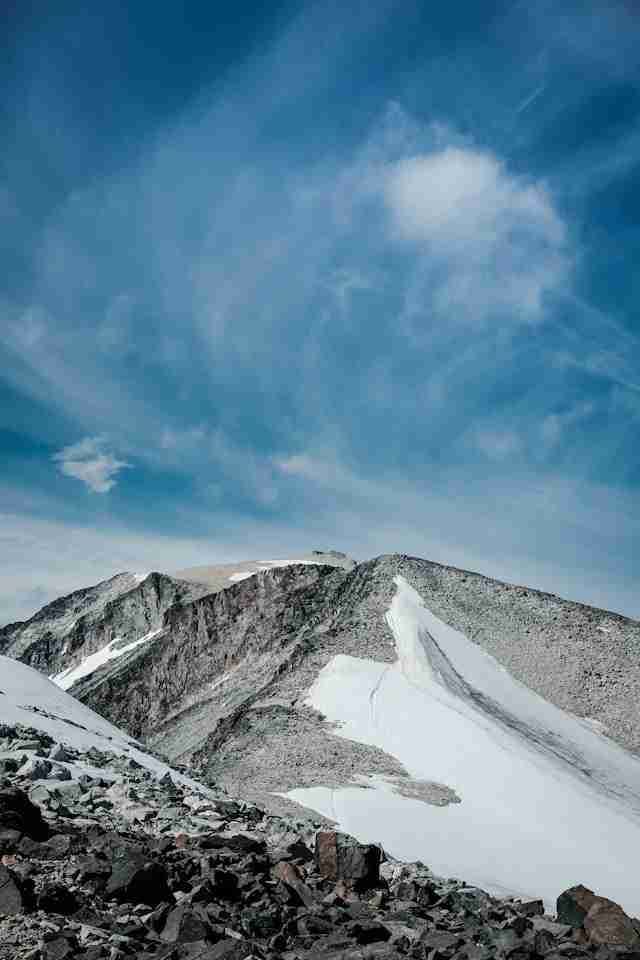
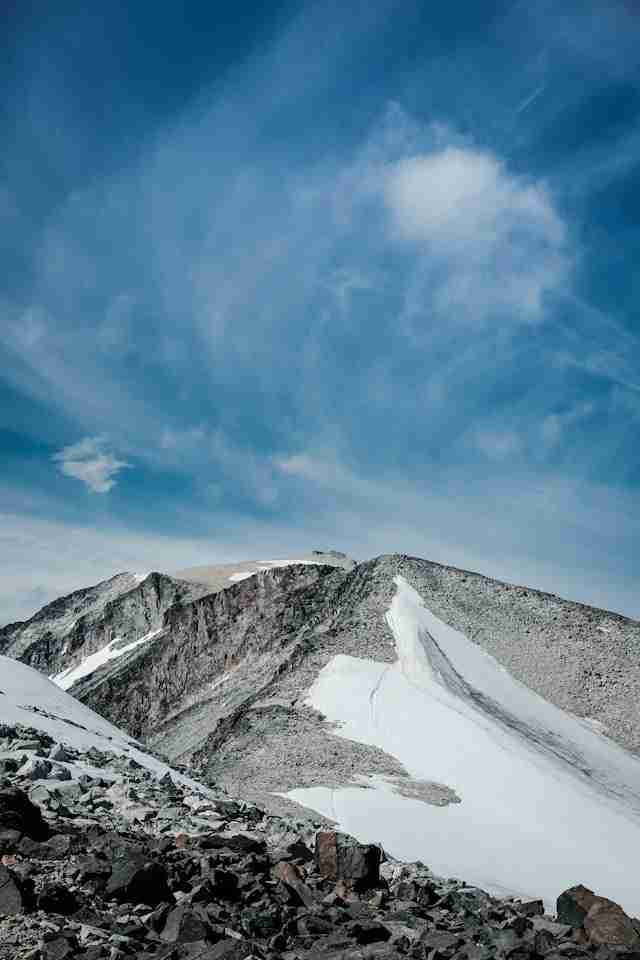
As the highest mountain in Norway—and all of Northern Europe—Galdhøpiggen rises to 2,469 meters in the heart of Jotunheimen National Park. Though its summit is accessible to fit hikers with moderate experience, its scale and surroundings offer a grandeur rarely matched in Scandinavia. Surrounded by a labyrinth of glaciers, ridgelines, and snowfields, Galdhøpiggen is more than a summit—it's a natural observatory from which photographers can frame the dramatic intersection of sky, stone, and ice. Whether you're shooting from the glacier approaches or standing at the peak itself, this mountain rewards both sweeping panoramic views and stark alpine minimalism.
Best Photography Opportunities
• Summit panorama at sunrise
The view from the summit is a vast sweep of alpine terrain: jagged ridges, crevassed glaciers, and snowbound basins extending in every direction. Arriving at or near sunrise offers the clearest light and warm alpenglow on the nearby peaks, especially Glittertind and Store Skagastølstind. A wide-angle lens captures the full breadth of the scene, while a mid-range zoom helps isolate bands of light across the snow. On clear days, the early golden hour light casts long shadows across the glaciers below, adding depth and sculptural form to the landscape.
• Glacier crossings on Styggebreen
One of the most scenic routes to the summit passes over the Styggebreen glacier, which features deep crevasses, blue ice layers, and high-contrast snow ridges. Guided groups often follow this route from Juvasshytta, and the trek itself offers abundant photographic opportunities. Use a mid-telephoto lens to compress lines of climbers crossing the glacier, or go wide to frame them against the vast snowfields and surrounding summits. Cloud shadows drifting across the snow offer excellent opportunities for black-and-white compositions that emphasize tone and shape.
• Ridgeline contrasts near Keilhaus topp
Just before the final ascent to the summit, Keilhaus topp offers a dramatic vantage across multiple flanking ridgelines. From here, you can frame glacial valleys with minimalist layering—rock, snow, sky—especially under soft light or mist. It's an excellent place to photograph hikers in scale against the terrain, with strong compositions available both facing east toward Visdalen and west toward the glacier approaches. Neutral colors and stark contrasts lend themselves well to monochrome interpretation.
• Stormlight and fast-moving cloudscapes
The weather in Jotunheimen can shift rapidly, often bringing waves of fog or fast-moving clouds that envelop the summit ridge. These conditions, while challenging, are visually rewarding—moments when light breaks through fog can create radiant, fleeting spotlights on ice or rock. A wide-angle or standard lens is ideal here, and bracketing is often necessary to balance exposure. Mist curling around the summit cairn or a passing group of climbers adds dynamic movement and mood.
• Rock texture and minimal compositions
While the grand views command attention, Galdhøpiggen's surface is also rich with detail. Wind-carved snow, frost-covered rock, and ice-rimed cairns all provide opportunities for tight compositions. A fast prime or macro lens can isolate crystals, boot tracks, or ice formations—subjects that tell the mountain's story up close. These shots are particularly effective in diffused light or during the blue hour, when shadows soften and colors mute into subtle, tonal gradients.
Best Time to Visit
The best season for photographing Galdhøpiggen is from mid-June through mid-September, when trails and glacier routes are open, and weather is most cooperative. During this period, days are long and often clear in the morning before clouds build in the afternoon. June and early July offer deep snowpack and crisp snowfields, making for stunning glacier scenes and clean compositions. The light at this time is often clear and sharp, ideal for high-contrast landscapes.
August and early September provide slightly softer light, more defined rock features as snow recedes, and fewer crowds. This is also a better time for shooting color contrasts between rock, moss, and ice. By late September, snowstorms may begin closing routes, and daylight hours shorten rapidly. Sunrise and sunset become more accessible for golden hour work without requiring extremely early starts or late finishes.
Winter and early spring are suitable only for experienced alpine photographers on skis or mountaineering gear. In these months, Galdhøpiggen becomes a true arctic landscape, with deep snow, short days, and volatile conditions. Photography here demands technical preparation but rewards with unmatched purity of light and solitude.
Regardless of season, sunrise is the optimal time to photograph the summit and its surroundings, both for the quality of light and the clarity of atmosphere. Afternoon conditions often bring haze, wind, or low clouds that obscure distant views.
How to Get There
The most common starting point for photographing and climbing Galdhøpiggen is Juvasshytta, a high-mountain lodge and trailhead accessible via a steep seasonal road from Lom. From Lom, follow signs up the Galdhøpiggvegen toll road—typically open from late May through early October depending on snow conditions. Juvasshytta sits at 1,841 meters and is reachable by standard vehicle during the open season.
From Juvasshytta, the route to the summit crosses the Styggebreen glacier, which requires crampons and a rope team for safe travel. For photographers unfamiliar with glacier travel, joining a guided group is strongly recommended. The round trip to the summit takes approximately 5–7 hours depending on snow conditions and group pace.
An alternative, glacier-free route starts from Spiterstulen in Visdalen. This trail is longer, steeper, and ascends more gradually through alpine terrain and scree before reaching the summit ridge. It's a more rugged hike but allows for independent travel in summer and offers excellent valley compositions during ascent.
Both routes have trail markers and shelter points, but weather changes rapidly—always carry offline maps, emergency gear, and sufficient food and water. There are no services on the mountain itself.
Recommended Photography Gear
Galdhøpiggen's high-alpine environment demands a well-balanced kit that's lightweight, weather-resistant, and adaptable to changing conditions. A full-frame mirrorless or DSLR camera with good high-ISO performance and dynamic range is ideal for managing both bright glacier scenes and low-light conditions on the summit.
A wide-angle zoom is essential for capturing summit panoramas, glacier landscapes, and dramatic ridgelines. A mid-range zoom adds flexibility for trail portraits and balanced compositions on the approach. A telephoto lens is useful for compressing layers of peaks, isolating ridgelines in storm light, or capturing hikers in scale against the landscape.
A lightweight carbon-fiber tripod is necessary for long exposures, sunrise or twilight work, and bracketing in windy conditions. A circular polarizer helps reduce glare on snow and enhances contrast in sky and terrain, though care must be taken to avoid uneven polarization at high altitudes. For long exposures in bright conditions, a 6- or 10-stop ND filter is helpful when working with moving clouds or meltwater streams.
Cold-weather accessories—such as lens cloths, sealed batteries, rain covers, and touchscreen-compatible gloves—are crucial. Keep batteries insulated and bring extras, especially in cold or windy conditions. A waterproof backpack with easy access compartments will make lens swaps safer and more efficient on narrow ridges or in blowing snow.
Nearby Photography Locations
Norway's second-highest mountain lies just northeast of Galdhøpiggen and offers dramatic views back toward its rival. The summit is often snow-covered well into summer, and sunrise from its east-facing slopes creates deep shadows and raking light across the glacier-filled basin.
South of Galdhøpiggen, the Besseggen hike is one of Norway's most famous—and for good reason. It provides high vantage points over the turquoise waters of Lake Gjende and the deep blue of Lake Bessvatnet, separated by a narrow knife-edge ridge. Excellent for wide compositions, especially in the soft light of early morning or late afternoon.
The glacial valley that stretches below the mountain offers peaceful forested rivers, moss-covered boulders, and low mist in the early hours. It's a perfect place for contrast against the stark high alpine world above. Fog and golden light filter through spruce and birch in late summer and early fall.
• Leirbreen Glacier and Høgvagltindane
Just southwest, Leirbreen offers sculptural glacial ice and reflection pools framed by sharp granite ridges. For photographers interested in abstract ice detail and glacier color, this area complements the vast views of Galdhøpiggen with more intimate alpine scenes.
Galdhøpiggen isn't just the top of Norway—it's the heart of a photographic journey through one of Scandinavia's most powerful landscapes. From sweeping ridges to silent snowfields, from morning light on glacier faces to the hush of fog in the valleys, it rewards the patient, the prepared, and the curious with frames shaped by ice, air, and ancient stone.
Comments
Loading comments…