
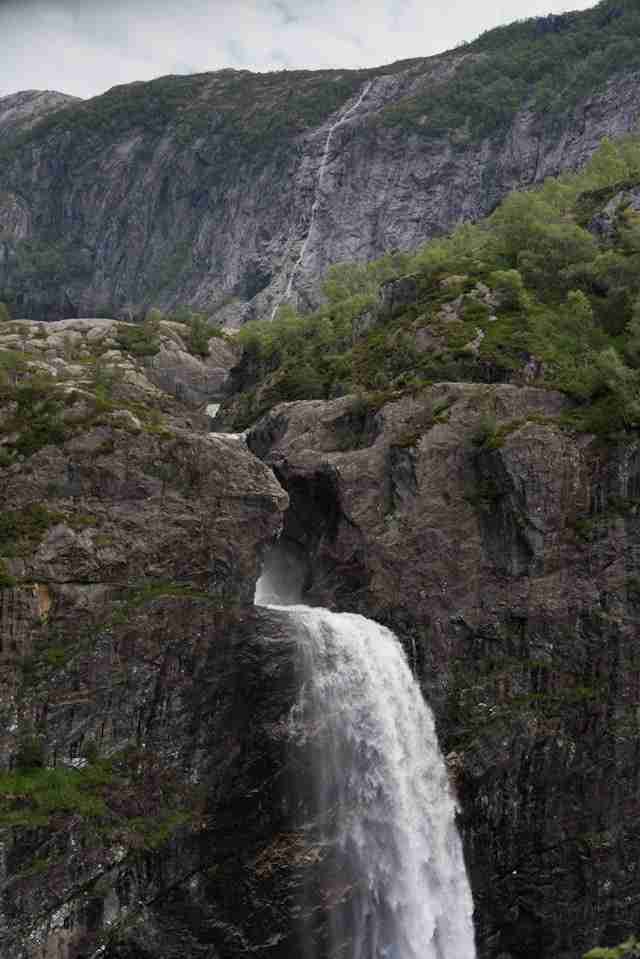
Hidden within the steep granite canyons of Rogaland County, Månafossen is one of Norway's most powerful and visually arresting waterfalls. Dropping 92 meters in a single, thundering plunge, the waterfall crashes through a cleft in the rock into a mist-filled gorge surrounded by raw, vertical cliffs and untouched wilderness. Though less visited than Norway's more famous fjordside waterfalls, Månafossen's appeal lies in its elemental force, unspoiled location, and cinematic viewpoints. It's a place where photographers can frame raw motion, fleeting light, and geologic texture without distraction—making it a must-visit for those chasing both drama and solitude in Norway's southwest highlands.
Best Photography Opportunities
• Frontal view from the primary lookout
The main viewpoint, reached after a steep 10–15 minute hike, provides a head-on perspective of the waterfall as it plunges into the gorge. From here, use a wide-angle lens to capture the waterfall, cliff walls, and the curve of the river below. Long exposures (1 to 3 seconds) smooth the water into a bright, silky contrast against the darker granite. On overcast days, soft light reduces harsh highlights and reveals detail in both rock and mist. Sunrise light occasionally grazes the upper cliffs, adding subtle warmth and contrast to the otherwise cool-toned scene.
• Side angles from the upper ledges
Just above the main platform, a network of narrow trails and rock ledges offer slightly elevated or side-on views. These allow you to frame the waterfall against sweeping rock faces or use nearby vegetation—scrub pine, heather, or lichen-covered boulders—as compositional foreground. A mid-range zoom (24–70mm) helps balance scale and context, while a telephoto (100–200mm) allows for tight framing of the water's impact zone, capturing motion, spray, and erosion patterns.
• Detail studies of spray and granite
The constant mist and powerful plunge create endless micro-compositions: rivulets sliding across rock, sunlight hitting airborne droplets, or moss clinging to the cliffside. Use a fast prime or macro lens to isolate these elements. Shoot with high shutter speeds (1/500s or faster) to freeze droplets mid-air, or slow the shutter slightly to emphasize movement within detail-rich scenes. Early morning or backlit conditions offer the best chance to capture water glinting against the dark canyon backdrop.
• Mist and low cloud in moody conditions
Månafossen excels in mist and light rain, when clouds roll through the gorge and the forested valley below disappears into soft layers of tone. Under these conditions, the waterfall becomes part of a mood-driven composition rather than the focal point. Use a wide lens to include atmospheric foreground elements, and embrace muted colors and deep shadow. These conditions work especially well in black and white, highlighting the tonal range between white water and granite mass.
• Twilight and blue hour compositions
For photographers willing to descend in low light, the falls take on a haunting quality after sunset. With the right conditions, residual light in the sky creates a soft ambient glow over the canyon, while long exposures (10 to 30 seconds) transform the waterfall into an ethereal streak of light. A tripod is essential, as is bracketing to manage high contrast between the water and surrounding shadows.
Best Time to Visit
Månafossen is most photogenic from late spring through early autumn, when trail access is clear and water flow is strong. May through July brings the most powerful flow due to snowmelt from the surrounding highlands. During this period, the volume of water and persistent mist require waterproof gear, but create the most dynamic and high-contrast frames. Early mornings during this time offer soft light, fewer visitors, and the highest chance for low-hanging clouds or fog.
August to early September sees slightly lower water levels but offers more stable weather and vibrant green foliage. Late summer also brings the possibility of dramatic afternoon light and thundercloud buildup, enhancing the drama of the falls and surrounding canyon.
Autumn, from late September to October, brings rich color to the surrounding trees and mosses. The warmer tones of fallen leaves and seasonal golden hour light contrast beautifully with the cool, steel-blue flow of the water. However, daylight hours are shorter, and temperatures can drop quickly—sunrise and sunset compositions require good planning and warm gear.
Winter is not recommended unless you're equipped for icy terrain and poor visibility. Snow can make the steep trail dangerous, and the falls may partially freeze, changing the scene entirely. Access is often closed or strongly discouraged due to safety concerns.
How to Get There
Månafossen is located in the Frafjordheiane landscape conservation area, about an hour and a half from Stavanger by car. From Stavanger, take the E39 south to Ålgård, then continue east via Fv45 and Fv281 toward Frafjord. The final approach winds up a steep valley road to the Eikeskog parking lot.
From the car park, the trail to the waterfall is short but steep, involving rock steps, chain-assisted sections, and uneven terrain. The hike to the viewpoint takes 10–20 minutes depending on pace and gear weight. Good hiking boots and stable footing are essential, especially in wet conditions.
The viewpoint is a sturdy wooden platform with railings, but there's limited space—plan to arrive early or stay late if you want uninterrupted compositions. There are no restrooms or facilities beyond the parking lot. Mobile coverage is limited, so download offline maps and prepare gear before departure.
Recommended Photography Gear
Photographing Månafossen requires gear that can handle wet, misty conditions and high contrast between shadowed cliffs and bright water. A full-frame mirrorless or DSLR body with good dynamic range is ideal. A wide-angle zoom (16–35mm or equivalent) is essential for capturing the full waterfall within tight framing at the main platform. A 24–70mm adds flexibility for mid-range compositions from various trail positions, while a telephoto (70–200mm) allows you to compress cliff lines or study the water's detail and motion from a distance.
A sturdy tripod is crucial for long exposures and twilight sessions, especially with uneven terrain and strong gusts near the falls. Rubber feet or a weighted center hook add stability on the rocky platform. A circular polarizer helps control glare from wet rocks and foliage while enhancing sky separation and water clarity. Neutral density filters (6- or 10-stop) are recommended for softening water flow during daylight hours.
Bring microfiber cloths, a lens hood, and a rain cover for both camera and bag. The mist from the waterfall is intense—gear must be wiped frequently. A waterproof hiking pack and breathable rain jacket are advised even in fair weather. Headlamps or flashlights are essential for dawn or dusk access. Spare batteries and SD cards should be kept dry in sealed cases.
Nearby Photography Locations
• Frafjord Valley
The approach to Månafossen offers pastoral scenes with steep cliffs, winding rivers, and traditional farm structures. In early morning or after rain, light mists drift through the valley, creating painterly compositions and opportunities for layered depth.
A short hike beyond the waterfall leads to an abandoned stone farmstead nestled in the highlands. The ruins, surrounded by birch forest and distant peaks, offer a moody, human-scale contrast to the raw power of the falls. It's especially photogenic in autumn or misty light.
• Frafjord Tunnel Viewpoint
On the road back from the falls, a pull-off before the tunnel entrance provides a view down the valley to the fjord itself. This is best shot at sunset, when the light rakes across the high cliffs, or in early morning fog, when only the valley floor is visible beneath a blanket of white.
• Egersund Coastline
Just over an hour south, the rocky coast around Egersund offers dramatic seascapes, weathered cliffs, and windswept heathland. For photographers wanting to pair inland drama with oceanic mood, it's an excellent coastal counterpart to Månafossen's inland gravity.
Månafossen doesn't just fall—it erupts. The sheer force of its descent, the isolation of its location, and the visual tension between stone and water make it one of Norway's most rewarding waterfall experiences for photographers. It's a place where you shoot not just for beauty, but for atmosphere—and where the roar of water becomes the soundtrack to some of the most powerful frames in the Norwegian wilderness.
Comments
Loading comments…