
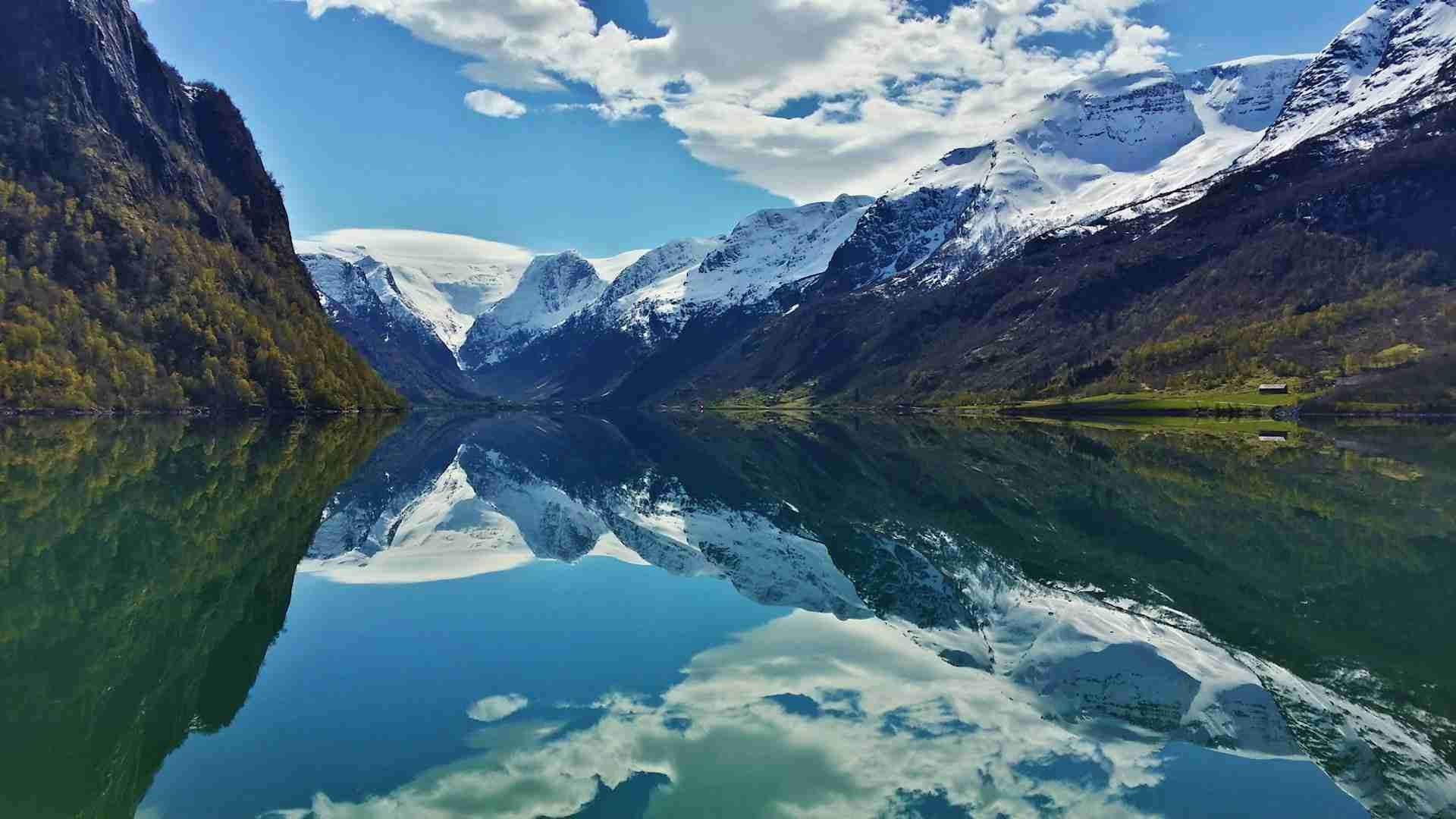
Oldevatnet is one of western Norway's most hauntingly beautiful lakes, lying deep in a glacial valley outside the village of Olden. Its water is fed by melt from the Jostedalsbreen icecap, the largest glacier in continental Europe, and carries a turquoise tint that shifts with light and weather. Steep cliffs rise directly from the shoreline, and waterfalls plunge into the lake from snowfields far above. On still mornings, the surface becomes an unbroken mirror, doubling the peaks, clouds, and light into compositions so perfect they feel unreal. By afternoon, winds sweep down the valley, breaking reflections into abstract patterns, and in stormy weather the lake transforms again into a stage for brooding skies and jagged mountains. Oldevatnet is a place of contrasts: serene and dramatic, accessible yet wild, intimate in its details yet vast in its scale. For photographers, it is a location that rewards both patience and persistence, offering new images with every season and every change in light.
Best Photography Opportunities
• Reflections at First Light
The defining feature of Oldevatnet is its reflections. At sunrise, when air is calm, the lake becomes a perfect mirror, doubling the mountains and waterfalls into symmetrical compositions. Wide-angle lenses can balance rocks or flowers in the foreground with the mirrored peaks in the distance, while telephotos isolate details like a single ridge or a ribbon of cloud reflected in the water. Even subtle ripples create painterly effects, turning sharp reflections into impressionistic colour washes. Arriving before dawn increases your chance of catching the lake before wind stirs its surface, and the shifting light during golden hour reveals new textures minute by minute.
• Waterfalls Feeding the Lake
Oldevatnet's surrounding cliffs are laced with waterfalls that change with the season and weather. In spring, meltwater surges down in torrents, while summer brings lighter, silvery streams that streak across dark rock. A telephoto lens helps isolate these falls against contrasting backgrounds, while a wide shot can combine them with the lake for layered compositions of stillness and motion. Long exposures smooth the water into fine strands, especially effective when framed against moss or forest. Shorter shutter speeds, by contrast, capture the raw power of rushing melt. Including waterfalls in the same frame as their reflections creates some of the most distinctive images of the lake.
• Boat Houses and Cabins
Traditional wooden boat houses line parts of the shoreline, painted red or left in natural timber. These are ideal subjects for anchoring wide landscapes, their simple geometry standing in contrast to the wildness around them. Reflections of boat houses in calm water add a second layer of symmetry, and evening light warms the tones of the wood beautifully. Rowboats, piers, and weathered fences provide smaller details to work with, especially when shooting tighter frames. These human touches create a dialogue between culture and wilderness, and help balance the overwhelming scale of the valley.
• Snow-Capped Peaks and Seasonal Change
The mountains above Oldevatnet hold snow for much of the year. Even in midsummer, patches of white linger on shaded ridges, contrasting with green slopes and turquoise water. Spring brings fresh snowmelt, autumn adds golden tones to vegetation, and winter transforms the entire valley into monochrome. Each season reshapes the lake's palette, from the vibrant greens and blues of July to the stark blacks and whites of January. For photographers, this makes Oldevatnet a subject worth returning to, as no two seasons—or even two days—are alike.
• Shifting Skies and Storm Drama
Weather in Stryn changes fast, and for photographers that is part of the reward. Heavy clouds rolling down the valley, sudden bursts of sunlight breaking through, or mist drifting across the lake all create dramatic moods. These conditions often produce the most memorable images, as the landscape takes on a layered, moody depth that clear skies cannot match. Black and white processing works especially well in stormy weather, highlighting the play of light and shadow. Long lenses can compress mountain layers into graphic compositions, while wide shots capture the scale of shifting skies.
• Evening Glow and Blue Hour Reflections
As the sun drops behind the surrounding peaks, the valley sinks into shadow, but the sky often glows with warm colour. This light reflects across the lake, softening into pastel tones during blue hour. Boat houses and cabins become especially photogenic in this light, as artificial lamps begin to flicker against the darkening landscape. Long exposures smooth the surface of the water into glass, enhancing the reflective quality. Even without bright colour, the cool stillness of evening gives images a quiet intensity that makes the lake feel timeless.
• Elevated Perspectives from the Hills
Though many photographers stay by the shoreline, trails in the surrounding hills offer elevated views of Oldevatnet. From above, the lake appears as a turquoise ribbon winding between jagged cliffs. These vantage points are especially striking at sunrise, when peaks catch light while the valley remains in shadow. A drone can replicate some of these perspectives, but hiking offers more creative control and opportunities to include foreground elements such as boulders or alpine flowers.
Best Time to Visit
Oldevatnet offers different moods at every time of day and every season, but understanding how light, weather, and season interact is key to making the most of it.
Mornings are the most productive for reflections, as calm air allows the lake surface to mirror the surrounding peaks with almost surreal clarity. The first hour after sunrise is especially rewarding, when golden light touches the tops of the mountains while the valley floor remains in soft shadow.
Evenings are equally valuable, with side light illuminating waterfalls and cabins, and blue hour adding calm reflective tones to the water. Artificial lights from scattered cabins sometimes appear at this time, creating warm highlights against the cool lake.
Seasonal variation is dramatic. In spring, melting snow feeds waterfalls and creates strong flow in streams. Summer brings the most stable weather and vibrant greens along the valley slopes, though midday haze is common. Autumn adds rich golds and oranges to the vegetation, often with morning mist rising from the lake. Winter transforms the entire landscape, with snow blanketing peaks and ice sometimes forming at the shoreline, though access can be more difficult.
Weather should never be underestimated. Norway's west coast can shift from calm sun to driving rain within an hour. Storms, however, are highly photogenic, creating dramatic skies and fleeting bursts of light that highlight ridges and reflections. Photographers who embrace changing conditions will find that Oldevatnet rarely looks the same twice.
How to Get There
Oldevatnet is located just outside the village of Olden in the municipality of Stryn, part of Norway's Nordfjord region. By car, it is only a short drive from Olden, with the main road following the shoreline for much of the lake's length. The drive itself is photogenic, with frequent pull-offs and parking spaces where you can stop to set up a tripod safely.
For those without a car, public buses run between Olden, Stryn, and Loen, but reaching the best viewpoints along the lake requires either a car or a bicycle. Cycling the lakeside road is possible, but the terrain can be steep and narrow in places. Hiking trails climb into the surrounding hills, providing elevated perspectives of the lake and valley. These trails vary in difficulty, from gentle walks to more strenuous climbs, and all provide excellent opportunities to shoot from above.
Access is free, and the shoreline is open to the public, though photographers should be mindful of private land near cabins and boat houses. Facilities are limited along the lake itself, so bring food, water, and clothing suited to rapidly changing weather. In summer, parking areas can fill quickly as both tourists and locals visit, so early arrivals help secure space and quieter conditions. In winter, snow and ice can make roads hazardous, and access may be limited. Planning ahead for conditions is essential, as sudden weather changes are common.
Recommended Photography Gear
A well-rounded kit is invaluable at Oldevatnet, as the location offers both vast landscapes and small intimate details.
A wide-angle lens is crucial for capturing reflections, full mountain ranges, and symmetrical frames of water and sky. A mid-range zoom such as a 24 to 70 millimetre lens is versatile for boat houses, docks, and balanced scenes that mix human and natural elements. A telephoto lens in the 70 to 200 millimetre range allows you to isolate waterfalls, compress mountain layers, or frame reflections of individual peaks.
A tripod is essential for long exposures, sunrise and sunset shooting, and blue hour stillness. A circular polariser is highly recommended, reducing glare on the water, deepening colours, and cutting through haze in the valley. Neutral density filters are invaluable for smoothing waterfalls and extending exposures during bright summer days.
A drone can provide unique perspectives of the lake winding through the valley, though flights should only be attempted in calm weather and always within local regulations. For macro photographers, summer and autumn bring wildflowers and insects along the shoreline, adding another dimension of subject matter.
Weather protection is critical: waterproof covers for cameras, layers for rapid temperature changes, and dry bags for carrying gear safely. Spare batteries are also necessary, as cold conditions near the glaciers drain power faster than expected.
Nearby Photography Locations
A short drive from Olden, this glacier descends from the Jostedalsbreen icecap and ends in a dramatic blue wall above a glacial lake. The hike to its base is rich with waterfalls and lush valley scenery, making it one of the most photogenic glacier walks in Norway.
• Lovatnet
This nearby glacial lake is famous for its turquoise colour and steep cliffs. Boat houses, docks, and reflections create compositions similar to Oldevatnet, but the surrounding valley is narrower and even more dramatic. Early morning mist adds atmosphere that pairs beautifully with reflections.
This cable car rises almost vertically from the fjord at Loen to the top of Mount Hoven. From the summit, photographers can capture panoramic views across Nordfjord, turquoise lakes, and distant glaciers. Sunset from the top is especially productive.
High in the mountains above Stryn, skiing continues even in summer, creating unusual contrasts of snowfields, green valleys, and alpine flowers. The open views from here stretch across peaks and glaciers, offering wide vistas distinct from the valley lakes.
Though further away, Geirangerfjord is one of Norway's most celebrated landscapes and a UNESCO World Heritage Site. Its narrow fjord, steep cliffs, and famous waterfalls such as the Seven Sisters make it a natural addition to any photography journey in the region.
Oldevatnet is the kind of place where time slows for photographers. Its calm mornings, stormy afternoons, and quiet evenings each reveal a different personality. For those who take the time to wait for still water, shifting clouds, or the glow of evening light, Oldevatnet delivers images that feel both powerful and serene, capturing the essence of Norway's landscapes at their most dramatic and peaceful.
Comments
Loading comments…