
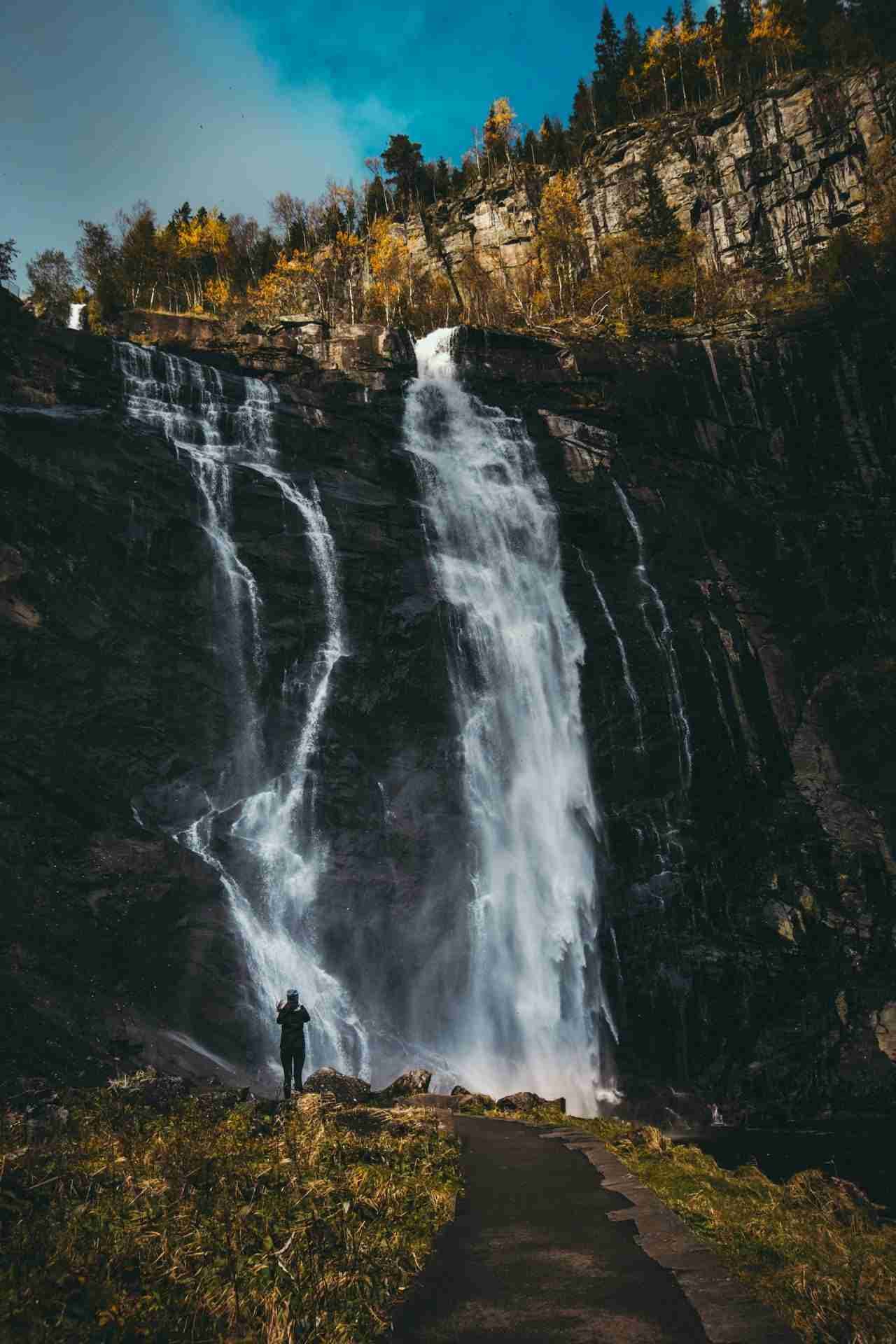
Skjervsfossen is a paired waterfall tucked into a steep valley between Granvin and Voss in western Norway. The falls drop roughly 150m with open viewpoints from both above and below. While it's less visited than some of the better known waterfalls in the region, it offers a lot to work with its clean lines, layered rock, mist in motion, and good access without long hikes. The surrounding cliffs and valley walls act as natural frames, and the water stays consistent year round, fed by streams. For photographers who want strong foregrounds and the ability to move between wide and tight compositions, Skjervsfossen is a flexible and rewarding location.
Best Photography Opportunities
• Lower Viewing Platform
The lower platform near the base of the falls is the easiest place to start and gives a clean view of both waterfall tiers. From here, you can frame the full drop in a single shot or use surrounding rock to create leading lines into the water. A wide lens helps fit the scene without distortion if you step back slightly. This spot also catches mist and spray, which adds depth when lit from the side. Conditions shift with cloud cover, but soft light works best for even exposure and balanced contrast.
• Detail Work in the Rock Face and Water Flow
The exposed cliffs around Skjervsfossen are full of cracked layers and streaks from years of water and mineral flow. These make strong graphic subjects, especially when paired with controlled shutter speeds to show the texture of moving water. A medium zoom lets you pick out patterns or isolate narrow runs of water sliding down the cliff. This kind of shot benefits from overcast weather or indirect light that avoids blown highlights. Look for reflected color from the sky or nearby moss that adds subtle tone variation to the rock.
• Mist and Motion at Close Range
Getting closer to the lower tier puts you inside the mist zone, where the movement of air and water becomes part of the frame. Use a lens hood or protective cover, and work quickly to avoid constant cleaning. This is the best place to capture the energy of the waterfall, especially with a slower shutter to blur the water's fall while the surrounding elements remain sharp. These images hold up well in color or black and white. Just be mindful of contrast and keep highlights from clipping in the water column.
• Upper Lookout
From the road above the falls, you can walk to a viewpoint that looks directly down the top tier. This angle gives a more abstract, graphic composition, showing the water's curve over the edge and the rock's structure beneath. Use a polarizer here to manage reflections in the water before the drop, and watch for foot traffic if shooting from the bridge. In soft morning or evening light, shadows from nearby rock formations add useful contrast.
• Vertical Compositions Along the Path
A well built path connects the upper and lower viewpoints, with railings and sections of exposed rock that create opportunities for vertical framing. These shots work well when including a person for scale or using the railing as a leading line toward the falls. They're also effective in varied weather, especially when light rain darkens the rock surface and adds contrast to the greenery. A narrow aperture helps keep both foreground and background in focus across the vertical depth.
Best Time to Visit
Skjervsfossen flows year round, but the best photographic conditions are in spring and early summer when melt water volume is at its peak. Morning offers the best light for the lower section, while afternoon brings angled light to the upper drop. Cloud cover is common in the area and often helps by reducing harsh shadow and highlight separation. Autumn adds strong color to the valley sides, and fog is frequent in the early hours. Winter access can be limited depending on road conditions, and ice near the falls can become a hazard. Avoid midday unless you're shooting in overcast light, as the contrast between bright sky and shadowed rock becomes difficult to manage.
How to Get There
Skjervsfossen is located just off Rv13 between Granvin and Voss in western Norway. A well marked side road leads directly to a small parking area near the upper viewpoint, and from there, a stone path descends to the base of the falls. The route is paved and maintained, with railings and signage throughout. There is no access fee, and the area is open year round, though icy conditions may close sections during winter. The road is narrow in places, but suitable for standard vehicles, and traffic is generally light.
Recommended Photography Gear
A wide angle lens is essential for capturing the full height of the falls from close range. A standard zoom allows for flexible work between rock textures, midrange shots, and tighter compositions. A tripod is recommended for long exposures and to steady shots in low light. A polarizing filter helps control reflections and deepen water contrast, especially when shooting top down. Bring a lens cloth or weather cover if working near the spray zone. A neutral density filter is useful for blurring motion in the falls, particularly on bright days. Footwear with grip is important on the stone path, which can be slick even in dry conditions.
Nearby Photography Locations
Located just outside Voss, this tall and often mist-covered waterfall features tiered rock and a wide cascade that photographs well in soft or diffused light. It's easy to access and works well for long exposure compositions from multiple distances.
A larger and more dramatic waterfall farther to the east with deep canyon views and a modern footbridge spanning the gorge. Best in early morning for side light and mist, though midday cloud cover also works well here.
• Oppheim Lake
A calm body of water near Voss that reflects mountains and cloud layers when wind is low. Good for symmetry based shots and minimalist compositions, especially in early light or low fog conditions.
• Granvin Church and Surroundings
A small church with simple lines set in an open valley, often surrounded by mist or framed by hills. Works well in soft weather and offers strong structure for documentary or architectural frames.
• Nærøyfjord Viewpoints
A short drive leads to one of the narrowest and most dramatic fjords in Norway, with steep cliffs and deep water. Best shot from above using long lenses to shape the valley and compress the curve of the waterway.
Skjervsfossen doesn't need a dramatic setup or long approach to deliver strong images. With solid access, steady flow, and well designed walkways, it gives photographers the ability to work close, shoot wide, or explore details without rushing. In the right conditions, it's a location that holds up for hours.
Comments
Loading comments…