
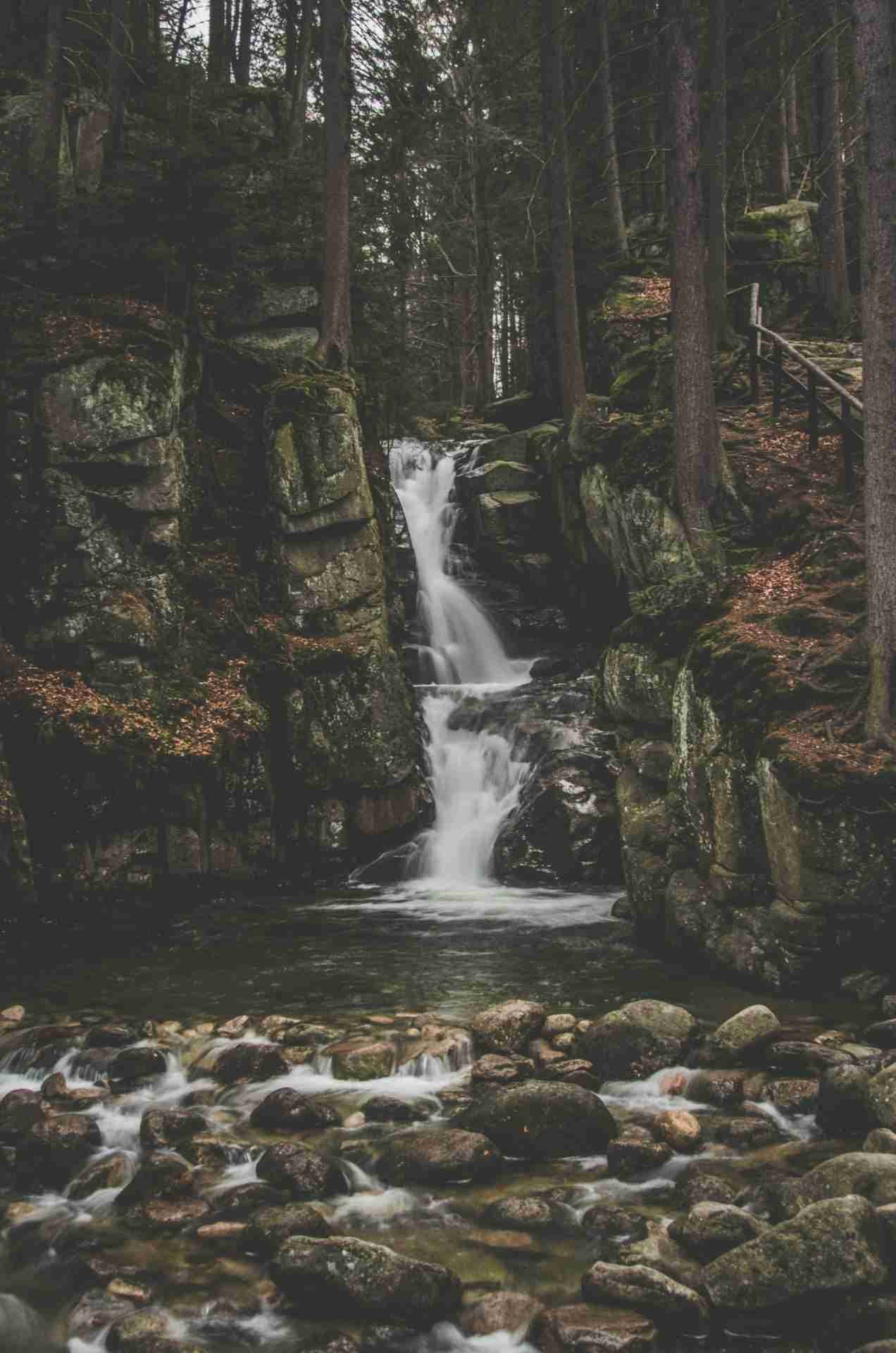
Hidden in a forested valley near the village of Przesieka in southwest Poland, Podgórna Waterfall flows over a series of rocky ledges into a cool, shallow pool. Surrounded by moss covered boulders, pine trees, and thick undergrowth, this compact but photogenic cascade is one of the quieter gems of the Karkonosze region. The waterfall drops in three narrow stages, each with distinct flow and shape, making it a strong subject for long exposure photography. Its setting feels secluded without being remote, and the trail to reach it is short and manageable. With soft morning light filtering through the trees and few distractions in the frame, this location is ideal for creating clean, focused images built around water movement, natural texture, and balanced composition.
Best Photography Opportunities
• Full waterfall composition from the lower pool
The most complete view of Podgórna Waterfall is found directly from the lower edge of the main pool. From here, you can capture the full vertical drop of the cascade along with the rounded basin at its base. Early morning light is best, especially on clear or lightly overcast days when sunlight filters through the trees without hitting the water directly. A tripod is essential for longer exposures to smooth the flow of the falls and reduce surface texture in the pool. Composing with the dark stone walls on either side helps to frame the waterfall and draw attention to the center of the image.
• Side angle with boulders and foreground texture
Moving to the left side of the falls reveals a slightly off center composition with more depth, especially if you include mossy rocks or tree roots in the foreground. This setup benefits from wide angle lenses that exaggerate the foreground scale and guide the eye toward the waterfall. Light here changes quickly, so it's helpful to scout the composition early and return when the light is even or low. Long exposures of one to three seconds will create smooth, ribbon like water while still showing detail in the surrounding rock. Reflections in the pool vary depending on light angle and surface movement.
• Upstream details and micro-cascades
Just above the main waterfall, the stream continues through a series of smaller drops and rock features that offer strong opportunities for detail work. These tighter compositions are perfect for studying water interaction with stone, moss, and vegetation. Overcast conditions help reduce glare and keep the color palette soft and even. A mid telephoto or macro lens gives you flexibility to crop into small patterns or isolate flowing water against textured surfaces. These shots work well in black and white or color, depending on how much tonal range or contrast the scene offers.
• Autumn color
In late September through October, the forest around the falls shifts to warm yellows and orange tones that contrast sharply with the dark stone and white water. This is the best time of year to include broader scenes with more of the canopy and surrounding foliage. Shooting from a slightly higher position along the trail can reveal the full height of the falls framed by color. A polarizing filter is useful here to control reflection off wet leaves and deepen color in the water and sky. This setup works best in the morning when light enters the clearing at an angle.
• Frozen details in winter conditions
During cold snaps in winter, parts of the waterfall freeze into icicles and smooth ice shelves, turning the scene into a completely different subject. Depending on snowfall, the rocks and trails may be covered, but the flow of the water often continues beneath sheets of ice. A tripod, gloves, and winter boots are essential for safe and stable shooting. Exposures tend to be longer in low light conditions, so a remote release or timer helps keep images sharp. Including the frozen pool and surrounding ice makes for graphic, textured compositions that are more about form and contrast than motion.
Best Time to Visit
Podgórna Waterfall can be photographed year round, but the best time to visit depends on your preferred lighting, foliage, and water conditions. In spring, the falls are at their strongest with snowmelt adding volume and speed. The greenery is fresh and bright, and the light filtering through the new leaves adds a subtle glow to the surrounding rocks and water. Early morning visits offer the most balanced light, with less glare and minimal foot traffic.
Summer brings denser foliage and dappled sunlight through the canopy, which creates shifting patches of highlight and shadow throughout the scene. If shooting during this season, aim for early or late in the day when the sun is low. Overcast conditions are also helpful for maintaining detail in the waterfall and surrounding textures.
Autumn is the standout season, with colorful leaves and reduced water levels making it easier to photograph foreground elements and reflective surfaces. The warm tones of the forest contrast well with the cool white of the water, especially under diffused light.
Winter visits require more preparation but can produce striking results. Snow and ice change the shape and color of the landscape entirely. Light is soft throughout the day, and the contrast between snow covered rocks and moving water is visually strong. Access may be more limited depending on trail conditions, but weekday mornings are often quiet and productive for photographers.
How to Get There
Podgórna Waterfall is located near the village of Przesieka in the Lower Silesian Voivodeship of southwest Poland. The trailhead begins near the end of Droga Turystyczna, a local road that leads from the village center. There is a small gravel parking area available near the start of the trail, with space for several cars. The trail is clearly marked and follows a forest path that leads to the waterfall in about 10 to 15 minutes on foot. The path is well maintained but can be slippery after rain or in winter.
No fees or permits are required to access the waterfall or the trail, and the area is open year round during daylight hours. Tripods are allowed, and there are no restrictions on personal photography. The trail is popular with hikers and casual visitors, so early mornings and weekdays offer the quietest experience for uninterrupted shooting. The waterfall itself is set just off the main trail and can be reached with a short detour down to the water's edge.
Recommended Photography Gear
For full views of the falls and surrounding area, a wide angle lens between 16 and 35 millimeters works well to include both the water and the forest in one frame. A standard zoom in the 24 to 70 millimeter range is helpful for mid range compositions and allows you to work from slightly farther back while still maintaining detail. For upstream sections and tight detail work, a macro or short telephoto lens helps isolate water patterns, moss, and rock surfaces.
A sturdy tripod is essential for long exposure work, especially in low light or when smoothing the water flow. A polarizing filter helps reduce glare on wet surfaces and brings out color in the foliage and rock. A neutral density filter is useful for controlling shutter speed during brighter parts of the day, allowing you to extend exposure without overexposing the highlights in the water.
In cooler seasons or after rain, waterproof boots and weather resistant clothing are recommended, as some compositions require stepping onto wet rocks or standing near the edge of the stream. Bringing a lens cloth or microfiber towel is also useful for wiping off spray or condensation from the front element. The location is compact, so you don't need to carry a full gear kit, but it helps to have options for both wide and tight shots.
Nearby Photography Locations
Located just a short drive from Przesieka, this mountaintop ruin offers expansive views over the Karkonosze foothills. The stone walls and forested surroundings are especially photogenic in the morning or during misty weather. A short hike is required, but the view from the top is well worth the effort.
• Karpacz and the Łomnica River
This nearby town sits along a small river with wooden bridges, water features, and access to trails leading into the Karkonosze Mountains. The riverside area is good for long exposure work with moving water and small cascades under tree cover.
One of the most well-known waterfalls in the region, Kamieńczyk offers a taller and more powerful cascade in a narrow canyon setting. It's busier than Podgórna but makes a great companion location, especially during spring and autumn when the flow is strongest.
Located just outside of Szklarska Poręba, this waterfall drops into a tight curve surrounded by pine forest. It's an easy walk from the main road and well suited for long exposures from a low platform near the water. Early morning is the best time to photograph without crowds.
A wide open body of water located between Przesieka and Karpacz, this spot offers panoramic views of the surrounding hills and low mountains. It's a good location for sunset or sunrise when the light reflects across the surface and the sky opens up behind the peaks.
Podgórna Waterfall is not a large or crowded destination, which is exactly what makes it a strong location for landscape photography. Its shape, setting, and surrounding textures create scenes that are clean and well balanced, with enough variety to support multiple compositions. Whether you're looking to practice long exposure work, capture autumn color, or shoot quiet winter scenes, the short trail and natural layout make this a place that's easy to return to with fresh ideas each time.
Comments
Loading comments…