
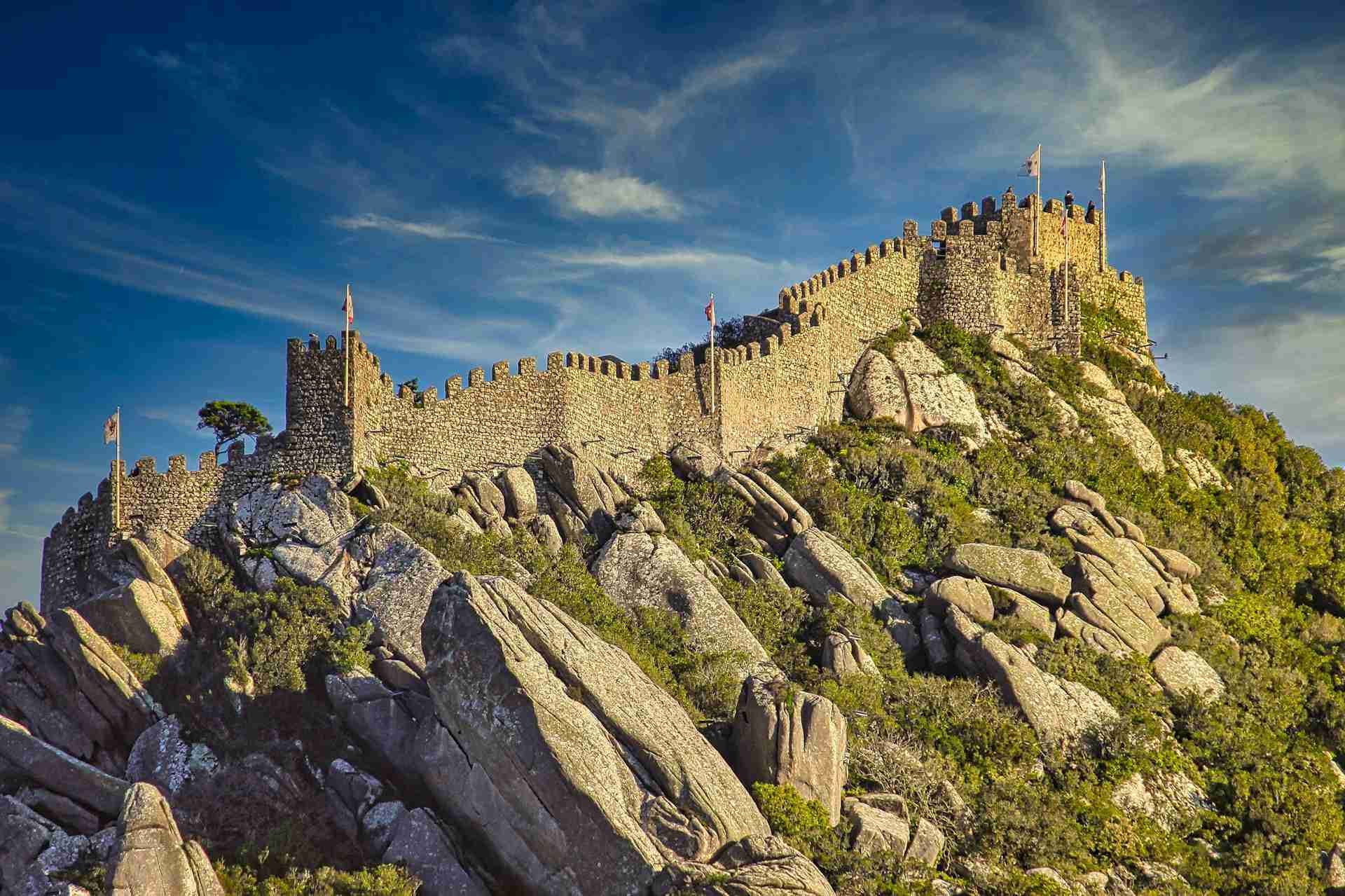
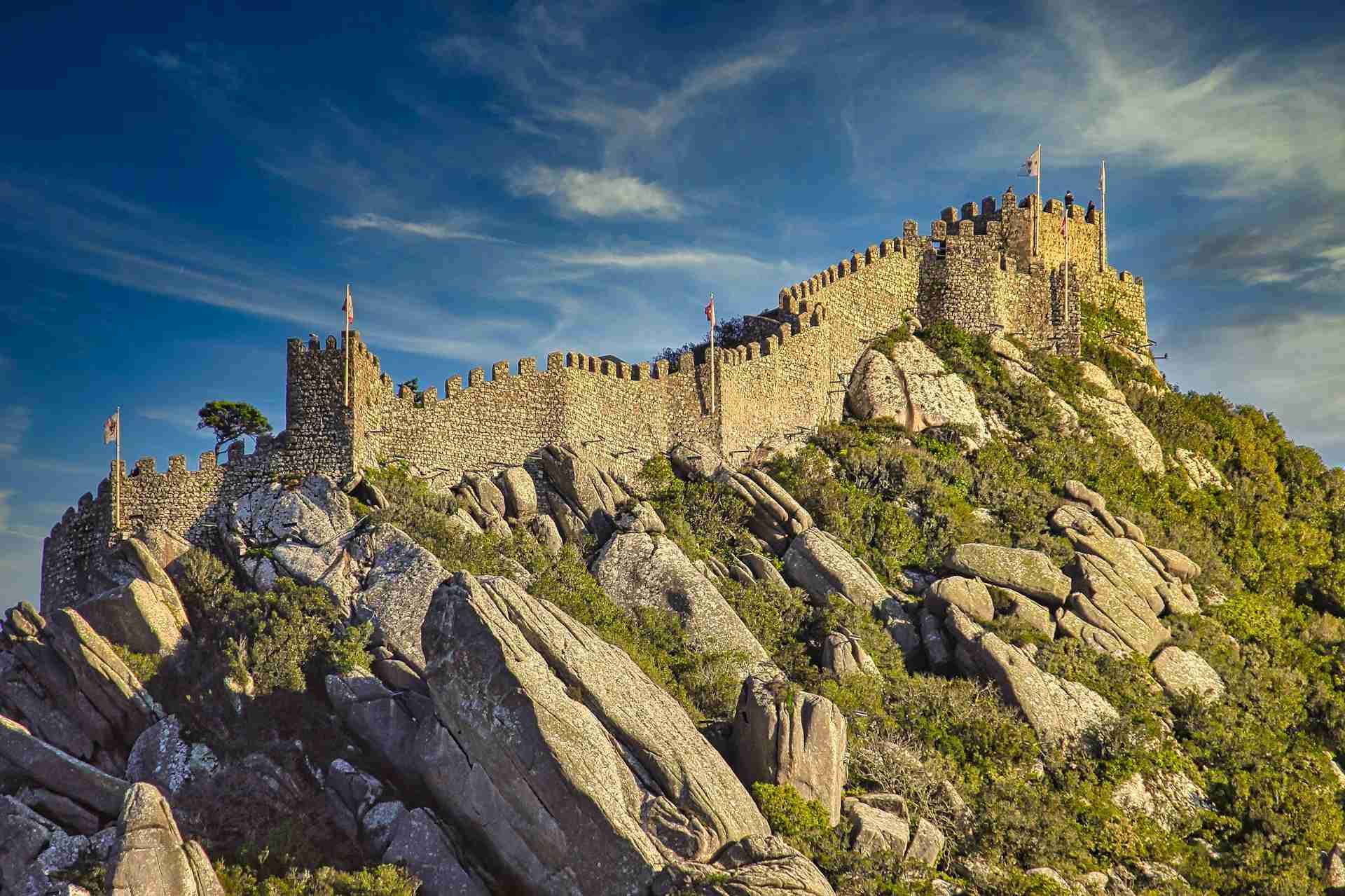
Perched high on the Serra de Sintra, the Castelo dos Mouros is a fortress that winds across the ridge in a dramatic chain of walls and towers. Built by the Moors in the 8th and 9th centuries, the castle was strategically positioned to oversee the coastline and control approaches to Lisbon. Today its weathered stone ramparts still snake across the mountain, offering some of the most commanding views in all of Portugal. For photographers, the site presents a combination of architectural history, rugged natural setting, and sweeping panoramas that shift with light and weather. The castle's irregular layout and jagged silhouette create compositions that balance human construction with the rawness of mountain and forest. With mist often drifting in from the Atlantic, Castelo dos Mouros is a place where atmosphere transforms stone into story.
Best Photography Opportunities
• Wide Views of the Ramparts from Approach Paths
As you climb toward the castle, several points along the trail provide elevated views of its walls zigzagging across the ridgeline. These sweeping perspectives highlight the way the fortress integrates with the topography. A wide-angle lens is effective here, capturing the scale of the walls as they rise and fall with the ridge. Early morning side light adds depth and relief to the stone, while mist in the valleys below enhances the sense of height. These views make for excellent introductory frames that establish the setting.
• Panoramic Scenes from the Towers
Once inside the castle, climbing the towers rewards you with expansive panoramas over Sintra, the Atlantic coast, and the rolling hills inland. These vantage points are ideal for wide landscape compositions, especially during clear weather when the horizon is sharply defined. Telephoto work is also rewarding, allowing you to compress the layers of hills, villages, and coastline into textured scenes. Sunrise and sunset from the towers are especially photogenic, when the low sun casts long shadows across the walls and warm tones play on the stone. On clear days, you can even capture Lisbon's skyline faintly in the distance.
• Detail and Texture in the Stonework
The castle walls are built of rugged granite blocks, weathered by centuries of wind and rain. These surfaces provide rich material for close-up photography, where lichen, cracks, and shadows form abstract patterns. Shooting along the crenellations reveals repeating shapes that can be composed graphically with the sky. On overcast days, soft light enhances texture without harsh contrast. These detail studies offer a quieter counterpoint to the grand panoramas and give a sense of the age and endurance of the structure.
• Castle in Context with Pena Palace
From certain points along the walls, Pena Palace can be seen rising in vivid color from the neighboring ridge. Including both Pena and the Moorish Castle in the same frame creates a striking juxtaposition of architectural styles and eras. Wide compositions can place the two landmarks together, while telephoto framing isolates Pena against the castle walls in the foreground. This interplay of landmarks is best photographed in clear afternoon light, when both ridges are evenly illuminated and the colors stand out strongly against the forest.
• Atmospheric Shots in Fog and Mist
Sintra is famous for its frequent mist, which often drifts across the mountains and cloaks the castle in atmosphere. In these conditions, the walls appear to fade into the fog, creating moody, almost otherworldly compositions. Telephoto isolation works well here, picking out towers or sections of wall emerging from the haze. Wide shots capture the walls disappearing into whiteness, emphasizing the castle's age and endurance against the elements. Misty conditions can occur at any time of day, but mornings are especially likely to bring low clouds.
Best Time to Visit
The Castelo dos Mouros is photogenic in every season, though the character of the site changes with light and weather. Spring brings fresh greens to the surrounding forests and soft, balanced light that enhances both landscapes and detail work. Summer offers the clearest skies and longest shooting windows, though midday can be harsh and the site is busiest with visitors. Autumn introduces warm color into the hillsides, providing strong contrasts against the grey stone. Winter can be quieter and moodier, with frequent fog, lower sun angles, and occasional rain that deepens color in the rock. For daily timing, early morning offers calm conditions, mist, and fewer people, while sunset creates warm light on the western-facing walls. Overcast conditions are excellent for detail studies, while clear days are best for panoramic views.
How to Get There
Castelo dos Mouros is located in Sintra, about 30 kilometers northwest of Lisbon. Trains run frequently from Lisbon's Rossio Station to Sintra in about 40 minutes. From the station, visitors can take local buses or taxis up the steep mountain roads to the castle entrance, or hike via marked trails through the forest, which takes roughly 45 minutes to an hour. By car, limited parking is available near the site, but spaces fill quickly, especially in summer. Entrance requires a ticket, which includes access to the walls and towers. Tripods are permitted, though space can be limited on the narrow walkways, so patience is required when other visitors are present. Drones are restricted due to the castle's heritage status and its proximity to other Sintra landmarks. Comfortable footwear is essential, as exploring the walls involves climbing uneven stone steps and navigating steep sections.
Recommended Photography Gear
A flexible kit is ideal for photographing the Castelo dos Mouros, as the site offers both sweeping landscapes and fine architectural detail. A wide-angle lens between 14 and 24 millimeters is essential for capturing the full expanse of the walls and towers. A mid-range zoom, such as 24 to 70 millimeters, provides versatility for general compositions along the walkways and for contextual shots that include Pena Palace. A telephoto lens up to 200 millimeters is highly useful for compressing landscapes, isolating towers in mist, or framing Pena Palace against the castle. A sturdy but portable tripod is important for long exposures during misty or twilight conditions, though space constraints may require careful positioning. A circular polarizer can help manage glare and deepen sky contrast, especially during bright summer days. Neutral density filters are useful if you want to work with long exposures on moving fog or clouds. Good hiking shoes, a weatherproof bag, and lens cloths are essential, as the site is exposed to sudden changes in weather.
Nearby Photography Locations
Located just a short walk from the Castelo dos Mouros, Pena Palace is a colorful 19th-century Romantic masterpiece that contrasts dramatically with the grey stone of the Moorish walls. Its bold colors and ornate towers are best photographed in morning light before crowds arrive.
A mansion and estate filled with gardens, grottos, and the famous Initiation Well. The site offers atmospheric compositions of spiral staircases, tunnels, and symbolic architecture. Overcast days work particularly well here to capture detail without harsh shadow.
This exotic palace surrounded by landscaped gardens offers strong architectural and botanical photography opportunities. Its domes and arches are particularly photogenic in side light, while the gardens provide seasonal color.
About a 20-minute drive from Sintra, this is the westernmost point of mainland Europe. The cliffs and lighthouse provide dramatic coastal photography, especially at sunset when the Atlantic horizon glows with color.
Situated in the historic center of Sintra, this palace is known for its twin chimneys and mix of Gothic, Manueline, and Moorish styles. It is best photographed in late afternoon when the façades are bathed in warm light and the old town comes alive.
Castelo dos Mouros is a place where stone, forest, and atmosphere meet in a timeless dialogue. Its weathered walls and elevated views reward both wide landscape visions and intimate detail studies. For photographers, it is a location that demands time and patience, where light and weather can transform the same wall or tower into something entirely new from one moment to the next.
Comments
Loading comments…