
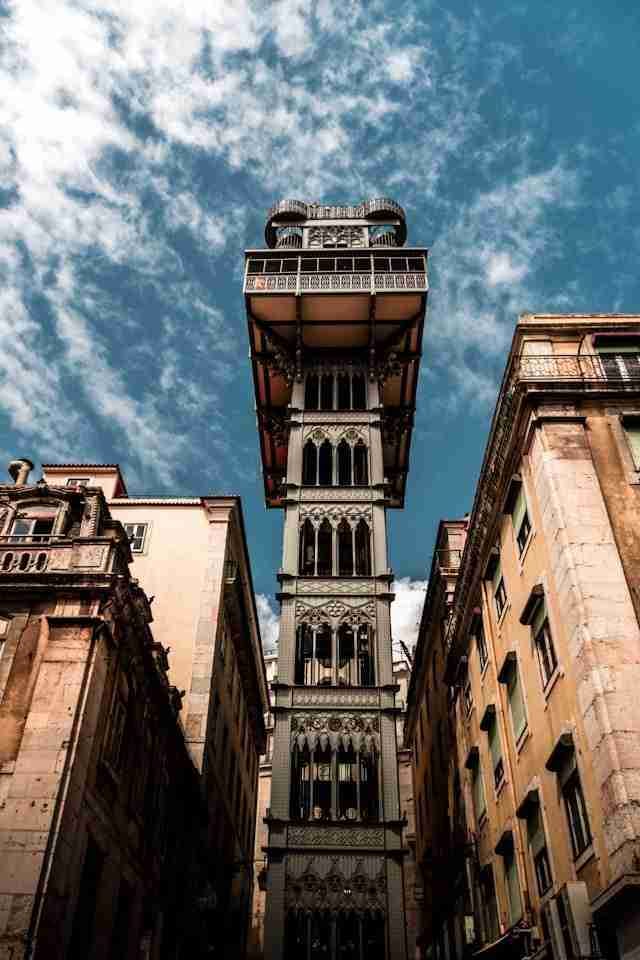
Rising between the bustling streets of Baixa and the elevated calm of the Carmo Convent, the Elevador de Santa Justa is one of Lisbon's most celebrated feats of urban engineering. Constructed at the beginning of the twentieth century, this wrought-iron vertical lift was designed by Raoul Mesnier du Ponsard, a Portuguese engineer who was heavily influenced by the architectural style of Gustave Eiffel. With its neo-Gothic embellishments, intricate iron latticework, and panoramic terrace above, the elevator has become an essential photographic subject in Lisbon. It not only represents a moment of technological optimism in the city's history but also offers a rare vertical framing opportunity in a city defined by sloping alleys, tiled walls, and rising light. Photographers will find opportunities at every level, from ground perspective to elevated vistas, where structure, shadow, and motion all converge.
Best Photography Opportunities
• Iron Details and Ornamental Filigree
The elevator's iron framework is a masterpiece of decorative engineering. Its scrollwork, geometric lattice patterns, and riveted plates form a textured skin that transforms with every shift in light. Use a macro lens or a standard zoom to isolate specific elements such as floral motifs or cast-iron flourishes that resemble lace. Early morning light from the east strikes the iron from the side, casting intricate shadows across nearby walls and sidewalks. Get close and shoot upward to create tension between weight and ornament, allowing the vertical composition to guide the viewer's eye. A black and white treatment can emphasize texture and contrast, stripping away distraction and focusing on the interplay of form and shadow.
• Interior Lift Ride and Framed Perspectives
Once inside the lift, the visual dynamic shifts to a dramatic vertical experience. The interior, enclosed in iron lattice panels, reveals a layering of views as the lift ascends. Photograph from the floor with your lens pointed up to emphasize verticality, or shoot through the patterned grilles as the cityscape changes with elevation. Wide-angle lenses are especially effective for creating immersive compositions that include both interior structure and glimpses of Baixa's rooftops. On the descent, reverse the focus and shoot through the same patterns, this time capturing people silhouetted against Lisbon's skyline. The slow speed of the lift provides just enough time to adjust settings and reframe mid-motion.
• Top Platform Vistas and Rooftop Geometry
At the summit, the viewing platform delivers a sweeping panorama of Lisbon's red-tiled roofs, the Tagus River, and distant landmarks like the 25 de Abril Bridge and São Jorge Castle. The scene is layered and complex, so start with a wide lens to establish the spatial breadth, then move to a medium telephoto to compress elements and create a more graphical approach. Look for visual rhythm in the rooftops or the way alleyways snake through the city below. At sunset, the warm light kisses the city's surface while the cast-iron rails of the platform glow subtly. This is a perfect setting for a combination of architectural photography and cityscape storytelling.
• Night Lighting and Long Exposures from the Ground
After dark, the elevator is lit softly from within, turning its skeletal frame into a glowing beacon. From the base in Rua de Santa Justa or further back along Rua Augusta, use a tripod to frame long exposure shots. Moving traffic adds light trails that contrast with the stationary structure, while the internal lights illuminate the metalwork with golden tones. Rainy evenings enhance the scene further, turning the cobblestones into reflective surfaces. Try positioning yourself behind passing figures or lampposts for layered compositions that balance sharp structure with atmospheric blur. A timed exposure of ten to twenty seconds is often sufficient to reveal the full glow of the tower and its urban surroundings.
• People, Queues, and Public Space Interaction
Throughout the day, the elevator attracts a steady flow of people: tourists waiting in line, couples gazing upward, and street performers drawing a crowd nearby. These human elements offer street photography opportunities that contextualize the monument as a lived space rather than a static object. Use a medium focal length lens to frame candid moments from a discreet distance. Capture the quiet anticipation of people in line, the rhythm of movement up the stairs to the viewing deck, or the delight of someone seeing Lisbon from above for the first time. These images offer an emotional anchor that complements architectural shots.
Best Time to Visit
The elevator and its surrounding plaza are most photogenic in the early morning, just after sunrise. The eastern light pours down Rua de Santa Justa and washes the iron structure with a warm tone, perfect for exterior shots of the tower against a quiet urban backdrop. During this time, crowds are minimal, making it easier to shoot from different angles without interruption. It is also the best time to capture the texture of the ironwork without harsh overhead light.
As the day progresses, the lift becomes one of the busiest tourist attractions in the city. While midday can be crowded, the light at this time is ideal for shooting close-up iron textures or high-contrast compositions where sun and shadow carve dramatic patterns into the walkways and façades. Cloudy midday skies provide even light, ideal for documenting the finer details of the structure without glare.
Golden hour, beginning in late afternoon, transforms the view from the top platform. The sun moves behind the river, illuminating the city's rooftops with a soft, golden wash. This is the time to switch from ground-level photography to elevated cityscapes. Blue hour offers a particularly dramatic atmosphere as the elevator is illuminated and the surrounding city begins to sparkle with lights. After rain, this becomes even more powerful, as reflections amplify the glow of streetlamps and windows. For long exposure work, arrive about twenty minutes after sunset and prepare to shoot until the sky deepens into rich indigo.
Seasonally, the elevator performs well photographically throughout the year. Summer evenings offer long hours of usable light, while winter's low sun creates prolonged golden hour conditions. Spring brings crisp air and cleaner skies, ideal for shooting distant views from the top deck. Autumn introduces a warmth to Lisbon's palette that enhances color contrast in street scenes and rooftop photography.
How to Get There
Elevador de Santa Justa is located in Lisbon's Baixa district, between Rua do Ouro and Largo do Carmo. It is easily accessible by public transit and ideally situated for those exploring on foot. The closest metro station is Baixa-Chiado, which connects both blue and green lines. From there, it is a five-minute walk downhill to the elevator entrance. The popular tram 28 also stops nearby, offering a scenic route through the city's historic neighborhoods.
Pedestrian routes from Praça do Comércio and Rossio Square are flat and direct, taking no more than ten minutes. While driving is not recommended due to narrow streets and limited parking, taxis and rideshare services are available from all parts of the city. Bicycles can be parked nearby, but riding uphill to Bairro Alto may be strenuous for some.
Entrance to the elevator requires a ticket, which can be purchased at the base or included in a 24-hour public transport pass or the Lisboa Card. Entry includes access to both the lift cabin and the upper walkway leading to the Carmo Convent. During peak tourist seasons, queues can grow quickly, so plan to arrive early or late in the day to avoid waiting. Photography is permitted throughout, although tripod use inside the cabin may be discouraged during busy hours. The upper viewing platform remains one of Lisbon's best free-roaming elevated spaces, and it rewards those who take the time to frame the city carefully.
Essential Gear Recommendations
To photograph Elevador de Santa Justa effectively, you will want a mix of wide and medium focal length lenses. A wide-angle lens between 16 and 35 millimeters is ideal for capturing both the iron structure from the base and the panoramic views from the top. Use it to emphasize vertical lines when shooting from the ground, or to create expansive rooftop views from the platform.
A standard zoom, such as a 24 to 70 millimeter, provides flexibility for street scenes, interior compositions, and framing people within the urban space. For capturing rooftop compression and isolating distant landmarks, a short telephoto lens between 85 and 135 millimeters is very useful. It also allows you to shoot details of the ironwork or frame portraits of visitors engaging with the structure.
Fast primes, particularly a 35 millimeter f1.4 or 50 millimeter f1.8, are excellent for handheld shooting in low light and for capturing expressive, intimate moments around the base or within the elevator cabin. A lightweight travel tripod is highly recommended for golden hour and blue hour long exposures. It is small enough to carry comfortably through busy areas but stable enough for low shutter speed work.
Additional essentials include a polarizing filter to manage reflections off glass and metal, and a neutral density filter to smooth movement in street scenes or water reflections. Bring extra batteries and memory cards if you plan to shoot throughout the day. Lisbon's humidity and salty air may require frequent lens cleaning, so pack a microfiber cloth and consider a weather-resistant cover for your camera bag if you are shooting in wet conditions.
Nearby Photography Locations
Just steps uphill from the elevator, this roofless Gothic convent offers towering stone arches open to the sky. Its skeletal architecture is best photographed during golden hour when the remaining structure casts long shadows through the open nave. Capture both wide shots of the full frame and close details of the worn stone for historical texture.
• Rua Augusta Arch
Descending from the elevator toward Praça do Comércio, the Rua Augusta Arch presents a neoclassical counterpoint to the iron tower. Its symmetry and carved figures are perfect for frontal compositions. Try framing the arch with the elevator in the background for a layered narrative of Lisbon's architectural eras.
• São Julião Church Rooftop Viewpoint
Just a block away, this elevated terrace offers a different angle on the elevator and the Baixa rooftops. Shoot during late afternoon when the rooftops glow and the elevator catches golden light against a pastel sky. The church's rooftop also provides a quieter vantage point free from crowds.
To the west, the Chiado neighborhood offers narrow streets, tiled façades, and creative shopfronts. Use the descending lines of the streets to lead the viewer's eye toward the elevator tower in the distance. Morning light here reflects off bright walls, making for dynamic contrast and color.
A longer walk or short ride uphill, the castle grounds provide a commanding view over the city. From the ramparts, you can frame the elevator tower as part of the Lisbon skyline, with the river and bridge stretching beyond. This location is ideal for wide city panoramas and deep telephoto layering.
The Elevador de Santa Justa offers far more than a ride. It is a monument to vertical vision, a platform for capturing Lisbon from above and below, and a rare subject where engineering elegance and human rhythm converge. For photographers willing to explore it at different times and angles, the rewards are both architectural and emotional.
Comments
Loading comments…