
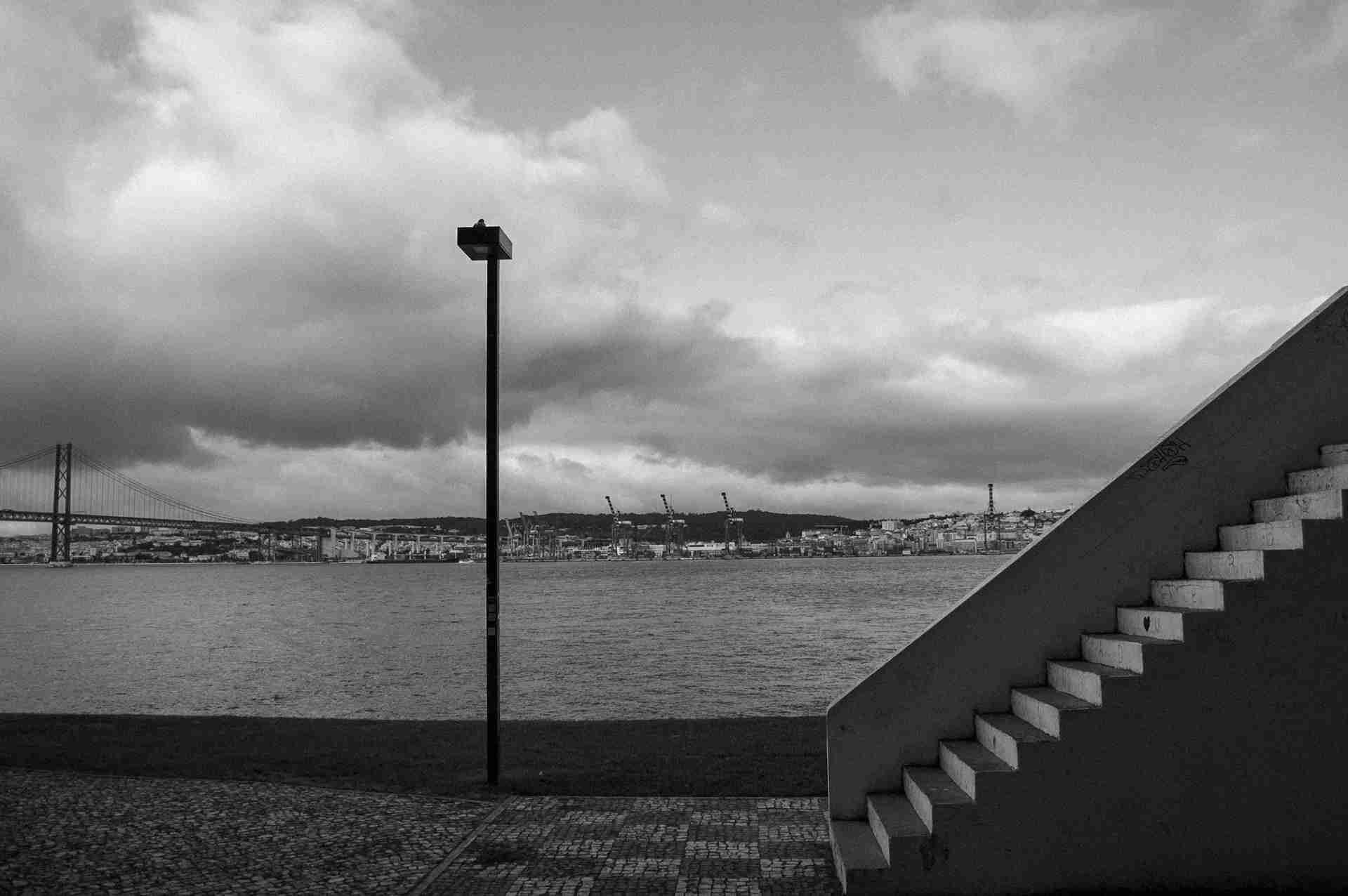
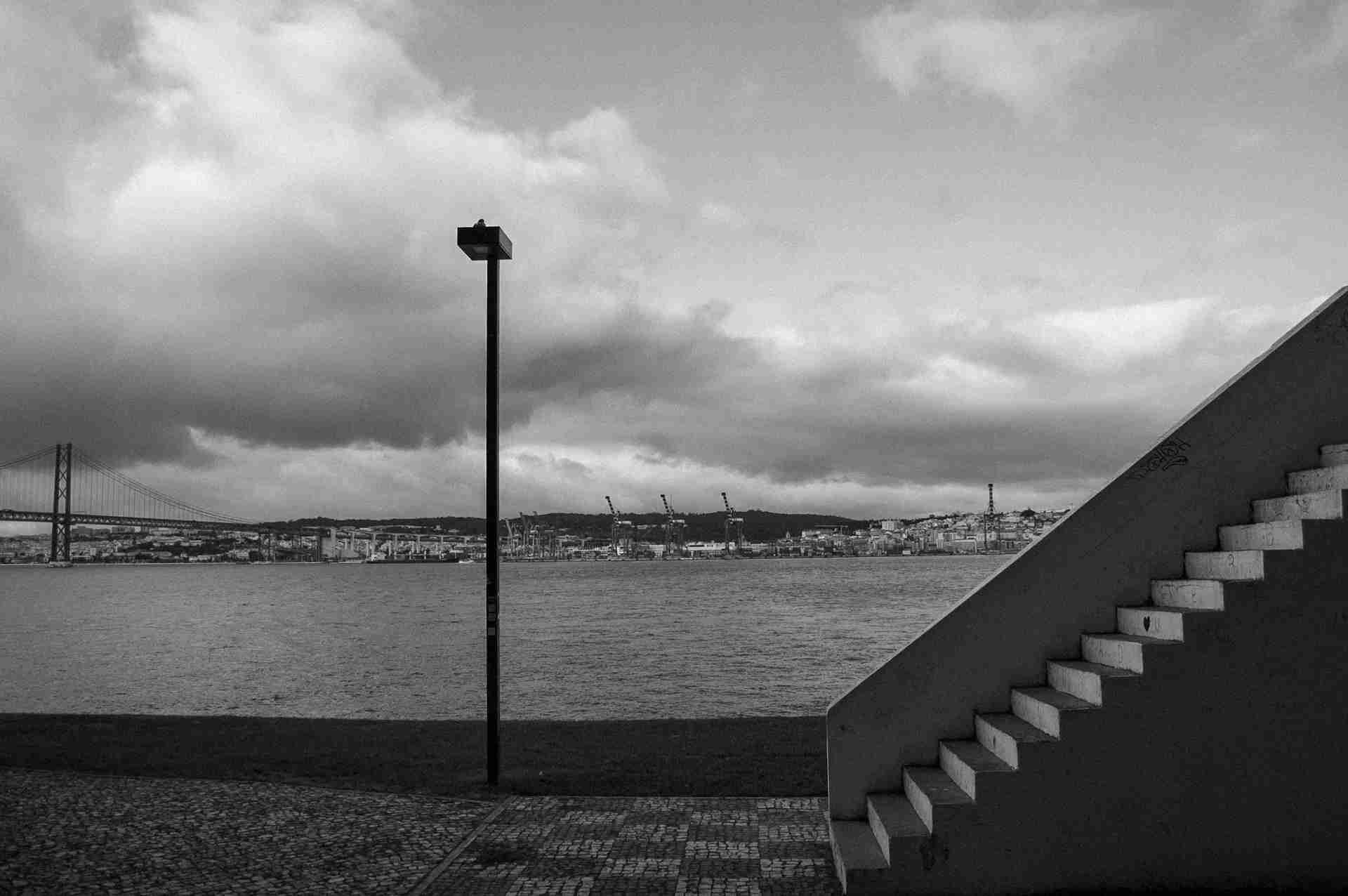
Nestled along the banks of the Tagus River in Almada, Jardim do Rio is a quiet yet visually engaging public space that blends modern sculpture, historical context, and sweeping views across to Lisbon. The park's standout feature is a unique staircase sculpture that appears to rise impossibly into the sky—an architectural gesture that invites both symbolic and compositional exploration. Coupled with open sightlines to the 25 de Abril Bridge and Cristo Rei towering above, this location offers a variety of urban and minimalist subjects. The gentle rhythm of the river, changing light throughout the day, and playful geometry of built forms make this an ideal spot for photographers interested in structure, negative space, and human interaction with landscape.
Best Photography Opportunities
• Stairway Sculpture Against the Sky
The defining feature of Jardim do Rio is the striking stair sculpture, an illusionistic piece that ascends vertically without any visible support. Best photographed from low angles, the stairs appear to climb directly into the sky, creating strong visual impact. Use a wide-angle lens to exaggerate its upward thrust, especially on days with clean blue skies or fast-moving clouds that enhance the illusion. For more graphic compositions, place the structure off-center using negative space to let it stand alone. Silhouetting the stairs during golden hour or backlighting them at sunset transforms the sculpture into a bold shape that hovers above the river.
• Bridge and Monument Framed from the Riverside
Jardim do Rio sits directly beneath the Almada side of the 25 de Abril Bridge, offering a powerful low-angle view of its steel structure stretching across the water. Including the Cristo Rei statue in the background completes the visual triangle between sculpture, engineering, and religious monument. Shoot at a medium focal length to balance these elements in frame, using the riverside walkway or railing as a leading line. Early morning light from the east backlights the bridge and glows off the surface of the Tagus, while afternoon sun paints warm tones across the structure's red-painted trusses.
• Abstract Reflections and Pavement Geometry
The park's layout includes clean, modern surfaces with geometric paving, benches, and planters that reflect early or late light in distinct patterns. After a rain or during morning mist, puddles form that mirror fragments of the bridge and sculpture. Use a telephoto or macro lens to isolate these elements and experiment with abstraction. Pay attention to how shadows from the stairs fall across flat surfaces or how puddles distort perspective. These compositions work best under soft light conditions, when reflections are clearer and contrast is moderate.
• Minimalist Portraits and Environmental Study
The open plaza and scale of the sculpture make Jardim do Rio a compelling location for environmental portraiture or street photography with a minimalist backdrop. The absence of visual clutter allows figures to stand out clearly against sky, water, or built elements. Position subjects in silhouette on the sculpture itself or framed within the bridge supports for dramatic layering. Overcast conditions are excellent for reducing harsh shadows and keeping skin tones even in portraiture. This is also a good place to document interaction between people and public space without distraction.
• Twilight Cityscape Across the River
As evening falls, the lights of Lisbon's waterfront begin to shimmer across the water, creating a calm and balanced cityscape. From the edge of Jardim do Rio, use a tripod and long exposure to capture the subtle movement of the river and the reflection of distant lights. The bridge's illumination adds structure to the scene, while Cristo Rei glows softly above. This time of day provides a cool palette that contrasts well with the sculpture's linear shape. Position the sculpture to one side of the frame to balance the open sky and urban sparkle across the water.
Best Time to Visit
Golden hour and early twilight are the most rewarding times to photograph Jardim do Rio and its staircase sculpture. Late afternoon sun from the west casts long, defined shadows and brings warmth to the steel and concrete elements. The sky takes on color over the Tagus, and the sculpture becomes more defined against the changing backdrop.
Morning light is softer and ideal for photographing details of the paving and nearby vegetation. Early in the day, the park is quieter, with fewer people on the paths or using the sculpture as a platform, making it easier to isolate your subject.
Overcast days can be surprisingly effective at this site. The absence of strong directional light enhances symmetry and simplifies the composition of the stairs and plaza. These conditions are also helpful for abstract or graphic work, especially when capturing reflections or the subtle tonal differences between stone, sky, and water.
Sunset provides a dramatic opportunity to silhouette the staircase sculpture, especially on clear days when the horizon glows behind it. Blue hour allows for city lights across the river to come into balance with the sky, making long exposures from the riverside walkway particularly rich.
How to Get There
Jardim do Rio is located along the waterfront in Almada, just south of the ferry terminal at Cacilhas. From Lisbon, take the ferry from Cais do Sodré across the Tagus to Cacilhas, which takes about fifteen minutes. From the terminal, it is a short walk south along the promenade directly into the park.
If arriving by car, cross the 25 de Abril Bridge and follow signs toward Cacilhas. Parking is available near the terminal and in nearby side streets. The site is flat and accessible, with paved paths and open plaza space suitable for tripods and equipment setup.
There are no entry fees to access the park or sculpture, and the area remains open year-round. The park is typically less crowded on weekdays and in early mornings or later evenings. Tripods are permitted, and the open space makes it easy to work with a range of gear sizes without blocking others. Restrooms and cafés are nearby, and the surrounding marina area offers additional photographic interest.
Recommended Photography Gear
A wide-angle lens between 14 and 24 millimeters is useful for capturing the full height of the staircase sculpture, especially when standing close or shooting upward from the base. A 24 to 70 millimeter lens is ideal for mid-range work that includes the sculpture, bridge, and skyline in balanced compositions.
A 70 to 200 millimeter telephoto lens will help isolate structural details, compress the elements across the river, or crop into patterns formed by the bridge supports. A tripod is essential for twilight and night photography, particularly when capturing long exposures of city lights and reflections on the Tagus River.
A polarizing filter helps manage reflections on the water or ground after rain and enhances sky color on clear days. A neutral density filter is helpful for softening motion in the river or clouds during longer exposures. A lens hood is also recommended, particularly when shooting into direct sunlight or low-angle flare during golden hour.
Bring spare batteries and a lens cloth, especially if working in windy or misty conditions near the river. A compact shoulder bag or backpack is ideal for moving between the different angles and elevations within the plaza. Good footwear is helpful on the large stone pavers, especially if climbing for alternate vantage points near the sculpture.
Nearby Photography Locations
Just a short walk inland, this scenic elevator offers sweeping views of Lisbon, the Tagus River, and the bridge from an elevated perspective. It is an excellent spot for sunrise or blue hour cityscapes.
Photograph ferries arriving and departing with the Lisbon skyline behind them. Early morning light reflects beautifully off the water and boats, and the terminal itself has interesting structural lines.
This semi-abandoned riverfront street runs beneath cliffs and includes decaying warehouses, graffiti, and quiet corners perfect for urban exploration and grittier textures.
• 25 de Abril Bridge Underside
Photograph the underside of the bridge up close by walking along the waterfront from Jardim do Rio. The structure provides excellent vanishing point compositions and repeating patterns.
A steep walk or short drive uphill leads to this monumental statue and viewing platform, offering panoramic shots back toward Lisbon and down to Jardim do Rio itself. Combine images from both locations for a layered visual narrative.
Jardim do Rio and its surreal staircase sculpture offer more than novelty. They provide a thoughtfully designed space where form meets light and simplicity reveals creative opportunity. For photographers seeking clean lines, symbolic gestures, and layered urban context, this riverside park is a location that continues to surprise with its compositional clarity and riverside calm.
Comments
Loading comments…