
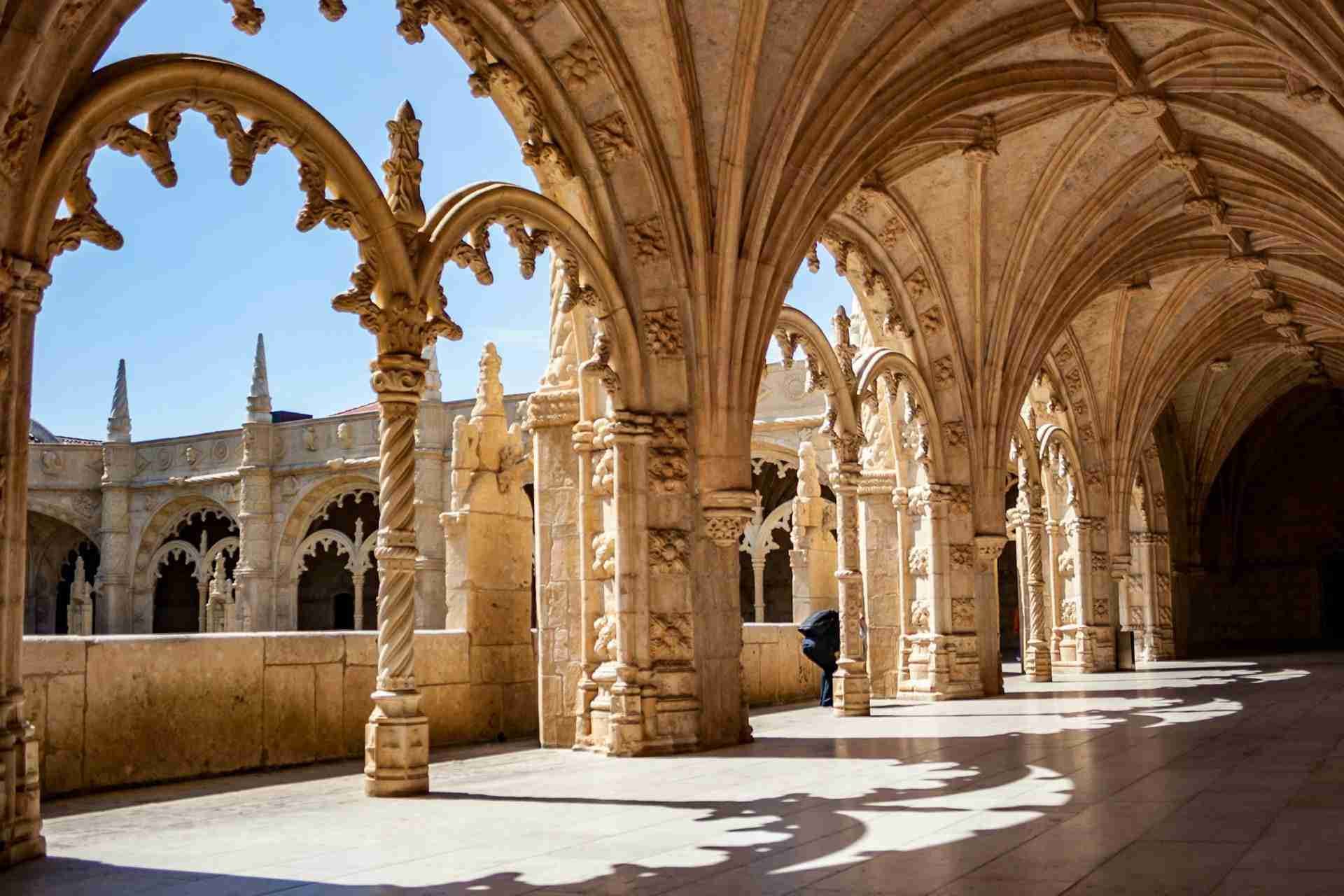
Jerónimos Monastery in Lisbon's Belém district is one of Portugal's most beautiful architectural landmarks. Built in the early sixteenth century and funded largely by the riches of maritime exploration, this monastery stands as a monument to the Age of Discovery. It showcases the height of the Manueline style, a uniquely Portuguese interpretation of Late Gothic that integrates maritime themes and intricate stone carving into monumental design. For photographers, Jerónimos Monastery offers a stunning array of visual material: lace-like cloisters, sweeping vaulted ceilings, elaborate portals, and the ever-changing light that filters through its sculpted forms. Whether you are documenting architectural grandeur, quiet historic spaces, or the play of light and shadow through stone tracery, the monastery rewards both the technical photographer and the visual storyteller.
Best Photography Opportunities
• Manueline Portals and Ornate Entryways
– The western and southern portals of the monastery are richly decorated with symbolic carvings that reflect Portugal's maritime past. Ships, corals, ropes, and religious iconography are all layered into the stone in astonishing detail. These entryways are best photographed during early morning or late afternoon when the sun casts low, angled light that enhances the relief and reveals shadow depth in the carvings. Step back with a wide-angle lens to capture the scale of the portals against the stone walls, or move in with a short telephoto lens to isolate intricate elements like heraldic emblems and sculpted saints. These portals are not merely decorative but serve as a narrative map of Portugal's age of exploration, making them a rich subject for both documentary and artistic approaches.
• Vaulted Ceilings and Nave Geometry
– Inside the Church of Santa Maria, which is part of the monastery, the ribbed vaulting presents a symmetrical masterpiece of Gothic engineering. The central columns rise like palm trunks before flowering into ribs that extend across the ceiling. Use a wide-angle lens from the nave's central aisle to fully capture the vertical scale and radial geometry. The vaulting is especially dramatic when sunlight filters through high clerestory windows, creating lines of light that trace along the stone. A tilt-shift lens will help maintain vertical integrity while emphasizing the depth of field. Consider compositions that lead the viewer's eye from floor to ceiling or from the central altar outward, emphasizing the cathedral-like ambiance of the interior.
• Cloister Rhythms and Arched Walkways
– The cloisters of Jerónimos Monastery are among the most beautiful in Europe. Two levels of intricately carved arcades surround a central garden, each level offering a unique interplay of light and structure. Morning light strikes the eastern arcades with intensity, while the afternoon brings softer illumination to the western galleries. Use a wide lens for grand perspectives that show the sweeping curves of the walkways, or a medium focal length to compress arches and create a repeating rhythm of shadow and stone. The cloisters are especially photogenic on overcast days when soft light enhances the texture of the carvings without producing harsh contrast. Detailed shots of stone tracery, floral motifs, and window shadows will add variety to your series.
• Royal Tombs and Sculptural Interiors
– Inside the church, visitors find the tombs of historical figures such as Vasco da Gama and Luís de Camões. These tombs are set beneath soaring arches and surrounded by sculptural detail that makes them excellent photographic subjects. Use a medium telephoto lens to frame the tombs in their architectural context or to highlight the texture and artistry of their decoration. Take advantage of the natural side lighting from windows that skim across the stone, revealing subtle contours and lending the scene a somber dignity. Long exposures can soften the movement of passing visitors and create a more meditative atmosphere, particularly if you are photographing during a quiet moment inside the church.
• Exterior Patterns and River Reflections
– The exterior of the monastery, with its row of arched windows, buttresses, and decorative turrets, is equally rich in photographic potential. From across the gardens or near the edge of the Tagus River, you can frame the monastery's long wall against sky and water. Late afternoon light warms the stone and creates distinct shadows under the architectural details. After rainfall, puddles on the pavement reflect the building's form and double the visual impact. Try shooting from low angles with a wide lens to exaggerate perspective or use a telephoto to compress architectural layers against the river traffic. The juxtaposition of historic stone and moving water captures Lisbon's enduring link to the sea.
Best Time to Visit
The best time to photograph Jerónimos Monastery depends on the light you are after and the kind of experience you want. Early morning, particularly on weekdays, is ideal for avoiding crowds and capturing soft light that wraps gently around the stonework. The morning sun strikes the southern façade, enhancing the relief of carvings and making the exterior portals glow with a golden hue. Inside the cloisters, the arcades catch first light and create sharp diagonal shadows that can be used compositionally.
As the sun rises higher, midday light becomes more diffuse, especially useful on overcast days for shooting fine details without harsh highlights. Interior shots benefit from this even lighting, especially in the nave and the cloisters, where you can better capture subtle textures and the interplay of light through the windows.
Late afternoon brings warmer tones and deeper contrast, especially on the west side of the complex. Golden hour softens everything and gives the entire structure a honey-colored warmth that photographs beautifully. This is a good time to focus on long exposures around the exterior or capture layered shots with passing visitors and architecture interacting.
After sunset, blue hour begins to envelop the monastery in soft ambient light. Although interior access ends before full nightfall, the exterior remains visible from nearby public walkways. Exterior lighting gently illuminates parts of the monastery, while the last light in the sky reflects off the Tagus River. If the weather is calm, this creates beautiful mirrored compositions.
Seasonally, spring and autumn are the most pleasant for photography. Spring brings flower beds to life in the cloister courtyard and soft morning air, while autumn gives the limestone surfaces a richer color under more dramatic skies. Summer offers strong light and longer hours, but also more tourists. Winter, though cooler and shorter, provides low-angled light nearly all day and quieter scenes inside and out.
How to Get There
Jerónimos Monastery is located in the Belém district of Lisbon, approximately six kilometers west of the city center. The easiest way to reach it is by taking tram 15 from Praça da Figueira or Cais do Sodré. The tram stops directly in front of the monastery at the Mosteiro dos Jerónimos stop. Several bus lines, including routes 727, 28, and 729, also serve the area and connect with nearby neighborhoods.
For cyclists, there is a riverside bike path that offers scenic views and leads directly to the site. Taxis and rideshare options are available from any part of Lisbon, with travel times averaging about twenty minutes from the historic downtown. Limited street parking is available nearby, but it can be competitive during busy seasons.
Admission is required to enter the cloisters and other interior sections, although the Church of Santa Maria is often accessible without a ticket. Entrance fees are reasonable, and discounted combination tickets can be purchased to include other nearby attractions. Photography is permitted throughout, though tripods and flash use may be restricted in certain indoor areas, especially during busy times or special events. Visiting early in the day not only improves lighting but also avoids long queues at the ticket office.
Essential Gear Recommendations
Photographing Jerónimos Monastery requires a versatile setup to do justice to its mix of interior and exterior grandeur. A wide-angle zoom lens, such as a 16 to 35 millimeter, is essential for capturing the scale of the nave, the sweeping arches of the cloisters, and the long façades of the outer walls. This lens is especially useful in tight spaces where distance is limited but you still want to capture architectural breadth.
A standard zoom lens, such as a 24 to 70 millimeter, adds flexibility for more contextual framing, whether you are shooting in the garden courtyard or walking along the cloister galleries. For detail work, a short telephoto lens in the 85 to 135 millimeter range allows you to isolate stone carvings, inscriptions, or decorative patterns in the portals and tombs. This is also a great focal length for shooting layered perspectives in the cloisters.
A fast prime lens, such as a 35 millimeter f1.8 or 50 millimeter f1.4, is ideal for handheld interior shots in lower light. These lenses offer excellent depth of field control and allow you to shoot in dim conditions without pushing ISO too high. A tilt-shift lens is particularly helpful for correcting converging lines when photographing high ceilings or tall façades from ground level.
Bring a lightweight tripod for long exposures in low light or for capturing soft motion effects in water or pedestrian flow. Use a circular polarizing filter to cut reflections from stone and deepen the blue of the sky in outdoor shots. Neutral density filters in the 6 to 10 stop range can help smooth water surfaces along the nearby Tagus or allow for long-exposure work during bright daylight.
Pack extra batteries and memory cards, especially if you are shooting all day and transitioning from morning interiors to golden hour exteriors. Lisbon's coastal air can carry moisture, so a lens cloth and basic weather protection for your camera bag are recommended. A remote shutter release is also useful for maintaining sharpness during tripod work.
Nearby Photography Locations
• Belém Tower
– Located a short walk from the monastery, this fortified tower offers a maritime counterpoint to the ecclesiastical forms of Jerónimos. Its waterfront setting, elaborate balconies, and sculpted turrets photograph beautifully at sunrise or sunset.
• Monument to the Discoveries
– Just down the avenue from the monastery, this sail-shaped monument honors Portuguese navigators and explorers. Climb to the top for an aerial perspective of the monastery and river, or photograph its statues in profile with long shadows at golden hour.
– Across from the monastery, this bustling café is famous for its custard tarts but also makes a lively backdrop for street photography. Capture the interaction of tourists, locals, and servers framed by tiled walls and historic signage.
– The Museum of Art, Architecture and Technology features a flowing modern form that reflects sunlight and casts dramatic curves. The contrast between the MAAT and the monastery's detailed stonework provides strong thematic juxtaposition for photographers.
– Housed in an elegant building nearby, the museum's interior exhibits vintage royal coaches beneath vaulted ceilings. Photograph the opulence of their design, or use reflections in the polished floors and glass to layer visual interest.
Jerónimos Monastery is not just one of Portugal's greatest architectural sites, it is also a deeply rewarding location for photographers seeking drama, texture, narrative, and history. Whether you are capturing it in full sunlight or under soft, introspective clouds, each part of the monastery offers a new way to explore form, light, and legacy.
Comments
Loading comments…