
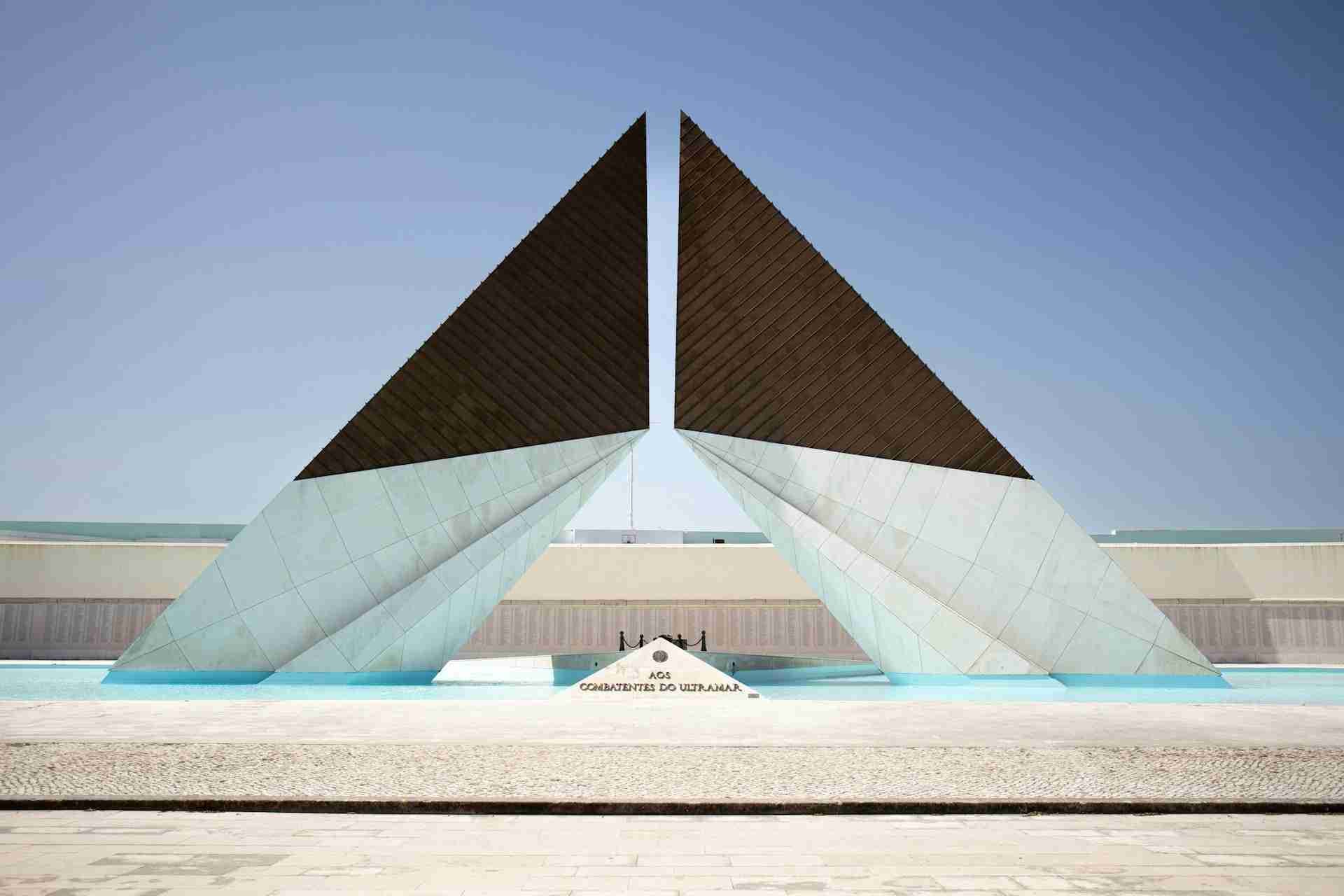
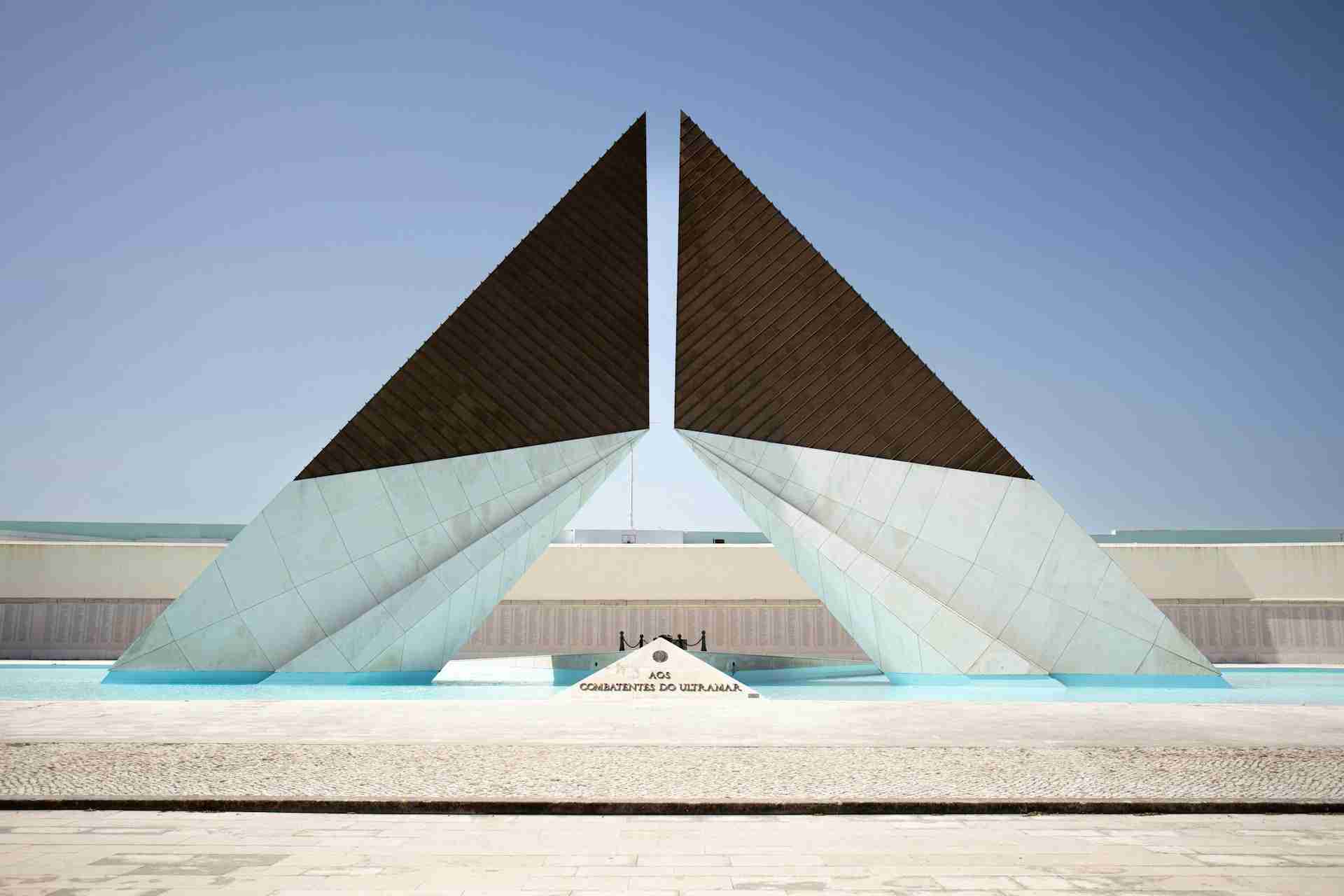
Set along the waterfront at Belém, the Monument to the Overseas Combatants offers a powerful blend of symbolism, geometry, and reflection that makes it a uniquely rewarding subject for photographers. Erected to honor Portuguese soldiers who served and died in conflicts abroad, the structure balances monumental scale with contemplative design. Two sharp, angular wings rise from a central pool, forming a triangular form that is perfectly mirrored in the water on calm days. Behind it, the eternal flame and inscribed stone walls provide a textural and narrative counterpoint to the clean lines of the sculpture itself. Whether approached as architectural photography, minimalist composition, or symbolic storytelling, this site is quietly commanding and visually precise.
Best Photography Opportunities
• Symmetry Over the Reflecting Pool
The monument's most iconic composition is shot straight on, centered across the water, where the wings and their reflection create a near-perfect triangle. This symmetry rewards precise framing, especially when the wind is low and the water remains still. Shoot at a slight distance to avoid including foreground pavement, or step closer to emphasize the mirroring effect. Early morning is ideal for calm water and soft light, while sunset adds warm tones that reflect richly in the pool. Using a wide-angle lens lets you frame the entire scene cleanly while maintaining architectural integrity.
• Abstract Angles and Geometric Isolation
Beyond the full-frontal view, the monument lends itself well to tighter, more abstract compositions that focus on its intersecting planes and angular shadows. Use a telephoto lens or move closer to isolate corners of the structure where light and shadow meet. Side lighting, particularly in the late afternoon, deepens contrast and defines the monument's lines sharply against the sky. These tighter shots often feel graphic and minimal, which can be emphasized further by shooting in black and white. Pay close attention to the placement of the eternal flame and its interaction with shadow, which can become a strong visual anchor.
• Twilight and Blue Hour Reflections
As dusk sets in, the monument takes on a quieter, more reflective character. The angular forms are lit gently from below, casting warm glows across the pool and amplifying the mood of stillness. Twilight allows for long exposures that smooth the water and add tonal gradient to the sky, especially when some color remains after sunset. A tripod is necessary here, and compositions benefit from symmetrical framing to take full advantage of the lighting design. These moments are ideal for creating contemplative, atmospheric images that emphasize the purpose of the monument as much as its form.
• Detail Studies of the Eternal Flame and Stonework
While the angular sculpture is the centerpiece, the eternal flame and rear stone wall offer detail-rich opportunities for photographers who work at a closer scale. The flame burns over a stone platform flanked by wreaths and tributes, offering a strong foreground subject when shooting from low angles. The surrounding stone wall features engraved names and clean lines, adding visual texture and historic weight. Shoot in soft light to avoid harsh shadows across the flame and inscriptions. These images serve well as visual punctuation in a series that includes wider compositions of the overall site.
• Juxtaposition with Maritime and Urban Backgrounds
The monument sits in a location that allows contextual shots incorporating the nearby Tagus River, the 25 de Abril Bridge, and Lisbon's skyline beyond. From various angles, especially the southwest side, you can position the monument so that the bridge appears behind it, creating a frame that connects history with modernity. These wider shots benefit from a longer lens to compress the elements, or a wide-angle to exaggerate depth if shooting from closer to the structure. The presence of the river and bridge adds movement and contrast to the clean, grounded lines of the monument itself.
Best Time to Visit
The Monument to the Overseas Combatants can be photographed throughout the year, but certain times of day and seasonal conditions offer enhanced possibilities. Early morning light is soft and directional, ideal for emphasizing the monument's structure without harsh contrast. It is also when the water in the reflecting pool is most likely to be undisturbed, creating mirror-like reflections. Mornings tend to be less crowded, giving photographers freedom to move and compose without interruption.
Late afternoon and golden hour introduce warmer light that rakes across the monument's surfaces, deepening shadows and enriching its texture. This side lighting helps bring out the depth in the monument's design while also warming the tones of the surrounding stone and metal elements. Blue hour is particularly effective for long exposures and symmetry shots, especially when ambient lighting from the monument contrasts with the cool tones of the sky.
During summer, the skies tend to be clear and light remains strong well into the evening. In winter, the lower sun angle creates more pronounced shadows earlier in the day and offers a cooler tonal palette. Wind is the primary condition to monitor here. Even slight breezes can disrupt the pool's reflection, so for reflection-focused compositions, choose calmer days or early hours. Rain can add additional mood, especially if shooting close-ups or texture studies, but it limits access to clean reflections and balanced symmetry.
How to Get There
The Monument to the Overseas Combatants is located in the Belém district of Lisbon, a popular area for both tourists and locals due to its concentration of museums, waterfront parks, and historical monuments. It sits directly opposite the Museu do Combatente and adjacent to the historic Fort of Bom Sucesso.
From downtown Lisbon, take tram 15E toward Belém and exit at the Belém stop. From there, it is a five-minute walk west along the riverfront. The site is also accessible via regional train from Cais do Sodré station to Belém station, followed by a short walk. Paid parking is available nearby along Avenida da Índia, though spaces can be limited on weekends or holidays.
The monument grounds are open to the public and free to access. Tripods are permitted, and the spacious layout provides ample room to set up gear without blocking pedestrian paths. There are no gates or closing times, but lighting for the monument becomes active at dusk and remains on into the night. Nearby benches and low stone walls make it easy to rest or reposition between shots. For evening or twilight sessions, bring a flashlight or headlamp to safely navigate gear and controls.
Recommended Photography Gear
A wide-angle lens in the 14 to 24 millimeter range is essential for capturing full views of the monument and its reflection across the pool. A standard zoom from 24 to 70 millimeters allows you to reframe quickly as you move around the structure, especially when shifting between symmetrical views and side compositions. For detail shots of the eternal flame or engraved stonework, a short telephoto or 85 millimeter prime lens provides compression and shallow depth of field that isolates texture and subject cleanly.
A sturdy tripod is necessary for twilight and blue hour work, especially for long exposures involving reflections or ambient light. A polarizing filter is useful for managing glare on the water, though it should be used cautiously to avoid eliminating the reflection entirely. Neutral density filters can help extend exposures during daylight hours, softening any movement in water or passing people.
Pack spare batteries and memory cards, as the open space encourages varied compositions and long sessions. A microfiber cloth is recommended for clearing sea mist from your lens if you're shooting on breezy days. Also bring a small spirit level or camera with a built-in level function to ensure perfect alignment in symmetry-based shots, as the monument's sharp geometry makes any deviation easily visible in frame.
Nearby Photography Locations
• Belém Tower
Just a short walk west of the monument, Belém Tower offers historic stone architecture set directly against the river. It is especially photogenic at sunrise and sunset when the surrounding water catches golden reflections, and the tower casts long shadows across the promenade.
• Padrão dos Descobrimentos
This striking riverside monument to the Portuguese Age of Discovery features dramatic sculptural figures and clean lines. The elevated viewpoint accessible via stairs or elevator offers panoramic views of the river and nearby monuments, including the Overseas Combatants site.
• Jerónimos Monastery
A masterpiece of Manueline architecture, this UNESCO-listed site combines intricate stone carvings, cloisters, and gothic arches with soft interior lighting. Photographers will find opportunities for architectural detail and light-shadow interplay, particularly in the monastery's central courtyard.
With its undulating roofline and futuristic design, the MAAT building provides a dramatic contrast to the nearby historic monuments. The structure is particularly effective in minimalist compositions and often catches bold side light late in the day.
• 25 de Abril Bridge Viewpoints
Various spots along the river near the Combatants Monument offer framed views of the iconic suspension bridge. These locations work well at twilight or with long exposures that smooth the river and highlight the bridge's glowing structure against the evening sky.
Photographing the Monument to the Overseas Combatants is an exercise in stillness and alignment. Its clean geometry, symbolic weight, and riverside setting offer a rare opportunity to blend architectural precision with emotional resonance. For photographers who value structure, reflection, and quiet design, this site remains one of Lisbon's most visually disciplined and rewarding locations.
Comments
Loading comments…