

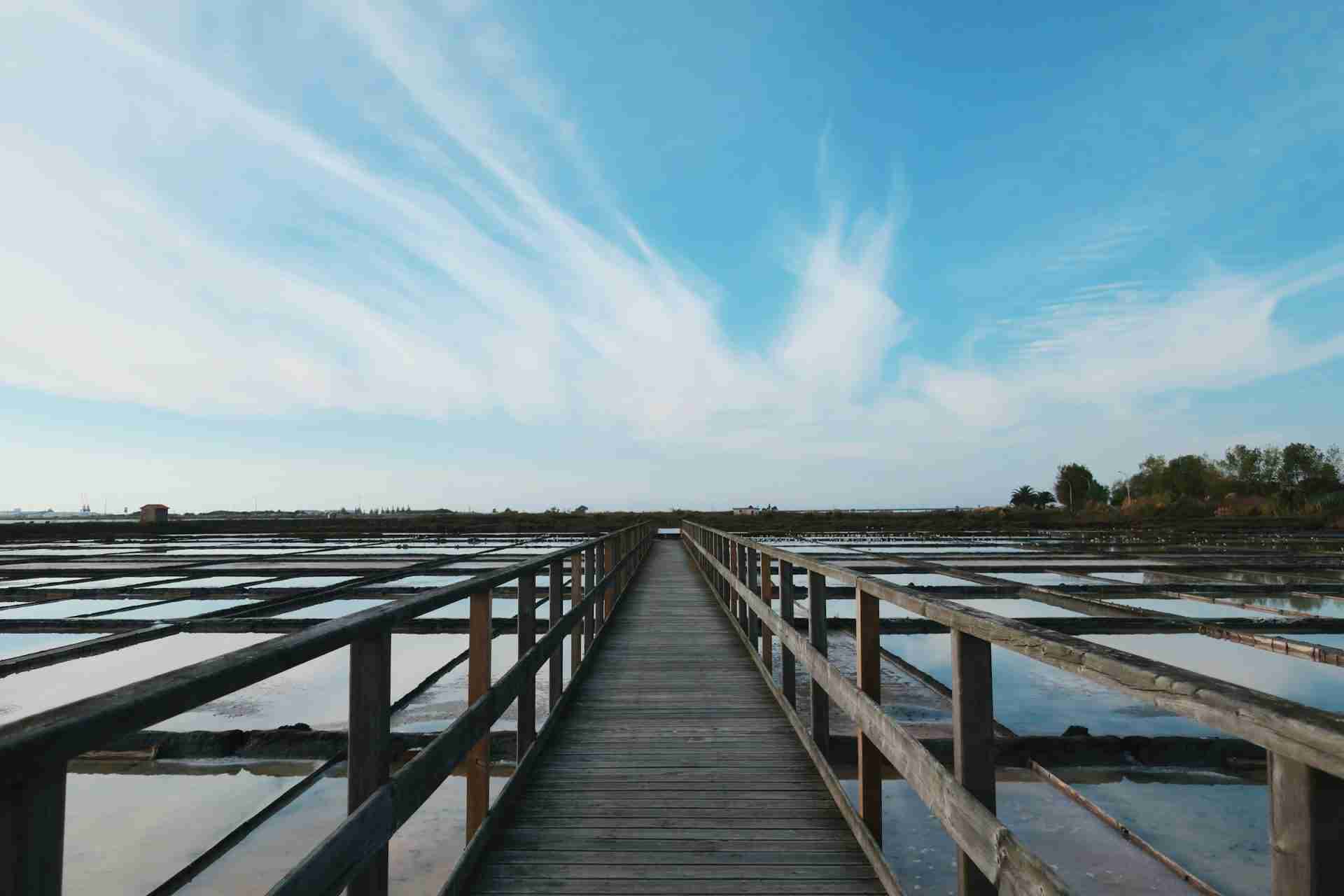
The bird observation area within the Salinas de Aveiro sits among a network of shallow salt ponds just outside the city of Aveiro. A long wooden boardwalk extends across the reflective flats, ending at a small viewing platform that overlooks the surrounding wetlands. The structure rises on wooden supports above the shallow water, creating repeating lines that stretch across the salt pans. Around the boardwalk, low earthen walls divide the traditional salt basins where water slowly evaporates under the sun. The combination of geometric ponds, reflective surfaces, and open sky creates a simple but visually striking environment that works well for both wildlife and minimalist landscape photography.
Best Photography Opportunities
• Boardwalk Leading Lines – The long wooden boardwalk is the strongest compositional element at this location. The structure runs straight across the shallow ponds, creating a powerful leading line that draws the viewer's eye toward the horizon. Photographers can stand near the start of the walkway and use the repeating wooden supports as a pattern that guides the composition. When photographed from a slight angle, the boardwalk creates diagonal lines that add depth and direction to the scene. Calm water often reflects the structure beneath it, doubling the geometry of the walkway and strengthening the overall image.
• Reflections Across the Salt Flats – The shallow water inside the salt pans frequently acts like a mirror during calm weather. Reflections of clouds, sky color, and the boardwalk supports can create very clean compositions across the surface of the ponds. Photographers who position themselves close to the edge of the water can maximize the reflective area within the frame. Even subtle color changes in the sky often appear clearly across the flats. These reflective scenes work especially well when the horizon remains simple and uncluttered.
• Birdlife in the Shallow Ponds – The salt flats provide feeding areas for several species of wading birds that move through the shallow water. These birds often walk slowly across the ponds searching for food, allowing photographers time to observe and compose their images. Longer lenses help isolate birds against the smooth water surfaces, creating clean wildlife compositions. When the water is calm, reflections of the birds can appear beneath them, adding symmetry to the scene. Early morning tends to bring the most bird activity while the area remains quiet.
• Geometric Patterns of the Salt Pans – The salinas are divided into rectangular ponds separated by narrow levees. These shapes form repeating geometric patterns that become visible from many points along the boardwalk. Photographers can use these lines to create balanced compositions that emphasize the structure of the landscape. When the water levels vary between ponds, the different tones of wet surfaces and exposed salt beds add subtle contrast. These patterns become especially noticeable when the sky is reflected across the flats.
• Viewing Platform Overlooking the Wetlands – At the end of the boardwalk, a small viewing platform provides a slightly elevated perspective across the surrounding salt ponds. From this point photographers can look back along the length of the boardwalk or outward across the wider wetland landscape. The platform allows for wider compositions where the repeating salt basins stretch toward the horizon. Birds moving across the ponds can also be photographed from this vantage point without disturbing their habitat. The open view across the flats makes it easier to frame simple horizon based compositions.
Best Time to Visit
Early morning often provides the most productive conditions at the Salinas de Aveiro. The wetlands are usually quiet at this time, which allows bird activity to unfold naturally without disturbance. Morning light also spreads softly across the shallow ponds, creating balanced exposures and gentle reflections.
Sunset can also produce strong photographic opportunities as warm colors begin to reflect across the water. When clouds are present, the sky often mirrors itself across the salt flats, creating layers of color within the landscape. Spring and autumn are particularly good seasons for bird photography as migratory species pass through the wetlands. Wind conditions also play an important role, since calm weather produces the clearest reflections across the ponds.
How to Get There
The Observatório de Aves area is located within the Salinas de Aveiro just outside the city of Aveiro in central Portugal. The salt flats sit along the Ria de Aveiro lagoon system a short distance from the city center.
From Aveiro, the salinas can be reached in about ten minutes by car by following local roads toward the salt production areas along the lagoon. Parking areas are available near the entrance to the salt flats where walking paths begin. From there, short trails lead toward the wooden boardwalk and observation platform.
The area is open to visitors and access to the outdoor sections of the salinas is generally free. Photographers should remain on designated walkways and paths in order to protect the fragile wetland environment and avoid disturbing bird habitats.
Recommended Photography Gear
A flexible lens setup works best at the Salinas de Aveiro because the location offers both landscape and wildlife opportunities. A wide lens is useful for capturing the boardwalk along with the reflective ponds and expansive sky. This type of lens helps emphasize the strong leading lines created by the wooden structure.
A telephoto lens is highly useful for photographing birds that move through the shallow ponds. This allows photographers to capture wildlife without approaching too closely. A tripod can also be helpful during sunrise or sunset when slower shutter speeds are needed for reflection photography. A circular polarizing filter can reduce glare on the water surface and improve color contrast in the sky.
Nearby Photography Locations
running through Aveiro are lined with traditional moliceiro boats painted with colorful designs. These long boats move slowly through the water and create interesting reflections beneath the surrounding buildings. The canals offer strong urban compositions that contrast with the quiet wetlands of the salinas.
is famous for its brightly painted striped houses that line the waterfront. These colorful wooden buildings create bold repeating patterns that are ideal for architectural photography. The nearby beach also offers wide Atlantic views and strong sunset opportunities.
features a long sandy shoreline and one of the tallest lighthouses in Portugal. The lighthouse rises above the surrounding buildings in red and white stripes that stand out clearly against the sky. Photographers can capture both coastal landscapes and architectural scenes along the beachfront.
• Ria de Aveiro Lagoon Wetlands
surrounding Aveiro contains numerous marshes, channels, and shallow wetlands that attract birdlife throughout the year. Photographers exploring these areas can capture reflections, wildlife, and quiet water scenes along the lagoon edges. Early morning often produces calm water and soft light across the wetlands.
• São Jacinto Dunes Nature Reserve, located across the lagoon from Aveiro, this protected reserve features coastal dunes, forest trails, and quiet Atlantic beaches. The mix of sand, vegetation, and ocean creates a very different landscape from the salt flats. Wildlife and bird activity are also common within the reserve.
Comments
Loading comments…