
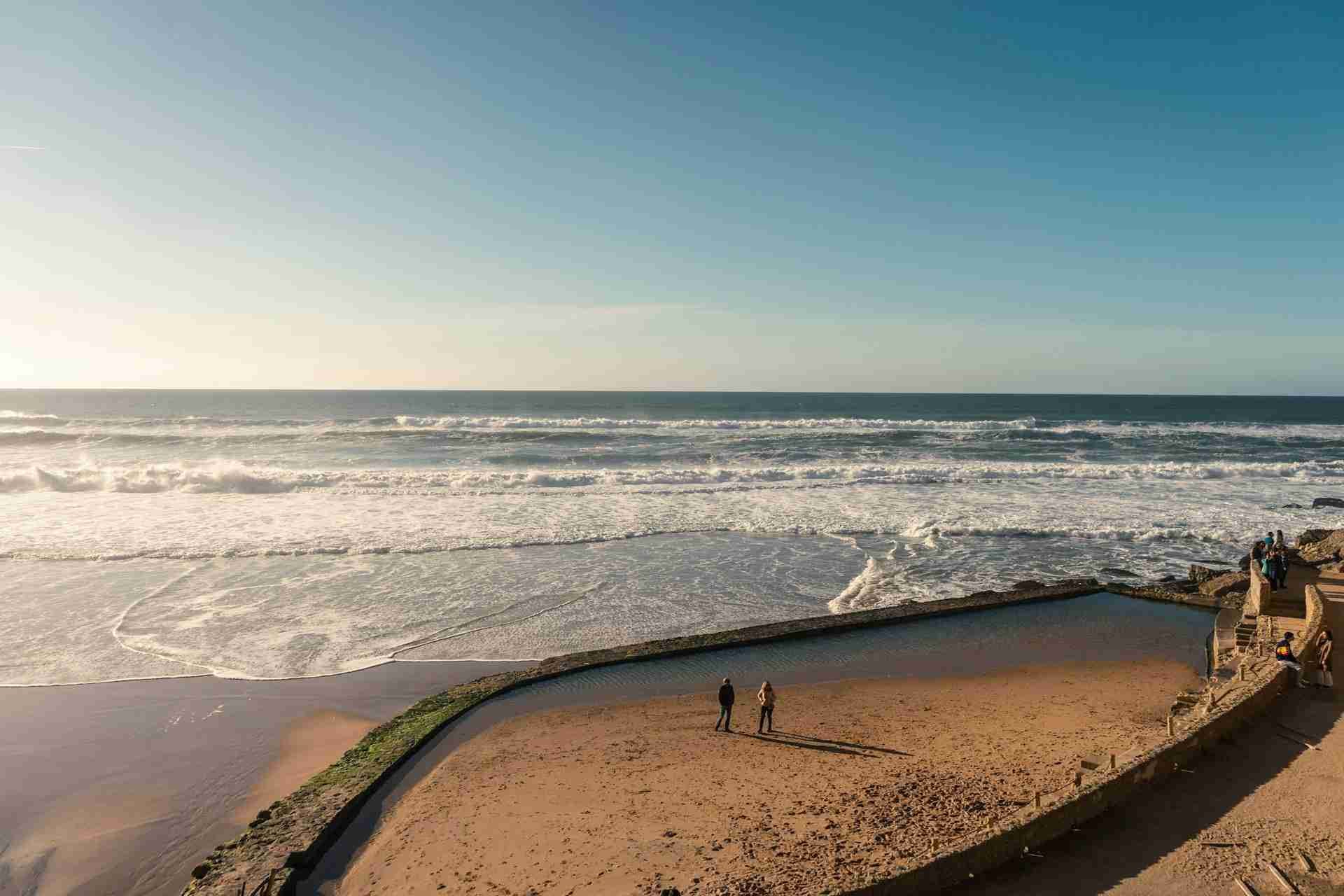
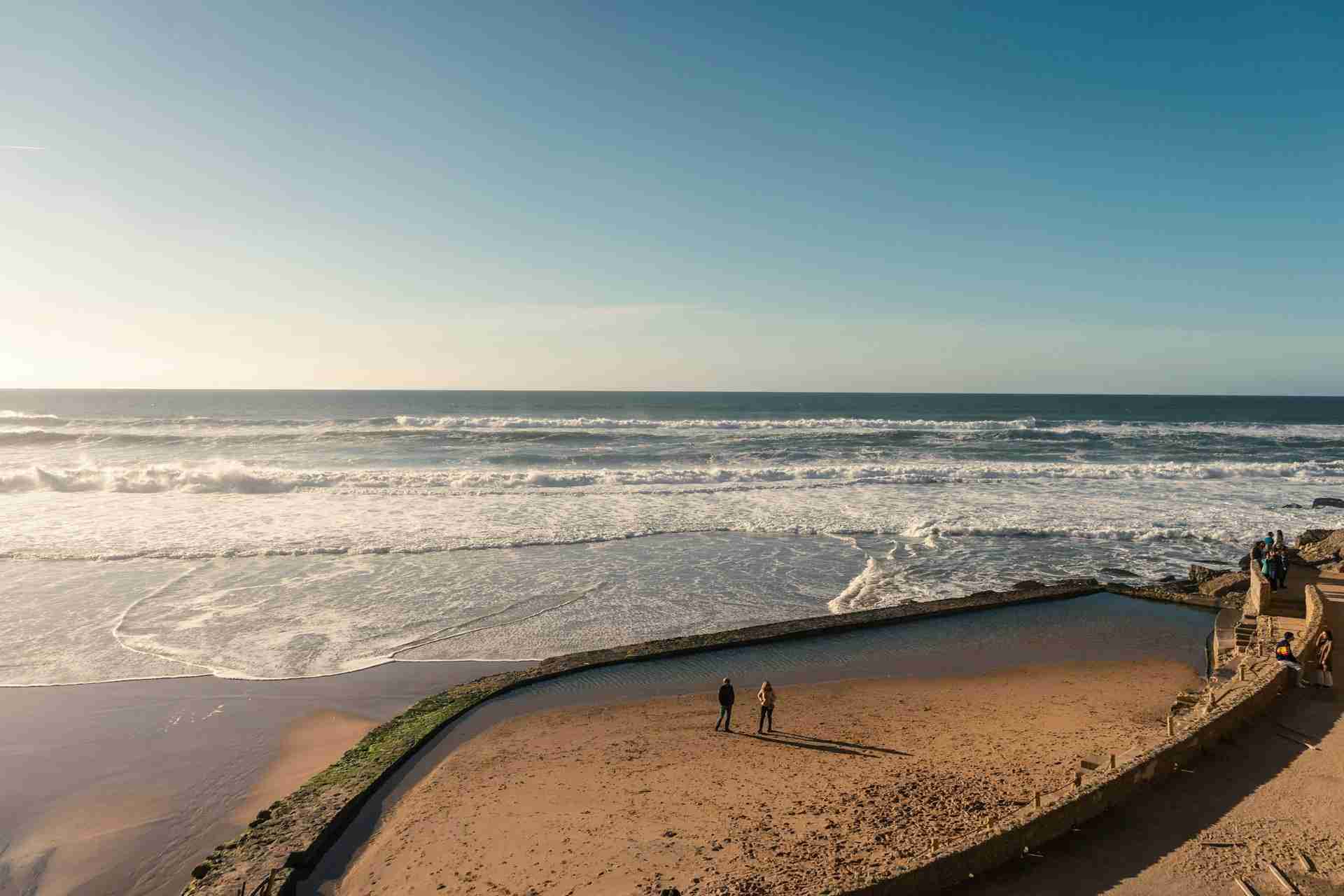
Perched on the western coast of Portugal, Praia das Azenhas do Mar is a small beach tucked beneath a dramatic whitewashed cliff village that seems to spill into the Atlantic. This location offers a striking mix of natural and architectural elements, with terraced houses clinging to the bluff, sea-sculpted rocks below, and a tidal pool that mirrors the movement of the ocean just beyond. The vertical contrast between land and water, as well as the interplay of light and shadow across the cliffside, makes it a rich setting for photographers interested in strong geometry and shifting atmosphere. Whether you are capturing the golden tones of late-day sun or the misty textures of Atlantic fog, Azenhas do Mar invites a careful, deliberate approach to composition.
Best Photography Opportunities
• Clifftop View at Golden Hour
The elevated viewpoint from the north side of the village provides the most iconic angle of Azenhas do Mar, with the whitewashed buildings descending toward the sea. Late afternoon light warms the cliff face and houses, while the ocean reflects softer pink and blue tones near sunset. Use a wide-angle lens to include the curving shoreline, tidal pool, and buildings in one frame, balancing exposure to preserve highlight detail in the sky and architecture. A tripod is helpful for low-light conditions as the sun drops, especially if you're layering multiple exposures for dynamic range. Wait for the moment when the light skims across the rooftops, adding dimension to the structures and softening the deep shadows below.
• Wave Action and Rocky Foreground
Down at beach level, especially near low tide, the rocky platform at the base of the cliff creates powerful foreground interest. The surf here is often active, and fast shutter speeds can freeze spray as it crashes over the rocks, while longer exposures smooth out the water for a more contemplative look. Position yourself carefully to use the rocks as leading lines toward the tidal pool or cliff face. Be mindful of the tide and slippery surfaces when composing close to the water. The contrast between the textured foreground and the clean lines of the buildings above creates dynamic compositions that tell the story of both natural force and human settlement.
• Tidal Pool Reflections and Twilight Glow
The saltwater pool built into the base of the cliff adds an unusual and photogenic element to the shoreline. At twilight or during the blue hour, the still surface of the pool reflects the fading light and the glow of the village above, offering a calm, symmetrical counterpoint to the rough ocean beyond. Use a tripod and shoot from a low angle to emphasize this reflection, especially if lights begin to appear in the houses above. Framing tightly on the pool and part of the village creates a surreal, almost painterly image that captures the duality of the scene.
• Fog and Soft Coastal Light
The Atlantic coast near Azenhas do Mar frequently experiences marine fog and low cloud cover, especially in the early morning or on cooler days. These conditions create soft, diffused light that reduces contrast and desaturates color, emphasizing shape and structure over intensity. This is an excellent time to photograph the village from mid-elevation, using layers of cliffs, rooftops, and sea mist to build depth in the frame. A telephoto lens helps compress these layers and isolate small compositions that convey the mood of the coast in quieter tones. The lack of hard shadow also benefits detail shots of the stone walls and tile roofs throughout the village.
• Nighttime Village Glow Above the Sea
After dark, Azenhas do Mar transforms into a luminous cluster of light against the dark Atlantic. Street lamps and house windows cast warm glows across the white façades, while the sound of the ocean continues below. Shooting from a clifftop overlook with a long exposure allows you to capture both the light of the village and the faint movement of waves and cloud. Include foreground elements such as railings, rocks, or vegetation to add depth and scale. This time of day is particularly effective in telling the story of the village's quiet isolation and its connection to the rhythm of the sea.
Best Time to Visit
Late spring through early autumn offers the most stable conditions for photographing Praia das Azenhas do Mar, with longer daylight hours and a greater likelihood of clear golden hour and sunset light. During this period, the sun sets over the ocean in direct view from the cliffs, producing vivid skies and soft sidelight across the village.
Early morning visits offer cool tones and fewer visitors, though the beach and pool are often in shade until mid-morning. Autumn brings more dynamic skies and the return of Atlantic mist and clouds, which enhance moodier compositions and diffuse the contrast between water, sky, and architecture.
Winter can be rewarding for those prepared for storms, wind, and fleeting bursts of light. The surf is stronger, tides higher, and village quieter, allowing for dramatic long-exposure work. Blue hour in winter is long and deep, giving photographers more time to explore subtle changes in tone.
Check tide charts if you plan to photograph at water level or near the tidal pool, as high tide can submerge some of the best foreground features. Wind conditions are also important, especially for longer exposures, since strong gusts can move gear or cause camera shake on cliffside overlooks.
How to Get There
Praia das Azenhas do Mar is located in the municipality of Sintra, roughly forty minutes northwest of Lisbon by car. From Lisbon, follow the A5 or IC19 to Sintra, then continue along local roads through Colares to Azenhas do Mar. Signage is clear near the village, and GPS directions are reliable.
There is a small parking lot near the main overlook above the beach, as well as limited roadside parking throughout the village. From the top, a series of narrow paths and stairways lead down to the beach and tidal pool area. The descent is manageable but can be slippery, especially when damp or after rain.
Public transport is available, though less direct. Trains from Lisbon reach Sintra, and from there local buses serve the coastal villages, including Azenhas do Mar. If you are planning a sunrise or sunset shoot, driving is more flexible, especially given the limited bus schedule.
Tripods are allowed throughout the area, and there are no entrance fees or restrictions for beach or cliff access. The paths and lookout points can become busy on weekends, so arrive early if you want unobstructed shooting space. Drones are not permitted within the Sintra-Cascais Natural Park without prior authorization, so aerial photography should be planned accordingly.
Recommended Photography Gear
A sturdy tripod is essential for sunrise, twilight, and long-exposure work. A wide-angle lens, ideally between 14 and 24 millimeters, is necessary for capturing the full sweep of the cliffside village, beach, and ocean in a single frame. A 24 to 70 millimeter standard zoom provides flexibility for mid-range compositions that combine architecture and seascape.
A telephoto lens between 70 and 200 millimeters is valuable for compressing cliff layers, isolating small architectural details, or framing elements like waves and birds against the village backdrop. A polarizer helps manage glare on wet rock surfaces or tidal pool reflections, while neutral density filters allow for longer shutter speeds during bright conditions when photographing moving water.
Lens cloths and rain covers are useful year-round, especially during foggy or windy conditions. Comfortable shoes with good grip are recommended for the paths down to the water, and a headlamp or flashlight is helpful if you plan to shoot before sunrise or after sunset. Bring extra batteries and memory cards, as longer exposures and bracketing will use up resources quickly.
Nearby Photography Locations
• Cabo da Roca
Just a short drive south, this is the westernmost point of mainland Europe, offering high cliffs, crashing waves, and strong directional light at both sunrise and sunset. The lighthouse and wild terrain make it excellent for dramatic landscape work.
• Praia da Ursa
Accessible via a steep hike from near Cabo da Roca, this secluded beach features unique rock formations and untouched sand, best photographed at low tide and with soft light. Its remoteness rewards those seeking wilder, more elemental scenes.
Inland from the coast, Sintra offers palaces, gardens, and misty wooded paths perfect for architectural and atmospheric photography. Early mornings here often bring low fog and soft light filtering through the forested hills.
North of Azenhas do Mar, this expansive beach is excellent for long-lens surfing photography and golden hour cliffside compositions. The beach also has interesting wall art and changing tidal textures.
Located in a cove south of Praia da Ursa, Adraga features a dramatic rocky arch, dark sand, and a backdrop of steep cliffs. It is well-suited to long exposure seascapes and is easiest to shoot during mid to low tide.
Praia das Azenhas do Mar offers an ideal combination of natural force and village intimacy, with every shift of light and tide opening new compositional possibilities. Whether you are chasing color across the sky, soft fog over the sea, or warm light across stone walls, this location provides a rich environment for seascape and coastal village photography in one compelling place.
Comments
Loading comments…