
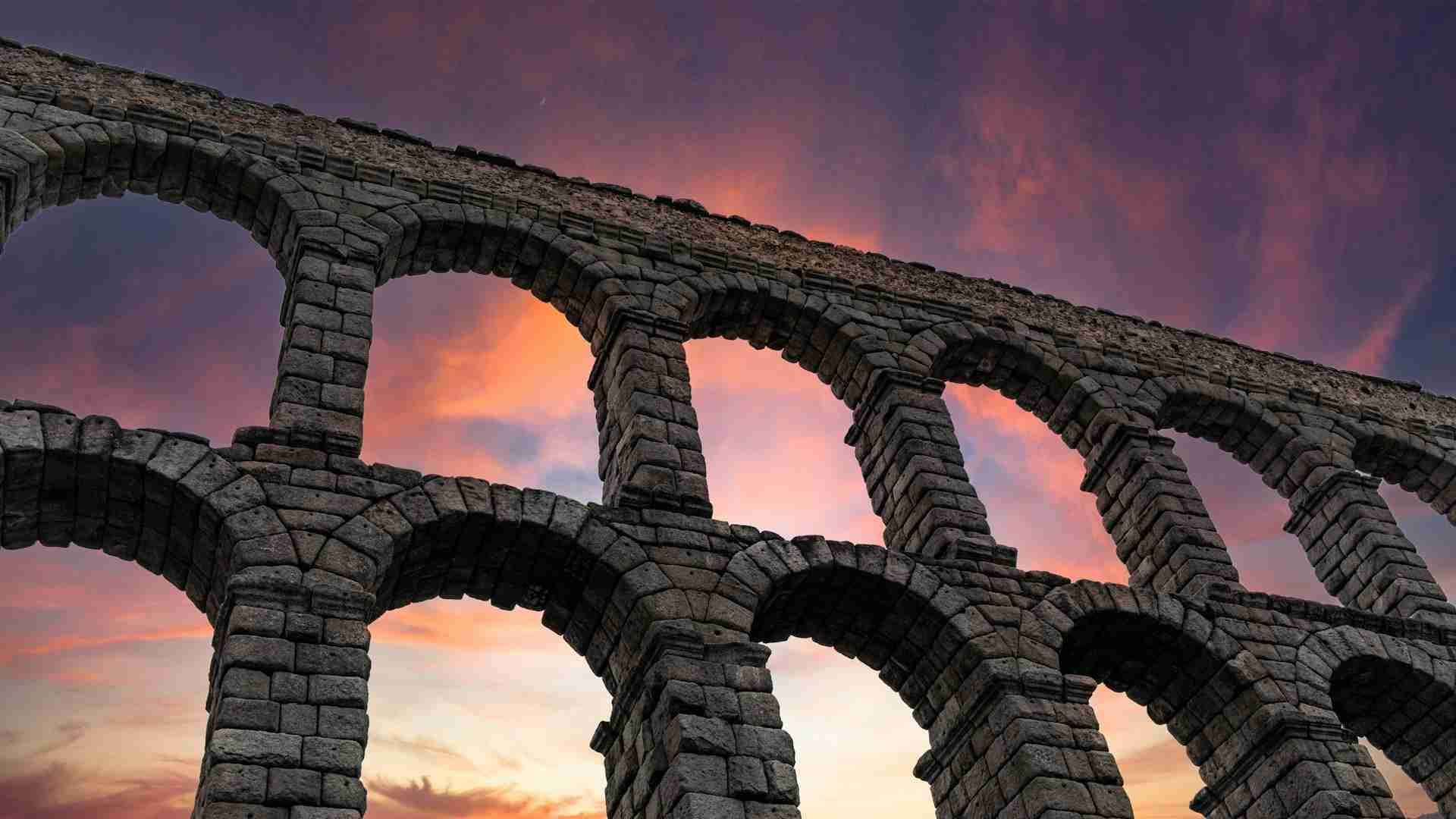
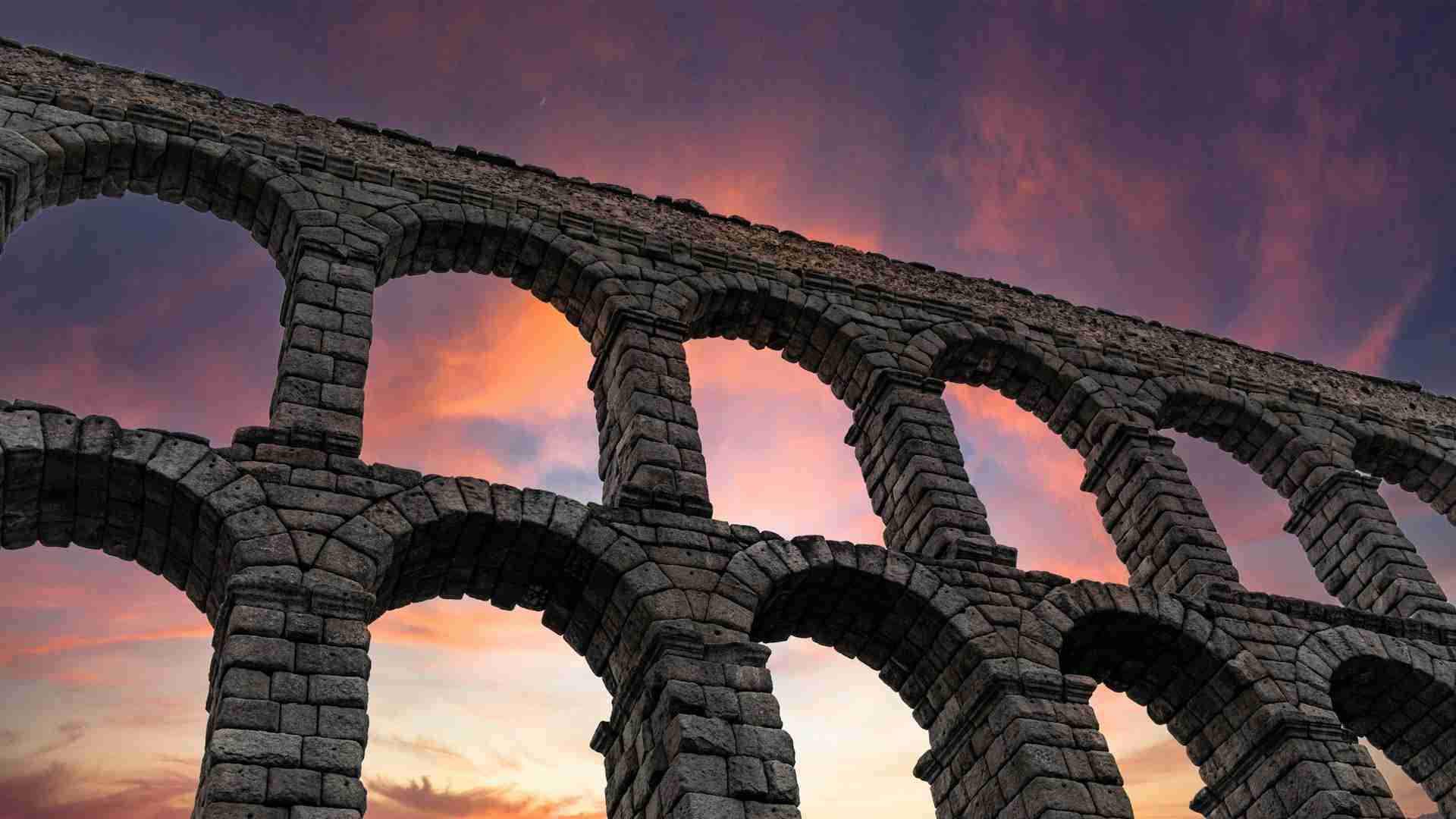
Stretching through the heart of Segovia with unmistakable rhythm and scale, the Acueducto de Segovia is one of the best-preserved Roman engineering structures in the world and a compelling subject for architectural photographers. Built from unmortared granite blocks, this towering double-tier aqueduct commands the skyline and cuts a bold line across the urban grid. Its 167 arches form repeating patterns that shift with light, angle, and time of day, offering endless variations in composition. Whether viewed from below in the Plaza del Azoguejo or from the elevated viewpoints to the east, the aqueduct's form invites close study of line, shadow, and proportion in a constantly changing interplay with its surroundings.
Best Photography Opportunities
Golden Hour from Plaza del Azoguejo
The most striking view of the aqueduct is from directly below its tallest section in Plaza del Azoguejo. Here, the towering arches rise high above street level and catch warm light during the golden hours. Early morning sun strikes the eastern face, revealing the surface detail in each granite block. In the evening, side light passes through the arches and produces deep shadows on the stone. Wide-angle lenses are especially effective in this position, letting you exaggerate the height of the structure while incorporating the surrounding cityscape. Including a passerby at the base of the arch can emphasize scale and add a sense of motion to the scene.
Side Views with Receding Perspective
Walking along the length of the aqueduct either east or west allows you to work with strong receding lines and repetition. Each arch becomes slightly smaller with distance, and the uniform construction creates opportunities to lead the viewer's eye across the frame. Side light during the morning creates narrow shadow slivers between each arch, while afternoon light softens contrast and flattens tones. A medium zoom lens in the 35 to 70 millimeter range gives you precise control over framing without losing the sense of rhythm in the composition. These perspectives are best when you want a cleaner, more abstract approach.
Top-Down Views from Mirador del Postigo
Above the structure, the Mirador del Postigo provides a sweeping overlook where you can photograph the aqueduct as it bends gently through the town. This higher elevation allows you to frame rooftops, walkways, and the arches all in one image. During golden hour, sunlight angles through the arches and casts long shadows on the buildings below. With a 24 to 70 millimeter lens, you can either shoot wider for context or zoom in to isolate visual patterns. Panoramic stitching is an option here as well, particularly if you want to preserve the curvature of the aqueduct without using a wide-angle lens.
Shadow Studies and Detail Work
The rough-cut granite blocks and perfectly aligned joints of the aqueduct reward close-up compositions. Early and late light creates strong surface shadows, revealing the tool marks and subtle imperfections in the stone. These textures are excellent subjects for black and white photography, especially on overcast days when soft light emphasizes structure without distraction. A short telephoto or macro lens helps isolate stone details, while a shallow depth of field can be used to direct attention to the transitions between blocks or the negative space within the arches.
Night Photography with City Light
The aqueduct is illuminated by ground lights after dark, offering a moody and atmospheric look that differs completely from daytime views. The warm artificial lighting highlights the base and inner curves of each arch while leaving the upper structure in shadow. Long exposures from street level allow you to balance the glow of modern streetlights with the ancient stone above. Including reflections from nearby windows or wet cobblestones can add complexity to your nighttime compositions. Tripods are permitted, and the quieter streets at night make it easier to set up without interruption.
Best Time to Visit
Photographers will find the most favorable light conditions in spring and autumn, when the sun sits lower in the sky and casts longer shadows through the arches. From March through May, the early morning sun lights the eastern face of the aqueduct, and the air remains clear and crisp. These mornings often have fewer people in the plaza, giving you more freedom to shoot wide scenes without distractions.
From September into early November, the tone of the light becomes warmer, especially in the evening, and the sky tends to hold more texture and color at sunset. This is the best season for photographing the aqueduct during golden hour and for shooting long exposures after dusk. These months also bring fewer tourists than summer, making it easier to use a tripod in public areas without having to pause between crowds.
Summer can still yield strong results, but midday sun is harsh and flattens the stone's surface. Plan to shoot early in the morning or after 7 pm when the angles become more forgiving. Winter visits allow for stark lighting and the possibility of fog or mist in the early hours, which adds atmosphere to long lens shots from elevated positions. Snow is rare but impactful when it occurs, creating a contrast between the cold surroundings and the warm color of the aqueduct's stone.
How to Get There
The Acueducto de Segovia is located in the center of Segovia, about one hour northwest of Madrid. If arriving by train, take the high-speed AVE line to Segovia-Guiomar station, then transfer to the city center by bus or taxi. The aqueduct is a short walk from the bus stop and is immediately visible upon arrival in Plaza del Azoguejo. If you are arriving by car, parking is available just outside the old town, with signed pedestrian access points leading toward the structure.
There are no entrance fees or access restrictions for photographing the aqueduct. It is a public monument that can be approached from all sides, with stairways nearby that lead to elevated viewpoints and walking paths. Tripods are allowed throughout the area, although care should be taken during busy hours to avoid blocking paths. The best time to shoot undisturbed is early in the morning or after sunset, especially during the shoulder seasons.
Recommended Photography Gear
A wide-angle lens between 16 and 35 millimeters is essential for working from the base of the structure and capturing the full vertical stretch of the arches. A 24 to 70 millimeter zoom gives you control over perspective and is particularly useful for mid-range compositions from above or along the sides. For compressing arches or working with fine stone detail, a 70 to 200 millimeter lens allows you to isolate individual design elements and pull distant features into tighter frames.
Bring a tripod for morning, evening, and night work. The long exposures required to balance ambient and artificial light after dark will benefit from stability, and it also helps with precise alignment for architectural work. A polarizer can be helpful for removing glare from the granite in harsh light, although wide-angle use may result in uneven skies. A microfiber cloth is useful for clearing dust and light debris, especially in windy conditions.
Comfortable walking shoes will allow you to move easily between shooting locations. The cobbled streets and stairways around the aqueduct require some agility when carrying gear. A lightweight backpack with side access will allow you to change lenses without setting your bag down on stone or wet pavement. If planning night photography, bring a small headlamp to assist with setup without interfering with your exposures.
Nearby Photography Locations
Set on a rocky promontory west of the aqueduct, the Alcázar is one of the most recognizable castles in Spain. Its towers and turrets rise above the valley and are best photographed from the nearby meadow trail during golden hour or twilight. The contrast between warm stone and open sky offers strong material for landscape or architectural studies.
This late Gothic structure dominates the town's central square and provides opportunities for both exterior and interior photography. Morning and late afternoon light pass through stained glass and cast filtered patterns on columns and floors. The square itself offers strong symmetry for shooting with a centered frame.
South of the aqueduct, this maze of narrow lanes and stone walls is perfect for documentary-style photography. Light reflects off walls at sharp angles, and the tight spaces reward careful composition. These streets are especially effective in early morning light when the shops are closed and the shadows are long.
Mirador de la Canaleja
This east-facing viewpoint looks over the rooftops and distant hills and offers a good angle for capturing sunrise. On clear days, you can see beyond the city and work with soft, layered gradients in both sky and structure. It is also a quiet spot for long exposures before the city wakes up.
Just a few blocks south of the aqueduct, this Romanesque church offers a quieter alternative for architectural photography. The rounded arches and textured stone contrast with the verticality of the aqueduct, and the area is less trafficked, giving you time and space to explore different angles.
The Acueducto de Segovia is more than a relic of Roman engineering. It is a living structure that frames the city and responds to the changing light of each season and hour. For photographers drawn to rhythm, proportion, and the meeting point of history and geometry, this is a location that continues to offer something new with every visit.
Comments
Loading comments…