
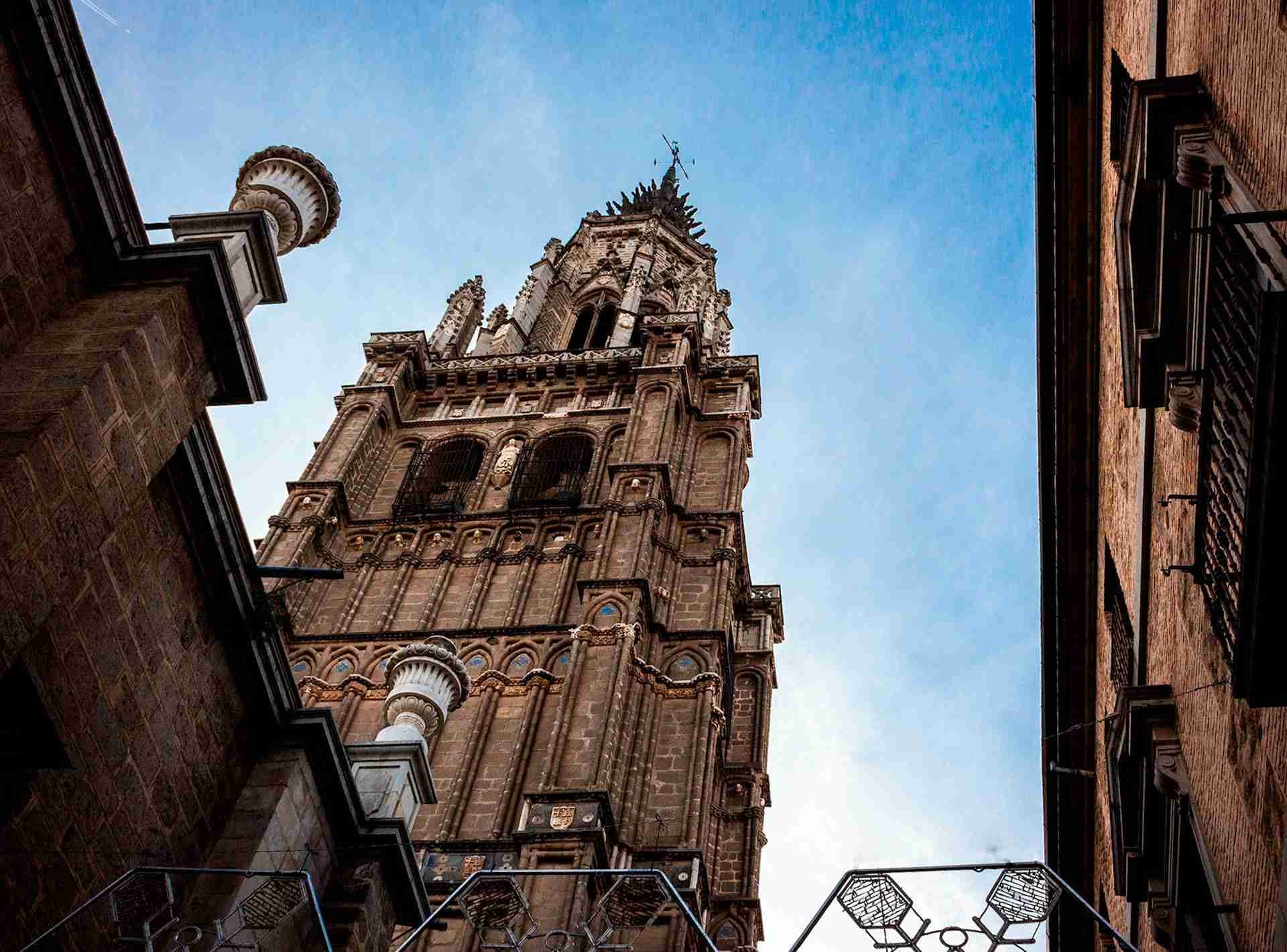
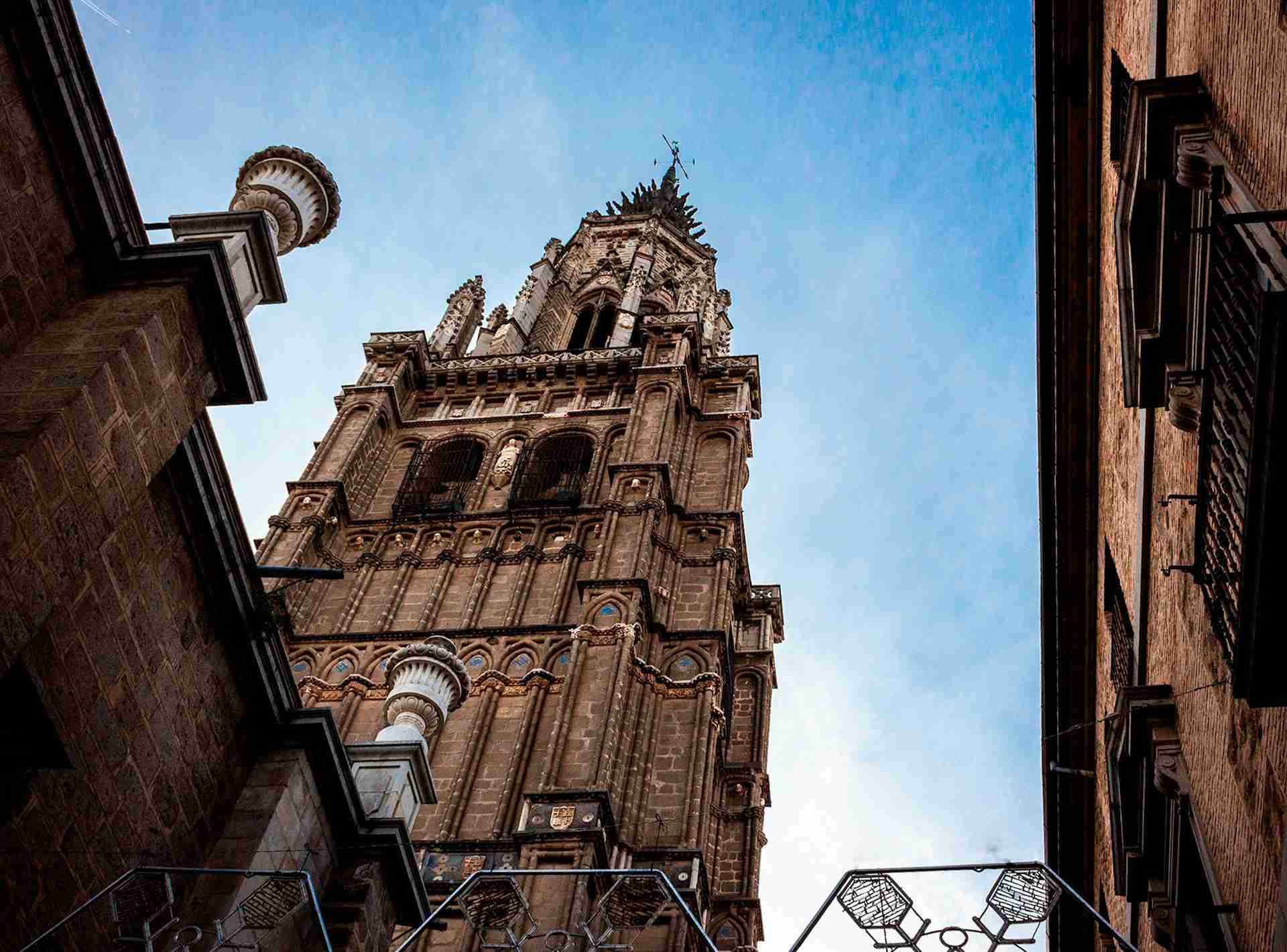
Rising from the heart of Toledo's old quarter, the Catedral Primada de Toledo is a triumph of Gothic architecture layered with Moorish, Mudéjar, and Renaissance influences. Commissioned in 1226 and built over several centuries atop a former mosque and Visigothic church, this monumental cathedral reflects the spiritual and political ambitions of medieval Spain. With its towering spire, richly sculpted portals, gilded altars, and soaring vaulted ceilings, the cathedral offers photographers an endless array of subjects—from grand architectural statements to quiet details steeped in centuries of devotion. Light moves through this space like a living presence, filtered through stained glass, bouncing off gold leaf, and spilling onto centuries-worn stone. Photographing the Catedral Primada is an invitation to explore one of Europe's most visually intricate and spiritually resonant sacred spaces.
Best Photography Opportunities
• The Nave and Vaulted Ceilings
: The cathedral's central nave is a masterpiece of Gothic design, stretching over 120 meters in length and supported by clustered pillars that rise toward a ribbed vault of astonishing complexity. For wide compositions that showcase the grandeur and verticality of the space, a 16–35mm lens allows you to capture the full alignment of the nave's central axis, leading the eye toward the Capilla Mayor and the gleaming retablo. From this central point, symmetry is your ally—use the repetition of arches and columns to create a sense of rhythm, while balancing the glowing side light streaming through the stained glass above. For a more immersive and spatially dynamic image, shift to the side aisles or transept to reveal the intersection of vaults and the interplay of light and shadow as it cascades down from the clerestory windows.
• El Transparente
: Perhaps the most unexpected and theatrical feature in the cathedral, El Transparente is a massive Baroque altarpiece carved through the rear of the main chapel, opening to a concealed skylight above. This sculptural explosion of marble, alabaster, and gilded stucco is designed to funnel light directly onto the tabernacle—an effect that, during mid-morning, is nothing short of celestial. Shoot upward from the base of the Capilla Mayor to capture the full verticality of the piece, or move laterally to explore how the light breaks across its undulating surfaces. Use a fast lens (f/1.8–f/2.8) to isolate details in the swirling figures and clouds, or bracket your exposures to retain the subtle luminance of the oculus without overexposing the lit surfaces. El Transparente is not only photogenic; it is a visual narrative that turns divine light into composition.
• The Choir and Organ Loft
: Located directly beneath the crossing of the nave, the cathedral's coro is enclosed by one of the most ornate Gothic choir screens in Spain. Within it, two rows of intricately carved wooden stalls depict historical, biblical, and allegorical scenes rendered with astounding anatomical realism and emotional intensity. Above, twin Baroque pipe organs stretch across the transepts, their cases carved with cherubs and scrollwork that seem to dance in the half-light. Use a mid-telephoto lens (85–135mm) to zoom in on the storytelling details within the stalls—pilgrims, saints, and grotesques locked in sculpted motion—or tilt upward to incorporate the gilded pipes and vault above. Because this space is often dim, high ISO performance and image stabilization are crucial for preserving fine detail without motion blur.
• Cloisters and Chapter House
: The cathedral's cloister, built during the 14th and 15th centuries, provides a more peaceful and contemplative space ideal for controlled architectural compositions. Four covered walkways enclose a central courtyard and are lined with Gothic arches, slender columns, and frescoes by Juan de Borgoña. In the morning, soft light enters from the east, casting angled shadows across the tiled floors and arcades. Use this to your advantage by framing compositions that emphasize repetition and vanishing points, especially looking through the layers of arches. Including human figures, such as a lone visitor or clergy member in silhouette, adds a sense of scale and narrative. In the adjoining chapter house, you'll find a circular space with ribbed domes and wall paintings of past archbishops—ideal for both documentary and moody environmental portraiture.
• Stained Glass and Interior Light Play
: With over 750 square meters of stained glass, some dating back to the 14th century, the Catedral Primada becomes a kaleidoscope of colored light on sunny days. The large rose windows and lancet panels cast reflections across the stone and wood of the nave, choir, and side chapels. Focus on capturing the color interaction with architectural surfaces—particularly the way light passes through deep blues and reds to strike the gilded edges of retablos or illuminate prayer benches. These moments of light are fleeting and best caught during mid-morning and mid-afternoon. Use a fast aperture to catch fine color gradients and a polarizer to adjust for glare or reflection if shooting obliquely. Consider focusing on secondary compositions—such as a pool of light spilling across a cloister bench or colored shadows cast on a stone pillar—for more abstract, emotionally resonant images.
• Exterior Facade and Tower
: Although the cathedral's location within the dense medieval grid of Toledo makes wide exterior shots challenging, there are several rewarding angles from which to capture its Gothic splendor. From Plaza del Ayuntamiento, the main portal and its deeply carved tympanum can be photographed with a tilt-shift lens or corrected in post to retain architectural lines. Evening light from the west enhances the texture of the portal's stone relief and helps isolate the spire against the sky. For vertical compositions, stand at the base of Calle Cardenal Cisneros and shoot upward to frame the tower rising above surrounding rooftops. The best time for exterior shots is late afternoon into blue hour, when the cathedral is softly lit and the surrounding streets are quieter.
Best Time to Visit
To capture the interior at its most photogenic, timing your visit is critical. The best light enters the cathedral mid-morning between 10:00 and 11:30, when the sun clears surrounding rooftops and streams through the south-facing stained glass. This is particularly effective in illuminating the nave, the rose window near the main entrance, and El Transparente. Afternoon visits from 15:00 to 17:00 provide warmer, lower light ideal for the cloisters and side chapels. These hours also help avoid the harsher midday lighting that tends to flatten details in the nave.
Weekday mornings offer the quietest conditions for interior photography. Tourist volume increases significantly on weekends and during holidays, especially in summer. If you're shooting with an eye for serenity, shadow, and sacred atmosphere, visiting outside of peak hours or in the off-season (November through March) can dramatically improve your experience.
For exterior shots, golden hour—both morning and late afternoon—provides the most nuanced light on the facade and tower. Evening light from the west enhances carvings on the main portal, while blue hour provides the best backdrop for architectural silhouettes and lit interior windows.
How to Get There
The Catedral Primada de Toledo is located in the heart of Toledo's old town, in Plaza del Ayuntamiento. Visitors arriving by train from Madrid can reach the cathedral in under 10 minutes by taxi or 20–25 minutes on foot from the Toledo station. The walk takes you across the scenic Puente de Alcántara and up through the medieval gate of Puerta de Alcántara or Puerta del Sol, following signs through winding cobblestone streets that eventually open onto the cathedral plaza.
Toledo is compact, and once inside the old town, everything is reachable on foot. The cathedral is clearly signposted throughout the city, and guided tours often start nearby. The entrance is on the western side, facing the Ayuntamiento. Tickets can be purchased on-site or online and include access to the nave, choir, sacristy, cloister, and the treasure rooms. There is a fee to enter outside of mass hours, and separate access to the bell tower is available via a timed reservation system.
Photography is permitted throughout the cathedral for non-commercial use, but flash and tripods are not allowed. For special photographic access—such as tripod use or after-hours sessions—written permission must be obtained in advance from the cathedral administration.
Recommended Photography Gear
Photographing the Catedral Primada de Toledo requires gear capable of handling low light, wide compositions, and detailed interiors without excessive weight. A full-frame camera body with good high ISO performance will allow you to shoot handheld in dim conditions while preserving shadow detail. A wide-angle zoom (16–35mm) is essential for capturing the nave, vaulted ceilings, and cloister arcs. A standard zoom (24–70mm) covers tighter architectural shots, and a telephoto (70–200mm) allows you to compress sculptural elements or isolate distant stained-glass windows.
A fast prime lens (35mm f/1.4 or 50mm f/1.8) is highly recommended for shooting in available light without a tripod, particularly in side chapels or where quiet discretion is needed. If visiting during the brightest hours, a circular polarizer helps manage reflections on polished wood or stone surfaces and enhances the intensity of stained glass colors.
A small clamp or flexible mini-support can be helpful in lieu of a tripod, provided it's used respectfully. Always carry extra batteries and memory cards—long exposures, bracketing, and HDR work can add up quickly. A lens cloth is essential for dealing with dust, and a lightweight, silent shutter mode is preferred when working in the cathedral's more reverent spaces.
Nearby Photography Locations
: This church's rooftop platform provides the best elevated view of Toledo's old town, with the cathedral spire rising prominently amidst the sea of terracotta rooftops. Ideal for sunrise or sunset photography with strong architectural layering.
: Just west of the Jewish Quarter, this 15th-century Franciscan monastery features flamboyant Gothic cloisters, hanging chains on the facade, and intricately vaulted ceilings that photograph beautifully in soft morning light.
• Calle del Cardenal Cisneros and Calle Chapinería
: These narrow streets around the cathedral offer dramatic upward views of the spire framed by stone walls and balconies. Perfect for compressed, moody compositions or candid street scenes.
: The intimate scale of these neighborhoods, combined with subtle architectural flourishes and filtered sunlight, provides a rich canvas for urban and architectural storytelling.
: For a panoramic view of Toledo with the cathedral as its focal point, Mirador del Valle—across the Tagus River—offers one of Spain's most visually compelling cityscapes. Shoot at golden hour or blue hour for maximum depth and tonal harmony.
The Catedral Primada de Toledo is more than a building—it is a vast orchestration of space, light, and devotion. Every corridor, every carving, every shaft of color-filtered light reveals another facet of Spain's spiritual and artistic legacy. For the patient and curious photographer, it is a location that continues to unfold, offering not just images, but experiences carved in stone.
Comments
Loading comments…