
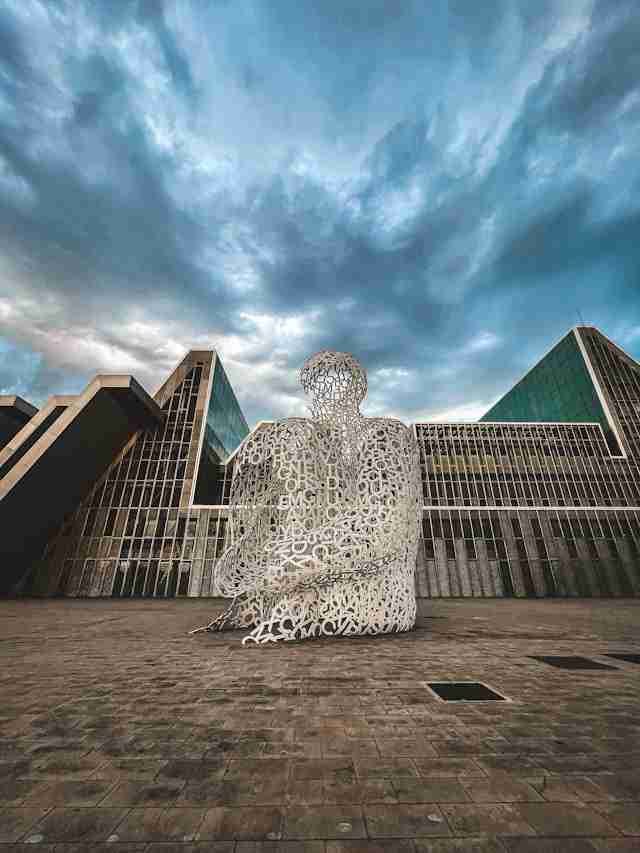
In the heart of Zaragoza, where the Ebro River flows past the sleek silhouettes of Expo 2008 architecture, a towering human figure made of white steel letters sits quietly in contemplation. This is El Alma del Ebro (The Soul of the Ebro) a 21st-century sculpture by Spanish artist Jaume Plensa. Standing over ten meters tall, the hollow figure is composed entirely of openwork alphabet characters in various languages, assembled into the shape of a seated person gazing toward the river. More than a sculpture, it is a study in contrast: light against shadow, openness against mass, and meaning against abstraction. For photographers, El Alma del Ebro is an endlessly versatile subject. Its latticework form interacts with Zaragoza's natural light and urban skyline in constantly shifting ways, inviting a range of photographic approaches from minimalist geometry to expressive silhouette.
Best Photography Opportunities
• Frontal View from the Avenue Entrance
Approaching the sculpture from the southern end of Plaza Lucas Miret Rodriguez, photographers are greeted with a clean, symmetrical view of the figure seated on the plaza floor. This vantage point emphasizes the scale and posture of the human form while clearly showing the outer shell of letters that make up its structure. The frontal view is perfect for capturing the sense of quiet presence that the sculpture conveys, especially in the early morning or late afternoon when sunlight slides across the plaza and gently fills the open spaces between the letters. A wide-angle lens in the 24 to 35 millimeter range is often the best choice here, allowing you to place the sculpture in its architectural context without distorting the figure.
• Backlit Silhouettes at Sunrise and Sunset
One of the most powerful ways to photograph El Alma del Ebro is by positioning yourself on the western or eastern edge of the plaza, using the rising or setting sun as a backlight. The sculpture's open structure allows light to pass through its steel letters, creating dramatic shadows and silhouettes that shift by the minute. At sunrise, cool tones dominate and the first golden light catches on the eastern edge of the figure, while at sunset the light grows warmer and wraps around the hollow torso. Shooting from a low angle can help exaggerate the height of the piece and create compositions that combine the human form with the horizon. Small aperture settings, such as f/16 or f/22, can produce a starburst effect when the sun peeks through the letters.
• Close-Up Letter Abstractions and Texture Studies
While the full sculpture is striking, some of the most creative images come from isolating small sections of the figure. The letters, though random in placement, form patterns that curve with the body and interact with light in ways that invite abstract compositions. By focusing on the upper back or around the head, photographers can capture intricate interplay between light and shadow, with shapes that read as both language and form. A prime lens in the 50 to 85 millimeter range provides shallow depth of field and excellent clarity, especially under soft or overcast light. These tight shots often work best on cloudy days or when the sculpture is in full shade, which reduces harsh contrast and allows for greater control over exposure.
• Twilight and Blue Hour Long Exposures
As the sun sets and the sky shifts to deep blue, the sculpture begins to glow under the ambient light installed around its base. During this time, El Alma del Ebro takes on a more ethereal quality, seeming to hover above the stone plaza. Long exposures of 10 to 30 seconds allow the soft lights to define the sculpture clearly against the darkening sky. Use a tripod and a remote shutter release to prevent motion blur, and experiment with different white balance settings to control the overall tone of the image. This is also a good opportunity to include light trails from passing cyclists or pedestrians if you want to add a sense of movement and life to the frame.
• Environmental Compositions with Architectural Surroundings
One of the strengths of photographing El Alma del Ebro lies in its location. Surrounded by open space, bold modern buildings, and the curve of the Ebro River, the sculpture can be used as the focal point of larger compositions that highlight Zaragoza's architectural evolution. To the northeast, the Zaragoza Congress Centre provides strong geometric contrast with its angular white roof and dark glass facade. Looking west, the flowing lines of the Bridge Pavilion designed by Zaha Hadid rise over the river in the distance. Including these landmarks in your frame can help contextualize the sculpture within the larger visual identity of the Expo district. Use focal lengths between 35 and 70 millimeters for environmental portraits that keep the figure readable while showing its place in the cityscape.
Best Time to Visit
The sculpture is accessible twenty-four hours a day, and the best time to visit depends entirely on the light you want to work with. For frontal and side-lit compositions, early morning provides a soft, cool-toned light that reveals the full shape of the figure without casting deep shadows. Mid-morning to noon can be challenging due to the overhead sun and strong contrast, especially during the summer months. Late afternoon and golden hour offer warm directional light that glances across the curves of the sculpture, deepening the shadows inside and intensifying the white tones on the surface.
Evenings and night are especially rewarding for photographers who want to explore longer exposures and the way artificial light interacts with the open metal form. The sculpture is lit from below with subtle ground lights that illuminate it evenly and provide a soft upward glow. During blue hour, the fading natural light in the sky balances perfectly with the artificial light, creating a scene that is both calm and vivid. The sculpture is usually quiet in the early morning and late evening, allowing photographers to work without interruption and without crowds in the background.
Each season adds a slightly different character to the sculpture. Spring brings longer twilight hours and soft skies, while summer gives you bold light patterns and clear reflections on nearby surfaces. In autumn, the lower sun angles and changing weather provide more varied cloud formations and stronger color in the light. Winter, though colder, allows for clearer skies and fewer visitors, and the white surface of the sculpture contrasts strongly against winter skies, especially in overcast conditions.
How to Get There
El Alma del Ebro is located in Plaza Lucas Miret Rodriguez, on the western side of Zaragoza's Expo district. It stands near the edge of the Ebro River and is flanked by the Zaragoza Congress Centre and the Bridge Pavilion. From the historic city center, you can reach the sculpture by taking the tram or local buses toward the Actur-Rey Fernando neighborhood. The ride takes about fifteen to twenty minutes. For those who prefer to walk or bike, the riverfront path offers a pleasant route that takes about thirty minutes on foot or ten minutes by bike.
Once at the plaza, access is open and unrestricted. There is no entrance fee or time limit. The open design of the surrounding area provides room to move freely and photograph the sculpture from a wide range of angles. While the plaza is occasionally used for public events, it is most often a quiet and peaceful space. There are no barriers around the sculpture, allowing you to work at close range, but it is important to respect the artwork by not climbing on or leaning against the structure. Tripods can be used without issue during quiet times, but consider limiting your footprint during busy hours to avoid blocking pathways.
Recommended Photography Gear
To photograph El Alma del Ebro effectively, bring a combination of lenses that allow you to work across scales. A wide-angle zoom lens, such as 16 to 35 millimeters, is perfect for capturing the full sculpture in its plaza, especially when you want to emphasize the space around the figure. This lens is also helpful for working with dramatic perspectives and shooting from ground level or from corners of the plaza that incorporate architectural elements. A standard zoom, such as 24 to 70 millimeters, gives you flexibility to compose both full-body and mid-range images without needing to change lenses often.
For detailed compositions, a fast prime lens in the 50 to 85 millimeter range will allow you to focus on small sections of the sculpture with beautiful sharpness and background separation. This is especially effective in low-light situations or when capturing letter patterns during blue hour. A tripod is essential for any kind of long-exposure work, including night photography and early morning low-light compositions. Bring a polarizing filter to control reflections on bright days and to increase sky saturation in wide-angle shots.
Since much of your time will be spent moving around the sculpture to work with changing light, a lightweight backpack and minimal gear setup is ideal. Include a cleaning cloth to manage dust and fingerprints on your lens, and pack a weather-resistant jacket or cover in case of sudden changes in weather. For those shooting at night or in low light, a headlamp with a red light option is helpful for navigating your camera settings without overwhelming your vision or disturbing the quiet surroundings.
Nearby Photography Locations
Just steps from the sculpture, this angular building offers clean lines and textured panels that make excellent subjects in their own right. Early morning light creates long shadows across its patterned walls, and its windows reflect the sky and the sculpture in interesting ways. For photographers interested in contrast between organic and geometric form, this is an ideal complement to the curves of El Alma del Ebro.
One of Zaragoza's most striking architectural works, the Bridge Pavilion crosses the Ebro River in a series of flowing shapes and intersecting lines. Its structure is particularly engaging at sunset when the sky reflects on the river and the soft lighting inside the bridge becomes visible from outside. Use a long exposure to smooth the water and draw attention to the form of the bridge above it.
Located just west of the sculpture, this large riverside park provides a tranquil setting for photographing natural elements such as trees, ponds, and walking paths. The reflections in the water, especially during early morning, add a calming counterpoint to the more structured lines of the Expo plaza. It is also a great location for candid shots and peaceful compositions that explore space and solitude.
• Basilica of Our Lady of the Pillar and the Historic Center
To the east, across the river and into the heart of Zaragoza, the historic city unfolds with baroque towers, cobbled streets, and wide plazas. The Basilica of Our Lady of the Pillar offers sweeping views of the city from its tower and can be photographed from the Puente de Piedra bridge for classic postcard scenes of Zaragoza. This pairing of old and new—the contemporary soul at El Alma del Ebro and the historical grandeur of the basilica—provides a complete portrait of the city's visual identity.
El Alma del Ebro is a sculpture that responds to the rhythm of the day and the passage of light, offering photographers a rare opportunity to explore form without rigidity and volume without weight. As you move around it, the figure dissolves and reassembles itself, creating endless compositions from the same shape.
Comments
Loading comments…