
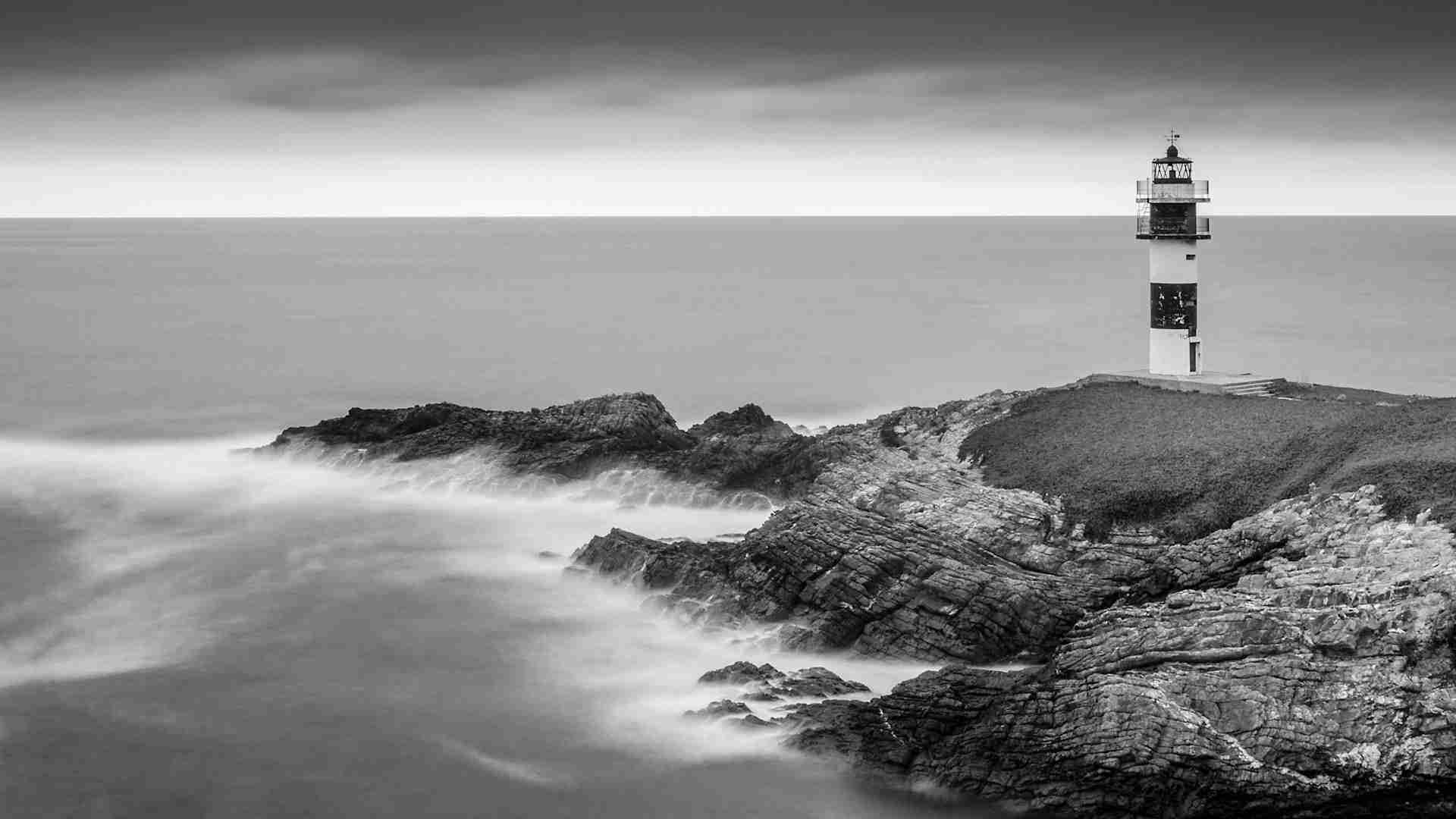
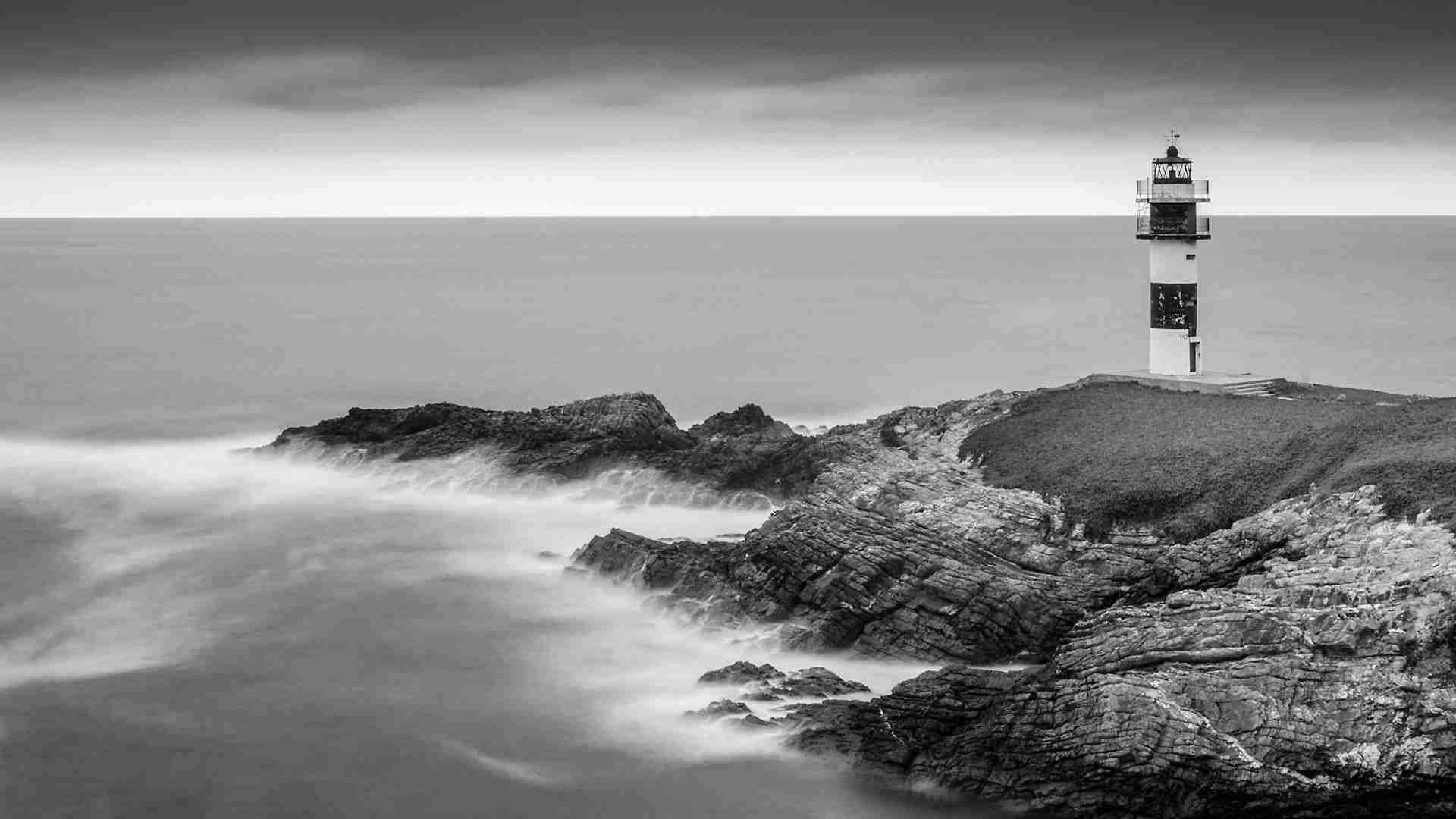
Perched just off the rugged coast of Galicia in Spain's northwest, Faro de Ribadeo stands on Isla Pancha, a small island tethered to the mainland by a single arched bridge. This pair of lighthouses—one modern, one decommissioned—marks the entrance to the Eo estuary and has become a favorite for photographers drawn to strong geometry, dramatic skies, and the ever-changing presence of the Atlantic. Isla Pancha's rocky shoreline, exposed location, and unbroken horizon offer a compact but highly dynamic environment where composition, light, and timing come together in powerful ways. The island may be small, but its potential for long exposure work, moody seascapes, and architectural contrast is anything but limited.
Best Photography Opportunities
Long Exposures from the Mainland Path
The most well-known view of Faro de Ribadeo is from the mainland side, where a narrow pedestrian path curves toward the arched bridge that leads to the island. This perspective allows you to frame both lighthouses with the stone bridge in the foreground and the open Atlantic behind. It's a perfect location for long exposures using an ND filter, especially during overcast or stormy weather when the sea blurs into soft motion and the clouds streak across the sky. A wide-angle lens helps include the bridge, the water, and the curve of the coastline while maintaining strong compositional balance.
Twilight Blue Hour with Lighthouse Illumination
As the sun sets and twilight deepens, the newer lighthouse becomes active, casting light across the rocks and water. Shooting during blue hour allows you to capture the contrast between natural fading light and artificial glow. This is a time for slow shutter speeds and careful exposure blending if needed. From the mainland path, frame the illuminated lighthouse as a focal point while keeping the bridge and horizon line clean. Use a tripod and remote release to avoid vibration and allow the full richness of twilight tones to build across the image.
Storm Clouds and High Drama Skies
Galicia's coastal weather brings frequent shifts in mood and light, with fast-moving clouds and storm fronts that create ideal conditions for dramatic seascapes. Position yourself early as the weather builds to capture the low pressure clouds as they move inland. Use a polarizing filter to deepen contrast and control reflections off the water and rocks. A telephoto lens can help compress the scene and exaggerate the scale of incoming clouds over the small island. These images often work well in black and white, highlighting the tonal structure of sea, sky, and stone.
Close Detail Studies of the Bridge and Structures
While the grand views dominate most portfolios, photographers willing to step back and explore details will find plenty of graphic opportunities around the island's edge. The arched bridge, with its stonework and symmetry, provides excellent raw material for tight compositions focused on line and contrast. Look for moments when waves crash against the base of the bridge, sending spray into the air. Use a fast shutter to freeze the motion, or go slow to blur it into streaks. The lighthouses themselves offer clean shapes, faded textures, and patinaed paint that reward close study.
Early Morning Fog and Coastal Softness
On calm mornings, particularly in late spring and early autumn, fog sometimes lingers along the coastline and softens the view of Isla Pancha entirely. In these conditions, both the bridge and the island can appear partially veiled, creating a layered, dreamlike composition. Shooting at low ISO with a longer exposure helps preserve the quiet mood of these scenes. Allow the composition to simplify, with only one or two key elements visible, and let the atmosphere define the image. These are quiet frames that benefit from patience and restraint.
Best Time to Visit
Isla Pancha is visually rewarding year-round, but the most consistent conditions for photography occur between late March and early November. Spring and autumn offer the best balance of light quality, active weather, and manageable tourist presence. Autumn, in particular, brings dramatic skies and lower sun angles, which enhance both color and shadow.
Sunrise provides light from behind the mainland and can bathe the lighthouses in soft, side-lit tones. Sunset shifts the light toward the west and creates deeper contrast across the water and stone. Blue hour is particularly effective here due to the functioning light and its reflection on the sea. Cloudy days and light rain can be advantageous for long exposures and moody images. Summer midday light can be harsh, and access paths may be busier. Plan to visit early or late in the day for calmer conditions and better control of the scene.
How to Get There
Faro de Ribadeo is located just outside the town of Ribadeo, in the Lugo province of Galicia. From the center of Ribadeo, drive or walk west along Avenida de las Islas Pancha, which leads to a small car park near the head of the footpath. The final section of the walk is pedestrian only and takes about five to ten minutes. The island itself is not accessible to the public except through private accommodations operated within the former lighthouse building, but all popular photography spots are located along the mainland-facing edge or from nearby cliffs.
There are no fees to visit or photograph the area from public paths. The terrain is paved and easy to walk, though sections near the edge can be slippery in wet weather. There are no restrooms or shops at the lighthouse site, so come prepared. Drone photography is not permitted without authorization due to proximity to operational infrastructure. Mobile signal is generally reliable, though the best light often comes when the site is at its quietest—early morning, or after weather has cleared.
Recommended Photography Gear
A wide-angle lens is essential for framing both lighthouses, the bridge, and the coastline in a single shot, especially from the mainland viewpoint. A 24 to 70 millimeter zoom provides flexibility for tighter compositions, architectural studies, and stormy skies. For weather-driven images and compressions with the ocean horizon, a 70 to 200 millimeter telephoto adds reach and dynamic layering.
A tripod is crucial for long exposures and low-light conditions. A six- or ten-stop ND filter will help smooth water and sky during extended shutter shots, while a circular polarizer is helpful for managing glare off rocks and shallow pools. Lens cloths are necessary, especially on windy or stormy days when sea spray can build quickly. Waterproof protection for your bag and gear is strongly advised. Pack lightly but deliberately, as walking conditions are simple but changeable with the coastal wind.
Nearby Photography Locations
Located just a short drive west of Ribadeo, this beach is known for its towering sea arches and natural rock cathedrals that become accessible at low tide. Shoot during sunrise or golden hour when soft side light reveals detail in the stone. Long exposures here can turn the sand and water into smooth, ethereal layers beneath the rock formations.
Puente de los Santos
This modern bridge spans the Eo estuary between Galicia and Asturias. From below or from distant viewpoints, the bridge forms a strong geometric subject against sky and water. Early morning fog often builds in the estuary, offering an opportunity for high-contrast silhouettes or soft, drifting atmosphere.
Just south of Isla Pancha, the tiny fishing port of Rinlo provides old stone buildings, working docks, and colorful boats. It's a compact but visually rich place for detail-oriented photographers interested in maritime life and textures. Visit early to catch morning light on the water and avoid crowds.
A viewpoint higher above the town of Ribadeo, this mirador offers long views over the estuary, town, and coastline. It's a great place to photograph light as it travels across the land and out to sea. Late afternoon is best, especially when clouds break over the water and create sun paths across the horizon.
An ancient Celtic hillfort set along the coast, this archaeological site combines historical stonework with dramatic sea cliffs. The headland location is ideal for panoramic shots, especially during sunset or when waves are active. Use a wide lens and low angle to place ancient walls against the expansive Atlantic.
Faro de Ribadeo on Isla Pancha is a place defined by precision and patience. The structure itself is simple, but what surrounds it (the changing sky, the motion of the ocean, the rhythm of light across water and stone) creates constant variation. For photographers who appreciate structure framed by mood, and geometry grounded in a restless natural environment, Isla Pancha offers a tightly framed world full of shifting possibility.
Comments
Loading comments…