
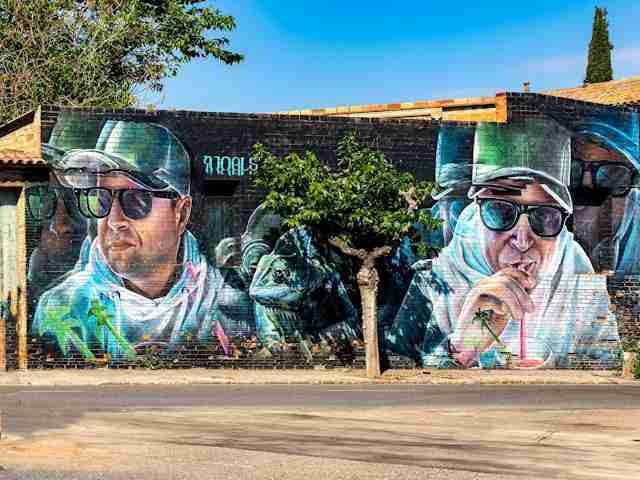
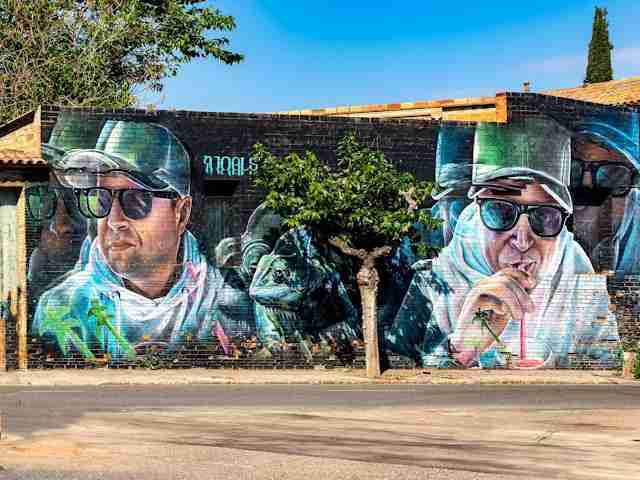
Tucked into the quiet agricultural village of Penelles in Catalonia's Lleida province, GRAFITI NÚM. 128 is one of many vibrant murals that have transformed the town into an open-air gallery. As part of the ongoing GarGar Festival, this particular work occupies a prominent wall with commanding visibility, showcasing bold forms, strong contrast, and rich color against the soft tones of the surrounding rural architecture. Like much of the town's street art, it reflects a blend of local identity and international style, creating a layered subject that rewards both technical precision and creative framing. With minimal foot traffic, unobstructed sightlines, and varied ambient light throughout the day, the mural offers photographers the freedom to experiment with perspective, context, and color relationships in a compact yet dynamic setting.
Best Photography Opportunities
• Frontal Documentation with Clean Geometry
The most straightforward approach to photographing GRAFITI NÚM. 128 is a square-on composition that emphasizes the flatness and symmetry of the wall surface. Using a 35 to 50 millimeter lens allows you to frame the entire mural without distortion while preserving the proportions intended by the artist. This setup works best in diffused light, such as early morning or under light overcast skies, which prevents glare and brings out the depth of painted detail. A level camera and tripod ensure architectural lines remain straight and true, especially useful if you plan to create a series or catalog of the town's murals. Clean geometry highlights the contrast between the modern artwork and the traditional village structure.
• Contextual Compositions with Environment
For a broader storytelling approach, step back and incorporate the mural's architectural surroundings into your composition. Include neighboring rooftops, street signs, or agricultural elements like fences or machinery to place the art within the real-world setting of Penelles. This contrast between rural life and contemporary mural work offers visual tension that enriches the image. Shooting during golden hour warms the color palette and enhances the texture of the stone and plaster. A wider lens between 24 and 35 millimeters will give you flexibility in balancing mural size with background elements.
• Shadow Play and Light Interaction
Throughout the day, shadows from adjacent buildings and street features move across the mural's surface. Rather than avoiding these interruptions, you can use them to introduce shape, rhythm, and natural layering into your shot. Capture diagonal lines from rooflines or tree shadows that cut across the painted form, using them to guide the eye through the composition. These kinds of interactions are most dynamic during mid-morning or late afternoon, when the sun creates strong lateral angles. Consider shooting multiple versions over time to study how the mural interacts with changing light throughout the day.
• Detail Work and Color Isolation
Tight compositions focusing on specific sections of the mural can reveal brushwork, texture, or color layering that may be lost in wider views. Use a short telephoto lens or standard prime to isolate corners, edge transitions, or points of symmetry. These studies are especially effective in black and white, where contrast and surface texture replace color as the dominant compositional force. Alternatively, focus on color harmony, using background elements such as painted doors, worn plaster, or natural foliage to mirror or contrast against sections of the mural.
• Incorporating Human Scale and Interaction
Including people in your composition can provide a sense of scale and narrative. Locals passing by, children playing nearby, or photographers at work can all add a layer of context and relatability. Use a moderate aperture around f/5.6 to f/8 to keep both mural and subject in focus, and time your shot so movement complements rather than distracts from the composition. These candid or semi-staged moments are best captured with a mid-range zoom or a fast 35 millimeter prime, which allows you to move naturally and respond to unfolding scenes without intrusion.
Best Time to Visit
Penelles is a year-round destination for mural photography, but the quality of your shoot depends heavily on the light and weather. Spring and autumn are ideal for moderate temperatures, soft light, and fewer visitors, especially if you plan to explore multiple murals in one session. During these seasons, early morning and late afternoon offer the best balance of shadow and saturation, enhancing color without washing it out.
Summer brings stronger contrast and potential glare during midday, but also longer twilight periods that are perfect for capturing murals in warm, even light. Winters are quieter and often overcast, which reduces harsh highlights and allows for more subdued, tonal compositions. Since GRAFITI NÚM. 128 is fully outdoors, the mural is available to photograph at all times, but visiting in the early morning avoids shadows cast by neighboring structures and helps prevent foot traffic in the frame.
Overcast days are particularly valuable for detail shots, eliminating harsh highlights and allowing consistent color reproduction. Avoid shooting in direct overhead sun, as it can flatten the mural and make camera exposure difficult to balance. Light wind is rarely a factor here, but occasional dust or pollen can accumulate on surfaces during dry seasons, so a lens cloth is helpful.
How to Get There
Penelles is located in the comarca of La Noguera in Lleida Province, Catalonia. The village is accessible by road from nearby cities like Balaguer or Tàrrega, with regional highways connecting from Lleida in under an hour. Public transport options include regional buses that stop in town, but driving is the most efficient way to reach the site, especially if you're planning to photograph multiple murals throughout the day.
Once in the village, GRAFITI NÚM. 128 is one of dozens of works scattered across the compact grid of residential and agricultural streets. The mural itself is easy to locate using local maps available at the town's entrance or through GPS using its name or catalog reference. Street parking is available near most murals, and walking distances between murals are short, making it easy to explore on foot with your gear.
There are no permits or fees required to photograph the murals, and tripods are permitted throughout the village. Be respectful of local residents, as many murals are painted directly onto private homes or barns. Early visits reduce both foot traffic and parked cars, which can block compositions if you're photographing from across the street.
Recommended Photography Gear
A mid-range zoom such as a 24 to 70 millimeter lens will cover most framing needs for full mural compositions and contextual scenes. A wide-angle option between 16 and 35 millimeters can be useful for tight spaces or for capturing the mural alongside its surrounding architecture. A fast 35 or 50 millimeter prime provides excellent sharpness and low-light flexibility for early morning or overcast days.
A tripod is recommended for precise composition and consistent framing, especially if you're documenting the mural as part of a larger series. A circular polarizer can help reduce glare from painted surfaces and improve sky definition, though be careful to avoid uneven polarization on wide-angle shots. Lens hoods are useful for controlling flare during strong side lighting in the afternoon.
A protective camera bag with quick-access compartments will make it easier to move around the village while keeping gear safe from dust or accidental contact with walls or street edges. Bring extra batteries and cards, particularly if you plan to shoot throughout the day or bracket exposures for post-processing flexibility.
Nearby Photography Locations
The town hosts more than 100 murals by artists from around the world, making it a premier destination for street art in a rural setting. Each piece offers unique opportunities for color, texture, and scale studies, with no two walls alike. Spend time walking the full loop to discover large-scale portraits, surrealism, and playful, community-based works.
A short drive from Penelles, this historic winery offers expansive vineyard views, stone buildings, and seasonal activity such as harvesting or bottling. It's a great place for late afternoon light and combining landscape with working architecture.
This restored inland lagoon offers wide open wetland views, bird photography opportunities, and calm, glassy water perfect for sunset reflections. A wooden boardwalk and observation towers provide elevated perspectives without disrupting the environment.
The nearby town of Balaguer offers a very different visual experience, with medieval streets, textured façades, and elevated viewpoints from the Santa Maria church. Blue hour in the town square provides opportunities for soft urban lighting and mixed architectural styles.
For photographers interested in night work, this stargazing park in the Montsec mountains offers certified dark sky conditions. Combine it with a day in Penelles to contrast street art and celestial photography in one visit.
GRAFITI NÚM. 128 stands as both a singular subject and part of a wider creative adventure winding through the streets of Penelles. With careful attention to light, composition, and surroundings, photographers can turn a flat wall into a living canvas that changes with every visit.
Comments
Loading comments…