
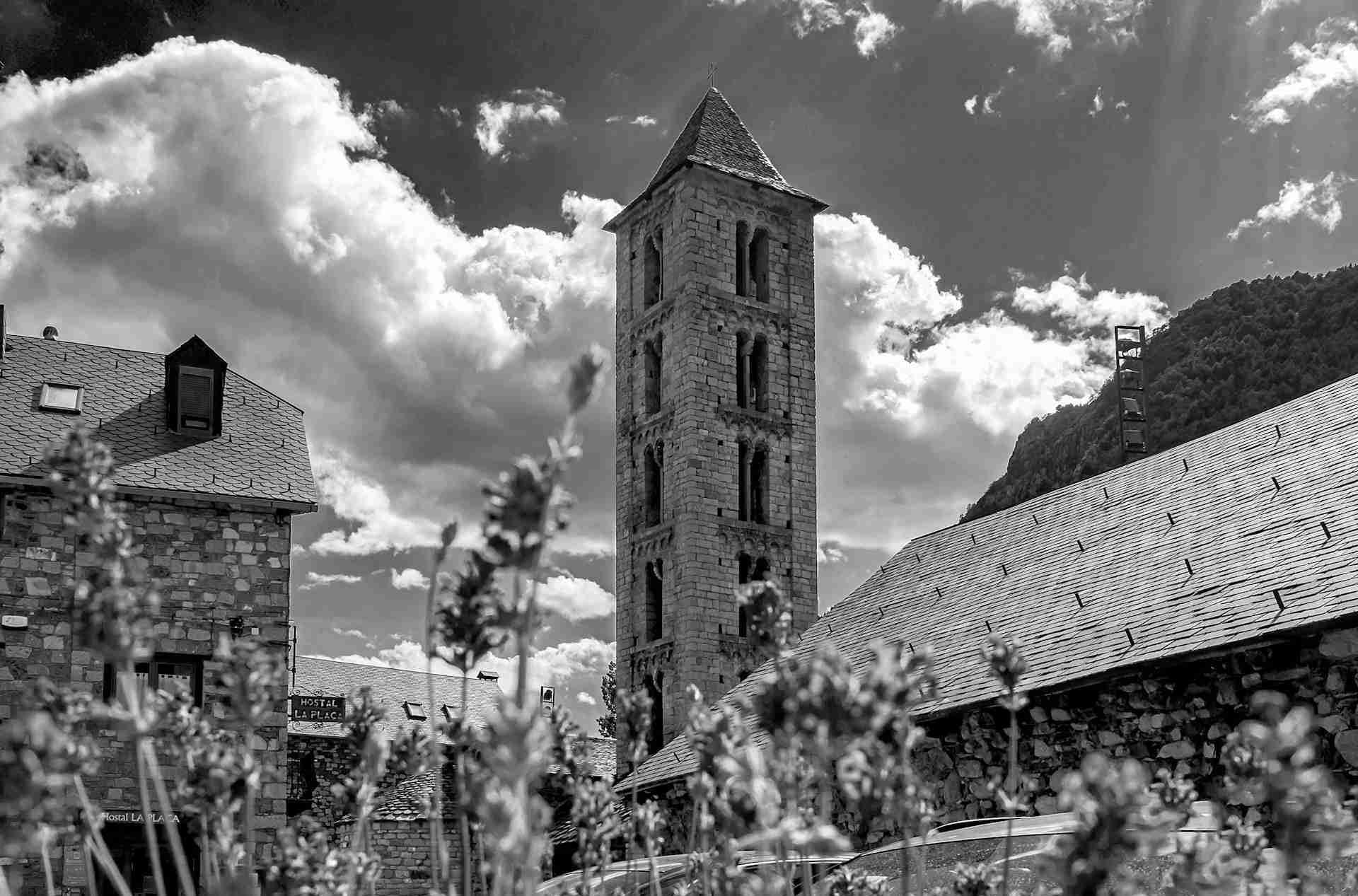
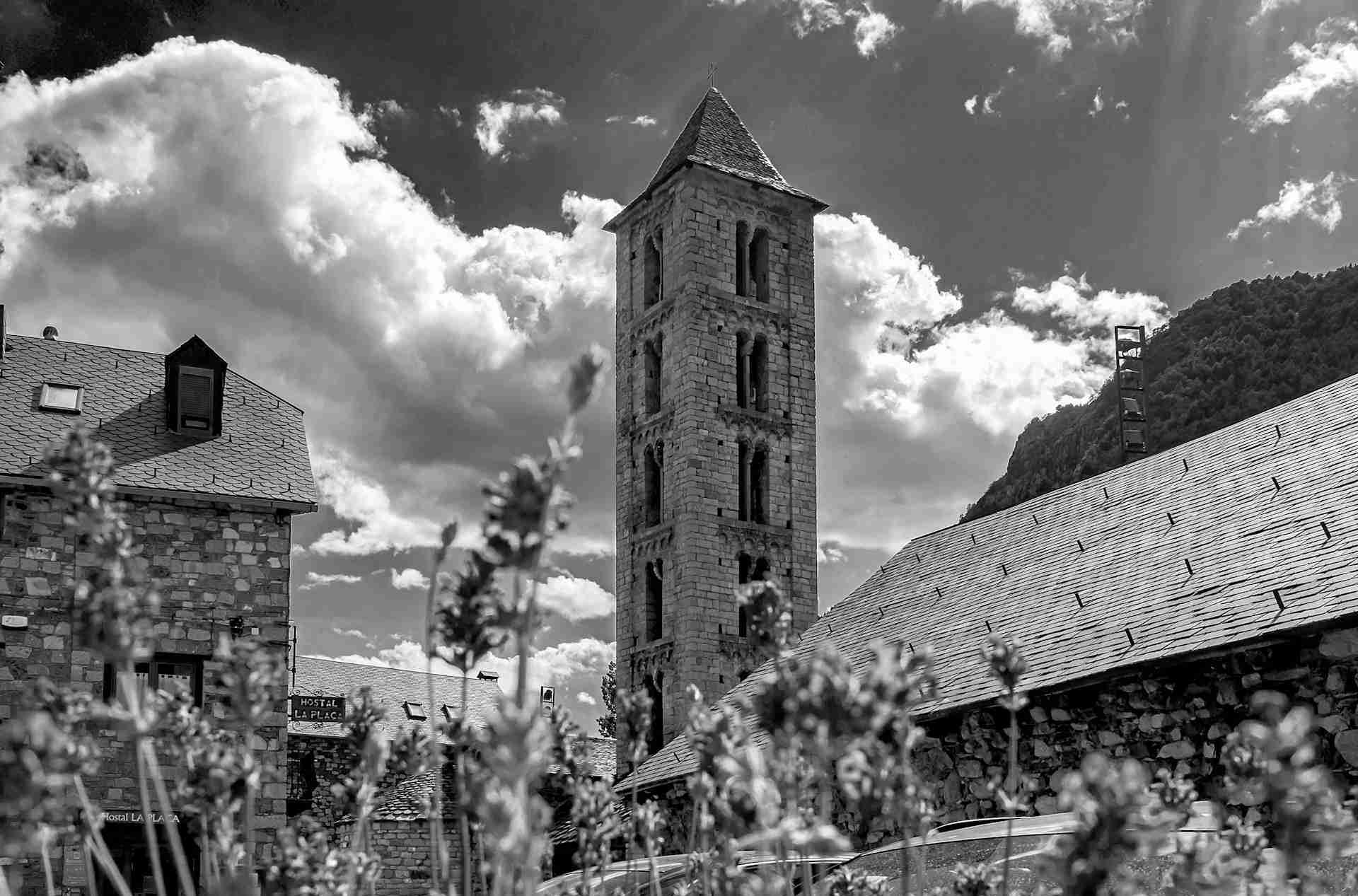
Nestled in the Vall de Boí within Catalonia's rugged Pyrenean landscape, the Iglesia de Sant Climent de Taüll is one of Spain's finest examples of Romanesque architecture—and one of its most atmospheric photographic subjects. Consecrated in 1123 and remarkably well preserved, this church exudes timeless simplicity. Its elegant bell tower, ashlar masonry, and harmonious proportions stand in quiet dialogue with the mountain backdrop. Inside, a digital projection recreates the famous Christ Pantocrator fresco—now housed in the Museu Nacional d'Art de Catalunya—casting vivid, spectral light across stone walls that have witnessed centuries of worship and snowmelt. Whether framed by sunrise alpenglow or the shadows of afternoon storms, Sant Climent is a convergence of landscape and faith, where every composition resonates with clarity, age, and grace.
Best Photography Opportunities
• Bell Tower Against Mountain Backdrop
: The church's six-story bell tower is its most immediately recognizable feature. Slender and unadorned, it rises in perfect symmetry, its Lombard-style arches opening onto the surrounding peaks. From slightly below the church grounds, you can frame the tower against the rugged slopes of the Pyrenees, capturing the vertical interplay between manmade form and natural ascent. Use a telephoto lens (70–200mm) to compress the background and enhance the tower's sense of verticality, or opt for a wide-angle lens from up close to exaggerate its height against sweeping skies. Sunrise provides soft, dimensional light from the east, illuminating both tower and mountain in warm hues, while late afternoon offers more dramatic shadows and stormy cloud contrast.
• Exterior Stonework and Shadow Play
: The church's exterior is built from local volcanic stone, fitted with such precision that its texture seems etched rather than laid. Each arch, frieze, and window opening contributes to the visual rhythm of the facade. For texture studies and fine architectural composition, shoot during the golden hour when the raking light casts deep shadows in the carvings and along the rooflines. A mid-range zoom (24–70mm) allows you to isolate corners, apses, and transitional stonework with flexibility. Pay particular attention to the apse, where blind arcading creates strong patterns and the stone has taken on subtle shades from centuries of exposure to alpine weather.
• Interior Fresco Projection
: Inside the church, a state-of-the-art digital projection brings back to life the Romanesque frescoes once painted on its curved apse, most notably the Christ in Majesty surrounded by apostles and symbols of the Evangelists. The interplay of ancient stone and modern light creates an ethereal experience that translates beautifully to photography. Use a fast lens (f/1.4–f/2.8) and high ISO to work in low light without flash, and consider bracketing exposures to capture the rich tonal range of the projection without losing the stone's ambient warmth. Wide-angle compositions from just below the apse give a full sense of the space and allow the digital fresco to dominate the image without distortion. Details—like the texture of the stone beneath the glowing colors—can also be captured with a prime lens for narrative close-ups.
• Framing the Church in the Landscape
: The surrounding village of Taüll and the valley itself offer multiple elevated points from which to frame the church in its full context. From the hillside path just west of the village, you can shoot downward across the rooftops with the church rising from among them, framed by dramatic ridges and sky. Early morning fog or drifting clouds enhance the feeling of timelessness and seclusion. Use a longer focal length to flatten the planes of village, church, and mountain, or create a panorama to encompass the layered terrain. In winter, the snow-dusted stone and stark branches surrounding the church offer minimalist compositions filled with quietude and contrast.
• Night Photography and Tower Illumination
: After sunset, the church and its tower are subtly lit by warm-toned uplights, offering strong contrasts with the cooler night sky. During blue hour, this lighting balance allows you to capture the building glowing gently against the final hints of daylight or a cloud-draped sky. Use a tripod for long exposures, and consider a composition that includes both the tower and a section of star-filled sky or passing clouds. In the absence of light pollution, the Milky Way is visible here in summer months—an opportunity to blend cultural heritage with astrophotography in a single, compelling frame.
Best Time to Visit
The ideal time to photograph Iglesia de Sant Climent de Taüll is during the shoulder seasons of spring and autumn, when light is softer, skies more expressive, and crowds relatively few. In late spring, fresh green grass carpets the church grounds, contrasting beautifully with the warm stone. Morning fog often drifts up the valley, adding a layer of mystery and layering to compositions. Autumn brings golden tones to the surrounding vegetation and slanted light that enhances both architecture and landscape.
Summer offers long shooting hours and clear skies, ideal for night photography and architectural clarity, though mid-afternoon light can be harsh and tourist traffic peaks. To avoid both crowds and glare, plan your sessions around sunrise and early evening. Winter, while colder and more logistically challenging, rewards the determined photographer with snow-draped rooftops, atmospheric fog, and complete solitude. The low sun angle throughout the day offers extended golden hour light, and the surrounding mountains gleam under fresh snow, creating pristine compositions rich in tonal range.
How to Get There
Iglesia de Sant Climent de Taüll is located in the village of Taüll, in the Alta Ribagorça comarca of Lleida province, Catalonia. The village lies within the Parc Nacional d'Aigüestortes i Estany de Sant Maurici and is part of the UNESCO-listed Vall de Boí Romanesque ensemble. From Barcelona, the drive takes approximately 4.5 hours, most of it on well-maintained highways until the final stretch into the mountain valleys. The closest large town is Pont de Suert, about 20 minutes away by car.
Once in Taüll, the church is situated just a short walk from the main parking area at the village entrance. Vehicles are restricted in the center, making the area ideal for pedestrian exploration. The church is open to visitors year-round, though hours vary seasonally. There is a modest entrance fee, which includes access to the interior projection system and visitor information. Tickets can be purchased on-site, and entry is generally uncrowded outside of high season.
No photography permit is required for non-commercial photography, though flash and tripods may be restricted during busy hours. For low-light interior work or extended sessions, visiting during the first hour after opening or just before closing is recommended to avoid large tour groups.
Recommended Photography Gear
To make the most of the setting's architectural detail and landscape integration, a full-frame camera with strong dynamic range and high ISO performance is recommended. A wide-angle lens (16–35mm) is essential for both capturing the bell tower's height from up close and composing sweeping scenes that include the church and its mountainous surroundings. A standard zoom (24–70mm) provides flexibility for detail shots and mid-range compositions, while a telephoto lens (70–200mm) is useful for compressing mountain layers behind the church or for shooting from hillside viewpoints.
For interior shooting, a fast prime lens (35mm or 50mm at f/1.4–f/1.8) is ideal for working handheld in low light. A tripod is critical for exterior twilight and night photography, particularly for long exposures of the illuminated tower. Filters are optional here, but a circular polarizer can be useful for cutting glare on stone or enhancing sky contrast during daytime shots. In winter, lens hoods and microfiber cloths are essential to manage condensation when transitioning between cold air and the warm interior.
Footwear suited to mountain terrain and a weather-resistant backpack will improve mobility, especially if hiking to nearby viewpoints. A remote shutter release or 2-second timer helps ensure stability during long exposures. And because this is a living cultural site, always carry a compact kit that allows you to move discreetly and respectfully among other visitors.
Nearby Photography Locations
: Just a short walk downhill from Sant Climent, this church shares similar Romanesque characteristics and is often overlooked by visitors. It provides opportunities for paired compositions and tighter architectural studies in a quieter setting.
Perched on a hilltop outside the nearby village of Durro, this small hermitage overlooks the entire Vall de Boí. The views at sunrise and sunset are expansive, and the solitary stone chapel adds a poignant focal point to wide mountain compositions.
• Boí Village and Valley Views
: The village of Boí itself offers narrow stone alleys, rustic wooden balconies, and mountain vistas. From the trail behind the village, you can shoot wide-angle scenes with villages and churches nestled into the hillsides.
: Just beyond the Vall de Boí, this national park features high alpine lakes, pine forests, and rugged peaks. A must for landscape photographers, especially those wanting to combine cultural and natural imagery in one journey.
• Barruera Riverside Path
: A peaceful trail runs along the river in Barruera, providing early morning mist, pastoral scenes, and occasional wildlife. Perfect for a quiet photographic detour before or after exploring the larger churches.
Iglesia de Sant Climent de Taüll is not just a church—it is a conversation between history and landscape, simplicity and grandeur. For photographers drawn to sacred spaces, mountain light, and the power of Romanesque design, this hillside sanctuary offers silence, depth, and a canvas as enduring as the stone from which it is built.
Comments
Loading comments…