
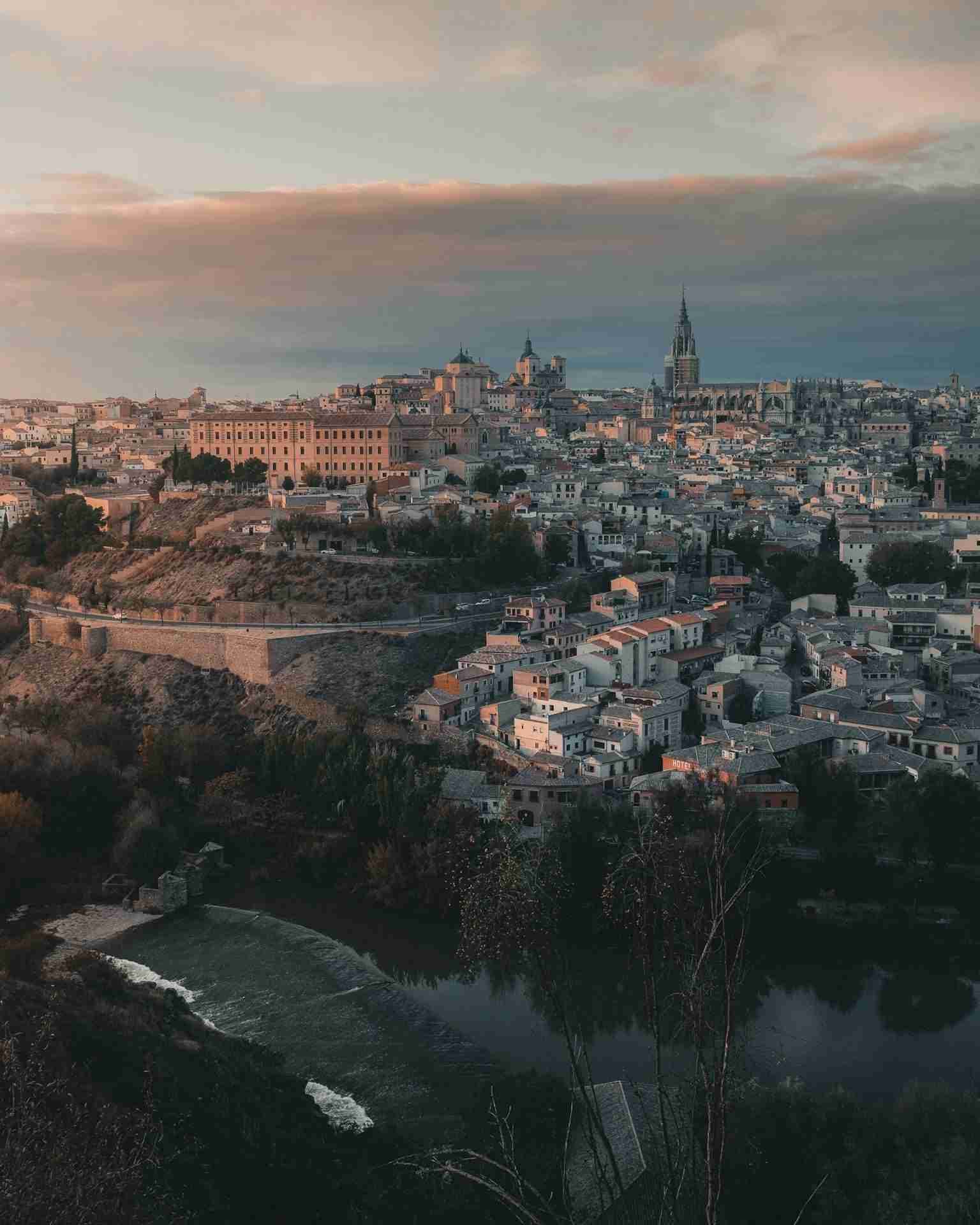
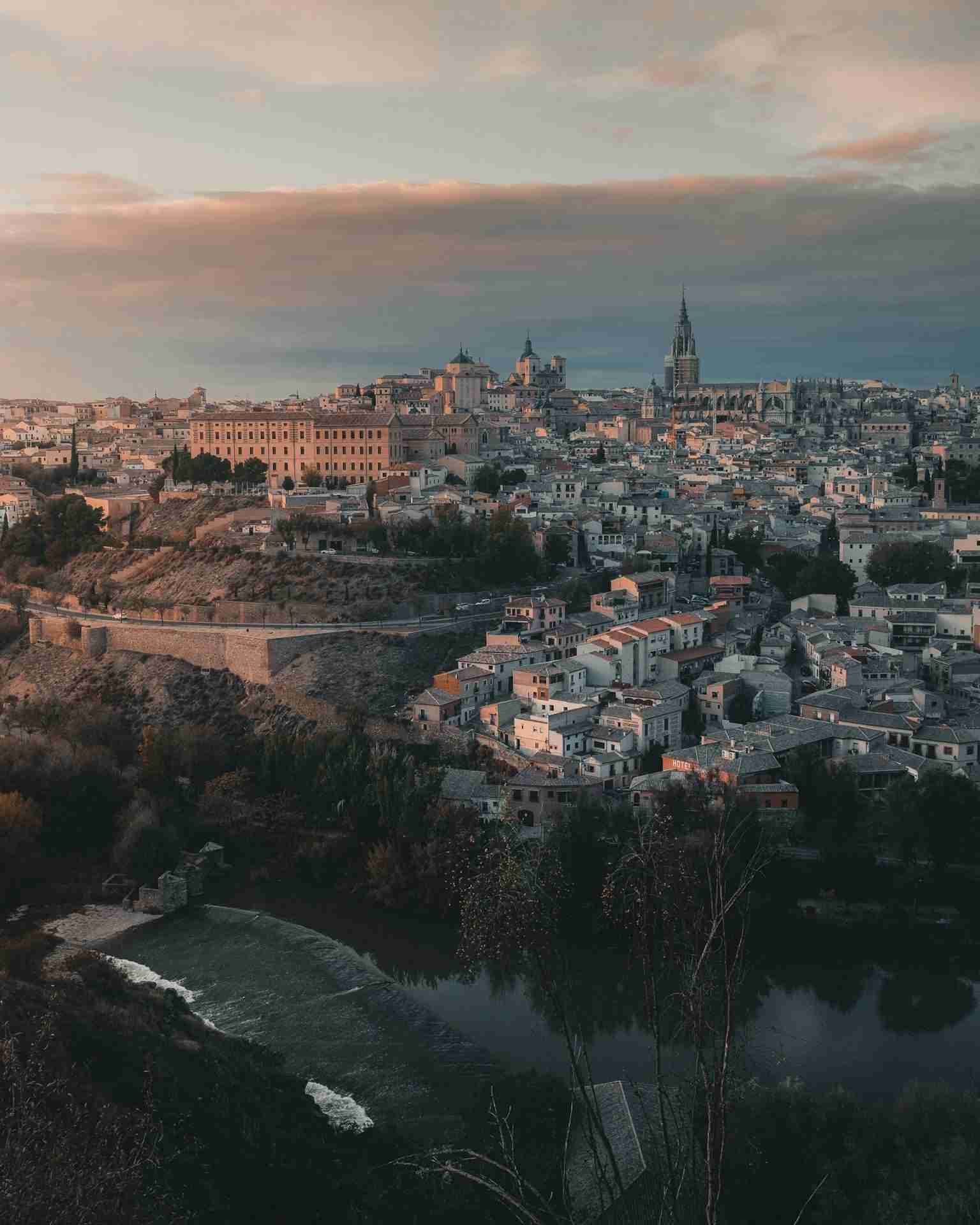
High above the meandering Tagus River, Mirador del Valle offers the most commanding and comprehensive perspective of Toledo—a city where Roman, Visigothic, Islamic, Jewish, and Christian legacies overlap in a dense mosaic of architecture and geography. From this elevated ridge, Toledo's old town appears suspended in time, its tangle of towers, domes, and terraced rooftops encircled by a sweeping river bend. For photographers, this viewpoint delivers a remarkably dynamic scene that evolves with the shifting light of day. From warm sunrise glows to the quiet grandeur of twilight, Mirador del Valle allows for a variety of compositions—from sweeping panoramas to compressed architectural studies—all framed by the natural contours of one of Spain's most historically layered cities.
Best Photography Opportunities
• Panoramic Skyline at Sunrise and Sunset
: The most expansive compositions from Mirador del Valle benefit from golden hour light, when the low sun enhances every detail in Toledo's stone architecture. At sunrise, the light flows in from the east, illuminating the Alcázar and the towering Cathedral of Toledo with warm highlights that emphasize their height and mass. The surrounding rooftops catch the glow while the river below remains cool and shaded, creating strong tonal contrast. Sunset reverses the mood, with long shadows stretching across the city and the entire skyline bathed in amber. Use a wide-angle lens (16–35mm) to take in the full sweep of the city wrapped by the Tagus. For a higher-resolution image, consider stitching a panorama of overlapping shots taken from a fixed tripod position to preserve both detail and curvature.
• Reflected Light in the Tagus River
: The Tagus is not just a framing device—it becomes a subject in its own right under the right conditions. On still mornings or calm evenings, the water mirrors the skyline above, creating symmetrical compositions that emphasize balance and atmosphere. Look for days with little wind to achieve this effect, and use a polarizer to adjust reflections and reduce glare from the water surface. Longer exposures at twilight can render the water smooth and glasslike, blending soft color gradients with the illuminated city above. Compose your frame to emphasize the curve of the river, allowing it to lead the viewer's eye naturally toward key landmarks.
• Telephoto Compressions of City Layers
: While wide vistas dominate most views from the Mirador, switching to a telephoto lens reveals an intricate layering of rooftops, walls, and towers that give Toledo its dense, organic appearance. Use a 70–200mm or longer focal length to isolate elements like the Cathedral's spire catching the last light, the defensive walls along the edge of the city, or the Alcázar rising from the skyline like a fortress. These lenses allow you to compress the depth of the city into graphic compositions that tell a different story—one focused more on structure, repetition, and the textures of ancient stone than on sweeping grandeur. The interplay of light and shadow becomes more apparent at these focal lengths, particularly during golden hour or on overcast days when subtle tonal variation replaces harsh contrast.
• Night Photography and Illuminated Landmarks
: After sunset, Toledo transforms into a softly glowing silhouette punctuated by the lights of the Alcázar, Cathedral, and surrounding streets. The Mirador provides an unobstructed view of this transformation, and blue hour is the ideal window for balanced exposures that capture both the cooling sky and the warmth of artificial lighting. Set up a tripod and use long exposures to enhance reflections in the river, or capture the movement of car headlights tracing curves along the riverside road. Adjust white balance manually to avoid unnatural color casts, and use a graduated ND filter or blend multiple exposures to retain detail in both highlights and shadows. The result is a scene that feels both ancient and eternal, suspended in the quiet hours of the evening.
• Foreground Framing and Seasonal Texture
: The landscape surrounding the Mirador is dotted with olive trees, dry grasses, and scattered rocks that can be used to build layered compositions. Including these foreground elements helps anchor the city in its natural environment and adds texture to wide-angle shots. In spring, wildflowers bring soft color to the arid hillsides, while in autumn, the warm light complements the faded greens and dry grasses. A lower shooting angle with a wide aperture (f/2.8–f/4) creates selective focus, drawing the viewer's attention into the frame through a foreground-blurred vignette. These compositions are particularly effective when the city is backlit or partially veiled in haze, enhancing depth and narrative.
Best Time to Visit
Mirador del Valle is photogenic at any hour, but light conditions and seasonal changes significantly affect the scene's tone and texture. For photographers seeking soft light and minimal foot traffic, sunrise is the best option. Eastern light directly illuminates the Alcázar, Cathedral, and surrounding rooftops, while the rest of the landscape remains quiet and undisturbed. This time of day also tends to offer clearer air and greater potential for reflections in the Tagus.
Sunset provides more drama in both light and sky, particularly after a warm day when the horizon fills with deep reds, oranges, and purples. However, sunset also brings larger crowds, especially in spring and summer. Arriving 30 to 45 minutes early allows time to claim a good spot and refine compositions as the light evolves.
Spring and autumn offer the most comfortable conditions for extended shoots. The light during these seasons is less harsh, the vegetation more textured, and the skies more expressive. Summer delivers high contrast and deep blue skies—ideal for high-impact images but more challenging to manage with midday glare. Winter brings long shadows and the possibility of fog or frost in the valley, transforming the scene into a subdued, minimalist study in gray and gold.
How to Get There
Mirador del Valle is located on the southern edge of Toledo, across the Tagus River from the historic city center. It is easily accessible by car, taxi, or on foot. The most direct driving route follows the Carretera del Valle, which wraps along the southern bank of the river and features multiple pull-off areas with dedicated parking and viewing platforms. These spaces accommodate both casual visitors and photographers needing room for tripods and extended gear setups.
From the old city, reaching the viewpoint on foot involves crossing one of the river's historic bridges—either Puente de San Martín or Puente de Alcántara—and ascending a paved road or trail that climbs steadily toward the Mirador. The walk can take 30 to 45 minutes, depending on your pace and starting point, and is especially rewarding during the early morning or late afternoon when the sun is low and the air is cool.
There is no entrance fee to access the viewpoint, and it remains open to the public at all hours. This makes it one of the few places in Toledo where photographers can shoot uninterrupted at dawn, dusk, or into the night. The area is safe and generally well-frequented, though quieter early in the morning. A flashlight or headlamp is recommended for navigating before sunrise or after dark, especially if walking.
Recommended Photography Gear
To make the most of this visually rich and variable landscape, bring a camera setup that balances wide environmental shots with tight architectural detail. A full-frame DSLR or mirrorless body with good dynamic range and low-light performance will provide flexibility throughout the day. A wide-angle zoom (16–35mm) is essential for capturing the full breadth of the cityscape and the curve of the Tagus River. For tighter compositions of towers, rooftops, and layered geometry, a 70–200mm telephoto is invaluable—particularly for sunset and twilight.
A tripod is crucial for shooting at blue hour, achieving sharpness in long exposures, and ensuring level alignment for panoramas. A remote shutter release or intervalometer helps minimize vibration, and in-camera leveling features are useful when working on uneven terrain. Graduated ND filters allow you to manage the contrast between the sky and the city, particularly at sunrise or sunset. A circular polarizer helps cut reflections on the water and deepen sky tones, especially in midday or late afternoon.
Weather-sealed gear bags are helpful year-round, as the hilltop can be exposed to wind, dust, or occasional rain. A microfiber cloth is essential for cleaning lenses during rapid light changes or after long exposure sessions. If planning to move between multiple pull-off points or hike up from the city, consider a lightweight setup that won't limit mobility.
Nearby Photography Locations
• Puente de Alcántara
: Located directly below the eastern edge of the old city, this medieval bridge offers dramatic views of the riverside fortifications and the Alcázar looming above. Shoot at dawn for directional light or after dark for long exposures with reflections in the water.
: From inside the city, the Alcázar provides elevated views back toward the Mirador and beyond. Its rooftop terraces are ideal for reverse angles and offer a different perspective on the river valley and surrounding countryside.
: This towering Gothic masterpiece is as rewarding to photograph from within as from afar. Interior highlights include vaulted ceilings, a richly illuminated altarpiece, and intricately carved choir stalls—all best captured during quiet mid-morning hours.
: A striking example of late Gothic and Mudéjar architecture, the monastery's cloisters, ribbed vaulting, and ornate portal carvings provide strong compositional elements in diffused light.
• Parque de Safont and the Riverbank Trails
: Below the city walls and across the Tagus, these green spaces offer tranquil reflections, access to wildlife photography along the river, and lesser-known compositions of the city framed by water and foliage.
Mirador del Valle is more than a viewpoint—it is a stage from which centuries of architecture, culture, and light unfold across the face of Toledo. For photographers, it is an ever-shifting vantage that rewards careful timing, detailed observation, and an appreciation for the ways in which landscape and history shape one another across time.
Comments
Loading comments…