
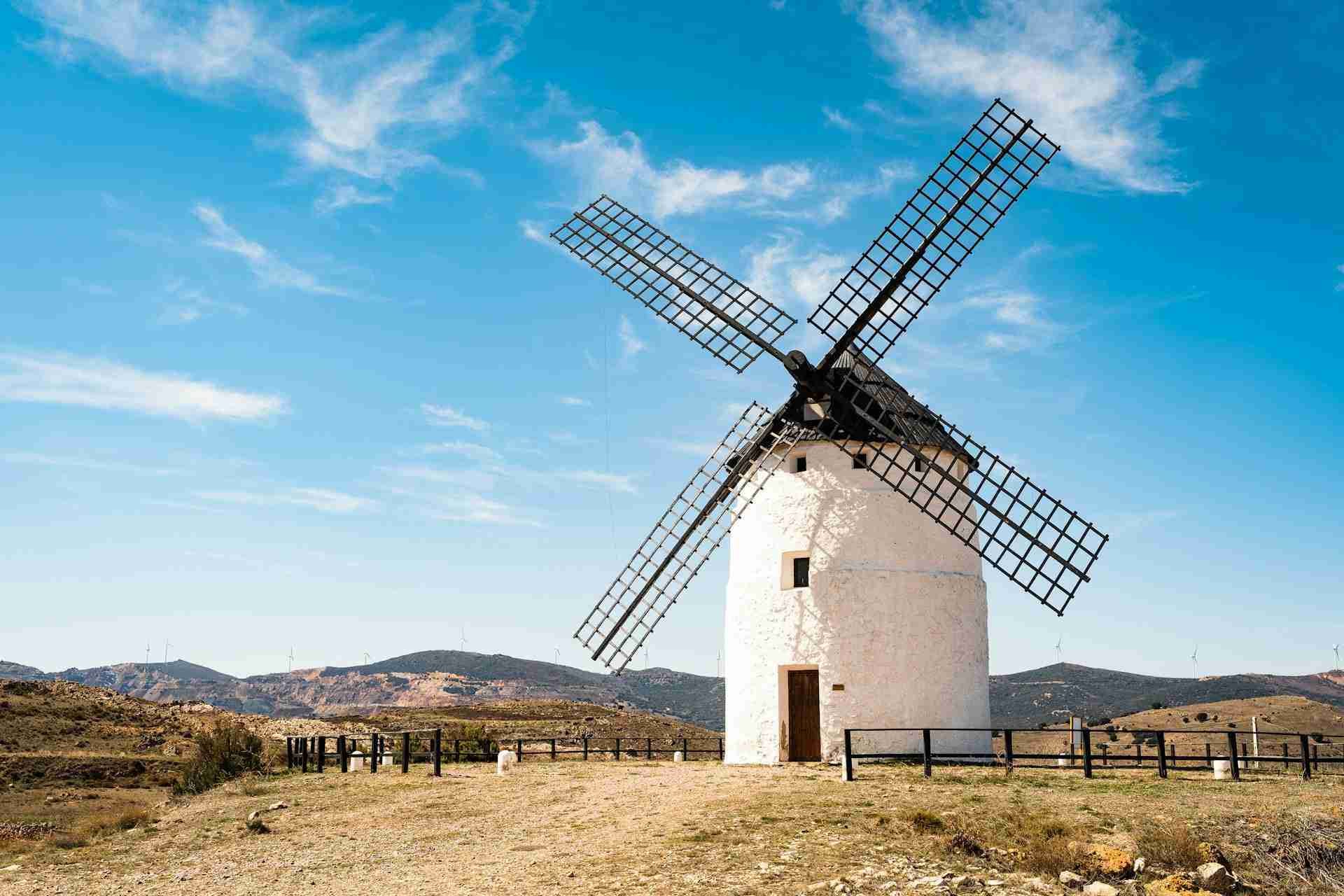
Rising above the small village of Ojos Negros in the province of Teruel, the solitary windmill known as the Molino de Viento de Ojos Negros stands as a quiet sentinel on the edge of the Sierra Menera. Unlike the more restored windmills of central Spain, this cylindrical stone tower remains rugged and relatively untouched, offering a far more grounded and textured subject. Surrounded by open plains, sparse vegetation, and wide skies, the windmill lends itself naturally to minimalist compositions that shift dramatically depending on light and season. Photographers drawn to stillness, form, and subtle change will find this location a rewarding study in simplicity, with few distractions and endless sky.
Best Photography Opportunities
• Golden Hour Profiles
The most reliable compositions come from side-lighting the structure during golden hour, when long shadows stretch across the surrounding ground and warm tones reveal the surface texture of the stone. Positioning slightly downhill from the windmill exaggerates its height against the sky and allows the curve of the hill to frame the subject cleanly. The blades, though no longer complete, provide just enough structural rhythm to build strong diagonals into the image. Wide-angle lenses capture the full structure along with contextual elements like fences, paths, or dry grass. Sunset offers warmer contrast, while sunrise provides a more isolated feel.
• Storm Clouds and Open Sky
With very little in the way of visual clutter, the windmill becomes a perfect counterpoint to dramatic skies during unsettled weather. Approaching storms often build over the Sierra Menera in the afternoon and create bold cloud formations that shift rapidly. Using a mid-range zoom to compress the relationship between the sky and tower works well, particularly if the horizon is kept low. A polarizer helps define cloud layers, and graduated neutral density filters assist in balancing exposures between sky and land. These conditions reward real-time adaptation, as the atmosphere can change minute by minute.
• Minimalist Black and White Studies
The stark contrast between the windmill's form and the open plain lends itself naturally to black and white interpretations. Shooting on overcast days or under harsh midday sun eliminates color distractions and allows tonal contrast to guide composition. The windmill's weathered surfaces, broken wooden arms, and dry grass all translate well into monochrome textures. Keeping compositions clean and relying on natural negative space builds a quiet visual rhythm. A 50 millimeter prime lens can be especially effective for these frames, as it compresses space subtly without distortion.
• Star Trails and Night Sky Photography
The remote location and low light pollution around Ojos Negros make this windmill a compelling foreground subject for night photography. Long exposures during clear nights can produce dramatic star trails or crisp views of the Milky Way, especially in late summer and early autumn. Framing the windmill to one side and allowing the night sky to dominate creates strong visual tension. A sturdy tripod, wide aperture lens, and interval shooting for stacked exposures are essential. Wind can be a factor, so using weighted tripods and protective coverings may help preserve sharpness during long sessions.
• Wide-Angle Contextual Landscapes
The surrounding terrain, including open fields, traces of the old mining railway, and the outlines of distant hills, can all be included in broader landscape shots that place the windmill in context. These compositions work best during soft light conditions, especially when the ground still holds morning dew or after light rain brings out color in the soil. A wide lens between 16 and 24 millimeters allows for environmental storytelling that includes footpaths, shadows, and ground texture. Including the horizon low in the frame emphasizes the scale of the sky and reinforces the windmill's isolation. These conditions are especially productive during late spring or autumn afternoons when the sun is low and directional.
Best Time to Visit
Spring and autumn are the most productive seasons for photography at the Molino de Viento de Ojos Negros. In spring, the grasslands are tinged with green and often dotted with small wildflowers that soften the otherwise arid landscape. The light during this season tends to be more diffuse in the early morning and evening, which is ideal for balancing sky and land. Autumn brings golden tones to the grasses and longer twilight periods that allow for extended shooting windows without harsh contrast.
Winter offers dramatic skies and the occasional snow, which can transform the scene entirely and highlight the shape of the windmill against a white ground. These moments are rare but highly photogenic. Summer tends to be hot, dry, and often hazy, with harsh midday light that can flatten textures. However, summer nights are ideal for night photography, especially on new moon evenings when the sky is darkest and clearest.
Golden hour on either side of the day is best for capturing texture and depth in the stonework and surrounding terrain. Sunset typically offers stronger color and side lighting, while sunrise provides a cooler palette and quieter surroundings. Tides and elevation are not factors here, but changes in wind and cloud cover can influence the feel of the scene dramatically.
How to Get There
The windmill is located just outside the village of Ojos Negros, a small settlement in Teruel province. The closest major road is the N-234, which runs between Teruel and Calatayud. From the village center, follow local signs or GPS coordinates to the windmill's hilltop location, which is reachable via a short gravel road that becomes narrow and uneven in places. A standard car can access the area during dry weather, though caution is advised after rain, as the road may become muddy and slick.
There is no official parking lot, but photographers can safely pull off near the base of the access path without obstructing traffic or local access. From there, it is a short walk up to the windmill, which sits on a modest rise above the plain and provides unobstructed views in all directions. Access is unrestricted, and there are no entrance fees or permits required to photograph the site.
There are no visitor facilities nearby, so anyone planning a longer shoot should bring their own water, food, and gear. Early morning or twilight visits require headlamps or flashlights, as there is no artificial lighting and the terrain around the windmill is uneven. Mobile reception is generally good in the area, but it is advisable to download maps and weather data in advance.
Recommended Photography Gear
A wide-angle lens such as a 16 to 35 millimeter is ideal for capturing the windmill alongside dramatic skies or low-angle foregrounds. A mid-range zoom between 24 to 70 millimeters allows for flexible framing, from environmental shots to detail studies of the structure. A fast telephoto is optional, but it can be useful for compressing background elements or isolating parts of the landscape under interesting sky conditions.
A solid tripod is essential for both low-light and long-exposure work, particularly in windy conditions or uneven terrain. A remote shutter release or built-in timer will help reduce camera shake. Neutral density filters are useful for slowing shutter speeds during daylight to smooth cloud movement or exaggerate stillness. A circular polarizer can reduce glare and add contrast to clouds, though its effect is less pronounced with wide lenses.
For night photography, a lens with a wide maximum aperture, such as f/2.8 or faster, is recommended. Bring extra batteries, as long exposures can drain them quickly in cold conditions. Dust and wind are common, so lens cloths and weather covers should be part of your basic kit. Everything can be carried in a compact backpack, as all shooting positions are within a short walking distance from the car.
Nearby Photography Locations
• Ojos Negros Greenway (Vía Verde de Ojos Negros)
This long-distance cycling and hiking route follows a former railway line and includes tunnels, viaducts, and gentle curves that create excellent leading lines and perspective-driven frames. It is especially photogenic during sunrise when early light filters through the cuttings and embankments.
• Sierra Menera Hills
These low, rolling hills surround the village and provide a natural backdrop for longer compositions. Their simple forms and changing vegetation throughout the year make them ideal for both telephoto studies and environmental shots that include the windmill in the foreground.
• Monreal del Campo
A nearby town with stone bridges, narrow streets, and the Jiloca River running through it. The riverbanks are especially rich in color during spring, and the water reflects surrounding architecture and trees, creating quiet, balanced compositions.
• Daroca
A fortified medieval town farther north, known for its high walls, defensive gates, and dramatic ridge-top location. Late afternoon light casts long shadows down the narrow streets, and the ancient stonework offers strong contrast for black-and-white studies.
This seasonal saltwater lake, a short drive to the north, is a key stopover for migrating cranes and other bird species. It also offers minimalist water landscapes, expansive skies, and mirrored light during dawn and dusk, particularly in autumn.
The Molino de Viento de Ojos Negros offers a quiet but powerful subject for photographers who appreciate structure, negative space, and the way simple forms change under shifting light. Its accessibility and timelessness make it an ideal location for thoughtful, unhurried photography.
Comments
Loading comments…