
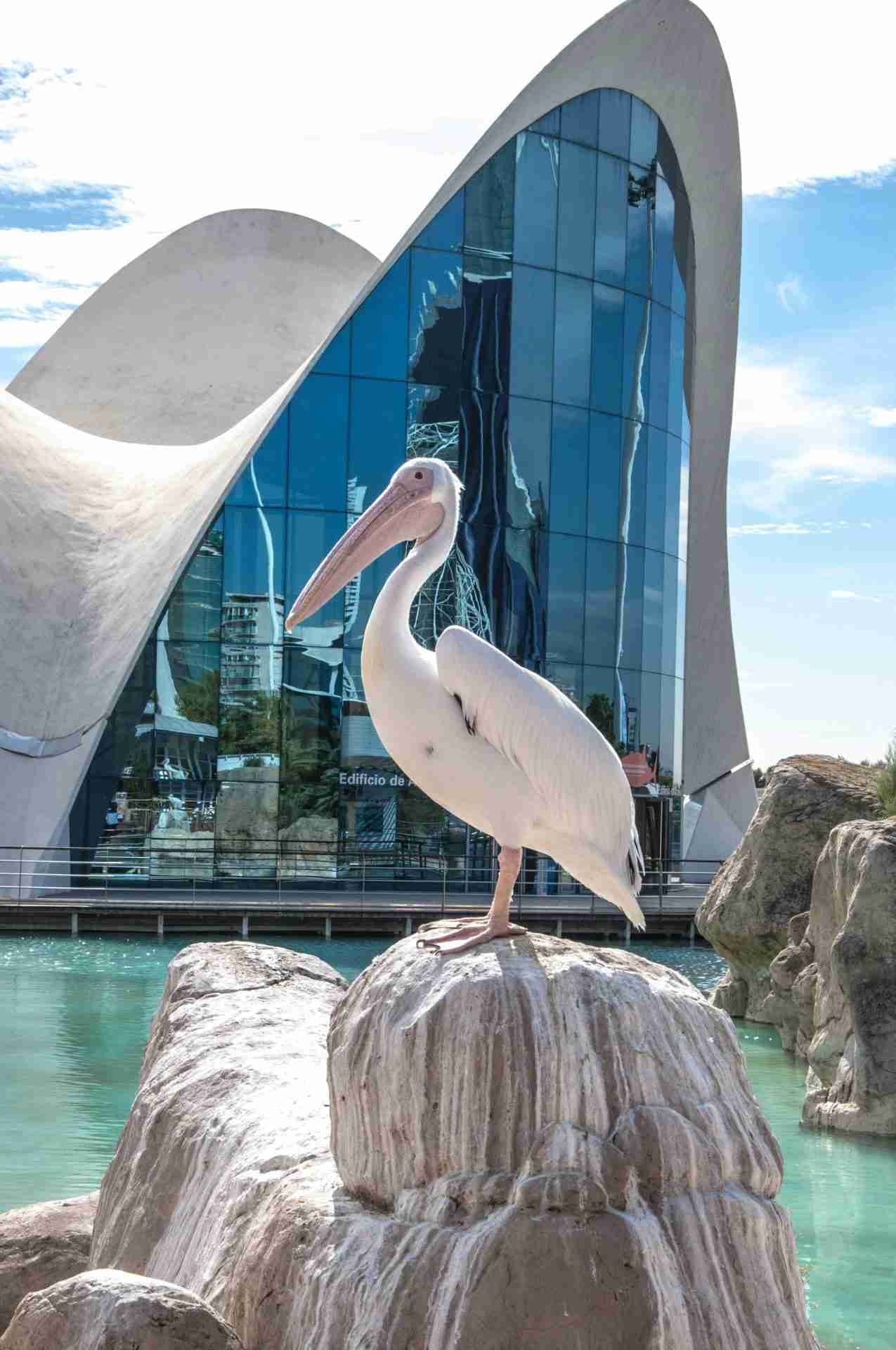
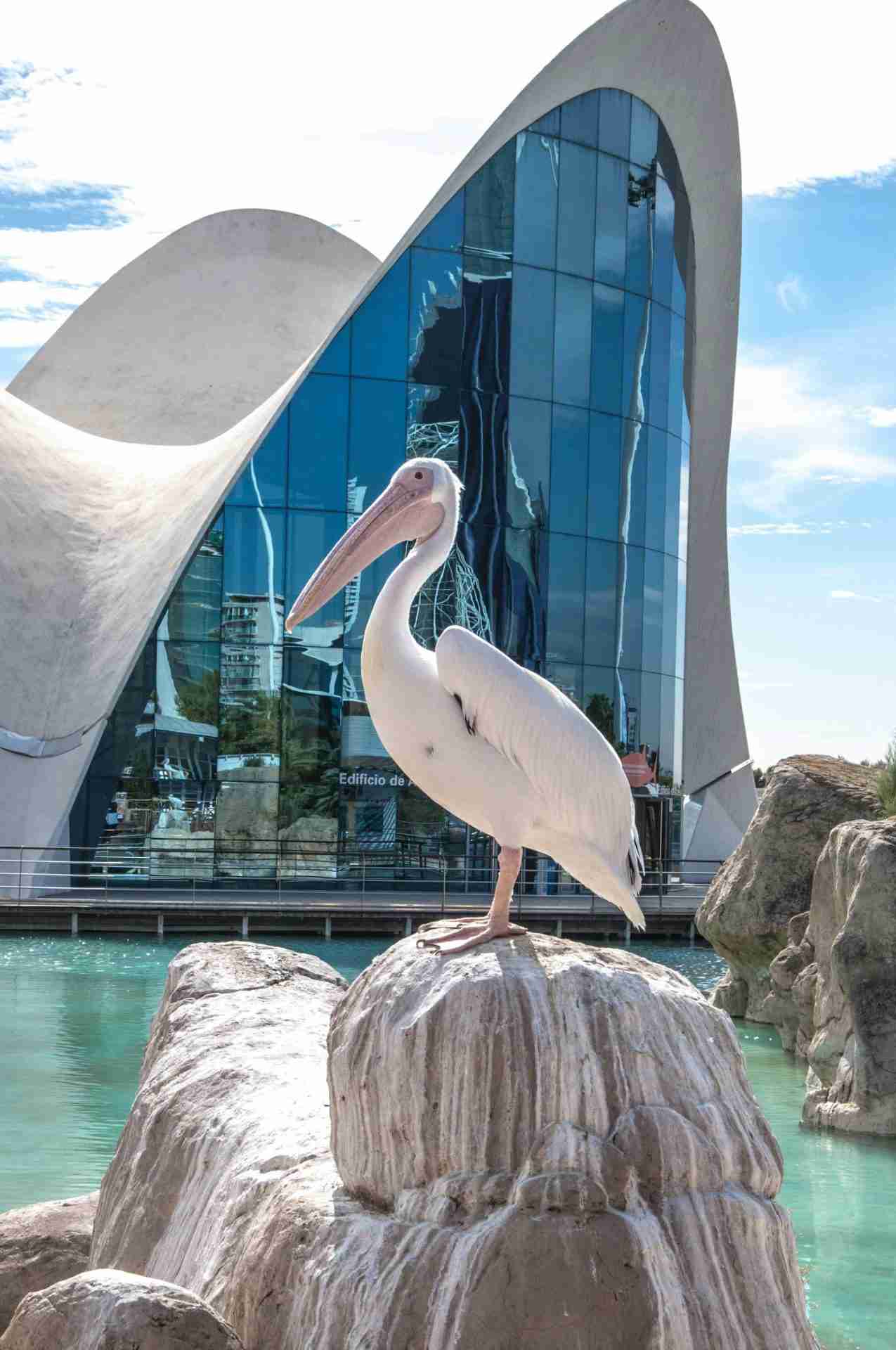
Set within the futuristic complex of the City of Arts and Sciences, Oceanogràfic València is Europe's largest aquarium and one of the most visually layered locations a photographer can explore in Valencia. Surrounded by shallow reflecting pools and shaped by the organic forms of architect Félix Candela, this ocean themed park offers opportunities that go far beyond underwater scenes. Glass tunnels, dramatic rooflines, minimal white structures, and mirrored water surfaces create an environment where natural history meets modern design. For photographers, it's a place where reflections, scale, and motion combine into scenes that feel like snapshots from another world.
Best Photography Opportunities
• Rooflines and Structural Forms
The entrance building, designed with a flowing concrete shell, provides an outstanding opportunity for architectural composition. The curves and flares of the roof rise out of shallow water and cast dramatic shadows across the surrounding pools. These surfaces reflect beautifully during golden hour, especially when framed tightly against the sky. Using a tilt shift lens or shooting with a low perspective can help straighten lines and emphasize the vertical lift of the form. Late afternoon light grazing across the concrete enhances its texture and depth, turning abstract compositions into bold, graphic studies.
• Reflections in the Surrounding Pools
Throughout Oceanogràfic, shallow water features border almost every building. These act as giant natural mirrors that reflect the clean white structures and passing clouds. Shooting across the water at a low angle with a wide lens produces symmetry and layered compositions. On calm days, the reflections are nearly perfect, while windy conditions introduce pleasing distortion. Blue hour is particularly effective for these scenes, with long exposures smoothing the surface and amplifying the glow of interior lights spilling through glass façades.
• Underwater Tunnels and Ambient Light
Inside the main aquarium buildings, the glass tunnels are immersive spaces that invite creative use of motion and color. As rays, sharks, and fish glide overhead, you can capture their silhouettes against the filtered blue light. Long exposures work well when timed with slower animal movement, while faster shutter speeds can freeze a passing school of fish in mid-turn. Shooting handheld is manageable due to the soft but consistent ambient lighting, though bumping ISO slightly helps retain clarity. Avoid using flash, and instead embrace the glow of interior lights to keep the atmosphere moody and true to the setting.
• Abstract Textures and Environmental Details
The exhibits often include coral, stone, and sculptural elements that lend themselves to more abstract or intimate images. These are perfect for macro lenses or zooms with good close focus. Patterns in sand, the textures of a jellyfish, or the ripple of a stingray's body become compositional studies when shot with shallow depth of field. The challenge lies in controlling reflections from the aquarium glass, which can be minimized by using a rubber lens hood or angling the camera carefully against the surface.
• Wildlife Photography
Oceanogràfic also houses open air environments including a wetlands exhibit and an aviary. These outdoor areas allow for natural light photography of birds in flight, flamingos in shallow water, and other semi-wildlife scenes. Telephoto lenses in the 200mm range work well here, and since the light is more predictable than indoors, it's easier to plan for ideal shooting conditions. Early morning is best for soft shadows and animal activity, while the late afternoon light casts a golden hue over the landscaped spaces.
Best Time to Visit
Photographers will get the most flexibility and best light by arriving as the park opens in the morning or visiting late in the afternoon close to sunset. Early access means fewer visitors inside the tunnels and more time to set up architectural compositions without foot traffic. Mornings also bring the calmest water for reflection shots around the buildings. In summer, midday light can be overly harsh on the bright white structures, so plan to explore interior exhibits during that time. Winter brings fewer crowds and more dynamic skies, which reflect beautifully in the pools, while spring and autumn offer comfortable conditions and vibrant lighting throughout the day. Blue hour around the pools and bridges is one of the most rewarding times to shoot, especially with a tripod.
How to Get There
Oceanogràfic is located within the City of Arts and Sciences complex in central Valencia. It is easily reached via public transport, with several bus lines stopping nearby and the Alameda Metro station about a 15 minute walk through the Turia Gardens. Pedestrian access is well marked and accessible, with ramps and broad walkways. Paid parking is available on site, but it can fill up quickly on weekends and holidays. Entry requires a ticket, and while there are no restrictions on bringing cameras for personal use, tripods and large equipment may attract attention from staff and could be restricted in some indoor areas. Be discreet with gear choices and prioritize flexibility and mobility over bulk. Re-entry may be possible on the same day, so consider leaving to shoot from outside the main entrance during blue hour and returning if conditions allow.
Recommended Photography Gear
Bring a combination of wide and mid-telephoto lenses to cover the diverse subjects. A 16 to 35mm wide lens is essential for architecture and interior tunnel compositions, while a 70 to 200mm lens is ideal for wildlife, distant subjects, and compression shots across the pools. A fast prime, like a 50mm f/1.4, is excellent for low light details inside the aquariums without relying on high ISO. A compact tripod is useful for twilight reflections outside but may not be allowed inside the exhibit halls. A circular polarizer helps control glare on exterior glass and water surfaces, while a rubber lens hood is useful to press against aquarium glass and eliminate reflections. Travel light to stay nimble and be ready to shoot handheld where stability tools are restricted.
Nearby Photography Locations
Right next to Oceanogràfic, this massive eye-shaped planetarium and cinema offers one of the most futuristic silhouettes in Valencia. Its reflection in the surrounding pool creates a symmetrical frame that changes dramatically with the light. Sunrise and blue hour are particularly strong times to photograph it, especially when interior lights create a glowing iris effect.
This science museum's ribbed white structure resembles a whale skeleton or ship hull, making it a magnet for photographers interested in repetition and pattern. The long facade works well with wide panoramic framing, while tighter shots reveal dynamic angles and shadow lines that shift throughout the day.
• Umbracle
A partially covered walkway filled with tropical plants and metal arches, the Umbracle blends nature and design. It is ideal for architectural details and soft plant portraits in natural light. Visit in the morning when the contrast between sunlight and shadow is most manageable and the space is quiet.
• Puente de l'Assut de l'Or
This suspension bridge looms over the complex like a harp or sail, with clean lines that intersect the skyline. Strong compositions can be made using the bridge as a backdrop or central element, especially when paired with slow shutter water reflections or strong silhouettes at sunset.
Just outside the complex, this reclaimed riverbed park stretches for miles and offers a completely different kind of scene. Tree-lined paths, fountains, and modern landscaping create relaxed frames, especially in golden hour light. It's a quiet place to catch your breath or capture candid moments away from the main crowds.
Oceanogràfic València blends structure, science, and sea life into a space that challenges the way photographers approach both subject and environment. Whether you are chasing symmetry, subtle reflections, or the movement of creatures beneath the water's surface, this location rewards patience and curiosity. It is one of the few places where the architectural exterior is just as compelling as the life it shelters inside.
Comments
Loading comments…