
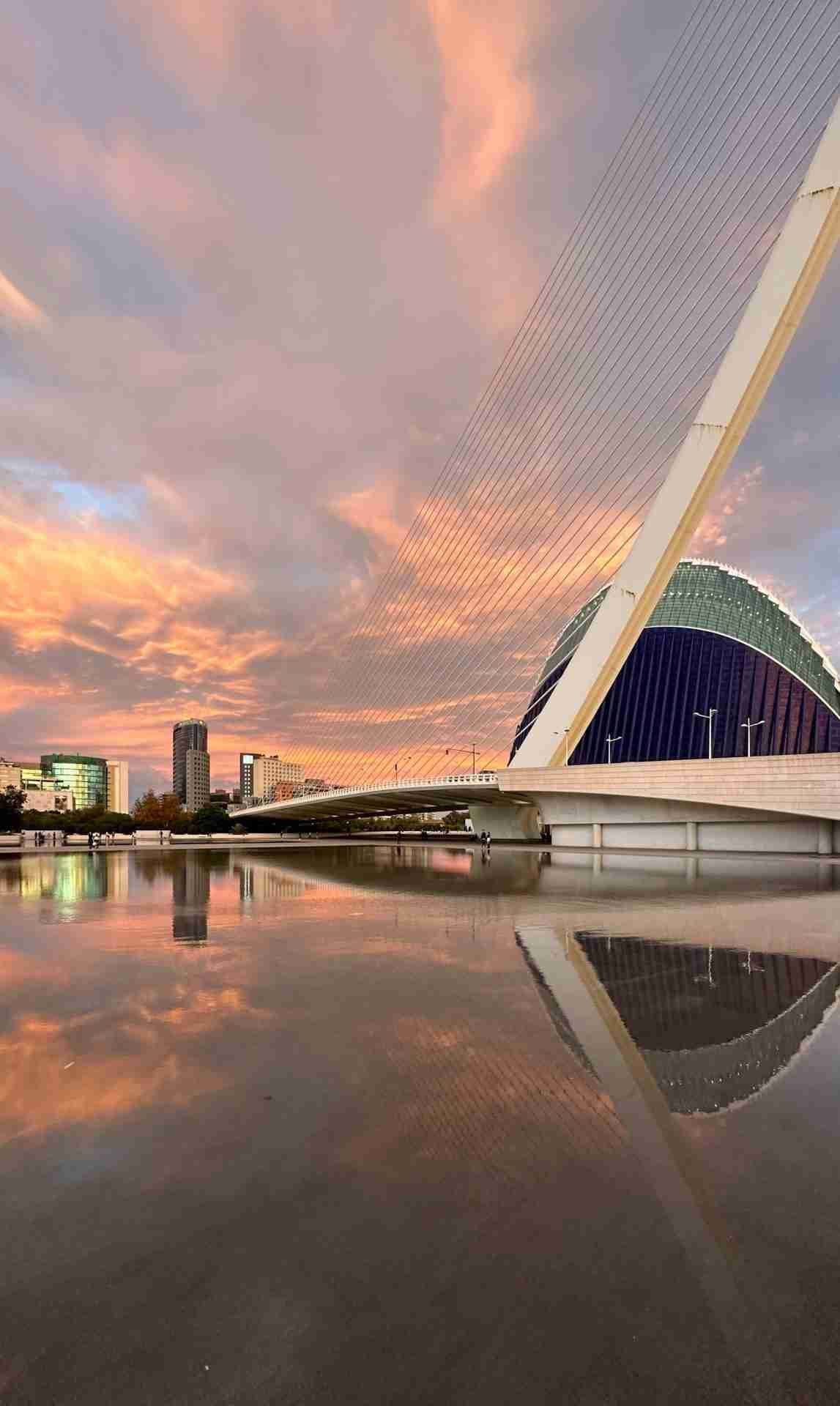
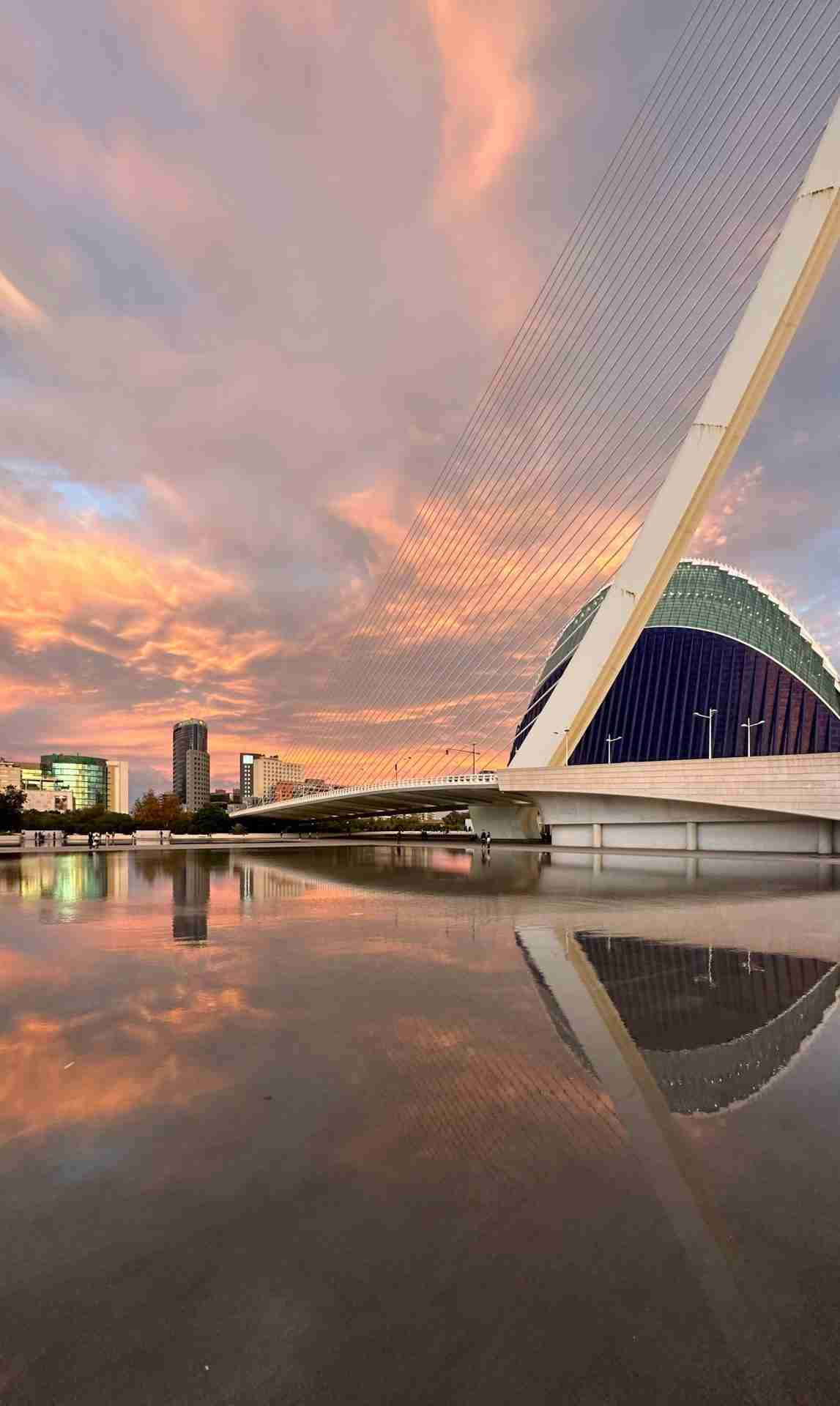
Puente de l'Assut de l'Or and the nearby L'Àgora building create one of the most visually striking architectural scenes in Valencia's City of Arts and Sciences. Both structures were designed by Santiago Calatrava and stand within the long landscaped corridor of the Turia Garden. The bridge rises high above the complex with a single white pylon that reaches skyward while a fan of cables spreads outward toward the roadway. Just beside it sits L'Àgora, a bold elliptical structure with a ribbed exterior that contrasts sharply with the slender lines of the bridge. Together they form a dramatic pairing of shapes and engineering. The surrounding reflecting pools, walkways, and open plazas give photographers plenty of space to experiment with different perspectives. Because the area was designed with sweeping curves, water features, and strong geometric architecture, it offers endless opportunities for modern architectural photography.
Best Photography Opportunities
• The Bridge Pylon and Cable Lines –
The tall white pylon of Puente de l'Assut de l'Or is the defining feature of the bridge and the most dramatic subject in the area. Rising more than a hundred meters above the surrounding structures, it creates a strong vertical element against the sky. The cables fan outward in precise lines that naturally guide the viewer's eye through the frame. A wide lens works well here because it exaggerates the height of the pylon and emphasizes the sweeping geometry of the cables. Standing near the base of the bridge can create a powerful upward perspective where the lines stretch dramatically overhead. Clean skies or light cloud patterns often work best because they allow the bright white structure to stand out clearly.
• Framing the Bridge and L'Àgora Together –
One of the most interesting compositions in the complex includes both the bridge and L'Àgora in the same frame. From certain walkways near the water features, the curved shell of L'Àgora sits beneath the towering bridge pylon. This pairing highlights the contrast between the bridge's thin structural lines and the solid ribbed form of the building. A wide lens helps capture both structures while keeping their relationship clear within the frame. Small adjustments in position can change how the bridge cables align with the curves of the building. These compositions work especially well when the evening sky adds soft color behind the architecture.
• Reflections in the Reflecting Pools –
The reflecting pools around the City of Arts and Sciences provide some of the most visually balanced compositions in the complex. When the water is calm, the bridge cables and surrounding buildings mirror clearly on the surface. Photographing from a low angle near the waterline can strengthen these reflections and create symmetrical images. A wide lens helps include both the architecture and the reflection within the same frame. Overcast conditions often work well for reflection photography because the softer light keeps highlights under control. These scenes highlight the clean design and geometry of the architecture.
• Architectural Details of the Ágora –
L'Àgora itself offers strong photographic subjects beyond the wide architectural views. The building's ribbed exterior structure creates repeating patterns that work well for tighter compositions. A mid range zoom or telephoto lens allows you to isolate these lines and curves without including too much of the surrounding complex. Shooting from slightly below the building can emphasize the sweeping shape of the roof. Light and shadow across the ribs often create depth and texture that changes throughout the day. These detail shots help reveal the complexity of Calatrava's design.
• Blue Hour Lighting –
Blue hour is one of the best times to photograph this part of the City of Arts and Sciences. As daylight fades, soft lighting begins to illuminate the bridge and surrounding structures. The deep blue tones of the sky contrast nicely with the bright white bridge and the darker structure of L'Àgora. A tripod is very helpful during this time because exposures become longer as the light fades. Reflections in the water often become stronger once artificial lighting appears. These conditions produce some of the most dramatic images of the complex.
Best Time to Visit
Early morning is a great time to photograph this area because the complex is usually much quieter. With fewer visitors walking around the plazas and walkways, it becomes easier to create clean architectural compositions. Morning light can also highlight the bright white surfaces of the bridge and surrounding structures.
Blue hour and early evening are often the most visually dramatic times. The architectural lighting begins to illuminate the structures while the sky deepens in color. Calm weather is particularly helpful for reflections in the pools. Because the complex is large and open, photographers can usually find different angles regardless of the time of day.
How to Get There
Puente de l'Assut de l'Or and L'Àgora are located within the City of Arts and Sciences complex in Valencia, Spain. The complex sits in the former Turia riverbed, which has been transformed into a long landscaped park running through the city. From Valencia's historic center, the area can be reached easily by bicycle, public transit, or car, and many visitors simply walk through the Turia Garden to reach the complex.
Several bus routes stop near the City of Arts and Sciences, and dedicated cycling paths run along the Turia Garden directly to the site. Parking garages and street parking are also available nearby for those arriving by car. Once you arrive, the bridge, L'Àgora, and the surrounding reflecting pools are easy to reach by walking along the open plazas and landscaped paths.
The outdoor areas of the City of Arts and Sciences are open to the public so there is no admission fee required to access the walkways, plazas, and exterior viewpoints around Puente de l'Assut de l'Or and L'Àgora. Tickets are only required if you plan to enter the interior attractions within the complex, such as the science museum or aquarium. For architectural photography of the bridge and surrounding structures, the public outdoor spaces provide full access to the best viewpoints.
Recommended Photography Gear
A wide lens is extremely useful for photographing the bridge and surrounding architecture. It allows you to capture the scale of the structures while emphasizing the sweeping lines of the design. A mid range zoom offers flexibility when framing both the bridge and the Ágora together.
A tripod is highly recommended for evening and blue hour photography when longer exposures are needed. A polarizer can help control reflections on the water and deepen the color of the sky. Because the complex involves a fair amount of walking between structures, carrying a lightweight kit makes it easier to explore different viewpoints.
Nearby Photography Locations
is one of the most recognizable buildings in the City of Arts and Sciences. Its eye shaped structure sits within a reflecting pool that creates near perfect reflections on calm days. The curved architecture and surrounding water make it a strong subject for symmetrical compositions.
features a dramatic skeletal exterior design that resembles the ribcage of a giant structure. The repeating white framework creates striking patterns and strong lines. Photographers can capture both wide architectural views and abstract detail shots.
• Pont de Montolivet
crosses the Turia Garden and offers elevated views across the City of Arts and Sciences complex. From here you can photograph several of the futuristic buildings together within the landscape of the park. Sunrise and sunset light can add depth to the scene.
is another dramatic structure within the complex. Its sweeping curves and layered metal surfaces create strong architectural compositions from many angles. The reflecting pools around the building often produce beautiful reflections.
runs through the city in the old riverbed and offers wide green spaces, walking paths, and views of the surrounding architecture. The park provides opportunities to photograph both the modern buildings and everyday life within Valencia. It also offers several elevated viewpoints looking back toward the City of Arts and Sciences.
Comments
Loading comments…