
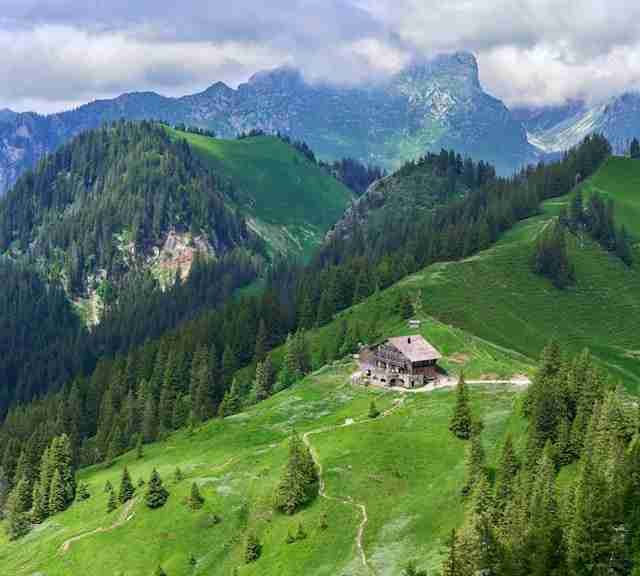
Perched high above the Jaun Valley in the Swiss Prealps, Chalet du Soldat offers a striking combination of alpine hut charm and panoramic mountain drama. Tucked beneath the craggy Gastlosen range, this location rewards those who hike in with vast views, crisp high-altitude air, and a wide-open bowl of terrain where light shifts rapidly across ridgelines and scree fields. The chalet itself is a traditional mountain structure, simple and functional, standing quietly against a wild, cinematic backdrop. For photographers, it serves both as a compositional anchor and as a base for working the surrounding peaks, particularly during first light or fast-moving weather. Whether you're chasing cloud breaks, waiting on golden hour, or scouting alpine textures in soft fog, this location thrives on patience and good timing.
Best Photography Opportunities
• Morning Light on the Gastlosen Ridge
The Gastlosen range towers behind the chalet in a sharp arc of limestone teeth, making it the clear focal point for early light. At sunrise, side lighting reveals every crack and ridge in the rock face, especially after a storm when the air is clean and crisp. Use a wide-angle lens to frame the chalet beneath the peaks or shift to a 70 to 200mm lens to isolate details in the rock. Autumn is particularly rewarding, with warmer low-angle light and less atmospheric haze. A tripod helps with exposure blending when dealing with deep shadows and highlights across the ridge.
• Cloud Breaks and Fast Weather Shifts
Because of its elevation and exposure, the area around Chalet du Soldat sees rapid changes in cloud and light, particularly in the afternoons. This makes it a prime spot for dramatic skies and soft light transitions. Compose with a wide field of view to catch shadows moving over the landscape, or use a longer lens to pick out sunlit patches across the valley. These shifting conditions are ideal for moody frames and black-and-white conversions. Always bring a lens cloth, since mountain mist and sudden wind can impact your setup.
• Alpine Textures and Foreground Detail
In summer and early fall, the alpine meadows around the chalet are dotted with wildflowers, grass tufts, and stone textures that make excellent foreground material. Use a low angle to anchor compositions with natural lines that lead toward the peaks. A polarizer can help manage glare off wet stone or enhance contrast in the grass. Focus stacking is worth considering if you're working with a close subject and want clarity from front to back.
• Night Sky and Hut Light Compositions
On clear nights with minimal moonlight, the altitude and lack of light pollution make this a strong location for astrophotography. The chalet can be used as a warm foreground when lights are on, while the Gastlosen form a rugged silhouette behind the stars. Use a fast wide-angle lens in the f/2.8 range or faster and shoot well after twilight for best results. Star trails work particularly well here due to the unobstructed sky and defined mountain edges.
• Winter and Shoulder Season Drama
When accessed in late fall or early spring, patches of snow may still linger on the ground while the peaks remain dusted. These transitional seasons offer strong contrast between white snow, dark rock, and the chalet's warm materials. Frame the chalet low in the scene to emphasize scale. These conditions also bring thinner air and dramatic sky gradients, especially just after sunrise.
Best Time to Visit
Late spring through early autumn offers the best balance of light, access, and alpine conditions. In June and July, wildflowers cover the foreground while the peaks hold streaks of snow. These months bring soft morning light and clouds that move steadily across the Gastlosen. Early light is especially productive, and the area stays quiet if you arrive before hikers.
August and September bring longer golden hours and cleaner skies. As the air dries out, visibility improves and the range becomes more defined. By mid-autumn, grass begins to fade and the landscape shifts toward cooler, more neutral tones. These subdued palettes work well under overcast skies or light fog.
Stormy days and passing fronts often deliver the most compelling conditions. Fog rolling across the valley or broken cloud cover below the ridge transforms the scene into layered compositions with subtle motion and mood. Winter is possible with proper snow gear, but trails may be icy or closed, and visibility can drop quickly.
Wind is common, especially in the afternoon. Early mornings are more stable and offer calm skies and better conditions for tripod setups. Always check detailed forecasts before planning a sunrise shoot, as weather conditions change fast at altitude.
How to Get There
Chalet du Soldat is located above the village of Jaun in the Canton of Fribourg, Switzerland. From Bern, it takes about 90 minutes by car to reach Jaun, or roughly two hours by public transit with transfers in Bulle and Charmey.
The trail begins near the village of Jaun-Dorf, where parking is available close to the trailhead. The hike to the chalet takes around 1.5 to 2 hours, depending on your pace and gear weight. The trail is well-marked and moderately steep, with forested sections that give way to open alpine pasture. There is no entrance fee, and the trail is accessible during the snow-free season.
Photographers carrying full kits should allow extra time and pack light where possible. The final stretch of trail includes switchbacks on loose rock and steep ground. Hiking poles are recommended, particularly if descending in low light after sunset.
Recommended Photography Gear
Your gear for Chalet du Soldat should balance weight and durability. A full-frame or APS-C body with good weather sealing is ideal, paired with a lens setup that covers wide to medium-telephoto focal lengths. A 24 to 70mm lens will be your go-to for most compositions, including foreground-to-background alpine views.
For isolating mountain detail or capturing valley layers, bring a 70 to 200mm or similar telephoto. Wide foregrounds, night sky work, and dramatic cloudscapes benefit from a 16 to 35mm or fast 20mm prime. For astrophotography, prioritize low aperture glass and a high ISO-capable sensor.
A carbon fiber tripod is necessary for stability on rocky terrain, especially in wind or for long exposures. Tripod legs with twist locks and wide feet are easier to position securely on uneven ground. A circular polarizer will help control glare and sky contrast in daytime conditions. A 6-stop ND filter is useful when capturing slow motion in fast-moving cloud or mist.
Additional essentials include extra batteries, a headlamp, a microfiber cloth for moisture, and a rain cover for your gear. Wear sturdy boots with ankle support, and bring water, snacks, and layers suited for rapid weather shifts. If you're staying after sunset, plan for a safe descent or book an overnight stay at the hut during open season.
Nearby Photography Locations
This well-known loop provides multiple views of the Gastlosen from different elevations. With access to meadow, ridge, and forest compositions, it's ideal for both wide and mid-range shots. Cloud movement and shifting light add variety throughout the hike.
Located just outside the village of Jaun, this tiered waterfall offers strong vertical lines and a cool, forested setting. It's ideal for long exposure work during cloudy weather or subdued light.
• Musersbergli Viewpoint
Positioned north of the main trail, this high point overlooks the Jaun Valley with layered terrain and open sky. Visit during late afternoon to catch side light on distant ridgelines and agricultural slopes.
A short drive west, this alpine lake is surrounded by forested hills and features strong reflection potential. Use early morning light for mirror-like surfaces or moody fog work when conditions allow.
• Oberberg Approach to the Gastlosen
This alternate trailhead gives you eastern access to the Gastlosen, where the rock formations are more jagged and dramatic. It offers tighter angles and rich late-day light for detailed landscape compositions.
Chalet du Soldat delivers high-altitude views, deep quiet, and a constantly shifting visual canvas. From its simple silhouette beneath the limestone ridge to the way clouds pull light across the land, this is a place that rewards time on foot and attention to weather. It is not a place for rushing. It asks you to slow down, wait, and photograph the light exactly as it is.
Comments
Loading comments…