
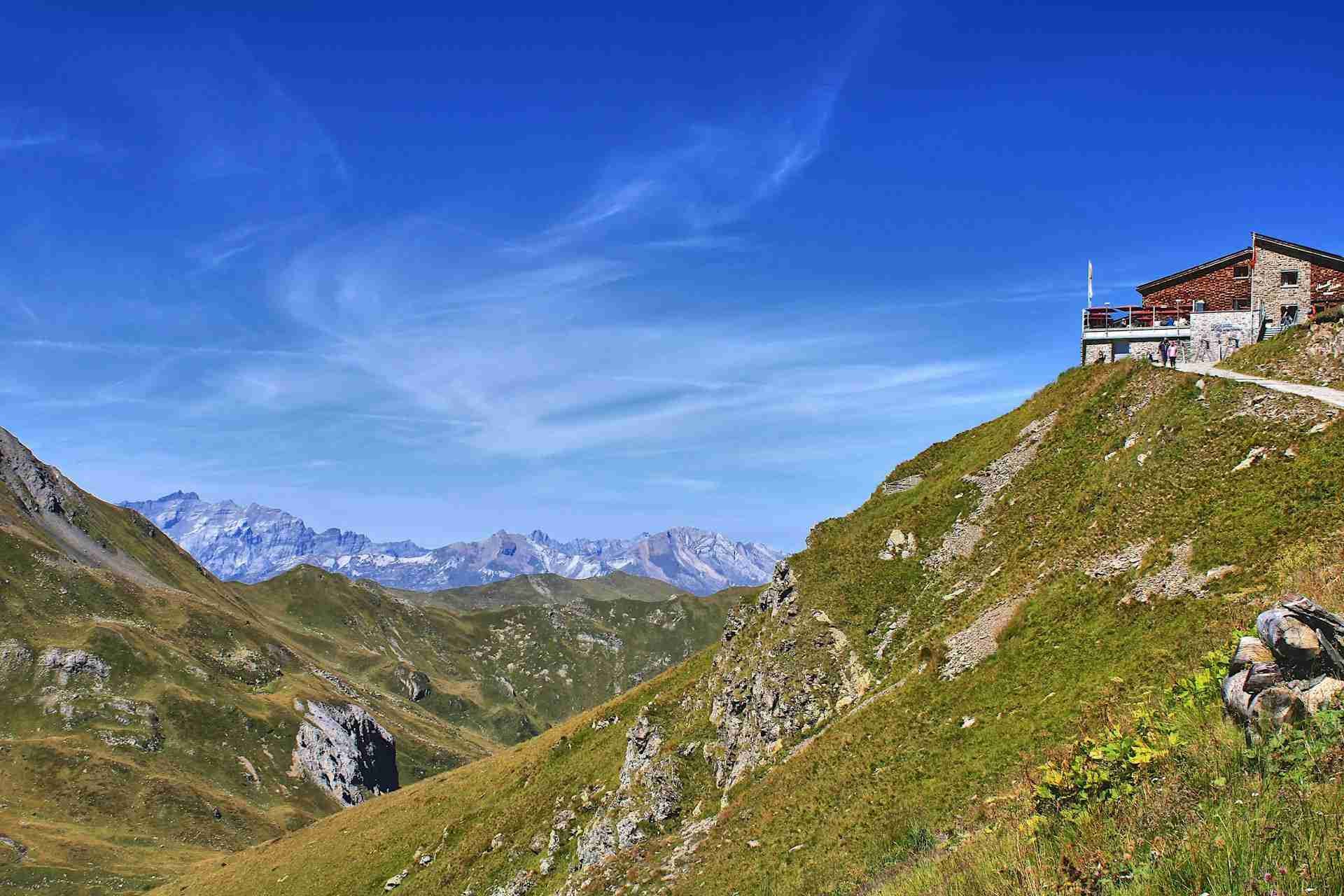
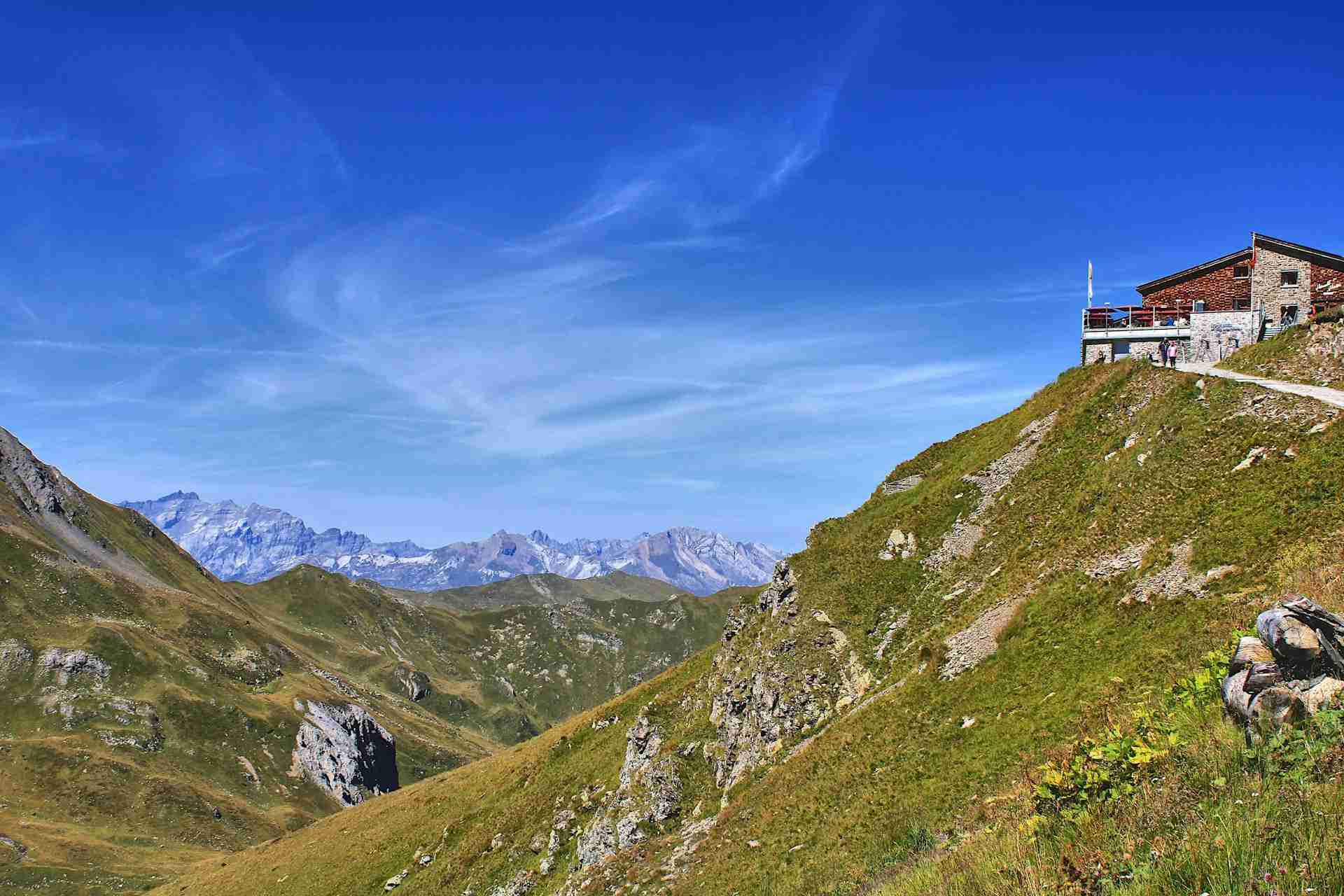
Perched at more than 2,500 metres above sea level, Hörnlihütte overlooks the alpine town of Arosa with a view that stretches far into the Graubünden peaks. The hut is both a refuge and a vantage point, offering photographers a chance to watch light sweep across ridges, valleys, and distant glaciers without the need for a strenuous ascent. Arriving here feels like stepping directly into the high alpine world: the air is thinner and cleaner, the sounds of town fade into silence, and the horizon expands with every step. In summer, wildflowers surround the paths that radiate from the hut, while in winter, the ridges are carved with tracks from skiers and snowboarders. Hörnlihütte is not just a stopover but a place to linger, to observe, and to photograph the constant transformation of mountain light.
Best Photography Opportunities
• Views from the Terrace
The terrace at Hörnlihütte provides one of the most immediate and rewarding vantage points in Arosa. From here, the ridges unfold in multiple directions, and the valley drops sharply below. Wide lenses capture sweeping panoramas, while telephotos bring distant glaciers and serrated peaks into focus. Mornings and evenings are especially rewarding, when soft light gives depth to the ridges and shadows move slowly across the valley. Even during the day, cloud shadows drifting across the slopes create dynamic changes worth photographing.
• Summer Meadows and Alpine Wildflowers
During the summer months, trails near Hörnlihütte are lined with colourful alpine flowers. Shooting from a low perspective places blossoms against the backdrop of peaks, creating vibrant compositions that combine small detail with grand scale. Macro photography is equally rewarding, revealing the textures of petals and alpine insects. Because the bloom shifts throughout the season, early and late summer each provide different palettes. The sound of cattle bells in the meadows adds to the sense of being in a quintessential Swiss landscape.
• Snow-Covered Ridges in Winter
In winter, Hörnlihütte transforms into a snowy outlook. The sharp ridgelines take on a sculpted look, with snowdrifts highlighting every contour. Sunrise and sunset create some of the most dramatic images of the year, when snow glows pink in alpenglow or turns blue in shadow. Exposure control is crucial here, as bright snow can overwhelm highlights, but the reward is crisp, minimal compositions. Skiers and snowboarders crossing the slopes can be used for scale or omitted for a more abstract treatment.
• Mountain Trails and Natural Leading Lines
Hiking routes spread outward from the hut, creating natural compositional elements. A winding trail cutting across a ridge can act as a strong leading line toward the horizon. Including a hiker in the frame conveys scale, while an empty path emphasizes solitude. These compositions are especially effective in early morning, when the trails are empty and the light is soft. In autumn, grasses turn golden, adding warmth and contrast to the rocky landscape.
• Shifting Weather Across the Alps
Weather in the Alps is rarely static, and at Hörnlihütte this works in the photographer's favour. Clear skies often give way to banks of cloud rolling across the ridges, and sudden shafts of light can spotlight entire slopes. Mist rising from valleys adds atmosphere, creating layered scenes with depth. Telephoto lenses are excellent for compressing these layers into graphic compositions, while wide shots emphasize the sense of vastness. Waiting for a break in the weather often produces the most memorable images.
• Night Sky Photography
The hut's elevation and distance from city lights make it an excellent base for astrophotography. On clear nights, the Milky Way stretches across the sky, and the hut itself can be included in the foreground when lit from within. Wide lenses with fast apertures are ideal for this work, along with a tripod and interval timer for star trails. Summer skies are best for the Milky Way, while winter nights offer sharp clarity and constellations framed against snowy ridges.
Best Time to Visit
Every season at Hörnlihütte offers distinct opportunities. Summer is ideal for meadows, wildflowers, and long days that allow for extended golden hours. Autumn brings crisp air, warm tones in the grasses, and clear views across long distances. Winter turns the ridges into a snowy wonderland, offering both minimalist landscapes and dynamic action with skiers on the slopes. Spring is transitional, with lingering snow alongside the first alpine blooms, providing a mix of subjects.
Mornings are often the calmest and provide soft light across the valley, while evenings deliver golden tones and alpenglow on the peaks. Midday light is harsher but works well for high-contrast black-and-white work or for isolating details with a telephoto lens. Sunset from Hörnlihütte is one of the most rewarding times, as the ridges glow and the valley below falls into shadow. For astrophotographers, planning around moon phases ensures the best chance of capturing stars in dark skies.
How to Get There
Hörnlihütte sits above the town of Arosa in the canton of Graubünden. The easiest way to reach it is by gondola from Arosa, which operates throughout the year though hours and schedules vary by season. The gondola ride itself provides excellent photographic opportunities, with views over forests, meadows, and the clustered rooftops of the town. From the upper station, it is a short walk to the hut along marked paths. Hikers can also ascend directly from Arosa, following trails that climb steadily through alpine terrain, though the journey requires stamina and planning. In winter, Hörnlihütte is integrated into the Arosa-Lenzerheide ski area, and skiers can reach it directly on the slopes. Parking is available in Arosa, but gondola access is recommended to avoid navigating steep mountain roads. The hut serves food and drink, allowing photographers to spend full days here without returning to town.
Recommended Photography Gear
Photographers at Hörnlihütte benefit from a versatile kit. A wide-angle lens is essential for sweeping alpine panoramas and for combining foreground detail with expansive backgrounds. A mid-range zoom such as a 24 to 70 millimetre lens provides flexibility for environmental portraits, hut scenes, and trail compositions. A telephoto lens in the 70 to 200 millimetre range is invaluable for compressing ridges, isolating wildlife, and capturing details across the valley.
A tripod is critical for sunrise, sunset, and night photography. Polarising filters help cut glare on snow and enrich blue skies, while neutral density filters allow for long exposures of moving clouds. In summer, a macro lens is rewarding for wildflower detail, while in winter, lens cloths and protective covers are essential for dealing with snow and condensation. Extra batteries are a necessity in cold weather, as power drains quickly at higher elevations. Sturdy footwear and layered clothing are just as important as camera gear, as conditions change rapidly in the alpine environment.
Nearby Photography Locations
The town of Arosa itself is photogenic, especially around Obersee Lake, where reflections of the surrounding mountains and church steeple are striking in calm conditions. Snow in winter adds another layer of charm to this scene.
Accessible by cable car from Arosa, Weisshorn offers one of the best panoramic viewpoints in Graubünden. Sunrise and sunset provide stunning light across the surrounding Alps, with views extending to distant peaks.
• Lenzerheide Valley
Connected to Arosa by ski area, Lenzerheide offers gentler alpine meadows and pastoral valley scenes. This area contrasts with the rugged peaks around Hörnlihütte, making it a strong complement for photographers.
Above Davos, Schatzalp provides a blend of alpine meadows, historic structures, and sweeping views. In summer, its botanical garden offers diverse flora for macro and landscape work.
The train journey into Arosa is an experience in itself, winding across viaducts and through deep valleys. Photographing from the train window provides dynamic perspectives of forests, waterfalls, and villages that are otherwise inaccessible.
Hörnlihütte is a place where alpine accessibility meets visual drama. The hut and its surroundings offer enough variety for an entire day of photography, from close-up details of alpine flowers to vast ridges glowing in evening light. For those who wait patiently for shifting weather, the reward is a portfolio of images that capture both the scale and intimacy of the high Alps above Arosa.
Comments
Loading comments…