
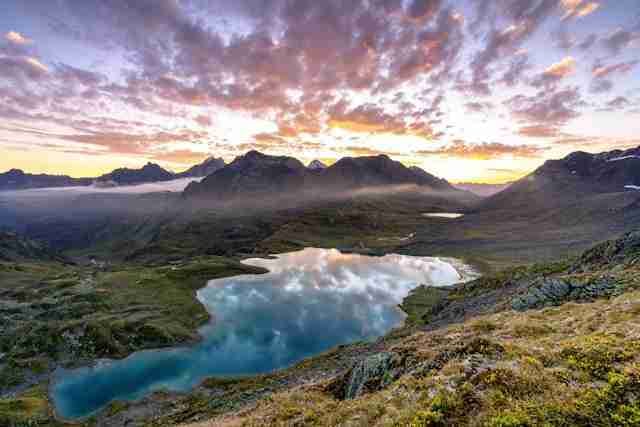
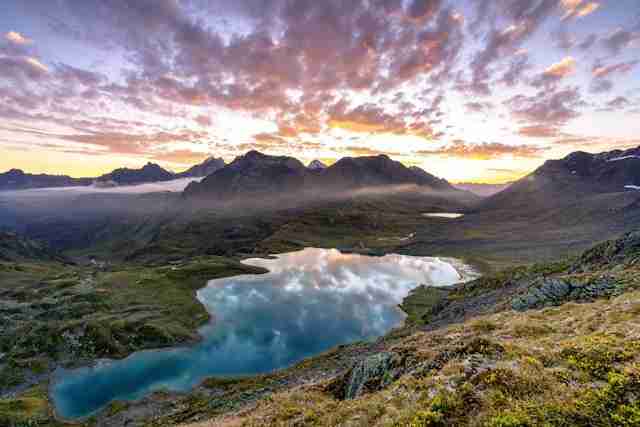
Jöriflüelafurgga is a rugged mountain pass carved into the high alpine wilderness above Davos, Switzerland. Nestled at 2,728 meters, this dramatic saddle opens into a basin of raw beauty defined by glacial lakes, fractured ridgelines, and sweeping views that seem to stretch beyond the curvature of the earth. A dreamscape for landscape photographers, it offers a visual feast of contrasts: turquoise meltwater against dark scree, delicate wildflowers pushing through unforgiving terrain, and long valleys flanked by towering peaks. Whether you favor sweeping wide-angle vistas, intricate alpine details, or abstract compositions born from the rhythm of nature, Jöriflüelafurgga is a location that rewards both patience and curiosity.
Best Photography Opportunities
• Jöriseen Lakes from the Saddle
: These otherworldly lakes—some small and circular, others narrow and branching—sit just below the ridge and shimmer in hues of turquoise, jade, and sapphire. Their coloration is due to finely ground rock particles suspended in glacial meltwater, which scatter sunlight and create luminous reflections. Shooting from the Jöriflüelafurgga saddle provides a commanding overhead perspective where you can frame the lakes as a mosaic set within a massive alpine bowl. Use a wide-angle lens at a higher elevation to emphasize the vastness, but also consider stitching vertical panoramas to capture the steep drop from the ridge to the water and the towering peaks beyond. Cloud shadows moving across the landscape can add drama and highlight the dimensionality of the scene.
• The Trail to Piz Vadret and High Ridges
: Extending southeast from the pass, the ridgeline trail toward Piz Vadret traverses some of the most cinematic high-altitude terrain in the region. This narrow path winds between exposed cliffs and precarious ledges, offering layered perspectives into the Val Susasca and beyond. The best time to photograph this trail is during the late afternoon, when the sun casts long, directional shadows that accentuate the jagged profiles of distant peaks. Use a telephoto lens to compress layers of mountain ridges and atmospheric haze, or step back with an ultra-wide to include the trail itself as a leading line that pulls the viewer through the scene. This is a perfect place to experiment with moody, black-and-white conversions that emphasize texture and form.
• Alpine Flora and Lichen-Covered Rock
: Despite the seemingly inhospitable environment, the trail to Jöriflüelafurgga explodes with alpine plant life in mid to late summer. Tiny blossoms like alpine forget-me-nots, gentians, and edelweiss grow between slabs of rock and in small patches of soil nestled between boulders. At higher elevations, the boulders themselves become canvases for color—streaked with rust-red lichens and moss in rich green hues. Use a macro lens to isolate these organic textures, or shoot wide at ground level to juxtapose the delicate flora with the vast stony landscape. These intimate shots provide context for the harshness and beauty of high-altitude survival, making them ideal additions to a broader landscape series.
• Glass-Like Reflections in Early Light
: On calm mornings, before the mountain winds begin to stir, the Jöriseen act like polished mirrors. The lakes reflect not just the surrounding peaks but also the color gradient of the sky—cool blues, soft violets, and warm pinks at dawn. This is the moment to use a tripod and neutral density filters to lengthen exposures, smoothing out any surface ripple and enhancing the surreal stillness. Compose your shot with symmetry in mind, placing the shoreline dead center or using foreground rocks to break the reflection and add depth. If you're fortunate enough to arrive before sunrise, consider bracketing exposures for a high-dynamic-range blend once the light breaks over the ridge.
• Snow Patches and Graphic Compositions
: Even deep into the summer season, snowfields remain on the shaded sides of the mountains and around the upper rim of the lakes. These white forms can be used compositionally to great effect—adding contrast, highlighting scale, and creating visual rhythm when placed alongside jagged rocks and dark skies. With careful framing, snow can act as a natural leading line or as a negative space that draws attention to a focal point. Consider shooting from a low angle, allowing the snow to occupy a dominant part of the foreground and lead the eye toward distant peaks. Overcast days, far from being a disadvantage, often enhance these compositions by softening shadows and deepening textures in the rock and snow.
Best Time to Visit
Jöriflüelafurgga is most accessible and photographically rewarding between late June and early October, a narrow window when the trails are generally clear of snow but the landscape still wears its alpine character. Early in the season, the lakes brim with glacial meltwater, appearing especially vibrant in color. Patches of snow still linger across the slopes, adding brightness and tonal contrast to compositions. Wildflowers emerge as early as mid-July, creating brilliant foregrounds of pink, yellow, and violet beneath vast stone amphitheaters.
August offers the most stable weather, with consistently clear skies and dry trails, though the harsh midday light and increased foot traffic make early starts essential. Golden hour in August is especially long and cinematic, with soft shadows moving slowly across the terrain. By September, the colors shift dramatically—larch trees at lower altitudes begin their autumn transformation, and the grasses and alpine plants fade into ochres and deep rust tones, making for exceptional late-season color studies.
October marks the cusp of winter's return. Snowfall becomes more frequent, and although trail conditions can vary dramatically, this transitional period produces extraordinary light. Morning frost, low sun angles, and atmospheric haze can add texture and mood to your images. Be aware, however, that weather-related trail closures or snow hazards may limit access. Always check mountain forecasts and trail reports before planning a visit during the shoulder season.
How to Get There
Start your journey from Davos, a well-connected resort town accessible via train from Zurich and other major Swiss hubs. From Davos Platz, take Route 28 toward the Flüela Pass, a high mountain road known for its winding switchbacks and stunning alpine views. After approximately 8 kilometers, you'll reach the Wägerhus parking area, a small but popular starting point for the hike to Jöriflüelafurgga and the Jöriseen lakes.
The trailhead is clearly marked and well-maintained, although it includes some steep, rocky segments. The route gains around 700 meters in elevation over 2.5 to 3 hours of hiking. There is no permit required to access the area, but the parking area often charges a daily fee, and you should be prepared with Swiss francs or a mobile payment app. There are no facilities at the trailhead, so bring all necessary supplies, including water, snacks, and sun protection.
Although the trail is rated moderate and is popular among hikers, its altitude and exposure to weather should not be underestimated. Conditions can change rapidly, with sudden fog, wind, or temperature drops. Hiking boots, layered clothing, and a weather-sealed backpack for your gear are recommended. Drone pilots should also check local regulations, as certain nature reserves nearby may prohibit aerial photography.
What to Pack for Mountain Light and Alpine Conditions
Photographing Jöriflüelafurgga demands a well-curated but adaptable gear kit. At its core should be a full-frame DSLR or mirrorless body paired with a weather-sealed wide-angle lens (14–30mm) for sweeping alpine vistas. The elevation and vast open views reward ultra-wide compositions, especially when shooting from high ground above the lakes. Add a fast mid-range zoom (24–70mm) for flexibility when moving between ridges and trail scenes.
A lightweight carbon fiber tripod is essential for low-light, sunrise, or long-exposure work, particularly around the reflective waters of Jöriseen. Circular polarizers are invaluable for cutting glare off snow and enhancing the saturated tones of the lakes. A 6-stop or 10-stop neutral density filter opens the door for daytime long exposures, adding movement and drama to clouds or smoothing water surfaces.
If flora and texture are part of your story, a dedicated macro lens will allow you to capture the fine detail of alpine wildflowers, mosses, and rock patterns. For aerial shooters, a drone with strong GPS stability and high-altitude performance (like the DJI Air series or equivalent) offers compelling overhead perspectives, though you'll need to monitor altitude limits and flight time closely due to the elevation. Don't forget spare batteries, microfiber cloths, and rain protection—not just for your gear but for yourself. Alpine light is both rewarding and unforgiving; gear choice can make or break your shoot.
Nearby Photography Locations
: This high-altitude road is a gift to photographers who enjoy blending infrastructure with nature. The switchbacks curve through rock-strewn valleys and beneath towering cliffs, making for dynamic leading lines and perspective shifts. Early mornings often bring mist and low cloud cover, creating a layered, moody atmosphere that works beautifully with long exposures or minimalist black-and-white interpretations.
: One of the higher accessible peaks in the region, Schwarzhorn offers a challenging but extremely rewarding climb. From the summit, the landscape unfolds in every direction, with views reaching into the Bernina Range on a clear day. The elevation provides excellent conditions for dramatic sunset shooting, with glowing peaks and fast-changing light that rewards quick reflexes and pre-scouted compositions.
: A short drive south of Davos, this peaceful and traditionally Swiss valley is lined with wooden chalets, alpine pastures, and sharp granite peaks. The contrast between human-scaled elements—barns, fences, winding roads—and the overwhelming verticality of the surrounding cliffs makes this a prime location for storytelling images that blend environment and culture.
: Ideal for calm, contemplative compositions, this lake is often overlooked in favor of more dramatic mountain scenes, but its smooth water and pine-lined banks offer excellent reflections and mood in the early hours. Come autumn, the surrounding trees light up with color, and mist drifting across the surface adds a dreamlike quality that suits long lenses and soft focus techniques.
: Quiet and often empty, this side valley feels untouched even in peak season. With its slow, winding trail and scattered alpine huts, it offers opportunities for layered compositions that feel timeless. Herds of grazing cows and the occasional burst of wildflowers add movement and color to otherwise tranquil frames. It's an ideal counterpart to the more vertical drama of Jöriflüelafurgga—softer, slower, but equally photogenic.
Jöriflüelafurgga isn't just another alpine pass—it's a full-spectrum landscape photography experience wrapped in light, texture, and atmosphere. The effort required to reach its heights is paid back in the form of endless visual compositions, whether you're watching clouds slip between jagged ridges or standing in silence beside glass-smooth lakes. It's a place where every element, from stone to sky, seems ready to collaborate with your lens.
Comments
Loading comments…