
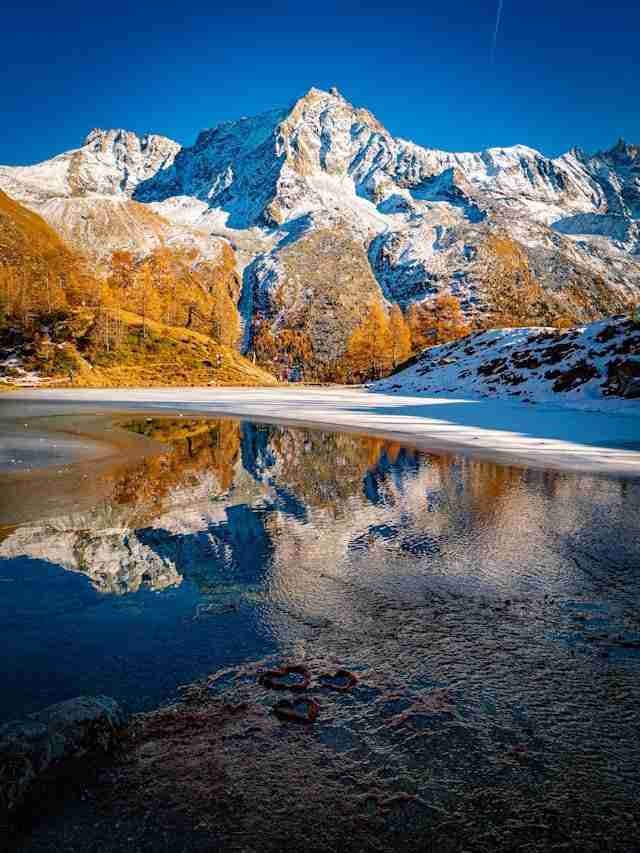
Nestled high in the Val d'Hérens near the village of Evolène, Lac Bleu is a pristine alpine lake known for its surreal turquoise hue, craggy mountain backdrop, and the absolute stillness that defines high-altitude terrain. At an elevation of over 2,000 meters, this glacial-fed lake lies in a natural amphitheatre of grassy slopes and towering peaks, offering photographers a compact but visually powerful scene. The lake's name—literally "Blue Lake"—is no exaggeration. Its crystal-clear waters take on a vivid cyan tone under midday sun, while early morning and golden hour transform it into a mirror for the sky and cliffs above.
Best Photography Opportunities
• Mirror Reflections with Mountain Backdrop
The lake's surface is frequently calm, allowing for perfect mirrored reflections of the surrounding peaks and sky. Shoot during early morning when the light first touches the ridges or late in the day when golden tones descend into the bowl. Use a wide-angle lens to anchor your composition with a rock or patch of wildflowers in the foreground for depth.
• Vibrant Aerial Views from Surrounding Ridges
The small size and clarity of Lac Bleu make it a prime subject for drone photography. From above, the lake appears as a radiant drop of blue amidst muted greens and grays—especially effective in contrasty midday light. Fly low to capture the lake's irregular shoreline or go high for minimalist top-down abstractions framed by surrounding rock.
• Detail Studies of Colour and Clarity
Along the shore, the water is so clear you can photograph submerged stones and aquatic plants, their textures refracted through the vibrant blue. Use a polarizing filter to cut surface glare and isolate tones or shoot wide open to blend ripples into an abstract color wash. These images work especially well in bright midday when the lake's hue is most intense.
• Environmental Portraits in the Alpine Bowl
The lake's isolated feel and natural amphitheatre make it perfect for environmental portraits, whether of hikers, solo travelers, or posed subjects in outdoor gear. Frame wide to emphasize scale, or use the winding trail, boulders, and sloped banks to create storytelling vignettes. Late afternoon light provides flattering side illumination with soft mountain shadows.
• Night Photography with Reflections and Stars
On a clear night, the remote setting and lack of light pollution make Lac Bleu a solid candidate for astrophotography. Use a sturdy tripod and long exposure to capture the Milky Way or starlight reflecting on the water. The nearby peaks can be silhouetted or softly lit with moonlight for a more ethereal frame.
Best Time to Visit
Lac Bleu is typically accessible from late spring through early autumn, depending on snowmelt and trail conditions. The best window for photography is from mid-June through September, when the trail is snow-free, wildflowers bloom, and the lake reaches peak colour clarity under alpine sun.
Early morning provides soft light and glassy water, ideal for reflections and tranquil compositions. Midday brings out the lake's brightest blue tones, best for aerials and top-down detail work. Golden hour adds warm hues to the stone and creates long shadows that accentuate the lake's natural contours.
Autumn (late September to early October) can bring more subdued, atmospheric light and golden grasses, while spring meltwater makes the lake swell slightly, altering shoreline shapes and reflections. Avoid visiting during or after heavy rain, as runoff can dull the lake's clarity and saturate the trail.
How to Get There
Lac Bleu is accessed via a hiking trail from the alpine hamlet of La Gouille, a short drive from the village of Evolène in the Valais region. From Sion, it's roughly a 45-minute drive up winding alpine roads through the Val d'Hérens.
From La Gouille, a clearly marked trail ascends steadily through forest and open pasture, taking about 45 minutes to 1 hour to reach the lake depending on pace and load. The trail is well-maintained and family-friendly, but good footwear and water are essential, particularly in warmer weather or post-rain conditions.
There are no facilities at the lake, so bring any necessary supplies with you. Photographers should pack light but bring a wide-angle lens, polarizer, and a tripod for long exposures or night shooting. Drone use is allowed but should be done respectfully, avoiding crowds and wildlife.
Exploring the Surrounding Area
The alpine terrain surrounding Lac Bleu offers additional shooting angles and wider views as you ascend above the water on connecting trails. Higher ridgelines reveal a full panorama of the Val d'Hérens, with deep valleys, winding roads, and distant glacier-covered peaks.
Nearby alpine meadows are filled with wildflowers in June and July, while rocky outcrops provide natural framing elements and dramatic backdrops. The area is also home to marmots and alpine birds—adding subtle wildlife elements to patient compositions.
Down in Evolène and La Sage, traditional stone-roofed chalets, flower boxes, and quiet village paths offer strong documentary and cultural photography opportunities in soft valley light.
Nearby Photography Locations
Just a short drive up the valley, the Arolla region offers views of towering peaks, glacier tongues, and rugged trail networks. Perfect for high-altitude landscape work or alpine adventure photography under dramatic light.
These rare, natural earth pillars rise dramatically from the valley floor, offering abstract, textural compositions and strong sunrise or sunset contrast. A great stop on your way back toward Sion.
A smaller but beautifully situated alpine lake near La Sage, this location offers stunning views of the Dent Blanche and pastoral surroundings, ideal for calm sunset reflections or peaceful pastoral scenes.
Two of the most photogenic villages in the region, with narrow lanes, historic wooden chalets, and views of surrounding peaks. Best captured during morning light or fog for a timeless, rural feel.
This historical irrigation channel path winds through forests and overlooks the Hérémence valley, offering peaceful trail shots and strong leading lines for composition. Best in the golden tones of late afternoon.
Lac Bleu is a reminder of why alpine photography endures. In a single, crystalline scene, it captures both stillness and scale—where the sky is doubled, the colour feels unreal, and the silence is only broken by wind and distant bells. For the photographer seeking purity of place, clarity of colour, and a touch of high-altitude magic, Lac Bleu offers an unforgettable frame carved into the heart of the Swiss Alps.
Comments
Loading comments…