
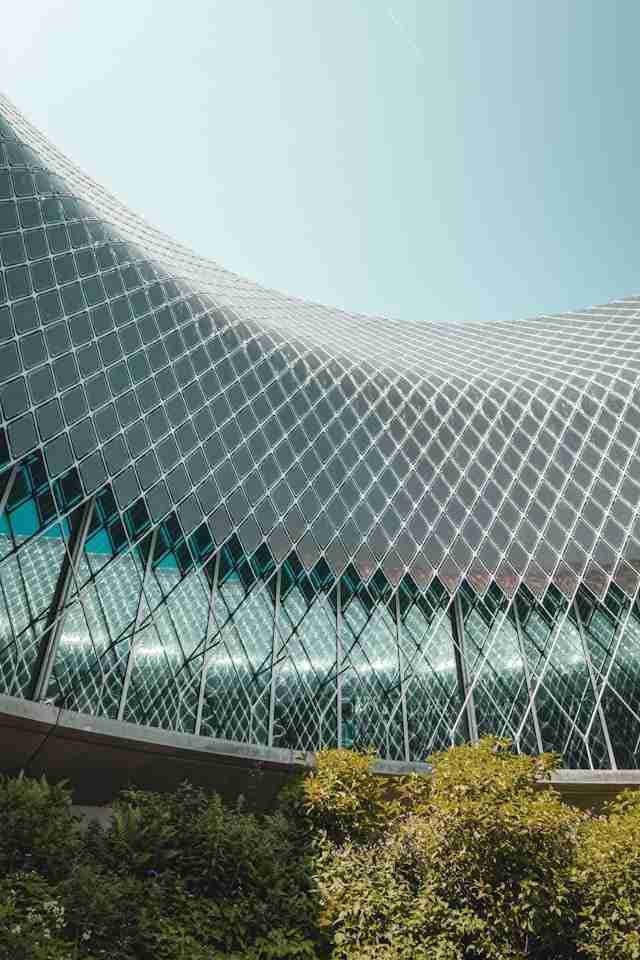
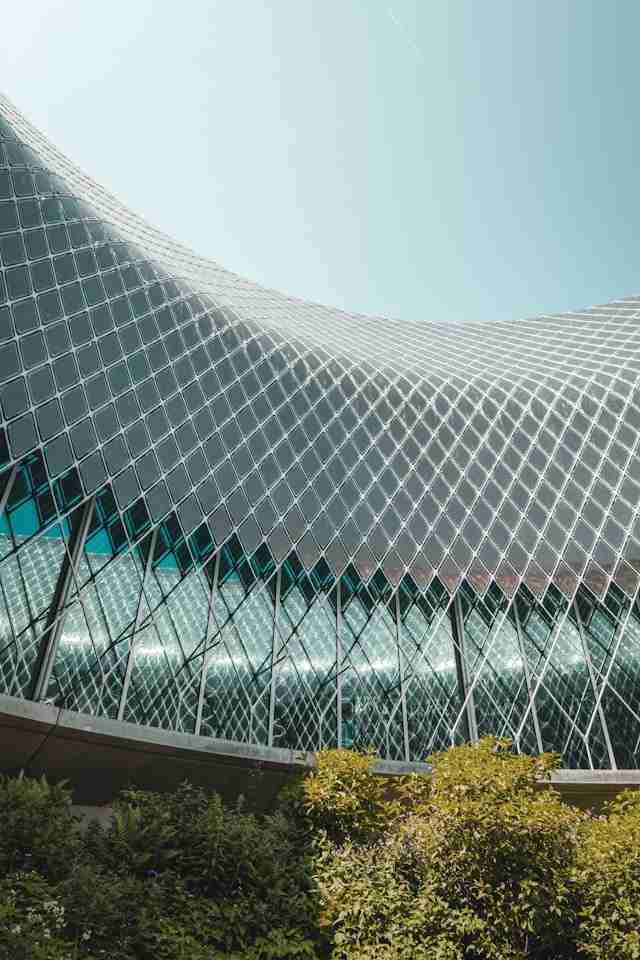
Set along the banks of the Rhine in Basel, the Novartis Pavillon presents a rare fusion of forward-thinking design and sustainable technology. This circular building, part of the Novartis Campus, is not only a center for science and dialogue—it's also a compelling photographic subject shaped by contrast, geometry, and innovation. Clad in a dynamic photovoltaic skin designed by iart and AMDL CIRCLE, the structure pulses with light and movement, transforming throughout the day and into the night. For photographers, it's a location that demands both technical attention and creative exploration. Whether you're interested in kinetic lighting displays, architectural symmetry, or reflections on the water, the Novartis Pavillon offers a study in precision and light-responsive design.
Best Photography Opportunities
Solar Facade Patterns in Direct Sunlight
The Pavillon's outer skin is composed of over 10,000 organic photovoltaic modules, which appear dark and uniform at first glance but shift appearance with changing light angles. During bright midday sun, these hexagonal units create intense highlights and deep shadows, rendering the building's facade as a patchwork of reflective patterns. This is an ideal time for close-up abstraction—using a medium telephoto lens to isolate sections of the skin where light hits strongest. Shooting in RAW preserves the full contrast range, especially helpful when balancing exposure between the sunlit surface and the shaded side of the building. Wide shots taken from a distance across the open campus or from an elevated position offer a clean, symmetrical form framed by open sky.
Twilight Lighting Activation
As day gives way to evening, the Novartis Pavillon's solar facade becomes an LED display system, illuminating with data-driven patterns of light in real time. Photographers working during this transition can capture the moment the structure shifts from passive form to active subject. A tripod and longer exposures (from 5 to 30 seconds) reveal smooth light trails and motion effects that can't be seen with the naked eye. Using a neutral density filter during the blue hour allows for further experimentation, blending soft ambient light from the sky with the rhythmic pulsing of the facade. This is also the time when reflections on nearby glass buildings and water surfaces come into play, adding a layer of context to the glowing geometry.
Architectural Symmetry and Circle Composition
The Pavillon's perfect circular form presents opportunities to work with symmetry in both frontal and overhead views. Shooting straight on from the main approach path, photographers can center the frame for a balanced, architectural portrait. A wide-angle tilt-shift lens is useful for maintaining vertical lines and avoiding distortion, especially when photographing from low or mid-height. Drones, where permitted, can offer a dramatic overhead shot that reveals the full circular plan and its relationship to surrounding urban forms and walkways. During early morning or late afternoon, the long shadows cast by the facade and nearby structures emphasize the circular boundary and create sharp geometric overlays.
Reflection Studies from the Riverbank
The Rhine's proximity makes it possible to photograph the Pavillon in a reflective context, especially in calm conditions or during long exposures. From the Kleinbasel side or from pedestrian walkways along the shore, the glowing structure is visible beyond the Novartis Campus gates. At twilight, the water captures the LED pulses in a soft blur, which can be emphasized using a tripod and remote shutter for smooth, uninterrupted exposures. This perspective also works well for compressing the Pavillon into the broader industrial and scientific landscape of Basel's north end. Including the riverbank in the foreground offers depth and a natural contrast to the sleek architecture beyond.
Interior Curves and Lighting Details
For photographers granted access to the interior, the Novartis Pavillon continues its visual language in curving walls, reflective surfaces, and naturally lit public spaces. The round footprint informs every element of the layout, with corridors and exhibition zones flowing around a central core. Floor-to-ceiling windows and light wells offer filtered natural light throughout the day, allowing for high-key, soft-focus compositions that contrast with the structured exterior. A fast prime lens like a 35mm or 50mm works well for these scenes, capturing low-light ambiance without needing to push ISO excessively. Interior light displays and exhibit installations also offer opportunities for creative color work, especially when using a slow shutter and controlled motion.
Best Time to Visit
Photographic conditions at the Novartis Pavillon are strongly shaped by its location near the Rhine and its south-facing exposure. Spring through autumn offers the longest shooting windows, with sunlight traveling across the building's surface from late morning until sunset. From March to October, direct sun on the photovoltaic skin begins around mid-morning, bringing out the highest degree of tonal contrast and specular highlights. These conditions are especially productive for high-detail shots or architectural abstracts of the solar panels themselves.
Golden hour, occurring late in the day, warms the entire scene and throws long shadows across the curved surfaces. The circular footprint becomes more pronounced during this time as the building casts elliptical shapes onto the pavement and nearby benches. Twilight is particularly important for photographers interested in the LED display. The facade's lighting system activates automatically around dusk and runs into the evening, changing in rhythm and brightness over time. The blue hour window—approximately 20 to 40 minutes after sunset—provides the most balanced light ratio between the illuminated building and the ambient sky.
Winter months see more diffuse light throughout the day and frequent cloud cover, which can be ideal for shooting structural detail or high-contrast monochrome frames. Snowfall, while rare, introduces a clean palette that heightens the building's form against the subdued background. Regardless of season, early mornings tend to be quieter, with less foot traffic and better chances of capturing clean compositions free of distractions.
How to Get There
The Novartis Pavillon is located at the southern edge of the Novartis Campus in Basel's St. Johann district, along the Rhine River. The building is open to the public and sits outside the secure perimeter of the campus itself, making it freely accessible without prior arrangements. Visitors can reach the Pavillon easily by public transportation: take tram line 11 to the St. Johann station, followed by a 5-minute walk toward the river. Local buses also stop nearby, and Basel's extensive bike paths make cycling a convenient option for locals and visitors alike.
For those driving, street parking is available in the surrounding area, though spaces can be limited during weekdays. There is no entrance fee to photograph the exterior of the building, and tripods are generally allowed outdoors. Interior photography may be subject to restrictions depending on the exhibit schedule and must adhere to staff guidelines. Photographers interested in drone work should check Swiss airspace regulations carefully, especially due to the Pavillon's location near both industrial zones and river traffic corridors.
Recommended Photography Gear
Capturing the Novartis Pavillon requires a kit that blends versatility with precision. A wide-angle zoom lens (16–35mm or 24–70mm) is key for framing the full structure in tighter spaces or capturing immersive views of the LED-lit facade. Architectural purists may benefit from a tilt-shift lens to control perspective and correct distortion when shooting from ground level or at tight angles. A mid-telephoto zoom, such as a 70–200mm, is excellent for isolating facade textures, capturing reflective elements, or compressing the structure against background elements like the river or skyline.
For night and blue hour work, a sturdy tripod is essential. The LED lighting system on the facade cycles continuously, so longer exposures are often necessary to capture its motion and pattern with clarity. A remote shutter release or timer delay helps eliminate shake during these long exposures. Neutral density filters can be used creatively to blur movement in the surrounding environment while keeping the building sharp—especially useful when including the river or pedestrian traffic in frame.
A circular polarizer can help manage reflections on the photovoltaic modules during daylight hours, though it should be used sparingly to avoid uneven gradients on the curved surfaces. A fast prime lens, such as a 50mm f/1.4 or 35mm f/1.8, is ideal for shooting indoors or at night without relying heavily on higher ISOs. Weather protection and a microfiber cloth are helpful in Basel's variable climate, particularly in colder months when condensation may affect lenses or filters. Because many of the best angles involve walking the perimeter or moving along the river paths, a lightweight bag with easy lens access is recommended.
Nearby Photography Locations
Just steps from the Novartis Pavillon, the Rhine promenade offers long sightlines and smooth waterside reflections. Early morning and twilight are particularly effective times to capture soft river light and passing boats, which add scale and motion to your compositions.
Campus Novartis (by appointment)
While the campus itself is private, guided architecture tours can be arranged in advance. These tours grant access to buildings by SANAA, Diener & Diener, Frank Gehry, and others. The internal courtyards and paths offer clean compositions, experimental angles, and excellent use of material and light.
A short walk downstream, this pedestrian bridge marks the meeting point of Switzerland, Germany, and France. Its sweeping arc and open metal structure create strong leading lines, best photographed at sunrise or dusk when cross-light adds dimension.
Voltaplatz and HeK (House of Electronic Arts)
This arts district near the Pavillon includes contemporary installations, industrial backdrops, and colorful murals. It's a rewarding stop for urban texture work and juxtaposition between old and new materials, especially in soft morning light.
An industrial port zone in transition, the Klybeck area offers raw textures, riverside warehouses, and large-scale graffiti. This contrasts nicely with the futuristic design of the Pavillon, giving photographers a varied set of subjects within a short distance.
The Novartis Pavillon isn't just a building—it's a responsive structure that invites photographers to explore how light, time, and technology can shape architecture. Its clean geometry and shifting illumination demand attention, rewarding both technical control and creative risk. Whether you're shooting in daylight for clarity or at night for atmosphere, this pavilion turns every frame into an exercise in modern precision.
Comments
Loading comments…