
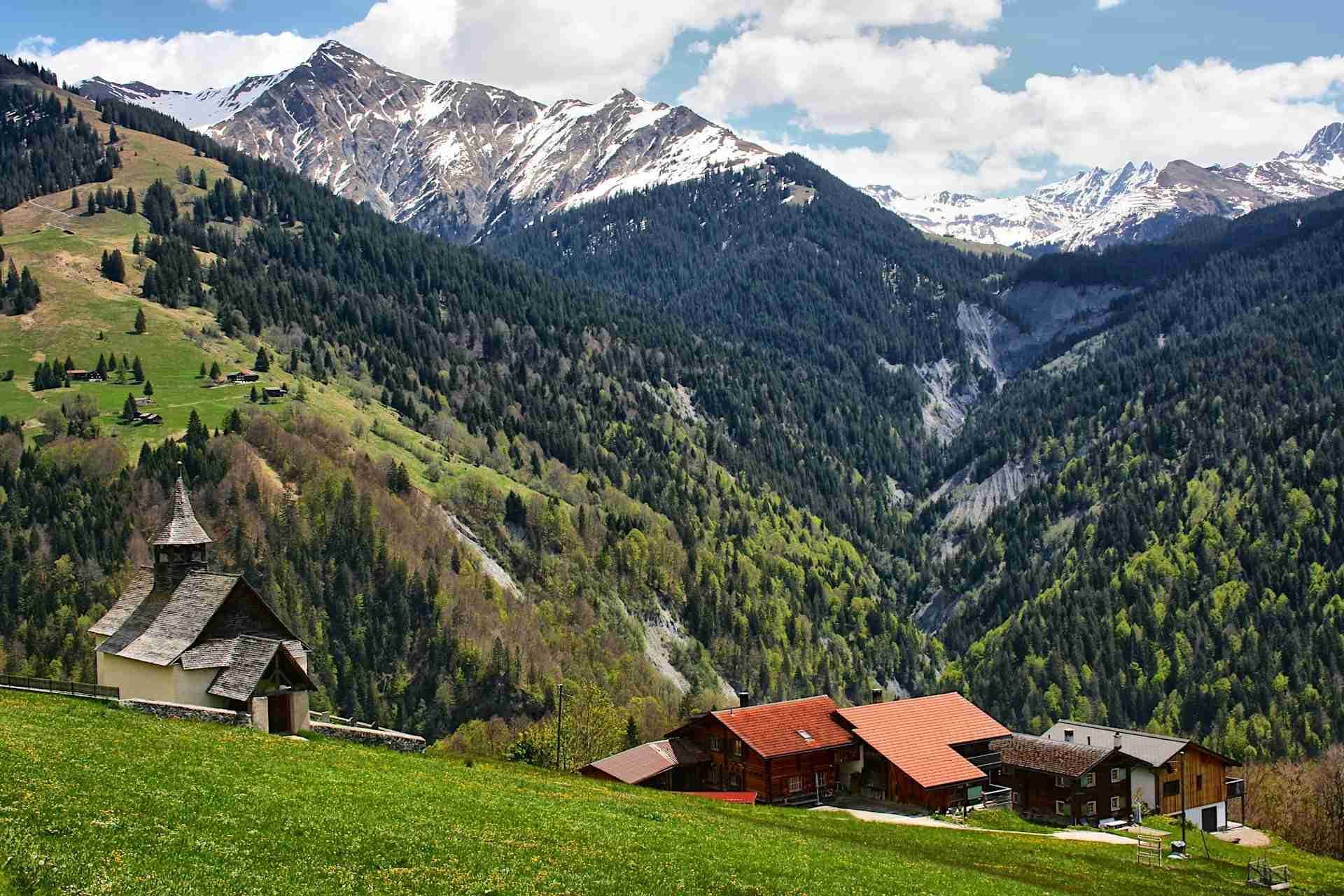
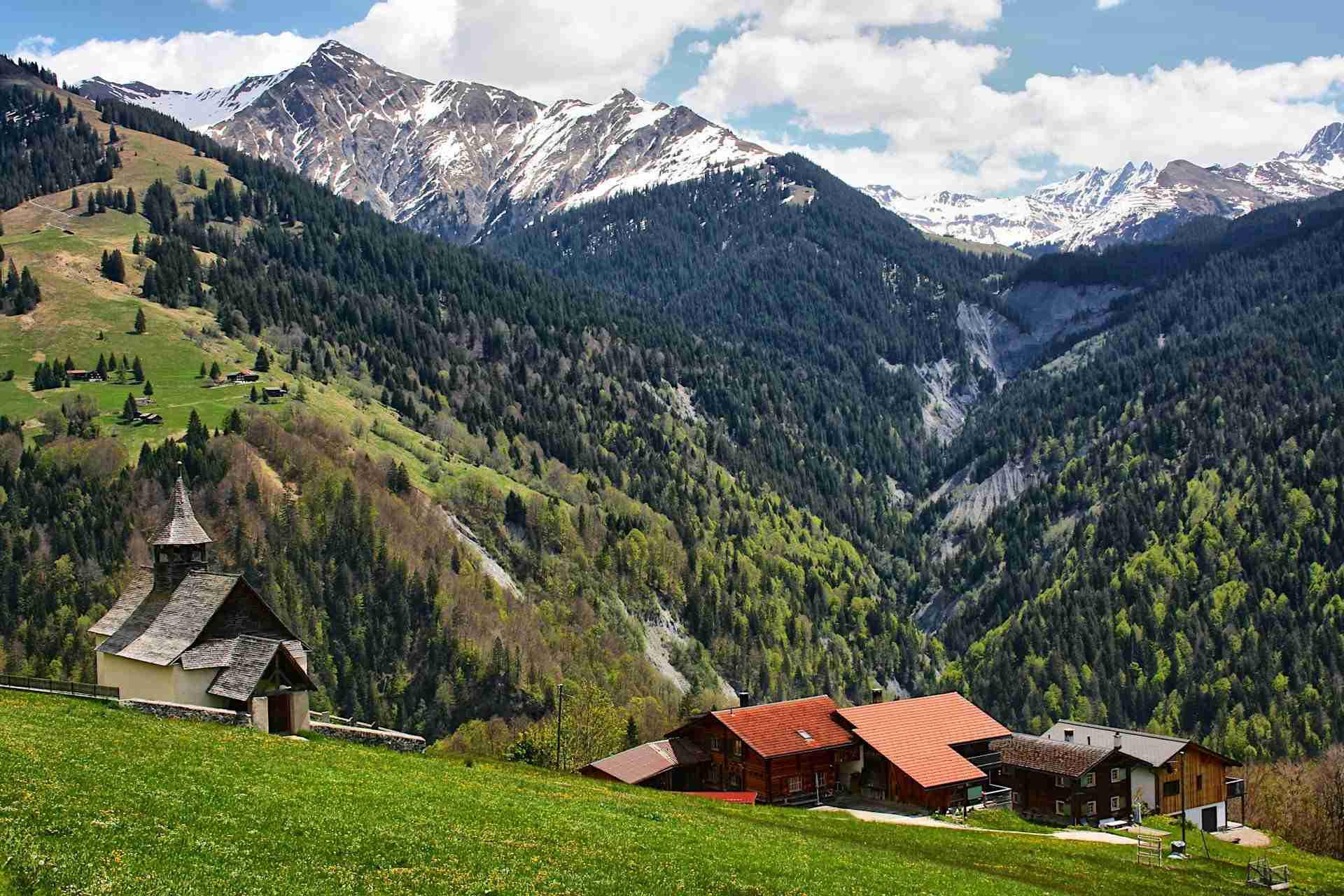
High in the alpine terrain of eastern Switzerland, perched above the Prättigau Valley, the Reformed Church of St. Anna in Schuders offers a uniquely peaceful and photogenic scene. With its modest white façade, pointed steeple, and steep-pitched roof set against the vast backdrop of mountain ridges, this solitary church is a visual focal point in a landscape of sweeping green meadows and jagged peaks. The hamlet of Schuders itself, accessible only by a winding mountain road and a dramatic single-lane suspension bridge, adds to the sense of isolation and reverence. For photographers seeking clean architectural lines, alpine scale, and light that plays constantly across the valley and slopes, this is a destination of quiet power and extraordinary compositional depth.
Best Photography Opportunities
• Classic Frontal View with Mountain Backdrop
: From the approach path just west of the church, you can frame the building straight-on with the Prättigau ridges rising in the background. Use a wide-angle lens (16–35mm) to place the church slightly off-center, incorporating both its shape and the panoramic sweep of the landscape. Morning light from the east illuminates the whitewashed walls with soft gold, while afternoon sun casts long shadows that stretch across the field. In spring and summer, foreground wildflowers add color and contrast, while in autumn, the tones shift toward gold and rust.
• Schuders from the Ridge Above
: Climb a short trail or drone above the church to reveal its setting in full context—perched at the edge of a drop-off, facing a seemingly endless valley. Aerial shots or high-elevation compositions show the village in its entirety, nestled amid pastures and forest bands. A telephoto lens can compress the church against layers of distant alpine ridges, emphasizing scale and solitude. Sunset often paints the valley in violet and blue tones, with the steeple catching the last light.
• Detail Studies of the Church Architecture
: Despite its simplicity, the Church of St. Anna features beautiful material detail—aged shingles, wooden doors, and old stonework steps. A 35mm or 50mm prime lens is ideal for isolating these features while including the texture of the surrounding grass or sky. After rain, moisture on the surfaces adds color and deepens shadows. The small bell tower and roof junctions are particularly effective in tight vertical compositions.
• Atmospheric Shots in Mist or Snow
: In early spring or late autumn, fog often rolls in over the hills, wrapping the village in mist and softening all edges. The church becomes a ghostly form, ideal for minimalist compositions in monochrome or muted color palettes. In winter, snow outlines the steeple and roof, while the dark forest behind provides high contrast. These conditions are ideal for storytelling frames that emphasize the spiritual stillness of the site.
• The Drive to Schuders and the Traversinersteg Bridge
: The journey to the village is itself a photographic experience. The single-lane Schuderserstrasse winds upward with dramatic hairpins and clifftop views, and the crossing of the historic Schuders suspension bridge—one of the highest road bridges in Europe—offers wide alpine perspectives. Stop along the way to frame the narrow road against the vastness of the terrain. These shots build narrative and offer a visual sense of arrival.
Best Time to Visit
The church and village can be photographed year-round, but the experience varies significantly by season. Late spring through early autumn (May to October) provides the most accessible conditions, with clear skies, green pastures, and active agricultural life in the village. Early morning offers clean directional light across the valley, while golden hour softens the slopes and silhouettes the steeple against the sky.
Autumn is particularly compelling for color and atmosphere. The larch trees on the surrounding slopes shift to gold, and the low sun enhances the texture of the terrain. This is also the most reliable time for mist-filled mornings and long twilight windows.
Winter transforms the site into a serene, snow-covered sanctuary. Access is more difficult, and the road may require winter tires or chains, but the church becomes the centerpiece of a stark, white composition. Low sun angles throughout the day make it possible to shoot in golden light even in mid-afternoon.
Avoid mid-day hours in summer, when the high sun flattens shadows and reduces tonal contrast. Evening is preferred for long exposures, when the church glows against the darkening landscape and lights begin to flicker on in nearby farms.
How to Get There
Schuders is located in the municipality of Schiers in the canton of Graubünden, Switzerland. From the A28 highway near Schiers, follow signs to Schuders via Schuderserstrasse—a narrow, winding mountain road that ascends steeply through forest and cliffside. The road crosses the famed Schuders Bridge, offering jaw-dropping views and requiring cautious driving, especially in poor weather.
Once in the village, parking is available near the church or at designated roadside pullouts. The church itself is easily accessible on foot, with short walking paths leading to the front and side viewpoints. The entire area is open to the public year-round, and there is no admission fee to visit or photograph the church. As this is a functioning place of worship, be respectful during services and avoid disruptive gear setups during community events.
Drones may be flown here, but local regulations apply—ensure you maintain line of sight, fly well above residential homes, and avoid overflying the church when visitors are present.
Recommended Gear and Shooting Tips
For wide landscape work and context-rich compositions, bring a wide-angle zoom (16–35mm) to capture the church in relation to the valley and sky. A standard zoom (24–70mm) is ideal for mid-range work, while a telephoto (70–200mm or 100–400mm) is useful for compressing layers of mountain terrain or isolating distant features.
A tripod is essential for golden hour, long exposures, and HDR blends when capturing high-contrast sky and shadow scenes. A polarizer can be effective for enhancing sky contrast or managing reflection off wet rooftops, but use it cautiously to avoid banding in ultrawide skies.
Weather can change quickly in the mountains, so bring a lens cloth, protective covers, and wear layers—even summer evenings can be cold at this altitude. If shooting at dawn or dusk, scout your angles in daylight first; the steep terrain can conceal views that appear accessible on a map but are difficult to reach in low light.
When possible, include elements of the village—fences, distant homes, hay bales—in your compositions to build a sense of place. The clean lines of the church benefit from visual storytelling that situates it within its alpine context.
Nearby Photography Locations
• Salginatobel Bridge
: Just to the south, this elegant arch bridge spans a deep gorge and is a masterpiece of Swiss engineering. Framed by dense forest and alpine rock faces, it's best photographed in side light or fog, when the structure emerges from shadow with graphic precision. Use a long lens to compress the arch against the valley or a wide lens from the nearby trailhead for dramatic leading lines.
• Schesaplana and the Rätikon Mountains
: The nearby alpine range offers some of the most dramatic ridgelines in eastern Switzerland. High hiking trails lead to overlooks above the clouds, with panoramic views of rock towers, glacial lakes, and deep alpine bowls. These are excellent for sunrise hikes and drone landscapes.
: Across the valley from Schuders, these traditional villages offer classic wooden chalets, narrow alpine lanes, and strong morning light as the sun rises over the ridge. Snowfall in winter makes for especially atmospheric black-and-white compositions.
• Vereinapass and Landwasser Valley
: This less-traveled alpine route offers forested switchbacks, waterfalls, and views down into the iconic Landwasser region. Excellent for moody, off-the-beaten-path compositions that contrast steep terrain with small-scale alpine farms.
: A photogenic village nestled at the foot of sheer limestone walls, Sankt Antönien is a superb location for winter photography, especially during early morning when shadows cut across the valley floor. It's also a great starting point for snowshoe hikes to remote chapels and huts.
The Church of St. Anna in Schuders doesn't rely on grandeur—it captures the eye with restraint, isolation, and its deep relationship to the alpine terrain. Photographers drawn to purity of form, shifting mountain light, and the quiet gravity of place will find here a subject that resonates far beyond its scale. In every season, from every angle, it invites you to slow down, frame with care, and let the silence of the peaks speak.
Comments
Loading comments…