
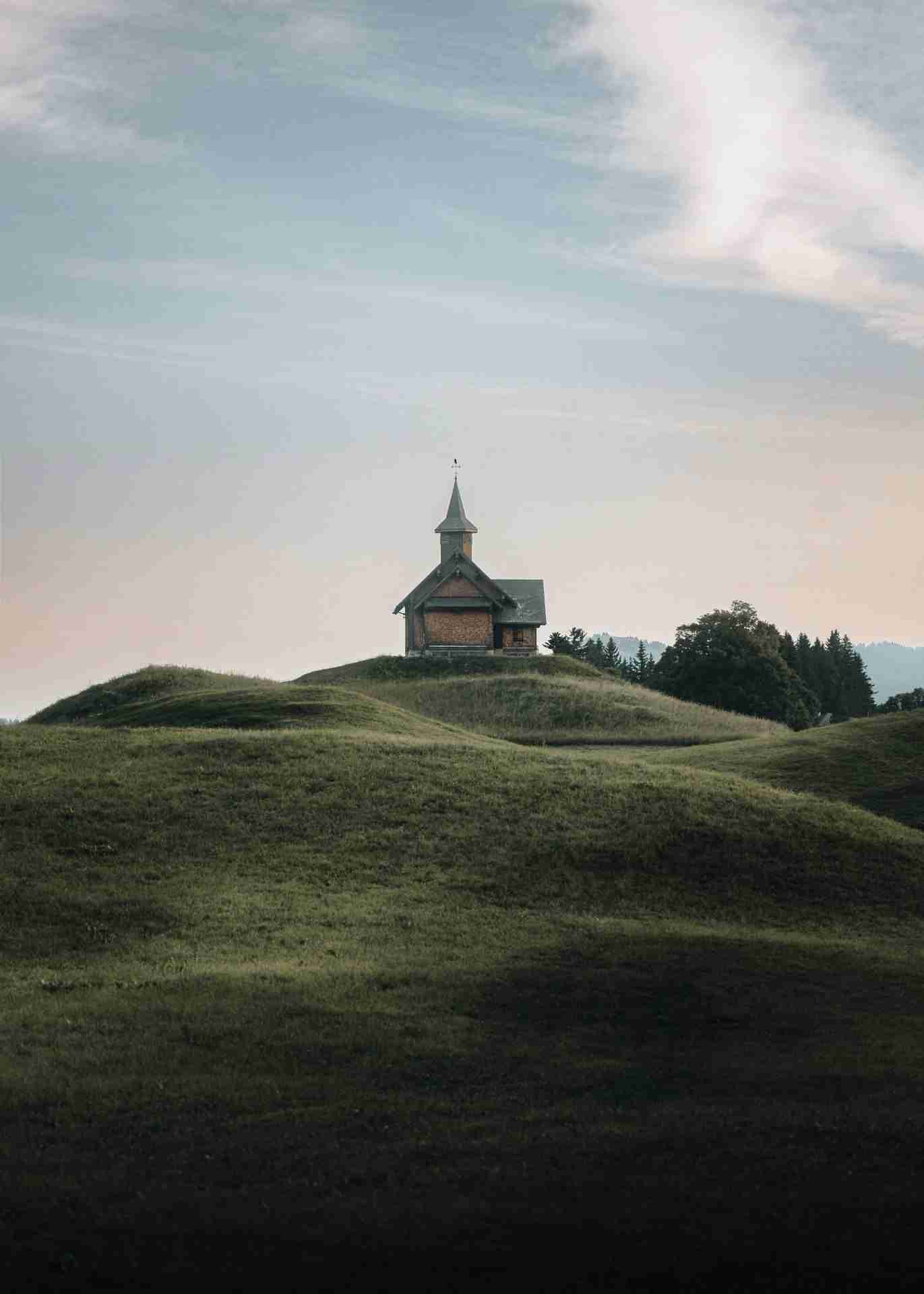
Stooskapelle Maria Hilf is a wooden mountain chapel that stands alone on a grassy rise just outside the village of Stoos in central Switzerland. Its dark timber walls and sharply pitched roof give it a grounded, compact presence within a wide landscape of soft hills and distant ridges. The chapel's form holds well against open sky and changes subtly throughout the day as light moves across the slope. With no surrounding buildings and minimal visual interference, the structure remains the clear focal point from almost every angle. For photographers looking to work with natural materials, clean separation, and slow changes in alpine light, this location offers reliable simplicity and strong balance across seasons.
Best Photography Opportunities
Full Environmental Composition from the Open Field
The open meadow to the west of the chapel offers a wide-angle opportunity to frame the full building with a backdrop of alpine ridges and moving sky. A 24 to 35 millimeter focal length provides enough space for foreground detail while keeping the chapel dominant within the frame. This location works well during golden hour, when the warm side light strikes the western face of the structure and softens the shadows along the slope. Include texture from the grass or trail segments to hold the foreground and lead the eye naturally into the scene. When clouds are present, they help fill the upper portion of the frame and prevent overexposure above the ridgeline.
Low-Angle Framing with Sky and Tower
By positioning yourself downslope and shooting upward toward the roof and bell tower, you can isolate the upper structure against the sky. This works best on days with shifting cloud cover or early in the morning when the light is diffuse and the roofline separates cleanly from the background. A 50 millimeter or short telephoto lens allows for compression without flattening the chapel's shape. Use a small aperture to maintain sharpness across the roof and tower. These compositions benefit from precise alignment to avoid distortion and work well in both color and black and white.
Midrange Detail Work with Texture and Form
A 24 to 70 millimeter zoom is ideal for working with smaller sections of the building such as doorways, stonework, and rooflines. The chapel's simple construction means detail shots depend on tone and surface rather than ornate decoration. Use soft light or overcast conditions to avoid harsh shadow across the pale surfaces. Try framing segments of the roof or tower against the negative space of the sky for studies in line and proportion. These images pair well in series or diptych formats when collected over a short session in changing light.
Backlit or Silhouetted Compositions at Dusk
Late evening light behind the chapel creates a narrow window for silhouetted work, especially in the shoulder seasons when the sun sets directly behind the ridgeline. Shoot from a lower angle to maximize separation between the roofline and background. A wide-angle lens helps include fading color in the sky and a portion of the field for structure. Use a tripod and keep your exposure low enough to hold the shape of the chapel while letting the sky carry the color. These compositions often read best with a clear sky or soft streaks of color near the horizon.
Minimal Framing on Overcast or Foggy Days
When clouds drop low or fog moves across the field, the chapel becomes a clean subject for minimal compositions. This is a strong approach for photographers who prefer muted tones and quiet structure. A midrange prime or zoom allows for quick adjustment as the light shifts and the fog thins or thickens. Work with horizontal framing to balance the base of the building with the open field, or shoot vertical to emphasize the upward draw of the tower. These images benefit from subtle editing and quiet presentation, often holding best in monochrome.
Best Time to Visit
Stooskapelle Maria Hilf can be photographed in all seasons, but each time of year changes the tone and accessibility of the location. Summer offers the most straightforward conditions, with green meadows, stable weather, and clear skies throughout much of the day. Early morning and late afternoon are the most productive hours, especially when clouds begin to gather near the peaks and the light stretches softly across the field.
Autumn brings muted tones and longer shadows, with the surrounding slopes shifting into warm browns and faded grass. The weather can change quickly, introducing low fog or overcast skies that work well for minimal or moody compositions. Winter introduces snow cover and a more stark palette, with the chapel standing out in high contrast against the landscape. Access remains possible via the Stoosbahn funicular and cleared village paths, though tripod setup may be slower depending on snow depth.
Spring is often overlooked but brings fresh color and misty conditions, with the grass returning and the surrounding slopes still holding patches of snow. This transitional time offers varied shooting conditions over short periods, making it productive for photographers who enjoy adapting to light and weather.
Light changes quickly in the early and late hours due to the surrounding ridges, so plan your arrival with time to scout angles in advance. Cloud movement is common and often enhances the visual structure of wide frames.
How to Get There
Stooskapelle Maria Hilf is located in the small mountain village of Stoos, which is only accessible by funicular or cable car. From the town of Schwyz, follow signs to the Stoosbahn valley station in Schlattli. Park at the base station and take the Stoosbahn funicular up to the village. The ride is short and runs regularly throughout the day. Once in Stoos, the chapel is a five-minute walk from the station, located along a gently sloping path near the edge of the open field.
There is no fee to visit or photograph the chapel, and the area is open year-round. Stoos is car-free, but the paved walkways are suitable for light gear setups and rolling camera bags. Winter access may require appropriate footwear depending on snow or ice. The site is not restricted in any way for personal photography, and tripods are welcome on the field and paths.
Recommended Photography Gear
Bring a wide-angle lens such as a 16 to 35 millimeter for full environmental compositions that include the chapel and surrounding landscape. A 24 to 70 millimeter zoom is useful for balancing the building within the frame or isolating small areas of texture and form. A longer lens between 70 and 200 millimeters helps compress background ridges or pick out cloud shapes above the tower.
A sturdy but lightweight tripod is recommended for early morning, dusk, or long exposures on foggy days. A circular polarizer helps manage glare on wet grass and brings out tone in the sky when cloud cover is thin. During winter, lens cloths and batteries should be kept warm, as temperature drops can affect performance quickly. Neutral density filters are not essential here but may be useful for slow shutter work when cloud movement is visible or light is intense on snow.
Because Stoos is a walkable village, you will not need heavy packs or full hiking gear. Dress in layers to adjust quickly to wind or changing weather, and bring a dry insert or rain cover in case of fast-moving storms. The simplicity of the setting rewards careful shooting with minimal equipment.
Nearby Photography Locations
A short hike or lift ride from Stoos leads to this panoramic ridge with long views across central Switzerland, including Lake Lucerne and distant peaks. Best in early light or late evening when cloud layers break along the horizon.
The village itself offers quiet streets, wooden structures, and small gardens that frame well in soft light. Use a midrange lens for working handheld and moving between compositions quickly.
At the valley station in Schlattli, the lower end of the funicular provides strong geometric framing with leading lines and high contrast between the rail structure and cliff walls. Works well in early morning or with indirect overcast light.
Morschach Overlook
Accessible by car from Schwyz, this viewpoint offers a wide landscape scene across Lake Lucerne and the surrounding terrain. Best shot with a longer lens to compress foreground slopes and distant peaks.
Muotathal Riverbend Area
Down in the valley, this quiet section of the river offers slow-moving water and alpine forest along the banks. Reflections are best captured during calm early hours with minimal wind.
Stooskapelle Maria Hilf is a location that rewards clarity, simplicity, and timing. With quiet structure, uninterrupted views, and subtle changes in light throughout the day, it gives photographers the chance to slow down and work with form rather than spectacle. Whether framed tightly or surrounded by the full sweep of the alpine field, the chapel remains a steady subject through the shifting mountain conditions.
Comments
Loading comments…