
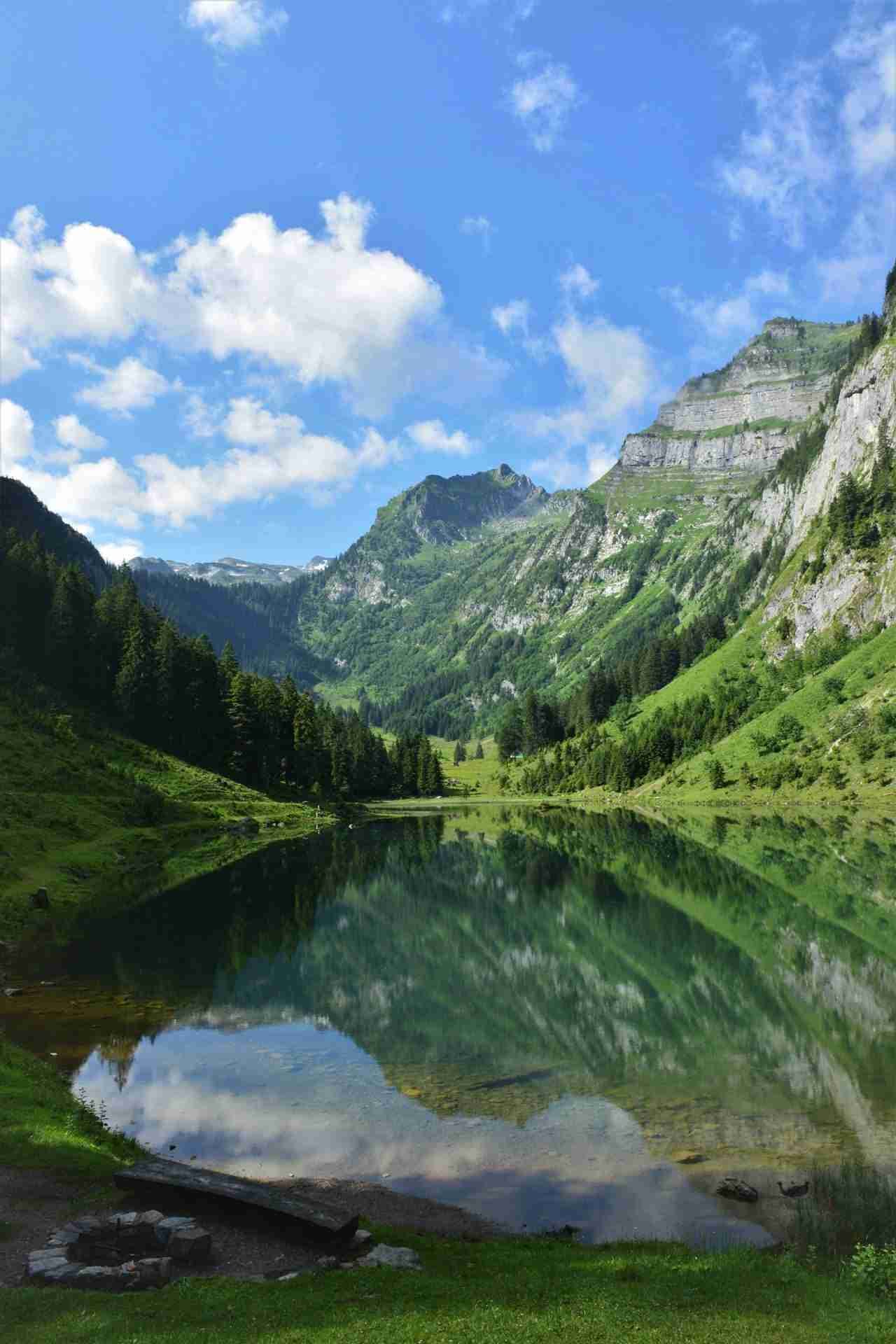
Talalpsee is a small alpine lake above the village of Filzbach in the canton of Glarus, Switzerland. Set in a bowl surrounded by meadows, forest, and jagged limestone peaks, the lake is accessible yet still feels removed. For photographers, the value of Talalpsee lies in its stillness and its scale. It's not a dramatic landscape in terms of size, but the shape of the lake, the sharp rise of the surrounding cliffs, and the clarity of the reflections give you the elements you need to build thoughtful, balanced compositions. The area around the lake is open enough to allow movement and repositioning as the light changes, and the path that loops around it provides a steady variety of angles and elevations without requiring a long hike.
Best Photography Opportunities
• Reflections of the Northern Cliffs
From the southern edge of the lake, you can look north and frame the cliffs that rise directly from the far shore. In calm conditions, this creates a clean mirror image across the surface of the water. Use a wide or standard lens to include some foreground grass or lakeside rock for added depth. This shot works best early in the morning when the water is undisturbed and the light comes in low from the east, warming the cliffs while the lake remains cool and shadowed.
• Side Trail Compositions with Trees and Rock
As you walk along the eastern side of the lake, the path rises slightly and offers mid-level views back across the water. From here, you can use tree trunks, large rocks, or fencelines to build foreground structure, while placing the lake and mountains in the background. These compositions benefit from side light in the late afternoon, when long shadows move across the meadow and the ridgeline starts to catch the last light of the day. A mid-range zoom gives you flexibility to build both wide and compressed versions of this scene.
• Low Angles with Foreground Texture
The lakeshore has patches of soft grass, exposed stone, and small plants that work well as foreground elements. Get low with a wide-angle lens and use the near/far technique to bring detail into the lower third of the frame while letting the reflection and mountains fill the rest. Shoot during soft light or light overcast to avoid harsh shadow lines across the water. A polarizer can help manage reflection intensity or deepen sky tones, depending on the angle of light.
• Forest Edge and Waterline Contrast
On the western side of the lake, the forest comes right up to the shore in places, giving you dark vertical lines that contrast well with the open water and sky. These frames are strongest with late light or during cloud cover, when the tree line acts as a clean shape against the brighter parts of the frame. Use a short telephoto to compress the tree trunks and reflection, or frame wider to include the full transition from forest to water.
• Winter Ice and Minimalist Scenes
In winter, the lake partially freezes and the surrounding meadow takes on soft, muted tones. This is a good time to shoot minimalist compositions that focus on shape, tone, and reflection rather than color. Foot traffic is lower, and the stillness adds to the quiet structure of the scene. Bring a tripod and use longer exposures to work with low light, especially if cloud cover is heavy. Tracks in the snow can add or interrupt compositions, so take time to scout a clean line before stepping in.
Best Time to Visit
Talalpsee is most accessible and photographically productive from late spring through late autumn. In early summer, the surrounding fields fill with wildflowers and the lake is usually calm in the morning. Sunrise and early golden hour offer the best conditions for reflection photography, with light rising behind the cliffs and gradually sweeping across the bowl. Late afternoon and evening sessions give you side light and longer shadows across the meadow, which are useful for working with depth and texture.
Autumn brings softer color and occasional low mist that settles over the lake, especially during temperature swings between warm days and cool nights. These conditions support slower, more atmospheric compositions, and the warm tones in the forest add color contrast against the cold clarity of the water. Winter visits are more weather-dependent, but offer a chance to build clean, high-contrast compositions using ice, sky, and shadow. Early light is cold and even, allowing for extended exposures and quiet color palettes.
How to Get There
Talalpsee sits above Filzbach in the Glarus region of eastern Switzerland. From Zurich, take the A3 highway toward Glarus and exit at Niederurnen. From there, a winding road leads up to Filzbach. The lake is accessed via a small mountain road that continues to the Talalpbahn cable car station. During summer, you can either take the short cable car ride or hike up from Filzbach on a well-marked trail, which takes around one hour.
Once at the upper station, the lake is an easy walk, roughly 15 minutes on a flat gravel path. There is no fee to visit the lake or walk the surrounding trail, and the area is open during daylight hours year-round, weather permitting. Parking is available near the base station. The path around the lake is firm and navigable with light gear, though it can become muddy after rain or snowmelt. Sunrise and early morning sessions are best planned with the first cable car or by hiking up before daylight.
Recommended Photography Gear
A 24–70mm zoom is the most useful all-around lens for working at Talalpsee, giving you flexibility for landscapes, mid-range scenes, and reflection framing. Pair this with a 16–35mm wide-angle lens for near/far compositions and expansive views across the lake and sky. A 70–200mm lens is optional but helpful for compressing distant ridgelines, isolating cliff texture, or pulling tighter layers out of a wider scene.
A sturdy but lightweight tripod is important for shooting in low light or managing slow shutter speeds for reflection and long exposure work. Bring a circular polarizer to control surface reflection and boost contrast in foliage or sky. An ND filter in the 6-stop range is useful if you plan to smooth water or shoot longer during brighter times of day. A waterproof backpack or cover is smart during early spring or late autumn when the trails can be wet or soft underfoot.
Nearby Photography Locations
• Walensee Shoreline at Murg
Just across the valley, the shoreline near Murg offers clean water reflections, lakeside forest, and steep cliffs rising directly from the lake's edge. It's excellent for low light and long exposure work, especially during sunrise.
Above Filzbach, the trails along Kerenzerberg offer panoramic views of Walensee and the surrounding mountains. These trails are ideal for wide landscapes and evening side light, and they connect easily to higher elevation viewpoints.
This long glacial lake west of Glarus has turquoise water, steep forested banks, and smooth reflections under calm conditions. It's best photographed early in the day before wind disturbs the surface. Bring a longer lens to work with layers of mountain and forest.
• Linth Valley Agricultural Fields
The lower valley around Näfels and Niederurnen includes open pastures and patchwork farmland framed by distant peaks. This area works well for minimal, wide-angle compositions with strong horizontal elements and low sky contrast.
A more challenging hike leads to a chain of three alpine lakes above Murg. These lakes are quieter and more remote, offering dramatic reflection potential, especially in the first light of morning. Plan for a full-day hike or overnight trip if including this location.
Talalpsee doesn't overwhelm with scale or force you into a single dramatic frame. It gives you time. Time to move, to wait for wind to drop, to see how the cliffs shift color in angled light, and to build a composition that holds. If you're willing to slow down and work with reflection, shape, and stillness, this lake rewards patience with subtle, lasting images.
Comments
Loading comments…