
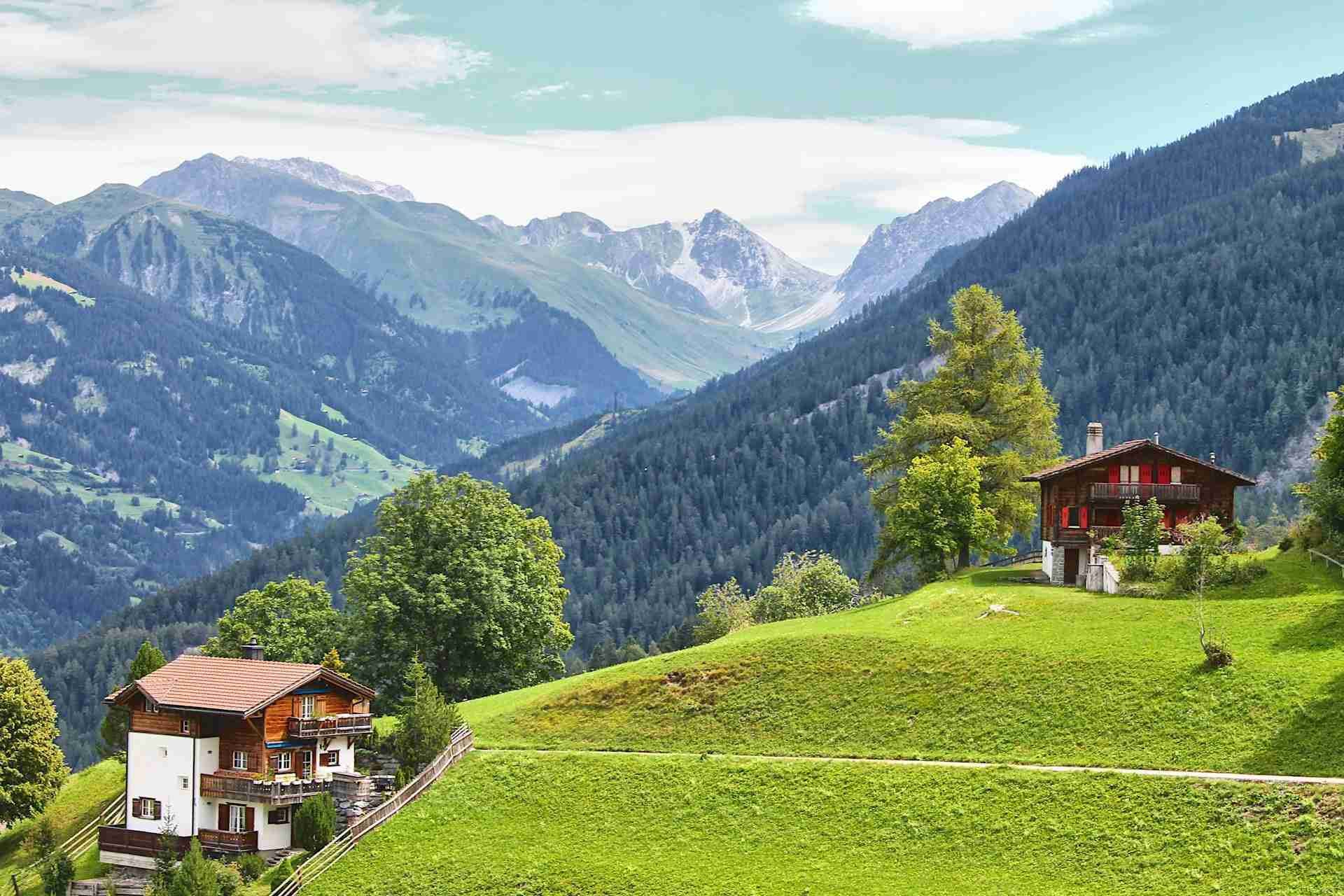
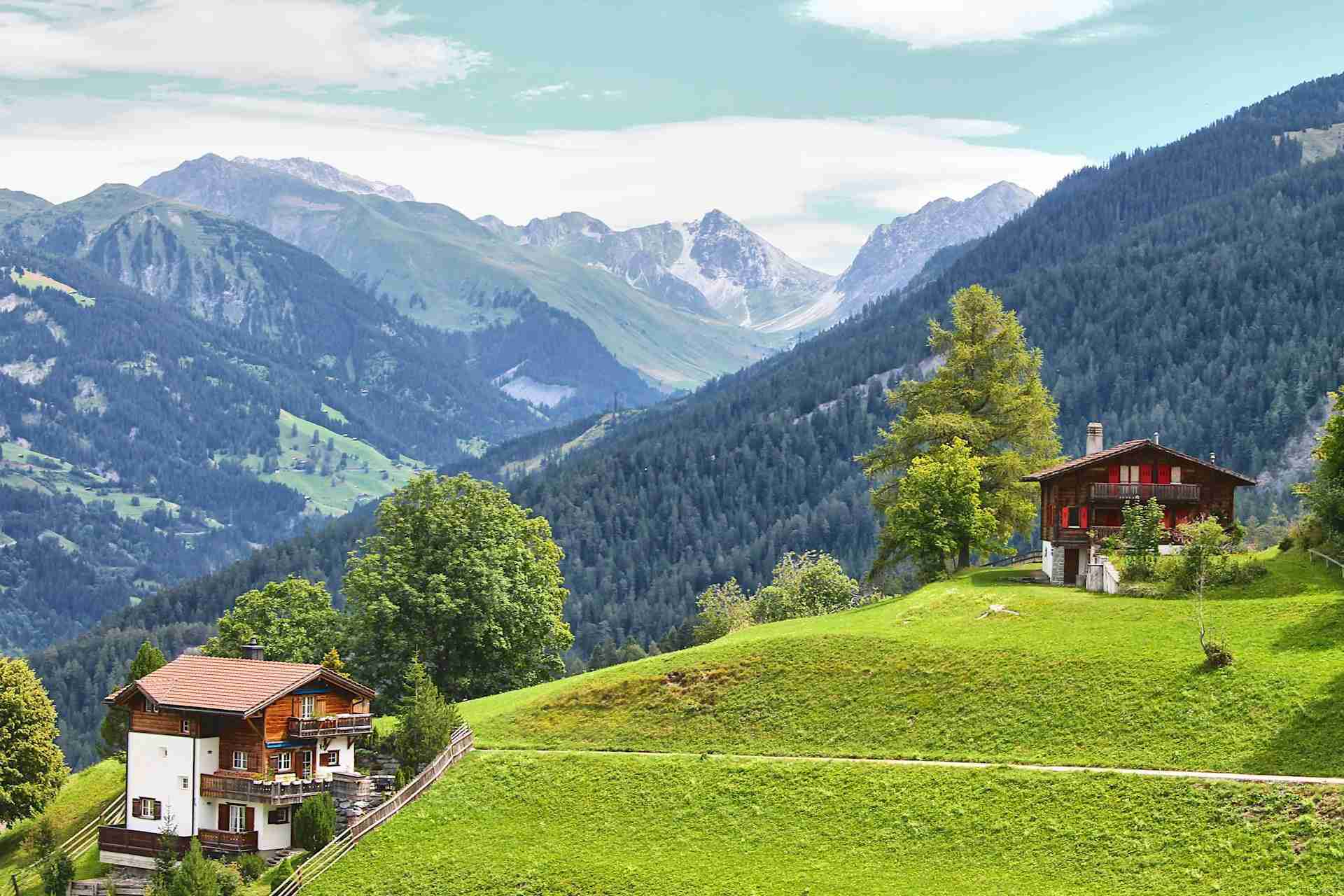
Tschiertschen is a quiet alpine village tucked into a high valley above Chur in the canton of Graubünden, where the terrain folds inward and light moves carefully across steep pasture, stone barns, and mountain forest. Unlike the larger and more developed resorts nearby, Tschiertschen remains understated and photogenic in its restraint. Chalets with sun-darkened timber line the narrow lanes, while hiking trails and ridgeline roads rise into open slopes framed by larch, spruce, and snow-dusted peaks. For photographers, the draw lies in the scale and structure of the village in its landscape, one of verticality, shadow, and soft transitions. This is a place for composing slow images with precise alignment, whether shooting early light cutting across rooftops or clouds breaking over the valley rim.
Best Photography Opportunities
Golden Hour in the Village Core
The heart of Tschiertschen is built tightly around narrow lanes and stepped walkways, where traditional alpine chalets cluster in layers. In the first and last hour of sunlight, long shadows from the buildings create sharp contrasts across the facades and stone streets. Use a standard zoom lens to navigate tight spaces and experiment with angles that frame the wooden balconies, flower boxes, and pitched roofs against open sky. Composing from just above the village, you can also layer rooftops into the surrounding valley. Overcast days are useful for softening highlights and revealing texture in wood grain and stone.
Larch Forest in Autumn Light
To the south and east of the village, trails climb gently through mixed forests that are especially photogenic in autumn when the larch trees turn gold. These paths offer strong vertical compositions of tree trunks and filtered light, as well as wide shots of the golden canopy from small clearings. A mid-telephoto lens will help compress the vertical forms, while a polarizer enhances leaf color and reduces glare. Misty mornings are ideal for creating depth within the forest and softening any harsh contrast. These are quiet scenes, best composed slowly and with careful attention to rhythm.
Pastureland and Barns Above the Village
On the ridge above Tschiertschen, scattered hay barns sit in open pasture, framed by receding slopes and distant peaks. These elements lend themselves to classic alpine compositions, particularly in early morning when cool light creates a subtle separation between structures and background. A longer lens allows you to isolate individual barns and compress the terrain into geometric layers. These fields are also excellent in spring, when fresh greens contrast with snowmelt and the first wildflowers. Be mindful of light wind that can shift grasses and create blur in longer exposures. Use a tripod and low ISO to maintain sharpness and tone.
Cloud Layers Breaking Over the Schanfigg Valley
One of the most compelling features of Tschiertschen is its view back toward the Schanfigg Valley and the slopes above Chur. In changing weather, low clouds often hang along the ridgeline, breaking intermittently to reveal light on the opposite slopes. These moments are ideal for wide landscape photography with strong atmospheric perspective. Position yourself on the higher trails above the village, where you can see both the village below and the peaks beyond. Use a graduated ND filter to hold detail in the sky and be prepared for rapid exposure shifts as light passes through the clouds.
Snowfall and Twilight in Winter
In winter, Tschiertschen becomes a small ski village with a limited but active lift system. Snow blankets the rooftops and mutes the entire color palette to soft grey, blue, and brown. The best scenes often occur just after sunset, when window lights begin to glow and snow retains the last ambient color of the day. Use a tripod for these low-light scenes and underexpose slightly to retain detail in the highlights. The contrast between warm interior light and cold exterior tones creates a subtle but powerful mood. Snowfall adds texture to otherwise static scenes and can be used to introduce motion with longer shutter speeds.
Best Time to Visit
Tschiertschen offers compelling photography year-round, but each season brings a different kind of visual story. Autumn is perhaps the most layered and colorful, when larch forests glow against grey ridges and early snow begins to dust the higher elevations. Winter transforms the village into a minimalist palette of white and brown, ideal for twilight photography and snow texture studies. In spring, contrast returns to the landscape, with new greens and scattered bloom pushing through the thaw. In summer, alpine trails above the village open up to distant peaks and wildflower-rich meadows.
Light moves slowly here, and because of the surrounding slopes, direct sunlight tends to arrive late and leave early. Early morning shoots benefit from soft sidelight as it filters into the valley, while late afternoon light can produce warm edge lighting on barns and ridge lines. Overcast skies work well in the forested areas, especially in autumn. Stormy or transitional weather often creates dramatic depth and movement in wide landscapes.
How to Get There
Tschiertschen is located in the eastern Swiss Alps, about twenty minutes by car or bus from the city of Chur. If arriving by train, disembark at Chur's main station, where regular buses run up the mountain to the village. The road is paved and accessible year-round, though winter conditions can make travel slower or require snow chains.
There is a small car park near the entrance to the village and additional spots along the main street. The village itself is compact and pedestrian-friendly, with narrow lanes best explored on foot. Most photography locations can be reached within a fifteen to thirty-minute walk from the village center. Higher ridge trails and forest routes require proper footwear and weather-appropriate clothing, especially outside summer. There are no access fees, and accommodations range from guesthouses to small hotels.
Recommended Photography Gear
A standard zoom from 24 to 70 millimeters is ideal for most village scenes and walkaround shooting. For forest details and barn compositions, a telephoto lens in the 70 to 200 millimeter range is useful for compression and isolating texture. A wide-angle lens allows for more immersive valley views and sunrise compositions when working from higher trails or ridge lines.
A tripod is essential for twilight and low-light scenes in winter or early morning. A polarizing filter enhances autumn color and reduces glare on foliage and wet surfaces. A graduated neutral density filter helps manage sky exposure in wide alpine landscapes. Weather protection for your gear is recommended year-round due to sudden shifts in wind, snow, or rain. In winter, extra batteries are advisable, as cold temperatures reduce charge faster. Layered clothing and grippy footwear are essential for safe and flexible movement across trails and steep streets.
Nearby Photography Locations
Switzerland's oldest city, Chur is rich in architectural detail, narrow medieval streets, and layered urban textures. It is best photographed in early morning or late afternoon when soft light filters into its enclosed alleys and stone plazas.
A short drive over the ridge, Lenzerheide offers open valley views, alpine lakes, and high-elevation trails with panoramic shooting opportunities. Best visited in summer or autumn when the mountain roads are clear and the larch forests turn gold.
Further up the valley from Chur, Arosa sits at the end of a deep mountain basin with expansive views, glacier-fed lakes, and ridgeline paths. The train route from Chur to Arosa also provides unique motion photography from the moving carriage as it climbs through tight curves and forest tunnels.
Across the valley, the villages of St. Peter and Pagig sit on open slopes with broad vistas back toward Tschiertschen. These areas offer excellent sunrise compositions and a quieter, pastoral contrast to the higher alpine terrain.
Vorder Praden
Just below Tschiertschen, this small hamlet is set among rolling pasture and works well for low-angle light and spring greens. The road between Tschiertschen and Praden winds through photogenic turns and wide views of the Schanfigg Valley.
Tschiertschen rewards patient photography. Its character is not in spectacle but in scale, line, and rhythm. Here, every barn sits with purpose, every path curves toward light, and each layer of forest, pasture, and stone reads like a study in placement. It is a place where compositions arrive slowly and the work is in noticing them.
Comments
Loading comments…